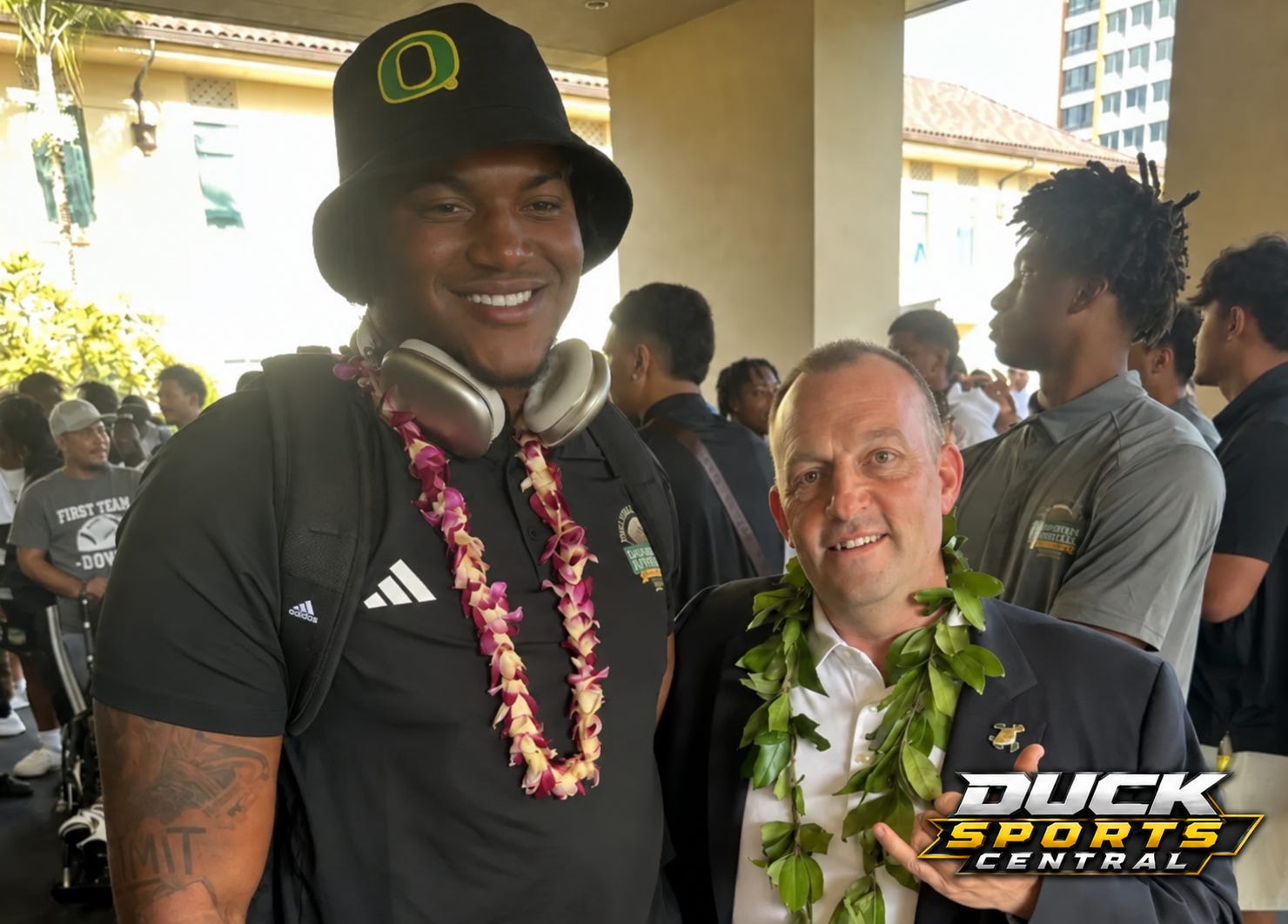
HONOLULU — I kept noticing Ziyare Addison after the rep was over.
The actual football was easy enough to watch. Addison is 6-foot-4.5, weighs about 280 pounds and has a wingspan approaching 6-foot-10, so he is not exactly difficult to find in a group of offensive linemen. He moves well for his size, plays with some edge and came to the Polynesian Bowl ranked as the No. 57 overall player in the country and the No. 9 offensive tackle.
Still, that was not the part I found myself watching most often.
A rep would end and Addison would stay near the coach. He would listen to the correction, ask something about it and sometimes remain there while another player received coaching. Then he would take that information back to the next drill and try it again.
This is seemingly simple stuff, but it is really important stuff. For a player with Addison’s ranking, there has been very little entitlement in the way he has approached the week. He began practice with the second group for Team Makai, and instead of looking like someone wondering why he was not with the starters, Addison practiced more like a player trying to make sure the coaches had a reason to move him.
Every time he got onto the field, it felt to me like he looked as if he belonged there.
“Coming to Hawaii and the culture, I wanted to experience the culture and just get out of my comfort zone,” he said. “It was something I wanted to play in, and I’m just excited to dominate and put on for my people back at home.” He has done quite a bit of both.
There is obviously a football reason for coming to the Polynesian Bowl. Addison gets to work against players he normally would not see back home in Florida, and the practices give him a chance to find out which parts of his game hold up when the guy lined up across from him is also going to a major college program.
The rest of the week has mattered to him, too, and Thursday provided the clearest example.
Away From the Field
The Polynesian Football Hall of Fame and Polynesian Bowl announced a multiyear partnership with Shriners Children’s hospital Thursday during a press conference led by Polynesian Bowl co-founder Ma’a Tanuvasa. Polynesian Football Hall of Famer Jesse Sapolu and Gov. Josh Green were among the speakers, along with First Lady Jaime Green and former Shriners patient Malaki Lee, a four-star offensive lineman in the 2026 class.
Addison was there with the other players, but I noticed him spending time in conversations that moved beyond the normal football topics surrounding an event like this. Green noticed him, too.
The Oregon signee showed a genuine interest in the children at the hospital and in learning more about what athletes can do with the opportunities football creates. It did not come across as somebody simply checking off another stop on the Polynesian Bowl itinerary. Addison wanted to talk.
“It’s been a really meaningful week,” Addison said in an exclusive interview afterward. “I’ve learned so much, not just from the coaches but also from the guys here. Spending time at Shriners Children’s hospital and seeing how we can make a difference really reminded me to do better, both on and off the field.” That side of him is not difficult to find.
Away from practice, Addison is gregarious and comfortable talking with people he has only recently met. He can move from a football conversation into something completely different without looking for an exit back to recruiting or the game.
Practice changes him a little. He has a lot more edge and not much in the way of conversation.
That part makes even more sense when you remember how little time Addison has actually spent playing offensive tackle. Oregon offensive line coach A’lique Terry did not recruit a finished product. He saw an athlete with a frame that could become something much different once Addison had more time at the position.
“The first time he reached out to me, he offered. I remember I was in the car with my coach, my mentor, my amateur, Coach Ray. It was all on three-way together—my dad was on the phone as well,” Addison recalled. “He saw me running the 200- and 100-meter track, and he saw the upside I had. I’d only been playing offensive tackle for barely five months. He just saw the upside.”
The track background is part of what made that projection interesting. Addison ran 12.84 in the 100 meters as a sophomore. He ran 25.58 in the 200 and also competed in wrestling, where balance and leverage are learned in ways that translate pretty well when a player eventually moves onto the offensive line.
His football résumé grew quickly. At Riverview (Fla.) Sumner, Addison started at left tackle for a team that reached the regional finals of Florida’s 4M playoffs in 2023. He played on defense, too, recording 11 tackles with four tackles for loss. Addison forced a fumble and recovered another during the season, and at one point Sumner even handed the ball to its big offensive tackle for a rushing touchdown against Tampa Jefferson.
There was enough athletic ability there for Terry to imagine what the future might look like. Addison was looking at Terry’s résumé from the other direction.
“Not only is he the best offensive line coach in the country, he’s also one of the youngest. Every year he’s been at the University of Oregon, he’s had a first- or second-round draft pick. I believe Josh Conerly Jr. is going to be a first-round draft pick,” Addison said.
Learning the Position
Raw is probably too strong a word for Addison because he already does too many things well, but he is still learning the details of playing offensive tackle.
That has been obvious this week, sometimes in a good way. Addison has spent a lot of time talking with coaches about his stance and pass protection. He asks about hand placement. When something does not work, he generally seems more interested in why it failed than in quickly forgetting the rep and moving on.
“He’s working like a sponge,” one coach noted. “That’s something I really love to see—kids who are hungry enough to spend the time learning.”
Wednesday was probably his best practice from what I saw. His feet looked better during the one-on-one periods and his hands were more consistent. There were reps where the defender got the better of him, but that almost made the next rep more interesting because you could watch Addison make an adjustment instead of simply trying the same thing again.
Different competition will do that.
A player with Addison’s size and movement ability can overpower a lot of high school defensive linemen before technique becomes much of a problem. That is harder here. The defenders are faster off the ball and better with their hands, so a lazy step or late punch can turn into a lost rep pretty quickly.
“Going against some of these top guys slowed the game down for me,” Addison said. “I’ve already had good reps going against players who are headed to the NFL, but battling elite talent here sharpened my technique. It’s been a huge learning experience.”
I thought that was a pretty good description of his week. The Polynesian Bowl gives Addison a chance to find out where his game is right now, but he has also treated it like another place to collect information. That is not new for him.
“I want to give a shout-out to Tony Dungy, Chance Warmack, and Ryan Walk—these are all professional guys, all guys that played in the league,” he said. “Having NFL guys and coaches pouring into you is a game-changer.”
Gary Kubiak was another opportunity for Addison to grow and learn. Addison spent quite a bit of time around the longtime NFL coach during the week, especially when the conversation moved toward pass protection. It would have been easy enough to listen, nod and go back to the drill. Addison kept asking.
“I spent a lot of time talking to Coach Gary Kubiak,” Addison said. “He gave me tips on slowing down the pass rush and refining my stance. Taking that advice and putting it to work against these defenders has been really beneficial.”
That matters more to me than whether Addison won every rep this week. College offensive linemen are going to lose reps. Freshmen are going to make mistakes, and Addison will eventually see defensive linemen at Oregon who are stronger or technically further along than anyone he faced during his high school career.
How quickly he learns from those moments will matter as much as anything he does. This week offered a pretty good look at that process.
Getting to Oregon Early
Addison did not wait for the rest of his recruiting class before starting that process at Oregon.
He enrolled early because he wanted the extra time, and when he talks about the decision, there is not much mystery about what he hoped to gain from it.
“It was just me and Cooper Perry—we were the first two people to step on campus,” he said. “Getting there as early as possible gave me a boost compared to everybody else in my class. I wanted to separate myself as soon as I stepped on campus.”
Tampa to Eugene is a significant move for a teenager.
Oregon does not have many Florida players on its roster, either, which meant Addison was not walking into a locker room filled with people from home. That was something he considered during the recruiting process.
“There’s not too many guys on the Oregon roster from Florida—currently, we only have three,” he said. “But if I ended up committing to the University of Oregon, I knew Coach Terry would make sure I was taken care of.”
The offensive line room has made the adjustment easier, but Addison also saw something else when he got there: experience.
Oregon had veteran linemen who were approaching the end of their college careers, which meant the amount of time Addison could spend around them was limited. Getting to Eugene early gave him a little more of it.
“All the guys I named that are going to be draft picks—Josh Conerly Jr., Harper, Nishad [Strother]—they’ve been amazing. I wanted mentorship from all the older guys before they leave,” he said. “It’s about getting everything installed in me from the best offensive linemen in the country before they head out to the draft.”
That sounds a lot like the player I have been watching in Hawaii.
If there is somebody nearby who knows something he does not, Addison wants to hear it. Conerly will not be at Oregon forever, so Addison wants whatever he can learn from him while he is there.
“The room we have makes it way easier for a guy from Tampa, Florida,” he said. “It’s just making the transition so seamless.”
The transition may be seamless. Football won’t. Addison seems fine with that reality.
A Recruit Becomes a Recruiter
There is another part of all-star week that happens almost constantly, even when nobody officially calls it recruiting.
Players talk. They compare schools and coaches. They talk about visits and teammates, and the conversations can carry a different kind of weight when the person making the pitch recently went through the same decision.
Addison is already doing some of that for Oregon. He has spent time around Tradarian Ball and Dakorien Moore in Hawaii, and he has also been around players the Ducks would still like to bring to Eugene.
“They’re ball players, no doubt,” he said. “Explosive athletes and even better people. Tradarian still has a year before he gets on campus, but he’s a top-five player right now. And Deuce Geralds is coming in, too. I’m definitely looking forward to recruiting him hard to join us.”
Geralds is worth watching. Southern schools are going to have plenty to say in his recruitment, but Oregon has given him enough to think about that he plans to see Eugene for himself. Geralds told me this week that he will be at Oregon for Junior Day on the 25th.
That is a significant visit. Addison also has some credibility in making the pitch because he recently made the move Geralds would have to consider. He knows what it feels like to leave Florida for Eugene, and he can talk about the transition from experience rather than from a recruiting brochure.
“We had the number one class in the country and the best recruiting class Oregon ever had. Shout-out to us. Shout-out to Dan Lanning,” he said. “It’s not just great athletes—it’s great people.”
The final part of that quote stuck with me because it fit more than just the recruiting conversation.
Football is obviously important to Addison. Nobody has to spend very long at practice to figure that out, and his willingness to seek out coaching tells you how seriously he takes becoming better at it.
There has been something else this week, though.
At Shriners, he wanted to know more about what was happening around him. During practice he wanted another coaching point, and when Kubiak was available, Addison used the opportunity rather than letting it pass. The same thing happened at Oregon when he arrived early enough to spend more time with Conerly and the older offensive linemen.
There is still a lot we do not know about what Addison will become. He needs technical work, as almost every young offensive lineman does, and his body will change once he spends extended time in Oregon’s strength program. Terry will eventually decide whether Addison is best suited to stay at tackle or whether his skill set makes more sense somewhere else along the line.
None of that needs to be decided in Honolulu. What I have seen this week is a player who knows he does not have all the answers yet and appears pretty determined to find them. Friday gives him one more game before he heads home, and Addison did not spend much time hedging when asked which team he expected to win.
“Team Makai all the way,” he said with a grin.
I knew before coming to Hawaii that Addison had the physical ability to become a very good college offensive lineman. That part was already on film.
Watching him here has added something else.
He wants to learn.
So far, he seems willing to do the work that comes with it.


