


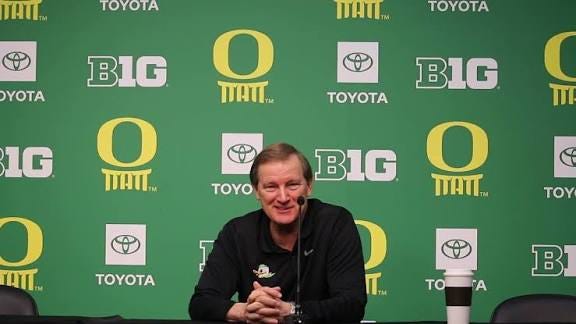
There was no attempt from Dana Altman to pretend Oregon basketball is simply picking up where it left off, because too much has changed for that. The roster has been rebuilt, the staff has changed and Oregon’s offensive personnel looks considerably different from what the Ducks carried into last season.
There are things Altman already likes about what has emerged from that reconstruction. Oregon appears to have more shooting around the perimeter, several intriguing guard combinations and enough offensive versatility to play differently than it has in recent years. There are also obvious questions, particularly around interior scoring and rim protection, where the Ducks no longer possess the same kind of established presence Altman has grown accustomed to having.
Even the process of assembling the roster has become something entirely different. So when Altman met with reporters ahead of the beginning of preseason practice, there was considerably more to discuss than rotations or who might start. Oregon is trying to figure out what this particular collection of players can become while simultaneously adjusting to a sport that continues changing underneath the feet of the coaches attempting to manage it.
After a summer that included three exhibition games in Canada, Altman sounds encouraged by the pieces Oregon has assembled. The larger challenge now is taking a roster built largely through individual evaluations and turning those pieces into an actual team.
Canada gave Oregon an early head start
Oregon is accustomed to adding transfers, but what is different this time is the sheer volume of new players attempting to learn one another at the same time. Altman estimated the Ducks added eight or nine portal players along with two freshmen, creating an environment in which almost everything ordinarily established through continuity has to be rebuilt.
That made Oregon’s summer trip to Canada more valuable than the results of three exhibition games. The trip forced the Ducks to install enough of their system to function against another team and accelerated a process that otherwise might not have begun until fall practice.
“Fortunately, we had an opportunity to go to Canada and play three games,” Altman said. “That helped us because it put some urgency this summer into getting some things ready.”
The trip also gave Altman and his staff an initial look at combinations they had previously only imagined while assembling the roster. Oregon remains a long way from a finished product, and Altman gave the team several weeks away after Canada before the players recently returned to begin ramping up toward live work and official practices.
Still, the staff came away from the summer with a better understanding of the roster than it might normally possess at this stage. One player, in particular, appears to have answered some questions early.
Andrew Meadow is already becoming a core piece
Altman did not offer many definitive declarations about roles this early in the process, but he made one about Andrew Meadow. After what the staff saw during the summer and in Canada, Meadow already appears to be separating himself as one of the players Oregon expects to build around.
“Andrew Meadow really stood out in Canada, and he’s stood out in a lot of areas — weight room, work ethic, his practices,” Altman said. “Andrew’s going to be a core guy for us. There’s no doubt about it. He just brings it every day.”
That is meaningful language from a coach who usually makes players earn everything before defining their place. Meadow’s emergence also fits into one of the larger themes surrounding this roster, because Oregon may not have the obvious established centerpiece it has possessed in recent seasons.
That puts additional value on dependable players capable of establishing the daily standard around a largely new group. Meadow appears to be doing exactly that, while Oregon has also seen flashes from some of the younger talent it brought into the program.
Altman pointed toward Jasper Johnson’s pedigree and the talent Oregon has accumulated throughout the roster, while specifically mentioning the ceiling of Tajh Ariza during the Canada trip. The challenge now is transforming that talent from something visible in individual moments into something Oregon can reliably build around once practices become more demanding and roles begin to take shape.
More guards means more possibilities
Oregon also appears to have considerably more flexibility in the backcourt, and Altman spoke positively about several combinations the Ducks have already tested. Rather than being locked into one obvious pairing, Oregon may have the ability to mix guards depending on the matchup and the kind of lineup the staff wants around them.
That includes Wei Lin, who returned to Oregon after initially entering the transfer portal. Altman said Oregon had never previously had a player enter the portal and then return, joking that the situation was a little like asking for a divorce and then reconsidering it.
Lin continued communicating with the program, ultimately decided he wanted to return and convinced the staff he could still help. There is, however, a clear developmental assignment attached to that opportunity.
“He turned the ball over a little too much for me last year,” Altman said. “For what I was looking for, what our team was looking for, he’s working really hard to cut those turnovers down.”
Altman still likes Lin’s instincts, scoring ability and shooting potential, and he believes the improvement that appeared during the second half of last season can continue. More importantly, Oregon does not appear dependent upon one backcourt configuration.
Altman mentioned Lin playing alongside Fred Payne, Jasper Johnson and Jerry Easter II as combinations the staff believes can work. That gives Oregon considerably more freedom to search for lineups based on matchups rather than simply filling predetermined positions, which could become particularly important while so many new players are still establishing roles.
Oregon’s offense is going to look different
Perhaps the most significant basketball change will come on the offensive end, where Oregon is preparing to blend some of its traditional concepts with a different approach. Assistant coach Tom Hankins arrives after spending the previous six seasons coaching in the G League system associated with Indiana, and Altman made it clear the Ducks will incorporate some different offensive ideas this season.
That change is partly philosophical and partly practical. Oregon’s previous offense relied heavily on reads, counters and familiarity developed over time, something Altman illustrated by pointing to former Oregon star Dillon Brooks and how much more comfortable he became within the system after multiple seasons.
By Brooks’ third season, Altman said he understood the offense well enough to recognize coverages and essentially call counters himself. That kind of institutional knowledge does not exist with a roster that has been rebuilt this extensively.
With so many new players, asking everyone to immediately master an offense built around years of recognition would create its own problems. Hankins’ experience working in an environment where players constantly move in and out made his background particularly attractive to Altman.
“We’re going to mix a lot of the things that we have done, but we’re going to put a lot of different stuff in,” Altman said.
There is another reason the players seem receptive to the changes. Altman joked that the new concepts feature “a lot of threes” and allow players to spend more time on the perimeter, but there was a basketball truth underneath the humor because Oregon’s personnel appears much better suited to playing that way.
Shooting should be a strength
Altman believes Oregon has dramatically improved its perimeter shooting, which may prove to be one of the defining differences between this roster and the one that struggled through last season. The Ducks appear capable of putting considerably more shooting on the floor at the same time, something that should change both their spacing and the way opponents have to defend them.
“We don’t have anybody who can’t shoot it on the perimeter,” Altman said. “I think we’ve drastically improved the 3-point shooting.”
That shooting should create better driving lanes and allow Oregon to attack defenses differently, particularly if the Ducks can consistently put four or five credible threats around the arc. It also provides the staff with more freedom to build lineups around complementary skills rather than searching for enough shooting to keep the floor properly spaced.
But every roster construction decision creates tradeoffs, and Oregon no longer has the same established interior option it has recently possessed. Altman acknowledged the Ducks do not currently have a proven go-to player on the block comparable to Nate Bittle or N’Faly Dante, meaning this cannot simply become last year’s offense with different names occupying the same spots.
“We have to play a little differently there,” Altman said. “But I think we’ve got the personnel.”
That may ultimately be the most interesting part of Oregon’s preseason development. Rather than forcing a largely new group into an old identity, the staff appears prepared to adapt the offense around what this roster actually does well.
Rim protection is the obvious question
The defensive tradeoff may be even easier to identify because Oregon has grown accustomed to having an eraser around the basket. Chris Boucher, Jordan Bell, N’Faly Dante and Nate Bittle gave the Ducks different versions of the same luxury: someone capable of correcting mistakes behind the rest of the defense.
Altman does not believe this roster currently possesses that type of shot blocker.
“Not like that,” Altman said when asked about Oregon’s rim protection. “We don’t have anybody that’s going to go block 70 shots.”
Taylor Bol Bowen may be Oregon’s best option in that role, although Altman wants him to become more comfortable aggressively challenging shots. The Ducks have other players capable of affecting attempts around the rim, but Altman was direct about the difference between having several capable defenders and possessing one elite shot blocker who can clean up mistakes behind everyone else.
That distinction changes how aggressively Oregon can defend elsewhere on the floor. An elite rim protector allows perimeter defenders to take chances knowing someone is waiting behind them, while a team without that luxury has to be more connected, disciplined and structurally sound.
Oregon may have improved its offensive spacing considerably. How well the Ducks manage defensive space and protect the paint without the same kind of shot-blocking presence could become one of the more important preseason questions.
Chemistry has been good. Adversity will tell more.
Altman likes how this team has interacted through the summer. Players have worked together, arrived on time and handled the professional details that coaches notice long before anyone begins keeping score, while Oregon has also avoided significant injuries through the early portion of its preparation.
But Altman also understands the limitation of evaluating chemistry this early because the Ducks have not faced much adversity yet.
“Character’s revealed in times of stress and adversity,” Altman said.
That test eventually comes for every team. Someone loses minutes, someone misses shots, someone believes his role should be bigger or Oregon loses a game it expects to win and has to respond together rather than simply enjoying the novelty of a new roster.
Until those moments arrive, chemistry remains largely theoretical. What Altman does know is that the group has made an effort to work together, play together and handle the daily habits that create the foundation of a good team, which gives Oregon a much better starting point than trying to fix those things later.
College basketball itself has become part of the challenge
Some of Altman’s longest answers had very little to do with Oregon’s offense or defense because the sport surrounding those things has changed so dramatically. Between transfer-portal movement, agents, compensation and players challenging eligibility restrictions through the courts, coaches are operating in an environment almost unrecognizable from the one Altman entered decades ago.
“It’s not recruiting anymore,” Altman said. “It’s negotiation.”
Tony Stubblefield handled much of that work for Oregon during this roster reconstruction, particularly communication with agents. Altman freely admitted that element of modern roster management does not necessarily match his personality.
“I get a little combative with them,” Altman said, acknowledging why Stubblefield taking a larger role in those conversations has helped the program.
The larger issue goes well beyond Oregon. Altman said he always believed players eventually deserved a larger share of the money generated by college athletics, but what he did not anticipate was the current system, where eligibility rules can differ according to court decisions and players have significant financial incentive to challenge virtually every restriction.
“We’ve got to have some rules somewhere,” Altman said.
For Oregon, the uncertainty is not entirely theoretical. Altman pointed to Malique Ewin, the former Arkansas and Florida State forward/center whose attempt to secure another season of eligibility remains unresolved. Ewin is not currently listed on Oregon’s official 2026-27 roster, leaving his potential place with the Ducks dependent upon how that eligibility process is resolved.
Altman described Ewin as an experienced and talented player who would raise Oregon’s ceiling if he becomes available. For now, however, the Ducks are left in the same position as programs across the country, trying to construct a roster while some of the rules governing that roster remain unsettled.
And then there is Kendre Harrison
There remains another fascinating possibility outside the traditional basketball roster, with Kendre Harrison potentially joining the Ducks once football season ends. Harrison is not currently listed on Oregon’s basketball roster, but Altman checked on the Oregon tight end recently and remains open to adding him whenever his football obligations conclude, assuming Harrison is healthy and Dan Lanning is comfortable with the arrangement.
The timeline makes predicting Harrison’s basketball role almost impossible. If Oregon football plays deep into the postseason, he could be joining a basketball team already well into its season and trying to learn enough on the fly to contribute.
Altman nevertheless sees a role that would not require months of offensive installation because defense and rebounding can translate more quickly. He watched Harrison play basketball before he arrived at Oregon and believes the same physical traits that make him such an intriguing football prospect could give the Ducks useful minutes around the basket.
“If it all works out,” Altman said, “he could still defense and rebounding for a few minutes, especially if we have some injuries like we did a year ago.”
Harrison is not part of Oregon basketball’s immediate preseason calculation, but he remains an intriguing piece that might become available later. For a roster without the same proven interior presence it has possessed in recent seasons, even a limited contribution built around physicality, rebounding and defense could eventually matter.
The first job is rebuilding Oregon itself
For all the roster changes, strategic adjustments and larger questions surrounding college basketball, Altman’s final message was considerably simpler. Last season was difficult, Oregon dealt with injuries, did not play well enough and never became the team Altman expected it to become.
He did not spend much time dwelling on it, but neither did he pretend it did not happen. The response to that season now becomes part of the identity this team has to build.
“We’re going to bounce back,” Altman said. “I like our personnel. And like I said, Tony’s done a good job putting the team together. Now we’ve just got to get them to play.”
That final thought probably defines Oregon’s entire preseason better than anything else Altman said. The Ducks appear to have more shooting, intriguing young talent, several different guard combinations and enough versatility for the coaching staff to rethink how Oregon plays offensively.
They also have questions around the basket, uncertainty surrounding eligibility and almost an entire roster learning how to play together. Oregon has assembled the pieces it believes can create a very different season, but the work now moves from roster construction to basketball, and that is where Altman will begin finding out exactly what this group can become.