


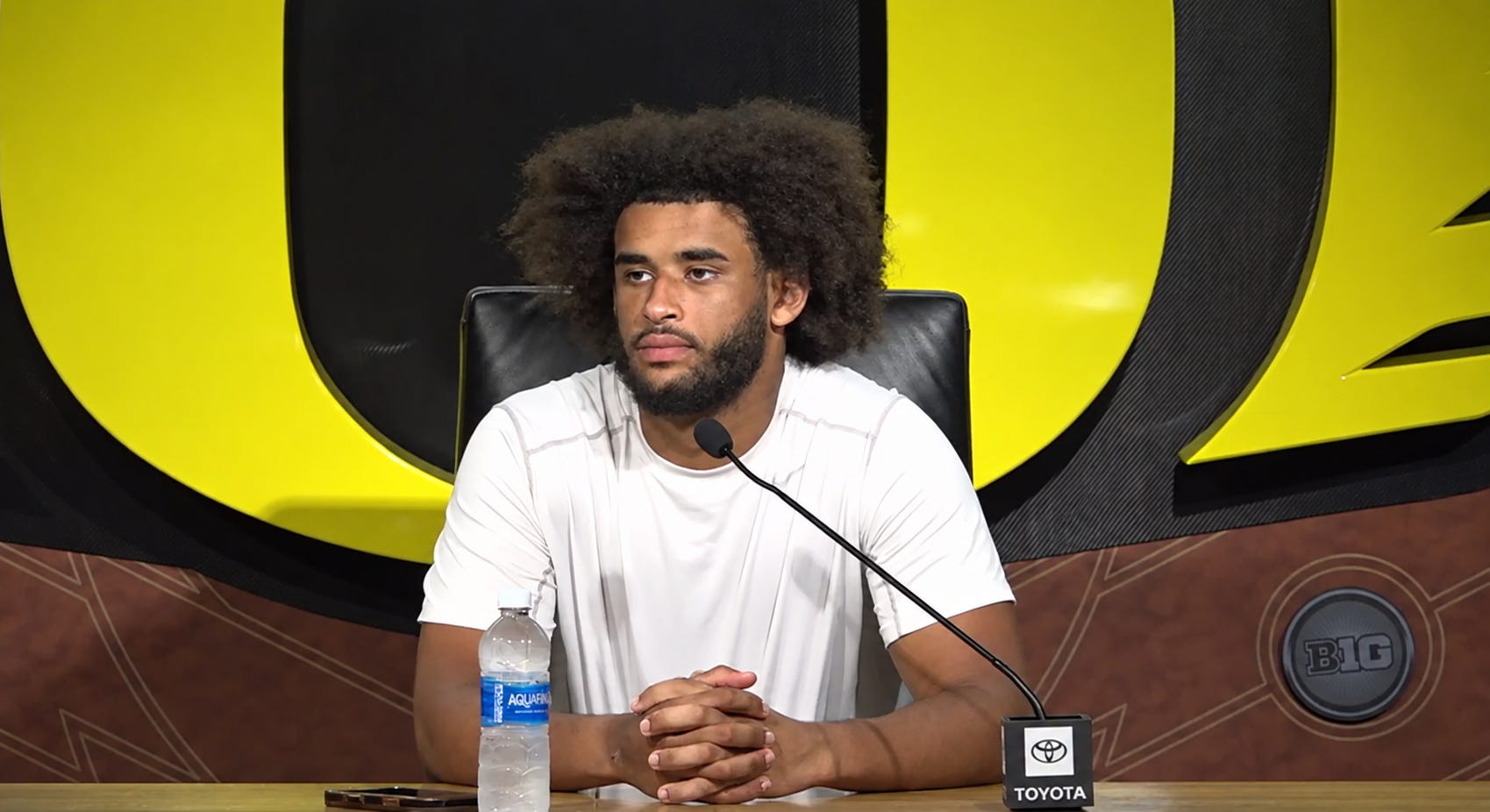
The Ducks have spent two weeks talking about a changed standard after Oklahoma State. Before USC, players are finally explaining exactly what that looks like — and Dante Moore’s voice is becoming a significant part of it.
There is a difference between saying practice needs to be better and explaining what better actually looks like, and Oregon has spent most of the last two weeks doing the former. Dan Lanning said the Ducks did not prepare the right way before Oklahoma State. Players talked afterward about focus, accountability and getting back to the standard that had carried the program before that loss. Then came Portland State, an opponent Oregon overwhelmed 84-0 in a game that offered some evidence the operation had improved without providing much proof about how those improvements might hold up against comparable talent.
This week, however, the conversation has become much more specific. Players are stopping practice when something isn’t right. Entire periods are being restarted. Teammates are demanding corrections before coaches have to make them. Dante Moore has become louder, not simply in the huddle or on Saturdays, but during meetings and between periods. Oregon’s defensive front is talking less about its preseason reputation and more about earning it. There remains work to do — Lanning said Wednesday the Ducks still had cleanup ahead of them with penalties — but the description of Oregon’s practices sounds different than it did before Stillwater.
That may be the most important piece of this week’s practice report. USC provides the opponent, but Oklahoma State still provides some of the lesson.
Practice is starting to look different
Aydin Breland described Tuesday as Oregon’s typical “Bloody Tuesday,” only this one came with an obvious USC emphasis. “We kind of had our typical Bloody Tuesday,” Breland said. “Obviously, it was SC focused. Just a physical practice, a lot of run focus.”
By Wednesday, Lanning said Oregon had moved deeper into situational work. “Good day of prep,” Lanning said. “Got into a little bit of red area and third down. Still have some cleanup to do when it comes to penalties and being able to attack that. But overall, guys have been working really hard this week.”
The interesting part isn’t necessarily what Oregon practiced. Red-zone work, third down, run fits and opponent-specific periods are standard pieces of a game week. It is how the players say those periods are being handled, and Breland offered perhaps the bluntest assessment of what has changed since Oklahoma State.
“The attitude’s changed,” he said. “The attitude of practice has changed. The accountability with our players has changed and our coaches has changed. Everybody is coming to practice and we’re coming to play, and it’s not lackadaisical practice anymore. It’s not hee-hee-ha-ha.
“Everybody’s getting straight to business, and if it doesn’t look right, we’ve been making sure that it does.”
Fox Crader described essentially the same correction from the offensive side, and his explanation went back to the week before Oklahoma State rather than simply what happened during the loss. “Really just an intensity to attack each and everything we’re doing,” Crader said. “We felt like the week leading up to Oklahoma State was not our standard in practice. And we attacked those little details. And we felt like we were letting too many things slip that we haven’t in the past.
“And so really, we just got back to us. We got back to, and we’re continuing to do that. We just know that we can’t let those things slip in the future.”
Crader’s definition of those details is important because none of them sound particularly dramatic. “It really, like I said, it’s all the little details like your routine,” he said. “How you attack every period and not just team periods, just indie work and stuff like that with the tenacity, with an intensity unknown to man like they always say.”
That is where this becomes more than players supplying the expected answer after a loss. Matayo Uiagalelei gave an example of how Oregon is enforcing the standard now that it wasn’t necessarily enforcing before.
“I think players do a good job of, like I say, we messed something up, like I think before, you know, we’d try and correct it,” Uiagalelei said. “But, like, now, instead of just correcting it, like, running back, like, you know what I’m saying, restart the whole period. It didn’t look the way we wanted it to look.”
That is considerably different from simply correcting a mistake on film the next day. Oregon is attempting to make the correction immediate enough that the mistake disrupts practice itself, and Lanning began describing that change Monday when he connected Oregon’s improved operation against Portland State directly to the week of work that preceded it.
“When you know what practice is supposed to look like and it looked much more like what we wanted it to look like last week, now as a player, every guy in this program’s goal is to get better,” Lanning said. “And when they see, okay, we improved in operation, we improved in execution on the field because of the way we practiced and what we did, it makes them want that even more at a higher level when you walk into a practice this week.”
Portland State was never going to validate whether Oregon had fixed everything exposed in Stillwater. It did, however, give the Ducks evidence that a better week of preparation could lead to cleaner football, and now comes the much harder part: making that same relationship survive USC.
Dante Moore is finding another level of leadership
If there was one subject that surfaced almost everywhere this week, it was Moore. Not because Oregon’s quarterback wasn’t already considered a leader. Crader, Uiagalelei, Lanning and Alex Olesh all made a point of saying he was. What changed after Oklahoma State is the realization that Oregon needed more of Moore’s voice because of how much weight that voice carries inside the building.
“I think Dante’s voice is huge,” Crader said. “And I feel like sometimes maybe in the past he didn’t realize how much of an impact he has on us.
“We always look up to Dante. Whenever he’s speaking, everybody’s locked in to what he’s saying and they take his words seriously. So it’s been good to see him kind of step up and, you know, when his energy is high, our energy is high. And I think he’s a huge leader in this organization.”
Uiagalelei was even more specific about what stepping up has looked like, while also making clear that the point wasn’t that Moore had previously been absent.
“When I say, like, we needed more, I don’t mean, like, he wasn’t doing enough,” Uiagalelei said. “I’m just saying, like, you know, we got our ass whooped two weeks ago. So, like, there’s going to be a moment that we really need to.”
Those moments are increasingly belonging to Moore. “Like talking before, like in a team meeting before Coach Lanning is, or like taking the initiative, like run, you know, redo team run, like start the period over,” Uiagalelei said. “Holding other guys accountable and challenging like the defense or challenging other guys on offense to be leaders too.
“And I think that’s really been an improvement and has shown just everywhere with our focus and our intent in practice.”
Lanning essentially confirmed that Wednesday. Oregon does not merely want its quarterback talking more. It wants him becoming another extension of the coaching staff when something isn’t right.
“I think that the biggest thing is his voice,” Lanning said. “We’ve been challenging him and he’s been challenging himself that his voice has to show up before game day. It has to show up beyond when it’s good, right? When things aren’t right, that’s where his voice has to show up.
“And just like a coach would reload a play, he needs to have that ability to do the same thing and demand what it needs to look like, which that’s shown up for him.”
Moore did not dispute any of it when his turn came Wednesday. “In my past, you know, when I was being a leader, I was thinking to myself I was doing, you know, enough, but I guess I wasn’t,” Moore said. “So I make sure every single day these past two weeks I’m just pushing myself even more and more as a leader and being more vocal, you know, showing them out there in practice, you know, running around, transitioning from period to period, communicating with them. I’ve been doing better with that.”
For Moore, the realization came directly from Stillwater.
“It was after the Oklahoma State game,” he said. “Not saying that I wasn’t taking every day seriously, but just when I was out there on the field, I felt like I was doing enough. And the moment that situation happened, not even just at practice, like during the game, when things were going bad, just being more vocal, being more of a leader out there, just on the sidelines, in the locker room at halftime.
“So that was a game, and that was a moment that helped mold us now as a team. And I learned from that, and I’m glad it happened. It’s a lesson for me to learn and been carrying ever since.”
This apparently hasn’t remained limited to Moore. He described a team where players are increasingly willing to coach one another and, equally important, willing to accept it.
“With my energy and my focus of being out there calling out certain things, I mean, it just gives other players confidence to do the same thing towards me,” Moore said. “If I’m not doing something right, they will call on me. So it’s always, you know, we’re always trying to get better.
“There’s no ego out there. So someone’s coaching me really hard, you know, I’m going to accept it. I’m going to coach them really hard.”
Olesh provided one more glimpse into how far that has extended away from the practice field. “We’ve had player-led meetings,” Olesh said. “And I think there are some times where, you know, the coaches step out and he gets in front of the entire room and talks to all the players about, you know, what we need to do moving forward, especially after the Oklahoma State game.”
That may be the clearest evidence yet of what Lanning meant throughout fall camp when he repeatedly talked about wanting a player-led team. Coaches can demand a standard, but players ultimately determine whether that standard survives when coaches aren’t the ones doing the demanding. Right now, Moore increasingly appears to be one of the players making sure it does.
The defensive front is done talking about its reputation
There may not be another position group carrying more external expectation into Saturday than Oregon’s defensive front. The preseason discussion centered on depth, talent and the possibility that this could become one of the country’s dominant groups. Through three games, Oregon has flashed plenty of that talent, but the sack production has not followed at the level many expected.
Lanning has provided context for some of it. Portland State produced few true drop-back opportunities and frequently used protections designed to get the football out or add bodies around the quarterback. Oklahoma State moved the pocket and adjusted its protections while Oregon came close several times without finishing, but the players aren’t hiding behind any of that.
“We’re focused on just rushing as a group and just trying to assault the quarterback,” Breland said. “So we’re just trying to get better at that every week in practice and hopefully it shows up.”
Uiagalelei was just as direct. “We got to get after the quarterback,” he said. “And, you know, if the DBs are doing their job back there, we got to do ours, too. It takes all 11.”
The more revealing answer came when Uiagalelei was asked whether USC could become a prove-it game for a defensive front that entered the season with so much attention.
“Knowing the front, beginning of the season, a lot of hype, a lot of this,” he said. “Let’s cut all that out because we haven’t played to the level where we really can play as a defensive front.
“We want to be the best group on the field. We want to dominate. And that’s really just been our focus. Cutting all the outside noise, focus on ourselves, focus on the opponent.”
For Uiagalelei personally, the correction begins with intent at the point of attack. “Starting off with the edge room, or just myself, like, just being violent at the point of attack,” he said. “Am I really striking this dude with the intent, like, put a hole through his chest? What’s my intent? So I think that’s been the big thing for me, just being more violent at the point of attack.”
Then he returned to the same accountability theme running through virtually every other interview this week.
“As a whole, I think just doing our job, just trusting my job and trust my brother that’s next to me that he’s going to do his job,” Uiagalelei said. “We don’t need to be a hero on a play and try and do all this. But really just doing our one-eleventh and then being the most violent, physical group up front.”
USC will make that discipline particularly important. Breland said the Trojans have shown “a lot of counter,” a physical offensive line and patient running backs, which creates a problem if Oregon’s desire to create disruption becomes an excuse to abandon gap responsibility.
“Just being physical up front,” Breland said. “Being patient on our gaps because their backs are pretty shifty, and just playing up front together.”
The same applies when Jayden Maiava escapes the pocket. Oregon wants more pressure, but blindly running past a quarterback with Maiava’s ability to create outside structure would solve one problem by creating another.
“He’ll have a lot of pressure in his face and he’ll scramble and he’ll still find a way to throw it and get the ball downfield,” Breland said. “So we just got to do our best in caging him and rushing him effectively.”
That idea of caging Maiava probably matters every bit as much as simply rushing him. Oregon wants more havoc, but it also needs the havoc to exist inside the structure of the defense rather than becoming players chasing individual plays.
Crader and the offensive line are going back to the details
The same correction is happening up front offensively. Crader did not deflect when asked what went wrong against Oklahoma State. Oregon shuffled pieces after losing Trent Ferguson, but Crader wasn’t willing to make the personnel change the explanation.
“I absolutely could have played better that game,” he said. “There was a lot of things that I didn’t have down pat that game, and I’ve been working on them every day.”
His list of corrections sounded exactly like the sort of things that disappear inside a box score. “It’s really just the little details and knowing the game plan, teeing off on a snap, every play not being laid off the ball, hand placement, things like that,” Crader said. “Just honing in all those little details to make sure that we get the job done on Saturday.”
That detail work becomes particularly important against a USC defense Lanning believes can create problems through movement and variety up front. Crader said Oregon has been studying the tells within the Trojans’ defensive line and nickel looks, searching for the small pieces that can turn a complicated picture into something recognizable.
“We have a game plan. I trust these coaches,” Crader said. “Every day we’re honing in on the little details of, you know, the tells with their D-line, tells and nickel, all the little pieces that go into a defense. We’re getting all those nuggets and holding it into our game plan offensively.”
There is also a longer-term benefit beginning to emerge from the offensive-line rotation Oregon has been forced to use. Crader believes the room is getting deeper rather than simply surviving change.
“I think the development’s been tremendous,” he said. “Obviously we have tons of guys that can play. Even, you know, seeing versus Portland State, we had like third-string guys going in and scoring touchdowns and stuff like that and have good technique out there.
“There’s still tons of things we’ve got to clean up as a group and just keep elevating the standard. But it’s been good to see the development.”
Crader knows something about how quickly that development can suddenly matter. His first start came against USC last season, shortly after getting some of the developmental snaps Lanning referenced earlier in the week.
“The confidence really just comes from the preparation and practice and just consistently doing your job,” Crader said. “Obviously, to get into the game is fun and being able to prove that you are who you say you are or you are who you think you are, it’s a good thing. Like I said, the preparation is really where all the confidence comes from, and that’s where I get mine.”
A year later, Crader isn’t the developmental piece anymore. He’s one of the players expected to make sure the preparation looks right before Oregon gets to Los Angeles, which is another small example of how quickly developmental snaps can become meaningful ones.
Development is becoming depth Oregon may actually need
Alex Olesh is another example of why those developmental snaps matter. Olesh came to Oregon understanding that becoming a complete tight end would require considerably more than catching the football, and he said Wednesday the increased playing time has accelerated the part of his game that needed the most work.
“Coming to Oregon, I wanted to come here to get developed, and I think the coaching staff has done a really good job developing me,” Olesh said. “And the more I play and the more I, you know, dip my feet in the water, the more I do that, the better I’ll get. I need to develop blocking and stuff, so getting in the game really helps that.”
His practice environment isn’t particularly forgiving. “I’m going against like the best, pretty much the best D-line in the country,” Olesh said. “So every day, you know, iron sharpens iron. I’ve just been getting better with Matayo Uiagalelei, Teitum Tuioti, Nasir Wyatt, all of them making me better. So I think I’ve come a really long way, and I’m just going to continue to get better.”
Lanning’s assessment was a little more measured, which is probably appropriate for a young player still trying to become an every-down piece.
“He’s growing in that category,” Lanning said. “I don’t know that it’s where he wants it. It’s not the final product yet. And that’s the great thing about young players is, you know, they’re going to continue to improve and get better.
“But he shows a willingness. It’s a matter of continuing to get the technique and continue to utilize the weight room to get stronger and build himself into a really good player.”
The larger point is that Oregon’s developmental depth is already becoming functional depth. Jeremiah McClellan’s broken foot has changed the receiver rotation. Jamari and Kendre Harrison were working their way toward greater availability as the week began. Carl Williams was expected back, while Jalen Lott returned to practice even though Lanning cautioned Monday that he wasn’t sure Lott would be available against USC.
Those are the moments when August conversations about “strengthening numbers” stop sounding like roster-building language and begin affecting Saturdays. Oregon spent camp talking about developing enough players to survive a season rather than simply identifying a starting lineup, and September is already testing that philosophy.
Even the kickoff plan is becoming another weapon
One of the quieter things Lanning discussed Wednesday may become particularly relevant against USC. Oregon’s touchback percentage dropped against Portland State, but Lanning made it clear that wasn’t a failure of the kickoff operation. It was intentional.
“Stats in some ways are for losers from that standpoint,” Lanning said. “You don’t care about touchbacks, non-touchbacks. You care about average starting field position.”
That changes the calculation because Oregon isn’t necessarily trying to remove the return every time. It is trying to determine whether the kick itself can create better field position.
“When you feel like you have an advantage or an opportunity to create that, you want to be able to do that,” Lanning said. “I think it’s also really hard for kickoff return teams to prepare for in the future where the ball is going to be kicked. What do we need to be prepared for when we can put the ball in different locations?”
Oregon effectively views a kickoff return stopped short of the 25-yard line the same way it would view a tackle for loss on defense. “We were able to create some TFLs,” Lanning said. “Anything behind the 25 in our mind is a TFL. With kick locations, that’s something we want to be able to have as a weapon and a tool.”
That feels especially relevant during a week when Oregon and USC both understand how quickly a special teams play can alter a game. The Ducks are not simply trying to survive those snaps. They are looking for places to manufacture an advantage, whether that comes from a return, coverage or making an opponent prepare for multiple kickoff locations.
The game is bigger. The practice cannot become different because of it.
There is an interesting contradiction running through Oregon this week. Lanning has openly acknowledged USC is not just another game. It opens Big Ten play, sends Oregon back into Southern California and matches two programs with more history and crossover than most of the Ducks’ new conference relationships. Breland called it personal for many of Oregon’s Southern California players, while Uiagalelei said playing in the Coliseum had been on his career bucket list.
Yet the practice message remains almost aggressively ordinary. Crader put it simply: “Don’t make things bigger than what they are. Just do our job.”
Moore sounded much the same when asked whether the week carried a playoff feel. “Just another game,” he said. “Nameless, faceless opponent. Worry about ourselves, execute our plays. And that’s all we can control.”
That doesn’t mean Oregon believes USC is ordinary. It means the Ducks seem to understand that treating the occasion differently can become its own distraction. Two weeks ago, Oregon learned what happens when its daily work slips below its standard. Last week provided a chance to restore some of it. This week is where the restoration gets tested against somebody capable of exposing every detail that still isn’t right.
Moore described the response to Oklahoma State as something larger than one quarterback becoming louder. “This team, we’ve all taken a bigger step as leaders,” he said. “When it comes from the defensive side of the ball, offensive side of the ball, even special teams.”
Then he arrived at the part that may matter most Saturday.
“The way we play together, the way we’re focused, dedicated to every single play, it just shows,” Moore said. “And this week’s been the same way.”
For Oregon, that is really the claim coming out of practice this week. The intensity changed. The accountability changed. Moore’s voice changed. Players are correcting one another sooner, restarting periods when the work isn’t right and refusing to let mistakes simply become something to discuss later on film.
USC is where Oregon finds out whether all of that travels.