


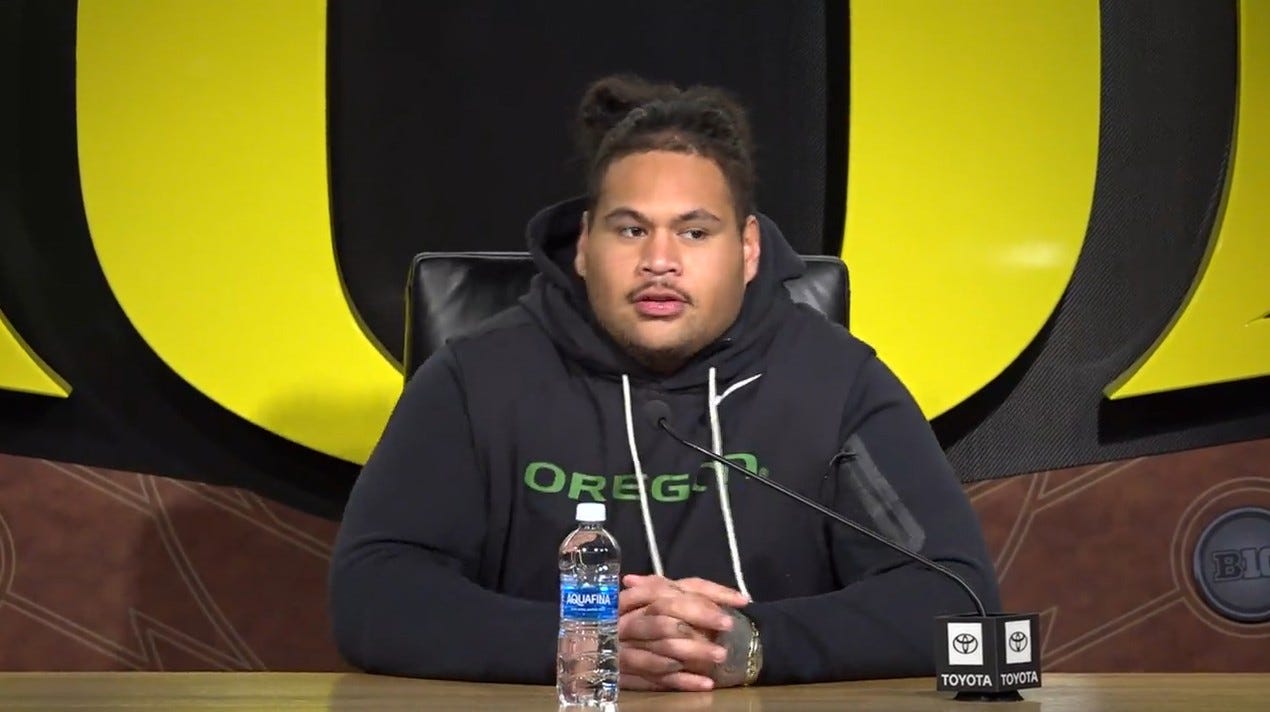
Dan Lanning had just walked off Oregon’s practice field Wednesday when he learned Dana Altman was retiring, and for a few minutes the conversation naturally moved somewhere larger than UCLA. Lanning talked about Altman as a mentor, about the way Altman treated his family and about a career that began far away from Hall of Fame recognition and eventually became one of the defining coaching tenures in Oregon athletics. What seemed to matter most to Lanning was not simply what Altman accomplished, but the manner in which he kept accomplishing it year after year.
“There’s people that do things the right way,” Lanning said. He traced Altman’s path through small-college and junior-college basketball before arriving at the word that seemed to connect all of it. “The way he did that is consistency. Consistency in his approach, the ability to be there and all in at all times, the adaptability of the game.”
Those comments were about Altman, but they fit almost too neatly into the football practice Lanning had just finished. Oregon’s Wednesday work centered on the red area and third down, with Lanning describing “some real detailed focus” against an unbeaten UCLA team that will punish lapses in exactly those situations. The Ducks also practiced with much more clarity about who will actually be available Saturday because the first injury report of the week finally answered some of the questions that had lingered since USC.
Dante Moore is listed as out against UCLA, as is Jeremiah McClellan, which removes Oregon’s starting quarterback and one piece of its receiver rotation. At the same time, freshman speedster Jalen Lott is not listed on the injury report at all for the first time this season, an encouraging development for a receiver who spent the first month unavailable and may finally be in position to contribute. It would be unreasonable to assume Lott immediately steps into a large role after missing so much football, and some rust would be entirely normal, but his speed gives Oregon another possibility at the exact moment McClellan’s absence removes one.
That combination makes this week much more interesting than another ordinary Wednesday before a conference game. Oregon spent August repeatedly telling us that depth had to mean more than highly rated players standing on the sideline, that backup quarterbacks needed meaningful repetitions before anybody knew when they would matter and that veterans had a responsibility to help younger players understand what Oregon football was supposed to look like. October has now reached the point where those ideas are no longer abstract, because the original plan has changed and Oregon has to prove the things it built underneath it are strong enough to keep working.
Raiola’s role has changed more than Raiola has
The quarterback story could have become the obvious source of disruption this week. Raiola entered at USC after Moore was injured, completed 19 of 25 passes for 289 yards and two touchdowns and helped Oregon finish a 41-27 win in one of the most difficult circumstances a backup quarterback can encounter. Now that Moore has officially been ruled out, Raiola moves from the player who had to be ready unexpectedly to the player around whom the week’s preparation is being organized.
Almost everyone Oregon made available has described that transition in remarkably similar language, and the common thread is how little they believe Raiola himself has changed. Lanning started there Monday when he was asked whether a quarterback preparing to start needed to carry himself differently inside the building. “No, there isn’t a shift,” Lanning said. “If he can just play like he played every single time, you know, last time, I think we’d be sitting in a really good situation.” He added that Raiola needed to continue preparing exactly as he had been because Oregon did not need “anything special” from him beyond what he was already doing.
By Wednesday, Lanning’s description had become even more explicit. He called the response around Raiola “business as usual” because the confidence teammates displayed at USC did not begin when he entered the huddle in Los Angeles. “Everybody had confidence in him because they see him do it a lot in practice,” Lanning said. “You get a lot of reps in practice regardless of where you’re sitting.”
That matters because Oregon spent August insisting that practice repetitions could not become meaningless simply because somebody else was taking the first snap on Saturday. Koa Ka’ai said during camp that the quarterback question eventually came down to consistency and whether a player could repeatedly move the offense, while Lanning said after the first scrimmage that Raiola looked like a “night-and-day different player” from the quarterback who arrived in the spring. The entire premise was that development had to occur before opportunity arrived, not begin only after the depth chart forced the issue.
Dave Iuli sees that preparation from a position where quarterback temperament matters enormously. Offensive linemen do not need a quarterback creating more anxiety behind them, and Iuli repeatedly returned to Raiola’s calmness when explaining what has stood out this week. “You don’t ever want to see your QB panicking or overthinking a lot,” Iuli said. “You can tell he knows ball knowledge,” adding that Raiola has looked comfortable handling the responsibility that now belongs to him.
Jerry Mixon sees the same thing from the opposite side of practice and said Raiola “hasn’t laid back since he was a backup quarterback.” Evan Stewart offered an even simpler description, calling him the “same Dylan” even though the role has obviously changed. Stewart said Raiola has remained “dialed in on every little detail,” which is probably a more useful description of a quarterback preparing to start than any dramatic attempt to manufacture a new leadership personality.
Raiola believes calmness is something preparation creates
Raiola’s own explanation of his composure may be more revealing than what everybody around him sees because he does not treat calmness as some natural gift that appears when the game becomes difficult. He connects it directly to preparation, film study and the other 10 players carrying out their responsibilities. In other words, the calm everybody noticed at USC was not Raiola ignoring the magnitude of the moment; it was the product of having enough information that the moment did not feel completely unfamiliar.
“It also comes with the preparation and the film study and just the camaraderie with the guys,” Raiola said. “It’s not a one-man show. It’s a full unit doing their job.” He said his own sense of peace comes from faith, preparation and understanding exactly what a particular play is asking him to accomplish before moving to the next one.
That becomes especially important when Raiola talks about how his previous starting experience has changed the way he processes film. He said the repetitions he has banked allow things to “hit me a little faster,” because he can recognize what he is seeing and begin visualizing the play before Oregon ever reaches Saturday. The end result is not simply knowing the call but understanding where the football should go once the defensive picture confirms what he saw during the week.
“I think just being able to see it, visualize the play and ultimately get to, all right, this is where I need to go with the football,” Raiola said. “I think it just makes it easier when you get out there in the game. Like you always say, that rep’s happened already. And now you just got to go execute on the field.”
Stewart described Oregon’s preparation using almost the same idea. The Ducks started working on UCLA during the bye, and Stewart said the offense has been trying to “win the game before playing the game” by experiencing the same situations enough times that Saturday becomes another version of something the players have already seen. That philosophy sounds almost identical to Ka’ai’s fall-camp explanation that Oregon wanted practice to be harder than the game because there was value in forcing players to solve difficult football against talented teammates long before the stadium was full.
The difference now is that Oregon gets to find out whether those repetitions actually qualify when a starter is unavailable. Raiola no longer receives the luxury of preparing as though he might play and then watching Moore carry the offense if the game remains normal. The work has to transfer, and everything we heard this week suggests Oregon would rather trust the preparation already completed than reinvent its offense around the identity of a backup quarterback.
Moore is out, but he has remained part of Oregon’s preparation
The injury report gives us clarity about Saturday, but it should not erase what Moore’s return to practice meant during the week. Lanning said Monday that Moore was back in helmet and shoulder pads, and teammates repeatedly described how encouraging it was simply to see him moving around, smiling and throwing again after the USC injury. By Wednesday, everybody knew the football question and the human question were no longer exactly the same thing.
Iuli said it was “great” having Moore back on the field because the team could see him enjoying football again rather than merely wondering how he was doing away from them. “He’s out there having fun again with a smile on his face,” Iuli said, and he framed the moment as something Oregon could learn from before continuing forward with the week.
Washington responded with humor that probably revealed just how normal Moore looked to teammates. “Oh, man, I hate that dude,” Washington joked. “He out there working already. I tried to get a sack on him earlier. Man, this dude back, man. He back.”
Raiola’s response was more personal because the relationship between the two quarterbacks exists well beyond the depth chart. He said that when he first saw Moore after USC, his immediate reaction was to hug him rather than begin discussing the game or the performance that followed Moore’s injury. “We didn’t really talk about the game because in that situation, football is not as important,” Raiola said. “To me, in that situation, that’s a relationship that I hopefully have for a long time.”
That is where some of Oregon’s summer culture discussion becomes useful without turning this into a culture story. Lanning spent fall camp asking veterans, “Who did you bring with you?” and Tony Tuioti talked about developing “commanders” capable of raising the level of the people around them. The quarterback room now offers a practical version of that idea because Raiola does not need Moore diminished for his own role to grow, and Moore apparently has remained engaged enough that Raiola said his presence still creates energy for the entire team. (20260826-201902)
The injury report tells us Moore will not play Saturday, but it does not tell us that he stopped contributing to Oregon’s preparation. Those are two different things, and one of the more encouraging parts of the week is how naturally the quarterback room seems to understand the distinction.
The offensive line may be showing the clearest evidence that August survived September
If there was one interview this week that most closely resembled the best conversations from fall camp, it was Iuli’s because he did not simply tell us Oregon’s offensive line had improved. He gave specific examples of what the group has done to create that improvement and how much of it depends upon players pushing one another beyond the formal practice script.
The offensive line entered the season with questions about cohesion, combinations and whether Oregon could consistently create the movement it expected in the run game. Iuli acknowledged Tuesday that the first month did not always look the way the group wanted, especially on the ground, but said the response has been deliberately collective. “We’ve grown a lot,” he said, before explaining that the focus has been running their feet, finishing blocks and improving together rather than waiting for one player to solve the problem.
The more interesting part came when Iuli described what happened during the bye. He said Oregon’s linemen deliberately increased their work in the weight room even though in-season lifting naturally decreases, because they recognized that moving defenders still requires maintaining the physical base they spent months developing. They have also stayed after practice and asked members of Oregon’s defensive line to give them additional repetitions against the exact movements and techniques they are struggling to solve.
“That’s what we’ve been doing every single day, just going back to getting extra, even after post-practice,” Iuli said. He described going to Washington and asking him to recreate specific looks so the offensive lineman could understand how the fit was supposed to feel, then said the larger lesson has been that the group must “work together as a group to try to do more things that can help us improve on the field.”
Iuli’s description of practicing against Washington probably explains the philosophy better than any slogan could. “Going against A’Mauri every day is stressful, but that stressful brings me calm during the game,” Iuli said. He explained that Washington attacks with violence, plays his assignment correctly and creates the kind of difficult work that makes actual game repetitions feel more manageable.
That is “practice harder than the game” without anybody having to say the words. It is also a very different picture than a coaching staff dragging players through extra work while everybody waits for practice to end, because the linemen themselves are asking defensive players to keep creating the stress they believe will make them better.
Iuli has become part of the player-led layer Oregon wanted to build
Iuli’s journey also gives him a perspective that several younger linemen simply cannot possess yet. He is a fifth-year player, has dealt with injuries and waiting, and said Tuesday that he is finally back at 100% after tearing his triceps in January. That history has made him one of the older voices in a room where several younger players arrived with enormous expectations and quickly discovered that college football development does not always move at recruiting-rank speed.
When Iuli was asked what that experience allows him to give younger players, he described leadership as part of the functional structure of the room rather than something coaches alone are responsible for. He said veterans such as himself, Poncho Laloulu and Kavika Rogers can answer questions before those same questions continually have to travel back to the coaching staff.
“It’s so important for guys like me, Poncho, Kavika, all the older guys to be in there and be in the young guys’ ear of letting them know, ‘Hey, this is what we do here. This is how it goes. This is the play. This is what we’re doing,’” Iuli said. He added that mentorship helps the veteran as much as the younger player because eventually those younger linemen have to become the people carrying the same information forward.
That is about as clean a midseason answer as Oregon could provide to the question Lanning asked on the first day of fall camp. “You were able to make it. Who did you bring with you?” was never really about surviving one practice, because the deeper issue was whether experienced players could begin assuming some of the responsibility for developing everybody beneath them.
The fact that Iuli now talks about younger linemen learning the standard from veterans rather than constantly needing a coach to explain it suggests at least part of that transfer is occurring. Whether Oregon can run the football well enough against UCLA remains a separate question, but the process behind trying to improve it looks considerably more mature than a simple promise to “execute better.”
Oregon’s defensive front understands the order of Saturday’s work
Washington gave us one of the best football quotes of the week because he reduced Oregon’s defensive challenge against UCLA to the order in which the work has to happen. Everyone would like to talk about sacks, pressure and what Oregon’s defensive front can do once Iamaleava is forced into a conventional passing situation, but Washington understands the Ducks have no right to enjoy that part of the game until they solve what comes first.
“Whoever we got on the clock, it don’t matter 200, 300 rushing yards, we still got the game plan: stop the run, you know what I mean, so we can earn the right to rush the passer,” Washington said. “We don’t stop the run, these dudes will continue running the ball on us.”
Washington then spent time talking about the defensive-line plays that rarely show up in a traditional box score. He mentioned being in the correct gap, limiting movement on double teams and doing enough dirty work that linebackers can reach the football without having to fight through the same blocks.
Those details matter because Oregon’s front can technically play a snap correctly without the player who did the most important work receiving statistical credit. Washington can absorb two blockers, stay square and keep the line of scrimmage from moving, allowing Mixon or another linebacker to make the tackle while the defensive tackle’s name never appears next to the play.
Washington called those the kinds of things “they don’t grade you for on the stat sheet” but said they are critical because that is how the defense begins eliminating the run.
Mixon described the responsibility behind Washington in simpler language. UCLA has three backs Oregon respects, and Mixon said the answer begins with dominating the line of scrimmage and “tackling them low.”
The tackling height became a recurring theme because UCLA’s shorter backs can disappear behind the offensive line and reappear once a linebacker has already lost the cleanest angle. Mixon called the visual discipline “high beam, low beam,” meaning the linebacker has to read through the offensive line before locating the runner in the gap rather than simply chasing the first flash of movement.
Washington offered an even more direct assessment of Knight. “This dude got some juice,” he said, before explaining that high tackles and arm tackles are unlikely to work against a back who runs that low to the ground.
That is what Lanning’s “detailed focus” looks like once it becomes football. The detail is not motivational language; it is the location of the defender’s eyes, the amount of movement surrendered on a double team and whether the first tackler arrives with leverage low enough to finish the play.
Four-quarter football has become one of the week’s recurring demands
UCLA’s rushing numbers explain why Oregon is emphasizing the run, but the way the Bruins have played late in games may explain why Oregon’s defenders keep talking about sustaining the work. Lanning said Monday that one of the things that immediately stood out on film was how much better UCLA has played in the second half and fourth quarter, which means the Ducks cannot treat a good opening series as evidence the problem is solved.
Oregon also has firsthand experience with Chesney’s offensive approach from last season’s playoff game against James Madison. The Ducks created a commanding first-half lead, then watched James Madison continue running the football effectively enough that the second half became considerably more uncomfortable than anybody inside Oregon wanted.
Washington remembers exactly what he disliked about that finish. “I feel like in that last fourth quarter, I know everybody talked about it, how many yards they ran up,” he said. Washington pointed to a third-and-short run Knight broke free and said those are exactly the plays Oregon has emphasized because “even in the fourth quarter, we got to stay on it.”
Mixon connected that memory to this season’s Oklahoma State game. Even though Oregon did not lose last year’s playoff game, he said the Ducks came away believing they should have finished it better, and that feeling resembles the frustration that followed Stillwater.
“Just like we preached this week, just have a four-quarter game this week,” Mixon said. His point was that Oregon cannot be a team that starts fast and slowly loses its discipline or physical edge, because UCLA’s entire offensive identity is built to continue asking the same question until the defense finally gives the wrong answer.
Raiola has heard the same message from Moore even though Moore will not play. He described UCLA as a team whose “best is coming at the end” and said Moore has been reinforcing the need to keep pushing, keep growing and continue finding answers for four quarters.
That is another example of how Oregon’s leadership structure is operating around the injury rather than stopping because of it. Moore cannot take the snap Saturday, but he can still help shape the way the offense prepares for the 60 minutes that follow.
Obidegwu’s improvement is increasingly about what he understands before the ball moves
The quarterback and run-defense stories have understandably dominated the week, but Oregon’s secondary also has specific work coming out of USC. Lanning said Wednesday that playing the football downfield has remained an emphasis because there were situations in Los Angeles where Oregon allowed itself to be hurt by deep throws even without committing the damaging pass-interference penalties that can make an explosive play even worse.
Ify Obidegwu is one of the players Lanning believes has made significant progress in that area. Lanning called him an “all-ball guy” whose personality has always been more about work than words and said Oregon has seen him become better at putting himself in position to attack the football rather than simply reacting after the receiver has already created the advantage.
Obidegwu’s explanation for that development was notable because he focused almost entirely on information. He talked about receiver splits, formation tendencies, what an offense’s strengths and weaknesses look like from week to week and what the formation is telling him before the ball is snapped.
“Just the small details,” Obidegwu said. “Just the experience, that helped. Definitely a big part of that for sure.”
When the discussion turned specifically to making plays on the football, he again described improvement as discipline rather than aggression. “Staying patient, staying patient in your technique,” Obidegwu said. “Trusting what you’re seeing out there. Just letting the plays come to me, not forcing anything.”
That is exactly the balance Oregon wants from a veteran corner. Experience should allow Obidegwu to recognize the play faster without tempting him to abandon the technique that allows him to finish it correctly.
McClellan is out, but Lott’s return gives the receiver room a new variable
McClellan’s absence matters because Oregon has already spent the first month adjusting receiver roles around injuries and availability. It also makes Lott’s disappearance from the injury report much more noteworthy than it otherwise would have been because Oregon may finally have access to one of the most naturally explosive young receivers on the roster.
Lott was already attracting attention during fall camp before the injury kept him from becoming part of the early-season rotation. Chris Hampton described him then as a player with “a ton of potential,” pointing specifically to his catch radius, acceleration, hands, ability to start and stop and overall burst.
The important thing now is not to turn medical availability into an immediate prediction about workload. A freshman who has missed the first month still has to reacclimate to game speed, timing, route detail and the physical conditioning required to play repeated offensive snaps.
Oregon also may not need Lott to become a complete every-down receiver immediately for his presence to matter. Speed affects a defense before the receiver ever touches the football because the possibility of a vertical route can change safety depth, create room underneath and force the opponent to respect parts of the field it otherwise might compress.
That gives Oregon options at the same moment McClellan’s absence removes one. Ross Douglas spent August explaining that Oregon did not need a traditional No. 1 receiver because he believed the room had a collection of players capable of playing winning football, and his standard for determining who plays was just as straightforward: “If they are playing winning football, they are going to play.”
Lott has finally cleared the availability portion of that equation. Practice now determines how quickly he can meet the football portion.
The changing receiver rotation brings Oregon back to accountable and capable
There is a reason Lott’s potential return should not be framed as a simple replacement for McClellan. Oregon’s skill personnel has been constructed around flexibility, with receivers moving between positions, backs functioning as passing-game pieces and tight ends allowing the offense to change formations without always changing personnel.
McClellan being unavailable therefore creates repetitions that have to be redistributed rather than one vacant job automatically handed to the next name on a depth chart. That places Oregon right back inside the standard Lanning established during fall camp when he asked players whether they were both accountable and capable.
“Do you do your job when you are asked to do your job, and are you capable of doing the job we ask you to do?” Lanning said after the first scrimmage. Players who met both standards would continue earning repetitions, while those who could not would see their roles narrow regardless of recruiting ranking or reputation.
Lanning essentially repeated the same idea this week when discussing young players whose roles expanded because of injuries. He said the mistake for a young player is making getting onto the field the goal, because the actual goal is doing the job correctly once the opportunity arrives.
That is how Oregon should think about Lott and everybody else absorbing McClellan’s work. The receiver room does not need another healthy body nearly as much as it needs another player the offense can trust without changing what it wants to call.
The bye seems to have removed the USC emotion without discarding the lesson
Oregon had every opportunity to spend the bye admiring what happened at USC. The Ducks lost their starting quarterback, turned to Raiola and still walked out of Los Angeles with a ranked road victory, which is exactly the sort of game players and coaches could comfortably keep talking about for another week.
Very little of the language coming out of practice suggests Oregon has done that. Stewart said the team has been focused on “staying consistent and pushing the rock,” describing a group that understands four games are not enough to start treating anything as complete.
Iuli described the same transition using the word urgency. He said Oregon knew from the beginning that the schedule would be difficult, and the only useful response was continuing to focus one week at a time rather than allowing a previous result to change the intensity of the current work.
Raiola had more personal reason than almost anyone to keep USC alive in the conversation, yet when he was asked Wednesday what he was most proud of after having time to process his performance, he immediately moved away from the individual numbers. “Yeah, just the win,” Raiola said, adding that Oregon had already “put that game to bed” during the bye because UCLA was undefeated for a reason and deserved the full attention of the offense.
That seems like the right outcome from the week off. Oregon did not need to forget USC, because the game provided important evidence about Raiola, the offense’s ability to adapt and the team’s response when a difficult road game changed. The Ducks simply needed to keep the information while discarding the emotional residue.
Wednesday’s red-area and third-down work brought Oregon back to unfinished business from August
Lanning’s description of Wednesday as a red-area and third-down day matters because both situations have been recurring development points since fall camp. Chris Hampton entered August talking about Oregon’s need to finish defensive possessions better, particularly in the red zone, while Mehringer continually emphasized finishing drives and protecting the football as offensive standards.
UCLA makes both situations especially important because the Bruins want to create pressure and confusion when the offense falls behind schedule. Lanning has spent the week describing simulated pressures, changing looks and linebackers who can operate almost like defensive linemen around the line of scrimmage, which means third down becomes as much a communication test as a physical one.
Stewart reduced the receiver’s responsibility against that kind of defense to something simple. He said protecting the quarterback from interceptions begins with “being in the right place at the right time,” then competing for the football once it arrives.
There is nothing exotic about that answer, and that may be precisely why it matters. Oregon does not need to invent some special turnover-proof offense against UCLA; it needs the quarterback, receivers, backs and protection all seeing the same picture quickly enough that the Bruins cannot create a mistake merely by changing the post-snap presentation.
That is what detailed practice is supposed to create. The play can be complicated, but the answer should feel increasingly simple after enough correct repetitions.
Oregon’s depth is developing partly because the roster keeps making itself uncomfortable
Iuli gave us another example of something that was discussed repeatedly during camp but is easier to recognize now that the season has provided real evidence. Oregon’s depth is not valuable simply because one position room contains eight names coaches trust; part of its value comes from the quality of work those players force on one another during practice.
Iuli has spent years working against Washington and described him as unusually agile and flexible for a player of his size. Even if Washington aligns outside, Iuli said the offensive lineman has to prepare for the possibility that he can cross his face and appear in an interior gap, forcing the block to remain technically sound from start to finish.
“Going against A’Mauri every day has not only helped me, but I know it’s helped him as well because I know we go through battles,” Iuli said. He also credited Bear Alexander with helping the offensive line during the first month because the presence of two powerful interior defenders gives Oregon’s blockers the exact kind of resistance they are trying to become better at moving.
That was the whole point when Ka’ai said Oregon wanted practice harder than the game. The staff was not searching for difficulty simply because difficulty sounds tough; it wanted the offense forced to execute correct technique against defenders capable of defeating imperfect execution.
Now the offensive line gets UCLA after spending another week asking Oregon’s own defensive front to make its life harder. That does not guarantee better run production Saturday, but it makes the preparation considerably more meaningful than a coach simply telling the group it must improve.
This is the part of the season where Oregon needs the things it said it was building
Raiola gave us the line Wednesday that probably ties the entire week together. “That’s what this whole program is built on is growth and also the connection piece of that,” he said. “I think that’s our biggest weapon. And we just need to keep that to keep showing up for us day in and day out.”
Growth and connection were easy concepts to discuss during August because the cost of failing to live them had not arrived yet. Oregon could talk about developing more alphas, building a player-led team, making practice harder than the game and creating enough depth that the bottom of the roster gradually moved closer to the top without having to immediately prove any of it in a ranked conference game.
This week gives all of those ideas consequences at the same time. Moore is out, which places the offense in Raiola’s hands after months of preparation behind the starter, while McClellan’s absence redistributes receiver repetitions just as Lott finally appears healthy enough to rejoin the available group. Oregon’s offensive line is trying to turn extra work against its own defensive front into a more reliable running game, while Washington, Mixon and the rest of the front seven are preparing for a UCLA rushing attack capable of punishing one bad fit, one missed tackle or one fourth-quarter lapse.
The secondary is still correcting the downfield ball skills USC showed can improve, and Wednesday’s red-area and third-down periods were designed to make Saturday’s most important situations feel less new when they arrive. Veterans such as Iuli are helping younger linemen understand what Oregon expects without requiring the coaching staff to explain every detail, and Moore is still contributing to the quarterback room even though the injury report has made clear that he will not take a snap.
That is why Lanning’s description of Altman’s career fit the afternoon without needing to become the subject of it. Consistency only matters when circumstances change, adaptability only matters when the original plan no longer applies and being all-in only matters when the work requires somebody to keep investing after the role has changed.
Oregon spent much of August trying to create a roster capable of handling exactly that kind of week. Saturday will not tell us whether every culture statement was true, and one game never could, but it will provide a much more meaningful test than anything Oregon could have shown us during fall camp.
Back then, the Ducks were building answers for questions they had not encountered yet. This week, several of those questions finally arrived at the same time.