


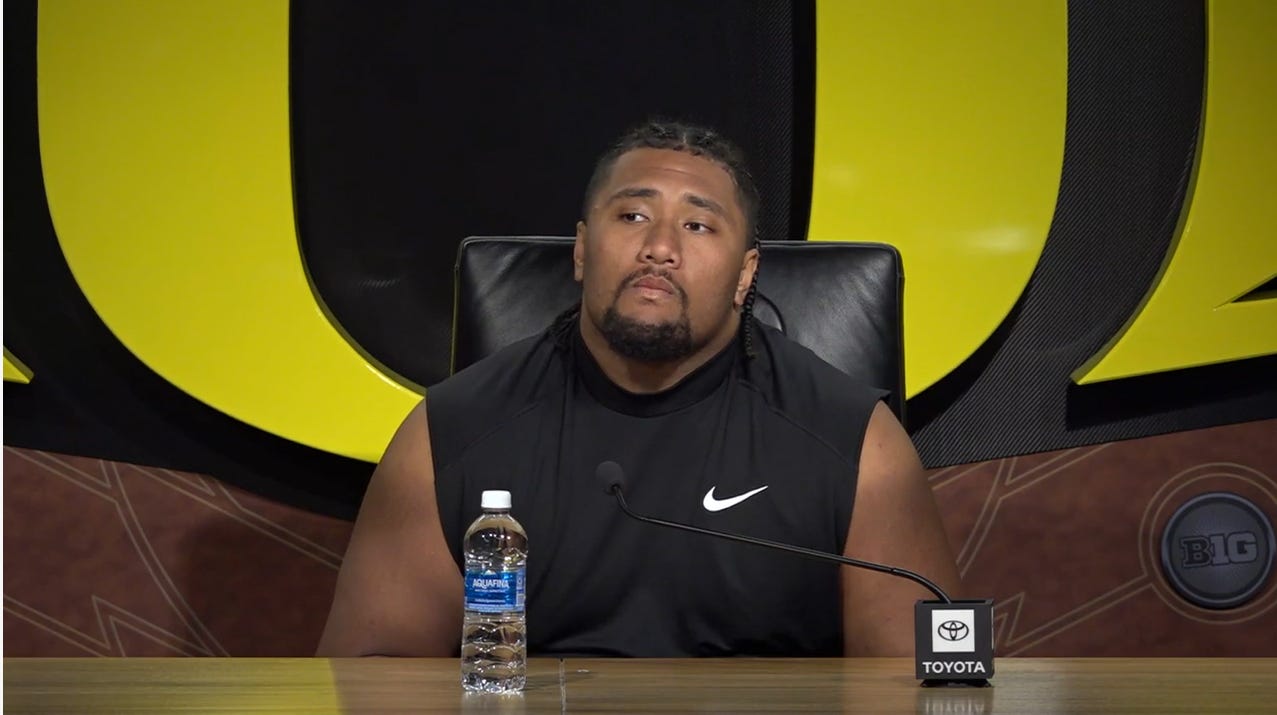
By the time Dan Lanning walked away from Oregon’s Wednesday practice, this week had become about much more than correcting seven turnovers from a 17-15 loss to UCLA. The Ducks had reopened competition at quarterback and across the offensive line, Lanning had inserted himself more heavily into the offensive operation, players were policing ball security before coaches had a chance to do it, and the offense was working through what Dakorien Moore described as significant changes in the way it was being put together.
Wednesday itself was designed around two areas Nebraska has made especially difficult: the red area and third down. Lanning called it a “good attack day” after what he described as another physical practice, and his emphasis remained on preventing third down from becoming an impossible situation rather than expecting Oregon to repeatedly rescue itself there. “Really tough team to prepare for when you talk about situational ball that we have today,” Lanning said. “With red area, third down, obviously best in the nation right now on defense on third down. So that’s an area that’s really focused and super important in this game. And as we talked about before, it’s about being able to stay on schedule on first and second to create better advantageous situations. But good energy and good attack from the guys today.” The interesting part of the week is that Oregon does not appear to be treating UCLA as something that can be fixed with one personnel change or one schematic answer. The conversations from Monday through Wednesday consistently returned to something broader: the Ducks had to identify what they actually do well, simplify enough of the operation to execute those things consistently and then hold players and coaches accountable when the standard still was not met.
The week started with the film removing the excuses
Lanning’s Monday evaluation established the tone because he refused to reduce UCLA to quarterback play, offensive-line play or play calling. When he was asked whether the film showed an execution problem or a scheme problem, his answer was “both,” and everything Oregon has done since appears to have grown from that conclusion.
“Again, we have to be able to do simple jobs and there’s a lot of plays you pull up and you’re one player away, one technique away,” Lanning said. “And then again, you got to ask yourself, are you putting our guys in the best situation to be successful at all times? And that’s, you know, in every phase, right? Special teams, offense, defense, all of it. And you see all those things revealing themselves a little bit in the game and some things that maybe we even identified earlier that could come up if we don’t — if you’re playing the wrong team or in the wrong look where you might get away with it in one week, but it’s not going to work every single week. And so all those things showed up. There’s both that we can get better at and improve at, and certainly working to do that.”
Poncho Laloulu described Wednesday’s offensive-line meeting room in much the same way, only from the perspective of a player who has been in the program long enough to know what Oregon’s offense is supposed to look like. He used a phrase from offensive-line coach A’Lique Terry — “factual feelings” — to describe a week in which reputation and experience are not enough to secure a job.
“Right now, we’re not playing up to our par in a standard that we’ve set over the years to come,” Laloulu said. “So I can totally agree with what Coach Lanning is saying, just trying to make a competition for the guys who really needs to play on the field. You know, at the end of the day, we want to play the best five to protect the guys behind us.”
Later, Laloulu returned to the film as the thing that makes the conversation unavoidable. “The eye in the sky, it don’t lie,” he said. “So whatever you put on film, that is your résumé right now. So I think we got to take that in and learn. Obviously, you don’t want to lose, but those are also lessons for us to really go back, watch film, see where we can get better and the coaching can get better and everybody else in this facility can get better. You know what I’m saying? Because at the end of the day, everybody plays a part into it. Not just the guys on the field, but even the guys who are giving us looks and the way we just operate throughout the facility and everything else.”
That is probably the best description of Oregon’s week. UCLA did not merely create a disappointing result; it produced a piece of film that made it difficult for anybody inside the building to argue that someone else was responsible.
The offense really is changing, even if Oregon is not telling Nebraska how
Lanning acknowledged Monday that there would be changes without revealing what those changes would be. By Wednesday, he offered the clearest indication yet that this was more than a normal week of installing an opponent-specific game plan.
“There’s a lot of hands on deck,” Lanning said when asked about the tone of communication inside the building. “Obviously, I’ve spent a lot more time on the offensive side of the ball this week. It’s been a different picture over there. I think a little bit more, again, collective effort. A lot of coach communication, a lot of player communication.”
Moore’s description from Tuesday went even further. He said Oregon is emphasizing accountability and communication because there are enough alterations that everybody needs to understand exactly what the offense is trying to become before Saturday.
“I would say it’s everything you just said, honestly,” Moore said when asked whether the communication had become more urgent or accountability driven. “Accountability mostly. We harping on ball security, being that we had a lot of turnovers this past game. Harping on our leaders just being able to communicate more, you know, because we got a lot of new plays that we’re putting in, changing the offense up a ton. So just being able to communicate and go out there and make sure everybody is confident in what they’re doing is the biggest thing.”
At first glance, “a lot of new plays” seems to collide with Lanning’s Monday comments about simplifying the offense. It probably does not. Lanning’s larger point was that Oregon had carried too much volume relative to what it was actually executing consistently, and the process now appears to be about changing the picture while shrinking the number of things the Ducks expect players to master on any individual snap.
“I think that starts with, like, dumbing down,” Lanning said Monday. “Okay, what are the things that we want to be able to do and do them really well? There’s probably been too much volume for what’s actually getting called in a game. So it’s something we’ve evaluated from that standpoint of, can we simplify what we’re trying to execute and then what do we do really well? I think there’s been some plays that we’ve ran that haven’t been extreme positives for us, but we kind of come back and look at them again and again. That’s not necessary in those moments. And then there’s been some plays that have been outstanding for us in the history of our time here that haven’t been because there’s just one guy that’s not able to sustain the block that we’ve been able to do in the past. So finding what our players can do well and maximizing those strengths.”
Wednesday, he made the same concept even more explicit while discussing the possibility of changing personnel packages. Oregon can use 10, 11, 12, 13 or even unusual quarterback packages, but Lanning’s governing principle was straightforward: “Use your best personnel, make sure that it’s simple enough that you can execute it at a high level.”
That sounds less like Oregon searching for a new offense and more like Oregon trying to remove everything that has prevented its best offense from showing up consistently.
The quarterback competition is real — and it is wider than two names
Dante Moore’s status remained unresolved publicly Wednesday. Lanning said Moore was practicing and throwing the football, and he sounded encouraged by what he saw, but he declined to get ahead of the availability report.
“He’s out there at practice today,” Lanning said. “He’s throwing the ball. It looked nice, right? It’s exciting to see. But we’ll let that play out as we communicate it.”
If Moore cannot go, Oregon is not simply handing the job back to Dylan Raiola after UCLA. Lanning made clear Monday that Raiola and Brock Thomas would compete through the week, then added Akili Smith Jr. to the public conversation Wednesday because Smith provides a different type of package.
“Akili’s done a really good job, and he’s probably the one that’s the most different from a package standpoint and things that you can carry and do different with Akili,” Lanning said. “A really strong arm. Bam will connect vertically on shots. Obviously, his feet become a weapon, right, and are a real tool for us as well. But, yeah, he’s done a really good job.”
The evaluation is not merely about which quarterback produces the prettiest throws during individual periods. Lanning said Oregon is grading timing, operational efficiency, ball security and consistency through practice because he wants the practice result to translate directly into Saturday.
“Timing is a piece of that,” Lanning said. “Operating what we’re doing and making sure that we can do it at a high level and I think evaluating efficiency through practice. So you can take the results and let it carry right over to game results, right? And be able to build off of, okay, what’s it look like in practice? Where has it been the most consistent? And grading that with a fine-tooth comb. And then making sure you have as many guys prepared as possible, right, to be able to evaluate that.”
Lanning would not eliminate the possibility of multiple quarterbacks playing, either, but his explanation illustrated the cost that comes with preparing too many possibilities. Every rep given to one quarterback is a rep another quarterback does not receive, and Oregon is far enough into the season that simply making practice longer comes with its own physical cost.
“I believe in doing whatever it takes to win,” Lanning said. “Whatever it takes to win, I think that’s our job, to challenge yourself to find what does it take to win. I’ve seen those happen and at times successful. I think we’ve all seen the result of when that’s not successful too. But I think all things are on the table for you to make sure you have success. The other damage piece of, okay, let’s go prepare three or four or two or one, when you start preparing multiple people for looks, you just subtracted reps from another person’s reps. And there’s just only so much time in the week.”
That competition extends to the people protecting them. Laloulu said his responsibility as the center is to make the operation work regardless of which quarterback is standing behind him, and he does not see quarterback uncertainty as an excuse for offensive-line uncertainty.
“I guess it is challenging, but not really,” Laloulu said. “Obviously, I played with multiple QBs during my years here. I was able to play with Bo for one game and then play with Dillon Gabriel and Dante and, unfortunately, with the situation we’re in right now. But at the end of the day, we’re just going to make sure whoever does the best in practice is going to be able to play come Saturday, both for the QBs and the O-line.”
Raiola’s response has become part of the evaluation
Raiola’s UCLA performance cannot simply be ignored because he played so well at USC a week earlier, and Lanning acknowledged Monday that both games have to be part of the evaluation. He also admitted that Oregon altered the picture after Brock Thomas entered against UCLA, getting the football out more quickly and creating cleaner opportunities, which makes the quarterback evaluation inseparable from the offensive evaluation around him.
Moore provided another piece of the story Tuesday when he described what happened after the loss. Raiola did not disappear from his teammates after being benched; he reached out almost immediately.
“Dylan texted me right after the game and told me that he was sorry for the way he performed,” Moore said. “Of course, that’s not a way anybody wants to go out there and perform. And I know that’s not him. I’ve seen some of his best plays. So we’re extremely behind him as much as we can, making sure we get his confidence back up because that’s why we bring him here. So he can get out there, so he can play, be confident, play fun, all them things. But no, he’s been attacking because he want to get back out there. He want to be great. He want to make them plays. He want to go out there and be who he came here to be.”
Lanning had already praised Raiola’s response Monday, particularly the way he handled being removed from the game in front of an entire stadium and a national television audience. The disappointment was obvious, but Lanning thought the body language that followed said something important about the player.
“A lot of you never go through life where you’re on a stage in front of the whole world and you get replaced in front of the whole world,” Lanning said. “That’s really hard, man. I don’t know how most normal people would handle that situation. I thought Dylan handled it with unbelievable grace right in that moment and was really humble, and there’s no way you’re not disappointed that you’re getting pulled from that moment, right? He handled that extremely well.”
The Nebraska connection naturally adds another layer if Raiola plays Saturday, but Oregon’s week has been far more about earning the opportunity than manufacturing a revenge storyline around it. Lanning said the game will mean something emotionally to Raiola, then immediately returned to preparation and what he described as Raiola’s professionalism.
The offensive line has gone back to “factual feelings”
No position is experiencing the open competition more visibly than the offensive line. Lanning said Monday that Oregon used so many different linemen against UCLA that continuity became difficult, but he also refused to use that lack of continuity as a reason to simply select five players and stop evaluating them.
“There isn’t a timeline,” Lanning said. “It reveals itself when it reveals itself, right? I don’t know the number exactly how many guys we tried out there on Saturday, but it was a lot and that’s hard to build continuity, but there’s nobody that’s separating themselves from a performance standpoint where you’re like, this guy has to be the guy consistently. And we have to be consistent at that position to be effective. But we have some guys that are capable of doing that. We just have to do it at a higher clip and more frequently, but there’s going to be really open competition at the position.”
Laloulu did not push back against any of that. His Wednesday interview may have been the clearest example of a veteran player accepting the premise that the offense has not earned the benefit of the doubt.
“You know, me being here for a while now, going into my fourth year and just knowing how it’s supposed to look like, and when I watch the film and it’s not how it’s supposed to look like, it kind of sucks, but it’s a learning lesson,” Laloulu said. “You know, also for me as well, I can do better leading and making sure the guys are up to par, not just the coaches. I appreciate the coaches for always taking it and taking action and holding themselves accountable. I know us as leaders, we can do better too for the guys, but even the O-line, we’re just not playing up to the best standard right now. And we’re not playing with the basics. We’re not doing something better enough.”
He went further when asked where the execution disconnect actually lives. Laloulu’s answer was not scheme-heavy because he believes the players have more responsibility away from the facility than they have consistently accepted.
“I think really it’s just the execution standpoint, really just everybody doing their job,” Laloulu said. “At the end of the day, you’re in college football in an era where college football, it don’t matter where you’re at. Everybody’s good. You know what I’m saying? So it’s not like where you got all the powerhouse schools, like, we don’t know what’s going to happen. And that’s what’s exciting about college football, right? So I think at the end of the day, we just got to execute our job. We prepare every single day for so long, for just like about two, three hours on Saturday. So really, it comes down to the guys and the players of like, are you guys really locking in off the field? You can’t only come to the facility and just watch film there. You got to watch film outside. You got to dig into the playbook, into the installs like that.”
That is a much more significant admission than “we need to block better.” Oregon’s offensive-line problem, in Laloulu’s telling, is partly technical but also connected to the kind of preparation and ownership that has to happen before practice ever begins.
Ball security has become visible accountability
The easiest correction to identify after UCLA was also the one Oregon could least afford to treat as a slogan. Lanning said Monday that he had seen poor ball-security habits before Saturday and had not created enough accountability around them, so this week Oregon made the consequence immediate.
By Wednesday, players were enforcing it themselves.
“I’ve been proud of the way that they’ve worked,” Lanning said. “I don’t see a lot of hanging heads. I think that’s challenging, too, especially when you’re young, to not lose a little bit of gusto and not lose a little bit of belief. But I feel like that energy has been there for guys going to attack and wanting to do right. And even accountability from a standpoint of ball-in-jeopardy type situations that we’ve had too many of and certainly too many of last game, where guys realize if they have bad ball security or they put the ball in jeopardy, they’re taking off and they’re running all the way across the field to go touch the other side of the wall. They’re holding themselves to that standard if it doesn’t get called out by a coach first. So the response, I think, from that standpoint has been really good.”
That detail tells us something about what Lanning meant Monday when he said Oregon’s practice accountability had not been good enough. The correction is not simply another reminder to hold the football high and tight; a bad rep now produces a visible consequence, and the players are expected to recognize the violation before a coach does.
Moore said ball security has become one of the central communication points of the week, and that fits with Lanning’s repeated description of quarterback play as beginning with protecting the football. Oregon may make changes to personnel, play calling and offensive structure, but none of them can rescue a possession that ends with the opponent holding the ball.
Oregon’s best players are being told to expect the football
There is another offensive correction that has become impossible to miss. Lanning said Monday that Jamari Johnson’s limited involvement against UCLA was “not remotely close” to enough, then expanded the point to Oregon’s entire group of explosive players.
“Jamari is a guy that needs to be touching the ball,” Lanning said. “We’ve got some explosive players that need to be able to touch the ball. Dakorien Moore is a guy that needs to be touching the ball. I can name a lot of guys that are guys that need to be touching the ball. When you have three-and-outs, obviously that limits your opportunities. The amount of time on the field when you have turnovers, that limits your plays. We had a lot less plays on offense than we had on defense because we turned the ball over. I think some of it starts there. But we can certainly find better ways to make sure that we get targets to players.”
Moore did not pretend receivers are indifferent about that conversation. He also did not turn it into a complaint about targets.
“Naturally, just like I would say just as a natural ball player, I would say I speak for anybody when I say that we want the ball,” Moore said. “There’s a ton of chances that we get, especially in practice, to where we make plays to show coach that we’re one of them guys who needs to be getting the ball. But I’m very just blessed to be able to be one of those players that he highlighted for future opportunities to be able to get the ball. So I’m looking forward to it.”
The receiver room also has a role in helping whichever quarterback wins the job. Moore said his experience in Oregon’s system gives him a responsibility to remove uncertainty from the picture by making sure the quarterback knows the receiver will be where the play expects him to be.
“I feel like being that I have more experience than they do being here and being in the offense, just helping them with the confidence level,” Moore said. “Telling them I’m going to be where they need me to be, and just basically having the reciprocated trust in one another.”
That may sound like ordinary receiver language, but trust has been one of the recurring words of Oregon’s week. The coaches are changing pieces of the operation, the quarterback job is open, the line is rotating and the easiest way for all of that uncertainty to become paralysis is for players to begin wondering whether somebody beside them will execute his assignment.
The defense refuses to accept the consolation prize
If the offense has spent the week confronting what went wrong, Oregon’s defense has been fighting a different temptation. The Ducks played well enough against UCLA that it would be easy for the defensive side of the locker room to separate itself from the result.
Brandon Finney Jr. rejected that idea Tuesday. “Our identity as a defense, who we want to be? We want to be a dominant defense,” Finney said. “Even in most situations like that, how can we win the game? We’re not expecting our offense to win the game. We’re expecting us to win the game first. Every game is really in our hands, in my opinion. We really want to be a dominant defense. Then as far as it goes, just instilling confidence in the offense, that comes throughout the week, making sure we can give them the best looks. So for that, when they’re in the game, they’re prepared.”
Devon Jackson made the same point from the linebacker room and added a detail that probably matters more than anything said publicly about offense versus defense. He talked with Laloulu for approximately 20 minutes after the game, not to dissect blame but to reinforce that one group was not separating itself from the other.
“We all in this together,” Jackson said. “It’s not like, oh, defense won the game and offense lost, or special teams won or lost. We all lost together and we all win together. So we got each other’s back no matter what. I remember talking to Poncho for like 20 minutes after the game and it’s just like, bro, I don’t care what’s going on or what happened. I got your back. I trust that group. I wouldn’t trade that group with anybody else in the country, despite what other people may think. And we’re going to continue to lean on each other because we all we got and we all we need.”
Matayo Uiagalelei went even further Wednesday because he thought accepting praise for the UCLA defensive performance would create its own problem. Oregon still gave up plays that helped determine the game, and he does not want a defense chasing statistical consolation.
“I think it’s easy to say, like, ‘Oh, you know, we played good on D. You know, we did our job,’” Uiagalelei said. “I feel like that’s more of a poisonous pill of success if you do that. We didn’t play as good as UCLA’s defense that day. So, I mean, there was a lot of good I feel like we did on D, but there’s a lot of plays, a lot of explosive plays that we don’t give up these explosive plays, we might not have any points on the board. And just limiting those explosive plays, and that just starts with doing your job, communicating, everybody on the same page, disciplined eyes, stuff like that. Eliminating explosives is the biggest thing.”
That may be the defensive equivalent of Laloulu’s “factual feelings.” Oregon can acknowledge that the defense improved without pretending the standard was satisfied.
The first-play problem has become an eye-discipline problem
Finney identified the next step for the defense as consistency, and he immediately connected that to Oregon allowing explosives on the opening play of multiple games. The Ducks have recovered well afterward, but the fact that the problem keeps appearing at the beginning of games has become too repetitive to dismiss.
“We’ve had explosives on the first play of the game,” Finney said. “That’s not ideal at all. And it’s just like we’re getting stops after those explosives. So it’s just like one thing we have to do, we got to stop those explosives. We got to stop the run. We got to hold down the passing game consistently, like you said, though. So that’s going to be the next step for us and continuing to play physical and relentless.”
By Wednesday, Lanning had separated the errors into different categories. Oklahoma State involved what he called a preparation error because Oregon had not created the necessary look during the week, while UCLA involved an eye-discipline violation in the secondary.
“I’d say that almost all of our big plays this year have been eye-discipline violations,” Lanning said. “And then they’re also different, right? Oklahoma State was an ill-prepared situation for us. Didn’t do a good job of getting that hat in the box that needed to be there in the box. I call that a preparation error, right? Meaning we didn’t have the right look. We didn’t create that motion, that QB keep, where it becomes that person responsible for the QB. In the last game, it was an eye violation in the back end. That has to be better.”
That matters especially this week because Nebraska’s offense is built to exploit exactly that type of mistake. Colandrea’s mobility, the run game and the play-action shots force defenders to process multiple threats without allowing their eyes to abandon the one responsibility that actually belongs to them.
Containing Colandrea requires rush and coverage to become one thing
Every defensive player asked about Nebraska’s quarterback arrived at essentially the same answer. Colandrea can create outside the original play, and Oregon cannot allow the rush to become so aggressive that it manufactures the escape lane for him.
Finney described him as “a really talented quarterback and a very mobile quarterback, one that’s going to kind of just move around the pocket and look to run and to pass the ball. So we know he’s going to take those shots downfield, but also when he’s running, when he’s booting out the pocket, we know he’s going to try to run the ball too. So a very able quarterback that we’re going to have to look to contain and stop explosives from.”
Jackson’s version was shorter but pointed toward the same structure. “He’s a good quarterback,” Jackson said. “We got to contain him, make sure he can’t get off the spot. We have the athletes to do that, for sure. And then try to confuse him, get him off his game. But he’s a very good quarterback. I got a lot of respect for him, for sure.”
Uiagalelei framed the job from the defensive front’s perspective and made the connection to the secondary explicit. “He’s running around back there crazy, man,” Uiagalelei said. “You know, he’s a good player. He’s fast. He can throw the ball. His speed and vision is definitely a threat. So, yeah, we just got to cage him, get hits on him, just do our job. Know that the back end is going to do their job, we’re going to do our job, and it’s all going to rush and coverage, work together.”
That last sentence is probably the important one. Oregon does not need one defensive end chasing Colandrea around the field; it needs four rushers understanding where he is allowed to escape and seven defenders maintaining coverage long enough for the cage to close.
Matayo’s sacks are beginning with practice habits, not a new pass-rush trick
Uiagalelei enters Nebraska week with the sack production Oregon wanted from him when the season began, but neither he nor Lanning described some new move or scheme as the reason.
“I think it’s just something we emphasize in practice, finishing,” Uiagalelei said. “Just being all around more violent, more aggressive on D, especially as a front. And, I mean, that’s all I can really say, just practice habits.”
Lanning connected that improvement to work that began months earlier and said the most important pass-rush trait against Colandrea may not be the initial win anyway. A quarterback who can escape the first rush forces defensive linemen to finish the second effort.
“I just think that Matayo’s second effort is operating at a really high clip right now,” Lanning said. “If you went back to the spring, I could almost point and say this guy’s going to have an unbelievable season because of how hard he worked in the offseason with his diet, his nutrition. And even he wants that extra reminder of, like, this week it’s going to be huge. Their quarterback can run, right? And he’s a great scrambler, right? But the second effort is going to be the difference. It’s not going to be necessarily the primary rush wins.”
That idea connects this week back to the practice-report themes Oregon talked about throughout August. The thing showing up on Saturday is not always something invented Tuesday; sometimes it is the accumulated effect of what a player has repeatedly made normal.
Aaron Flowers’ absence creates another development test in the secondary
Oregon also received clarity this week on Aaron Flowers, and it was not the kind the Ducks wanted. Lanning said Wednesday that Flowers underwent surgery and will be out for the foreseeable future after trying to play through the injury.
That places more responsibility on Peyton Woodyard and freshman Devin Jackson, both of whom played against UCLA. Lanning saw good and bad from both, including a safety-fit error on UCLA’s touchdown run, but he also said there were legitimate bright spots in their work.
Uiagalelei has watched both players from the other side of the defense and emphasized the way the younger Jackson has approached his first season. “Both of those guys, unbelievable work ethic,” Uiagalelei said. “You know, I played with P. Wood since I was a kid. And then D-Jack, young Devin Jackson, he came in as a freshman this year, and I don’t know, he’s come in with the mindset like, ‘I don’t care how I’m a freshman. I’m going to do my job. I’m going to try and play,’ and come in hungry. I like that. Both of those guys are going to be phenomenal.”
The timing makes their development important because Nebraska is not an opponent that allows an inexperienced safety to hide. Colandrea’s run threat can pull a defender’s eyes forward while Gilmer and Barney attack the space created behind him, and Oregon already identified disciplined eyes as one of the defensive areas it most needs to clean up.
Bailey Ettridge sees a team handling the losses better than the outside world might assume
The most unusual perspective on Oregon’s emotional state came from Bailey Ettridge, who has enough life experience to view a bad football Saturday differently than most players in the locker room. The former welder has also become one of Oregon’s most consistent performers, but he said there was little satisfaction in punting well when the team did not win.
“I don’t really — I mean, you already know you had a good game, but as I said, that’s what I’m here to do,” Ettridge said. “That’s why I was here. I was recruited to perform and kick the way I’m kicking. So it’s nothing really to celebrate. You just got to keep doing it week in, week out.”
When he was asked to assess the team as one of its older players, Ettridge did not describe a locker room sinking under the disappointment of 3-2. “I think we’re in a good spot,” he said. “Obviously, we’d like to perform a little bit better on the field. But the way we attack practice and meetings and how we’ve handled the two losses, I think shows the maturity in the group. And, yeah, I think we’re just excited to get the chance to go back out there and prove that we are who we can be and just keep going.”
His perspective on pressure may have been even more useful because it came from somebody who spent a decade waking up for construction work before college football became his job.
“It can get pretty repetitive here, but we get to be here every day playing football, playing a game we love in front of all these fans,” Ettridge said. “There’s harder things in life than playing football. So I think we are all blessed with the opportunity that we get to come here and do this every day. I would much prefer doing this than welding, I’ll tell you that.”
There is something useful in that simplicity during a week filled with quarterback decisions, offensive restructuring and outside criticism. Oregon’s players still have to come to practice and do the work.
The outside noise has become part of the lesson, but not the excuse
The discussion around Oregon this week has been loud enough that nearly every player was asked some version of the same question: how do you avoid allowing public criticism to become part of practice?
Finney’s answer was that social media has never carried enough weight for him to make it part of his self-evaluation. “I find it hard to really find what people say online, like, really truly affect me,” Finney said. “Because it’s just like, why would I let your opinion inflict me or my thoughts on my performance or my thoughts on our performance? Because people are going to be there when you’re doing good. When you’re doing bad, they’re going to leave you. That’s one thing I learned about social media. Social media ain’t really a big motivation for me at all.”
Jackson has gone a step further by largely removing it from his phone. “As a team, it has nothing to do with how we show up and prepare,” he said. “For me personally, I don’t see it because it’s not on my phone. Personally, the good or the bad, I don’t see it because, again, it has nothing to do with how we show up every day. What people say on the outside has nothing to do with how I practice today, whether that was good or bad, or how I practice tomorrow and how I practice the next day and how we continue to prep for this next game.”
Moore admitted his relationship with social media is different because he enjoys interacting with fans. He also agreed with Evan Stewart’s postgame assessment that Oregon had become too focused on outcomes rather than the process producing them.
“We are very outcome driven,” Moore said. “I feel like we do need to be process driven, and that’s something as leaders that we’ve all been harping to the team. But me personally, I would say that I am kind of into the media, being that I have a lot of fan stuff. I’m very interactive with my fans. So I’m all into that. But when it comes to game day, I’m all locked in, focused, phone on the hard DND, not really talking to nobody, in my own zone type thing. So I’ll say I handle it pretty well.”
Lanning’s approach is not pretending the outside world disappears once players enter the building. He acknowledged Wednesday that asking 18- to 22-year-olds to simply ignore their phones is not realistic, so his responsibility is to model how he handles it and keep returning the players toward things that can actually affect the next result.
That distinction fits the entire week. Oregon is not trying to convince itself UCLA did not happen, and it is not pretending criticism does not exist. The response has been to make the film, practice and internal standard louder than either one.
This week is testing whether Oregon can turn accountability into football
There has been no shortage of language inside Oregon’s program about response, but the most important thing from Monday through Wednesday is that some of it has become tangible.
The quarterback job is being graded rep by rep. The offensive line has reopened competition around finding the best five. Lanning is spending more time directly involved with the offensive side of practice. Ball-security mistakes carry an immediate consequence that players are beginning to enforce themselves. Moore says the offense is changing significantly, while Lanning is simultaneously trying to make what Oregon carries into the game simple enough that the players can execute it at a high level.
The defense is approaching the week with a different kind of accountability. Finney does not want the offense carrying responsibility for winning the game, Jackson refuses to separate one unit’s performance from the final result and Uiagalelei called feeling satisfied about UCLA a “poisonous pill of success.” At the same time, Oregon is attacking the details that still showed up defensively: explosives, eye discipline, the first play of the game and containing a quarterback capable of turning a successful rush into a broken-play gain.
That is why this practice week feels different from a normal correction week after a loss. Oregon did not come out of UCLA believing it merely needed to play harder. The coaches and players have spent the week questioning who should play, what they should be asked to execute, how much offense they should carry, where accountability needs to become more visible and whether the preparation habits away from the practice field have consistently matched the expectations inside it.
Laloulu’s description of the film remains the cleanest way to understand all of it. Whatever Oregon believed it was before UCLA matters less than what the tape says it is right now, and Saturday becomes the next opportunity to change that résumé.
There is still talent everywhere, and the players have not lost belief in one another. The practice report this week is about something more important than belief, though: Oregon has spent the week trying to make sure belief is finally supported by repeatable execution.
Nebraska will tell us whether it worked.