


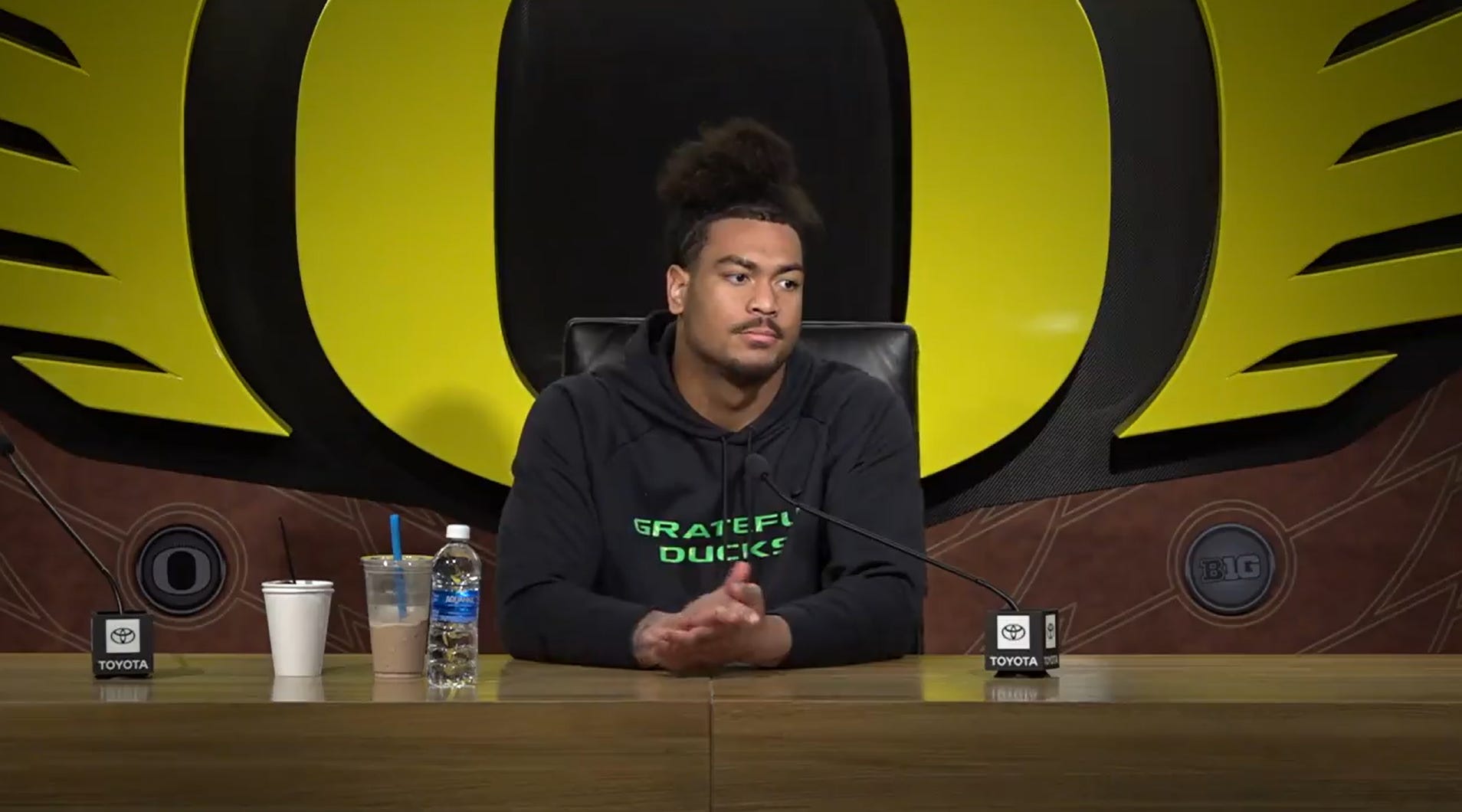
EUGENE — There were only two days of media availability this week as Oregon accelerated its preparation for Friday night’s trip to Michigan State. That limited the usual opportunities to evaluate the Ducks’ development on the practice field, but conversations with players and coaches offered something potentially more revealing: a chance to connect the team’s recent resurgence with the work that began months before the season.
Throughout fall camp, Oregon’s coaches emphasized the importance of mental processing, communication, player-led accountability and developing enough depth to withstand the inevitable injuries of a long season. Those were familiar themes, but they also represented legitimate questions about a roster that was still searching for the right combinations at several positions.
Now, with Oregon riding a three-game winning streak and having rediscovered much of the confidence that disappeared during its midseason struggles, those early conversations provide an interesting perspective on what has changed. The Ducks have not suddenly discovered a new collection of talented players. Instead, the players who were already in the program appear to be developing the trust, familiarity and confidence necessary to consistently take advantage of that talent.
The Offensive Line Is Finally Becoming a Unit
Perhaps no position group better illustrates Oregon’s evolution than its offensive line, which entered fall camp with considerable individual talent but unanswered questions about how those players would fit together.
During August, offensive line coach A’lique Terry repeatedly emphasized the importance of identifying the right combinations rather than simply placing the five most talented individuals on the field. The challenge was developing communication and chemistry among players with different levels of experience, something that inevitably requires time and repetition.
Veteran center Iapani “Poncho” Laloulu has been central to that process. During fall camp, he emerged as the stabilizing presence within the room, providing leadership while helping younger players understand the expectations of Oregon’s offensive system.
This week, Laloulu explained how that process has begun producing more consistent results, particularly as the offensive line has developed greater familiarity through the past several games.
“Obviously, this past three weeks, really, you’ve just seen the gel between, you know, a young kid like Tommy and the older guy like me and Fox with him,” Laloulu said. “And then you got Janoris and you got Doug on the other side who were kind of, you know, other veteran guys. So I think really it’s just like the communication part is something that we really wanted to harp on.”
That communication extends beyond the offensive line itself. Laloulu emphasized the importance of making sure tight ends and other offensive personnel understand their assignments, particularly when Oregon uses formations and blocking concepts requiring multiple players to adjust together.
The development of Tommy Tofi has been another important part of that process. Tofi was among the young linemen attracting attention during August, but his physical tools were only part of the equation. Laloulu described the personal responsibility that comes with helping a young player adapt to college football, particularly one who spent time living with veteran teammates while adjusting to life away from home.
“Tommy’s growing up,” Laloulu said. “You know, he’s still a young kid, but as a man, I can see the mannerisms of some things that, you know, Tommy’s growing up in.”
Laloulu also explained that youth cannot become an excuse once a player earns meaningful responsibilities, particularly along an offensive line where one missed assignment can compromise an entire play.
“I tell him like, hey, like if you’re on the field, you’re called to be a veteran no matter what you do. You got to carry yourself and play the same way. Like if you were a senior or whatever it is, you know, you got to have that fire.”
That perspective is particularly important because Oregon’s offensive line has faced criticism throughout the season. The improvement seen against Ohio State and Michigan suggests the group is beginning to benefit from the continuity that was missing earlier, although Friday will provide another opportunity to determine whether that development is sustainable.
Hill Is Seeing the Difference in the Details
Dierre Hill Jr. offered a complementary perspective on the offensive line’s development, emphasizing the connection between improved practice habits and Oregon’s recent offensive production.
“Shout out the O-line, shout out law firm,” Hill said. “You just see them in practice and in meetings as well. It’s just the attention to details. Our coaches coach us hard, and obviously, you know, we can’t be the dynamic team we want to be if we can’t influence the run game.”
That observation connects directly to a question Oregon faced during fall camp, when Hill’s versatility was already being discussed as an important part of the offense. His ability to align in multiple positions and contribute as both a runner and receiver made him an intriguing weapon, but the effectiveness of those opportunities depended on the offensive line and supporting players executing their assignments.
Against Michigan, Hill provided an example of how that preparation can turn an ordinary play into an explosive gain. On his 49-yard touchdown reception, Hill was the final option in Raiola’s progression rather than the intended primary target. His ability to turn a checkdown into a touchdown reflected both individual playmaking and the execution of teammates who helped spring him downfield.
“Really just confidence in myself and just my teammates trusting me and obviously being the last progression in the read,” Hill said. “We weren’t expecting nothing big, but obviously just being smart with the ball and just being who I am, being a player, being a playmaker, and just trying to help the team as much as I could.”
Hill believes the changes extend beyond any single player or position group. After a first half of the season marked by inconsistent execution, he sees a team becoming more comfortable with its responsibilities.
“First half of the season, we had some hiccups and stuff like that. We weren’t playing our ball, but I feel like now we’re starting to feel ourselves more and just be loose and more focused and just being who we truly can be.”
That confidence is increasingly evident in the way Oregon’s offensive players describe their responsibilities. Rather than emphasizing the difficulty of executing different concepts, they are discussing the importance of trusting the players around them and allowing their preparation to produce results.
Jay Johnson Has Simplified the Offensive Conversation
The transition to Jay Johnson as Oregon’s interim offensive coordinator has also contributed to a change in how players describe their responsibilities.
Hill offered a particularly useful explanation of Johnson’s approach, emphasizing that the offense continues to move players around and create different looks without requiring them to process an overwhelming amount of information.
“Coach Jay, he’s a very firm guy. He’s cool with all of us, but it’s a yes or a no. I mean, it’s very simple with him,” Hill said.
“We move around fast, and a lot of guys get in a lot of different spots, but our minds are not wandering everywhere. He keeps it strict, not strict, but he keeps it simple and easy for us so we can line up fast and obviously make some wrinkles in there so the defense doesn’t catch on to what we’re doing.”
The distinction is important because Oregon has not abandoned the versatility that was emphasized during fall camp. Instead, the offense appears to be finding ways to use that versatility without creating unnecessary complexity for the players responsible for executing it.
Lanning has also pointed to Dylan Raiola’s growing understanding of the offense, particularly his improved decisions and willingness to protect the football rather than force plays that are not available.
“I thought some of the best decisions that you guys don’t see are the times that he throws the ball away, right?” Lanning said. “And he’s not putting it, you know, in jeopardy. I thought he did a really good job of protecting it, two hands in the pocket consistently.”
That development has allowed Oregon to maintain offensive production despite the loss of Dante Moore. The more significant change may be that Raiola and his teammates are beginning to operate with a shared understanding of what the offense is asking them to accomplish, allowing them to play faster without sacrificing discipline.
Elijah Rushing’s Patience Is Paying Off
Few players provide a stronger connection between Oregon’s fall camp discussions and its current situation than Elijah Rushing.
When we examined Rushing’s development during August, the central theme was patience. A highly regarded recruit who arrived with considerable expectations, Rushing had spent much of his early career learning behind more experienced defensive linemen rather than immediately assuming a prominent role.
His observation that “everyone’s journey is different” became an important part of that early discussion. Now, with Teitum Tuioti unavailable, Rushing has been asked to apply those lessons in a considerably larger role.
This week, Rushing reflected on the influence Tuioti and Matayo Uiagalelei have had on his development, particularly the example they established long before he was asked to become a regular contributor.
“Tatum has been, like, he’s like a mentor. I can’t even put into words,” Rushing said. “The amount that he’s impacted me, like him and Matayo, just allowing me to see from their example, like, I don’t know that I would be the player I am without them having an example, following their steps.”
Rushing recalled arriving around the Fiesta Bowl following the 2023 season and initially feeling the need to prove himself immediately. Tuioti helped him understand that preparation and consistency mattered more than attempting to make an impression on every snap, a lesson that became particularly valuable during the physically demanding practices that followed.
“There were just times like I’m gassed, I’m tired,” Rushing said. “And he just like, hey, just like get up. Like, I know you’re tired. I’ve been there. But the last thing you want to do is just show that you’re tired or gassed. You got to just always have a motor.”
Rushing’s development reflects something Oregon’s coaches have emphasized throughout Lanning’s tenure: Meaningful depth is created through preparation long before an injury forces another player onto the field. His current opportunity is not the beginning of his development, but the point where the work he has accumulated over multiple seasons must begin producing results.
Wyatt’s Development Has Become More Complete
Nasir Wyatt entered fall camp with a different challenge. His explosiveness as a pass rusher was already evident, but Chris Hampton wanted to see whether Wyatt could develop into a more complete defender capable of handling early-down responsibilities.
The emphasis during August was on maintaining his athletic advantages while improving his strength, technique and understanding of run fits. Those areas remain important, but Rushing believes Wyatt has made substantial progress.
“He was one person who has been renowned and known for his pass rush, but as far as the first-, second-down run game, he’s really got to step up,” Rushing said. “I’ve seen him in the games, in the C area against tight ends, really get knockback and be able to get in on those plays.”
Wyatt, meanwhile, described a moment following Oregon’s loss to Illinois as particularly important in helping the team rediscover its identity. He believes Lanning’s message challenged players to return to the qualities that had helped establish their success rather than allowing outside expectations to influence their approach.
“Coach Lanning talked to us, and I think that team meeting he had with us after that game was really like a moment to shift,” Wyatt said. “He was just telling us, you know, just we got to go back to our traits, the things that got us here, you know, playing fast, you know, really just like he say all the time, just letting it hang, just being you, doing your job.”
Wyatt believes the players responded by turning their attention away from outside expectations and concentrating more deliberately on what they could control. That shift has become particularly important for Oregon’s defense, which has increasingly demonstrated its ability to create disruption without losing the assignment discipline that allows its individual talent to be effective.
The Defense Is Learning to Celebrate Its Work
One of the more interesting observations this week came from Rushing, who described a subtle change in how Oregon’s defenders interact during games.
The Ducks have long emphasized moving immediately to the next play, but Rushing believes the defense had become so focused on that mentality that players were failing to recognize successful execution.
“Something that we’ve tried to focus on going as the weeks have gone on is just celebrating our success,” Rushing said. “There were just times like people would make a play, and we’d just kind of try and get to the next play. We were so focused on next play that we didn’t even get to really just live in the moment and celebrate what we did.”
That may seem like a small adjustment, but it connects to Lanning’s broader effort to restore the team’s confidence and enjoyment of the game. Oregon’s defense has become increasingly productive as its players have developed greater trust in one another, and recognizing successful execution has helped reinforce that connection.
The emphasis on fundamentals remains central to that improvement. During fall camp, Hampton discussed the importance of creating more negative plays, improving tackling and converting pressure into drive-ending opportunities. Those goals required more than adding defensive concepts; they required players to execute together.
Lanning pointed to Dylan Williams’ forced fumbles against Michigan as an example of preparation beginning to produce visible results.
“I wish you guys could come to practice in fall camp because what we saw play out there with Dylan is exactly what we’ve seen from this guy really all season,” Lanning said.
He noted that Oregon regularly practices attacking the football, including drills designed to develop the timing and technique necessary to dislodge it from a ball carrier. The larger lesson is that takeaways and explosive defensive plays are rarely isolated events, but often the result of habits established through repetition, even when those habits take weeks or months to produce meaningful results on game day.
The Leadership Developed in August Is Being Tested in November
Perhaps the most meaningful connection to fall camp involves the player-led accountability Lanning emphasized from the opening days of practice.
Back in August, Lanning challenged his veteran players to consider more than their individual performances. His question, “Who’d you bring with you?” reflected an expectation that experienced players would help elevate the teammates around them rather than simply concentrate on maintaining their own positions.
That concept has become increasingly relevant as injuries have forced younger players into more prominent roles. Laloulu’s work with Tofi, Tuioti’s mentorship of Rushing and the expanding responsibilities of several defensive backs all reflect the kind of development Oregon hoped would emerge from its internal leadership.
Lanning also noted this week that more than 11 freshmen have played at least 200 snaps, while approximately 80% of the team’s snaps have come from players who arrived at Oregon directly from high school.
“I think it’s a clear indication of kind of how we’ve wanted to build this,” Lanning said. “Guys coming here, earning a role, and then that role grows as they continue to produce.”
Laloulu offered perhaps the clearest example of how that culture is experienced by the players themselves. Asked about Lanning’s leadership during a difficult season, the veteran offensive lineman emphasized the coach’s willingness to accept responsibility rather than look for someone else to blame.
“Coach Lanning is one of a kind,” Laloulu said. “That’s a rare dude you find who, despite the success he wasn’t having, that Coach Lanning will put it on himself. And that’s rare to find. Usually people point fingers and blame.”
That approach appears to have resonated with Oregon’s players, particularly as the team worked through its midseason difficulties. Rather than allowing disappointment to fracture the locker room, the Ducks have increasingly described a renewed commitment to their shared responsibilities and the importance of continuing to develop together.
Final Practice Notes: A Short Week, but a Longer Story
Oregon’s preparation for Michigan State has been compressed into an unusually short week, requiring the coaching staff to accelerate the normal practice schedule while managing players dealing with the physical demands of November football.
Lanning explained that Sunday was effectively treated as Monday for the coaches, while Monday’s practice operated more like a Tuesday session for the players. The objective was to complete much of the installation early enough to allow players to absorb the game plan without sacrificing the preparation necessary for a Friday road game.
The Ducks are also managing several important personnel situations. Lanning indicated that Doug Utu had participated in some activities earlier in the week after being injured against Michigan, while Bear Alexander would be limited initially as the staff evaluated his ankle. Jordan Davison was also progressing after coming out of his walking boot, although Lanning deferred formal updates to the availability report.
The larger story, however, extends well beyond the limited practice schedule. What Oregon’s players described this week was not a sudden transformation, but the accumulation of work that began in August.
The offensive line’s communication has improved, younger defenders are applying lessons learned from veterans, and players throughout the roster are beginning to demonstrate the confidence that comes from understanding their responsibilities. That progress does not guarantee another strong performance Friday, particularly against a Michigan State defense that has improved considerably in recent weeks.
But the conversations emerging from this shortened practice week provide an important reminder about how football teams develop. The work that eventually determines a season often begins long before anyone recognizes its significance, and for Oregon, the lessons from fall camp are finally becoming visible when they matter most.