


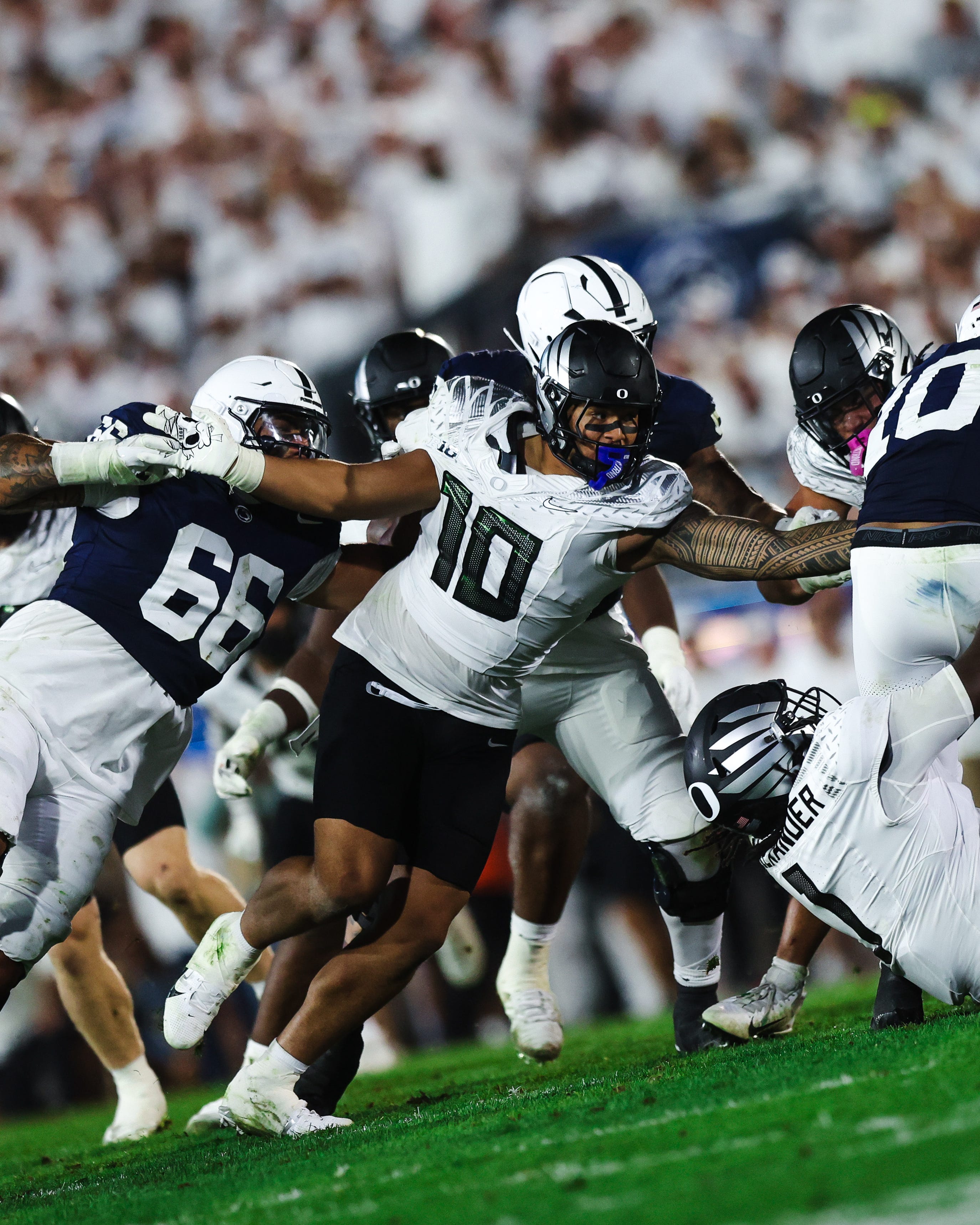
There are times when the most important question about a football team is not whether it has enough talent, enough experience or enough schematic answers. Sometimes the question is narrower than that. It comes down to whether a team can turn what it already does well into something more punishing, more reliable and more transferable against elite competition. That is the question facing the 2026 Oregon defense.
The Ducks were not a bad defense last season. They were not even an average defense. By most conventional measures, Oregon was very good. The Ducks allowed 17.9 points per game, 273.7 yards per game and 4.40 yards per play. They intercepted 15 passes, forced quarterbacks to make uncomfortable decisions and were difficult to consistently drive against. That kind of production does not happen by accident, and it certainly does not happen without talent, coaching and a clear defensive identity.
But the standard at Oregon has changed. Very good is no longer the full conversation. Oregon is recruiting at a national level, building depth at a national level and expecting to compete deep into the College Football Playoff. When that becomes the standard, the evaluation changes. The question is no longer whether Oregon can field a strong defense. The question is whether Oregon can field the kind of defense capable of carrying a team to a national championship when the offense has an off night, when the weather is bad, when the quarterback is under pressure or when the opponent across the field has just as much talent.
That is where last season’s pass-rush profile becomes so interesting. Oregon’s 2025 defense generated pressure at a rate that placed it in the upper tier nationally. Using the advanced pressure data we have discussed, Oregon produced pressure on 36.9 percent of opponent dropbacks. That is not a minor number. That is not a “good enough” number. That is the kind of number that belongs in the same conversation as elite defensive fronts. The Ducks were able to move quarterbacks, distort pockets and create enough stress to affect the rhythm of opposing passing games.
The issue was what happened after the pressure arrived.
Oregon finished with 30 sacks last season. Depending on which data source is used, the Ducks’ sack percentage looks more respectable than the raw pressure-to-finish concern suggests, but the broader point remains the same. Oregon’s pressure profile looked more dominant than its finishing profile. The Ducks were able to create the beginning of negative plays, but they did not convert enough of those opportunities into sacks, lost-yardage downs, forced fumbles or the kind of drive-ending moments that define championship defenses.
That is the one thing separating Oregon’s 2026 defense from being something truly elite.
Pressure Is the Foundation, Not the Finish Line
Pressure matters because it changes the way an offense operates. A quarterback who has to move off his spot cannot throw with the same timing. A quarterback who has to reset his feet often loses the rhythm of the route concept. A quarterback who sees color flashing in front of him will speed up his process, even if the rush does not get home. In that sense, Oregon’s defense already had one of the most important ingredients of a high-end unit.
However, pressure by itself is not always enough against the best teams on the schedule. The better the quarterback, the more important finishing becomes. Elite quarterbacks can survive a muddy pocket if there is an escape lane. They can punish pressure if the rush loses contain. They can turn a near-sack into an explosive scramble or a late throw outside the structure of the play. Against average teams, pressure may be enough to create bad throws. Against championship-level teams, the defense has to close the play.
That is the difference between disruption and destruction. Oregon did a lot of disrupting last season. The next step is turning that disruption into defensive control. A pressure that forces an incompletion is useful. A sack that creates second-and-17 changes the play sheet. A hurry that leads to a throwaway can keep a defense on schedule. A sack on third down gets the defense off the field. A quarterback hit can have a cumulative effect. A strip sack can change a game.
