


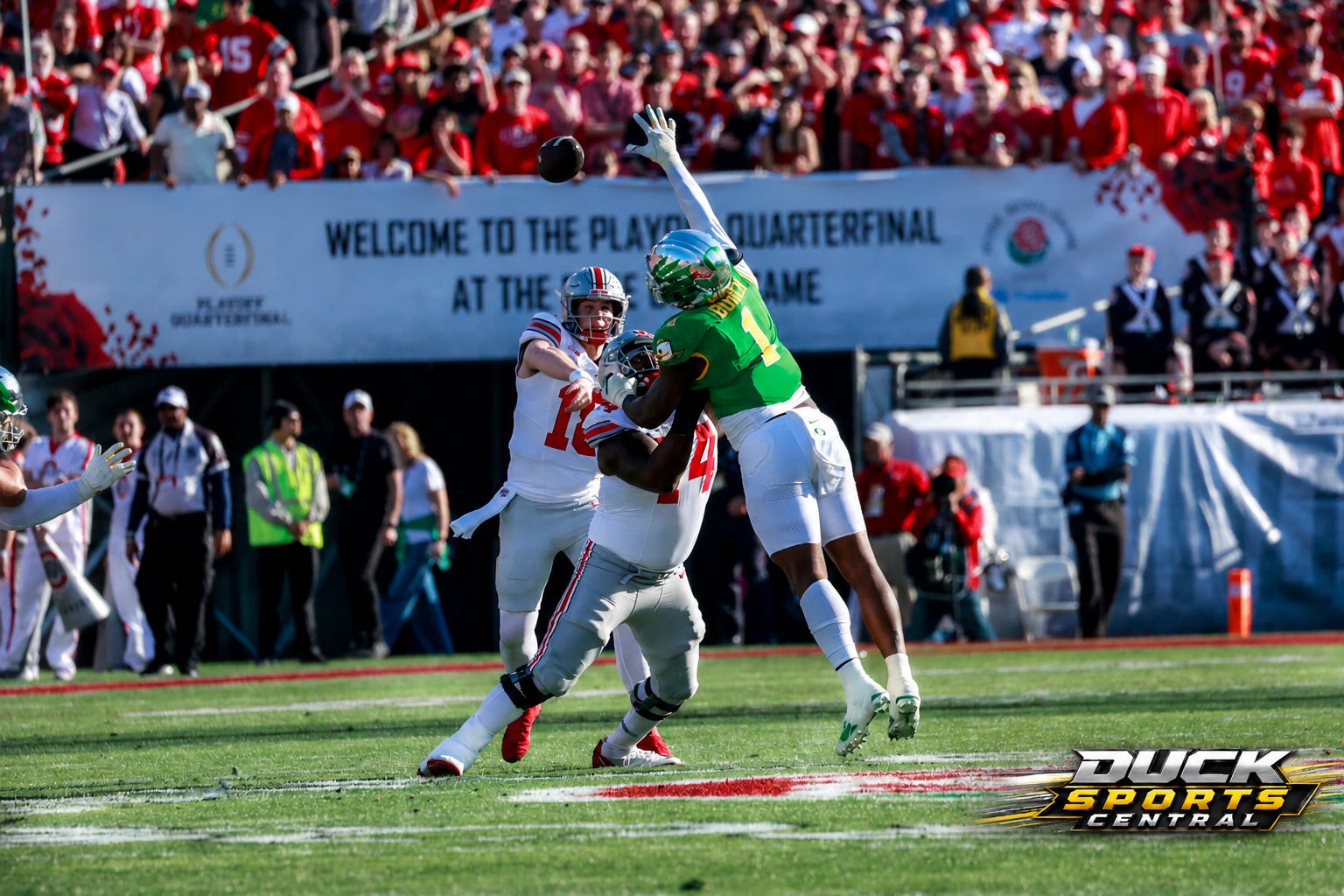
With Julian Sayin sidelined, the Buckeyes must find another way to unleash Jeremiah Smith while leaning on an improving ground game and a defense that remains among the Big Ten’s most difficult to move the ball against.
There are few programs in college football capable of losing a quarterback with Julian Sayin’s production and still putting an offense on the field with as much talent as Ohio State possesses. Unfortunately for Oregon, the Buckeyes are one of them.
Saturday’s meeting in Columbus will feature two teams whose seasons have taken unexpected turns. Both entered the fall with legitimate national championship ambitions, both have experienced significant disappointment and both will be playing without the quarterbacks they expected to lead them through November.
For Ohio State, Sayin’s absence removes the player responsible for much of an offense that has averaged 474.8 yards and 36.6 points per game. His 2,007 passing yards and 19 touchdowns helped establish the Buckeyes as one of the nation’s most explosive offenses before an injury forced freshman Luke Fahey into a starting role.
The results were encouraging in some respects during last weekend’s 30-18 loss to USC, but the Buckeyes struggled to translate their considerable statistical advantages into touchdowns. Ohio State accumulated 464 yards, controlled possession for nearly 40 minutes and reached the red zone four times, yet scored only one touchdown.
That is the opportunity Oregon must recognize. The Buckeyes remain enormously talented, particularly at the skill positions, but the offense that arrives Saturday will not be quite the same one that produced those impressive season averages.
Defensively, however, Ohio State remains formidable. Opponents are averaging just 273.5 yards and 15.5 points per game, and the Buckeyes have surrendered only four passing touchdowns through eight games. Even without an overwhelming pass rush, they have consistently made opposing offenses work for everything they get.
For Oregon, understanding the individuals behind those numbers is the first step toward understanding what it will take to leave Columbus with a victory.
QB Luke Fahey: The freshman suddenly holding Ohio State’s season
2026 statistics: 30-of-51 passing (58.8%), 463 yards, three touchdowns, two interceptions; 10 carries for 13 yards
PFF grade: 62.8
There is a substantial difference between being the backup quarterback at Ohio State and suddenly being asked to preserve the Buckeyes’ championship aspirations. Fahey is discovering that difference at precisely the moment Oregon arrives in Columbus.
The former three-star prospect from Southern California has appeared in five games this season, but his first career start came last Saturday against USC. He completed 21 of 38 passes for 260 yards and a touchdown without throwing an interception, although the Buckeyes fell behind early and never fully recovered.
Those numbers require some context. Ohio State asked Fahey to throw 38 passes, the most attempted by the team in any game this season, despite the presence of one of the Big Ten’s better running backs. His completion percentage was just 55.3%, and his 6.8 yards per attempt represented a considerable drop from Ohio State’s season average of 10.1.
Still, the performance was hardly a disaster. Fahey operated an offense that gained 464 yards and converted seven third downs, and he showed enough composure to direct a lengthy fourth-quarter touchdown drive.
The larger question is how much of Ohio State’s offense Ryan Day is comfortable putting on his shoulders.
Fahey does not offer the same proven ability to attack defenses vertically that Sayin provided, although his decisiveness and willingness to deliver the football on schedule remain important strengths. His 62.8 PFF grade also reflects the uneven play expected from an inexperienced quarterback suddenly facing a much higher level of competition.
Oregon defensive coordinator Chris Hampton has an opportunity to complicate that transition. The Ducks have improved substantially in the secondary, and their ability to disguise coverage while generating pressure could force Fahey to process more information than he faced in his first start.
The challenge is doing so without leaving Jeremiah Smith isolated against a single defender. Oregon cannot become so focused on confusing the freshman quarterback that it forgets who is catching his passes.
RB Bo Jackson: The player Ohio State may need most
2026 statistics: 128 carries, 637 yards, four touchdowns; 13 receptions, 103 yards, one touchdown
PFF grade: 80.1
Considering the extraordinary expectations surrounding Ohio State’s offense, Jackson’s sophomore season has been relatively quiet. After rushing for more than 1,000 yards as a freshman, he entered 2026 expected to become one of the nation’s premier running backs.
He has not quite reached that level statistically, but his recent performances suggest the Buckeyes may be finding the version of Jackson they anticipated.
The sophomore has produced two 100-yard performances in his last three games, including a career-high 121 yards on 21 carries against USC. His 5.8 yards per attempt in that contest were particularly impressive considering the Trojans knew Ohio State was operating with an inexperienced quarterback.
Jackson is a powerful runner with the vision and patience to exploit defensive overpursuit. At approximately five yards per carry for the season, his production has been steady rather than spectacular, but his ability to find cutback lanes makes him dangerous against aggressive defensive fronts.
His 80.1 PFF grade suggests a player whose individual performance has been better than the raw rushing totals might indicate.
The significance for Oregon is obvious. If Jackson can consistently generate four or five yards on early downs, Ohio State can keep Fahey out of obvious passing situations and create favorable opportunities for Smith through play-action.
The Buckeyes also have another emerging option in Isaiah West, who rushed for a career-high 65 yards on 13 carries against USC. With Ja’Kobi Jackson recovering from foot surgery, West has become increasingly important to the offensive rotation.
Together, Bo Jackson and West generated 186 rushing yards against the Trojans, helping Ohio State finish with 204 yards on the ground. That kind of production would create significant problems for an Oregon defense that must already devote considerable resources to limiting Smith.
For Hampton, stopping Jackson is about more than winning the rushing battle. It is about preventing Ohio State from establishing the kind of offensive balance that makes defending its extraordinary receiving talent almost impossible.
WR Jeremiah Smith: The most dangerous player on the field
2026 statistics: 62 receptions, 1,067 yards, 13 touchdowns
PFF grade: 93.0
There is no reason to complicate the evaluation of Jeremiah Smith. He is the best player on Ohio State’s roster, arguably the best player in college football and the single greatest individual challenge Oregon will face Saturday.
The Ducks already know what happens when an opponent fails to account for his extraordinary talent.
Smith was nearly unstoppable in Ohio State’s Rose Bowl victory over Oregon following the 2024 season, catching seven passes for 187 yards and two touchdowns. His combination of size, speed, body control and physicality overwhelmed an Oregon secondary that had played reasonably well against most opponents that season.
Two years later, Smith is an even more accomplished receiver.
His 1,067 receiving yards and 13 touchdowns in seven games represent staggering production, particularly considering how opponents approach defending him. He averages 17.2 yards per reception and has already produced multiple 200-yard performances this season.
The advanced numbers offer an even clearer picture of his importance.
According to CollegeFootballData-derived usage tracking, Smith has commanded approximately 35% of Ohio State’s targets this season. That is an extraordinary concentration of offensive opportunities for a program with so much former blue-chip talent at the other receiving positions.
He has also accounted for roughly one-third of the team’s red-zone targets, demonstrating that his value extends beyond explosive plays between the 20-yard lines.
Perhaps the most remarkable aspect of Smith’s production is that defenses know where the football is going, yet frequently cannot prevent him from making the play.
That has become particularly important with Fahey under center.
Against USC, Smith caught 10 passes for 83 yards and a touchdown. The 8.3-yard average was dramatically below his season production, but the volume of receptions demonstrated Ohio State’s determination to keep its best player involved.
The absence of Sayin may reduce Smith’s opportunities to generate explosive plays downfield, but it could actually increase the emphasis on getting him the ball quickly through shorter routes, screens and designed touches.
Oregon’s secondary is considerably different from the group that struggled against Smith in Pasadena. Players such as Ify Obidegwu, Aaron Scott Jr., Na’eem Offord and Davon Benjamin give Hampton more flexibility in coverage and a greater collection of athletes capable of competing against elite receivers.
But improved personnel does not eliminate the problem.
Smith is capable of defeating quality coverage, winning contested catches and turning routine completions into substantial gains. Assigning one defender to him throughout Saturday’s game would be a dangerous proposition, regardless of that player’s individual talent.
The Ducks must also account for the opportunities created elsewhere when additional defenders shade toward Smith.
Senior Devin McCuin has emerged as Ohio State’s second-most frequently targeted receiving option, while former five-star prospect Chris Henry Jr. provides another talented weapon capable of exploiting favorable matchups. Brandon Inniss also remains part of a receiving group that is deeper than its production might suggest.
There is no realistic expectation that Oregon will eliminate Smith from the offense. The objective must be to limit explosive plays, tackle immediately after receptions and force Fahey to manufacture sustained drives rather than relying on his extraordinary receiver to produce instant offense.
That may be the most important defensive assignment of Oregon’s season.
DE Kenyatta Jackson Jr.: The veteran leading an unusual pass rush
2026 statistics: 26 tackles, 5.5 tackles for loss, three sacks, two forced fumbles
PFF grade: 72.0
Ohio State’s defensive production presents an interesting contradiction.
The Buckeyes have been among the Big Ten’s most effective teams at limiting yardage and scoring, but they have struggled to generate sacks. Through eight games, Ohio State has recorded just 11, an unusually modest total for a program accustomed to featuring elite defensive linemen.
Jackson has been the most productive member of that pass rush.
The 6-foot-6, 263-pound fifth-year senior leads the team with three sacks and has added two forced fumbles. His experience and length make him a difficult matchup for offensive tackles, particularly when he is able to establish leverage and disrupt the quarterback’s intended throwing lane.
Jackson recorded 11 tackles for loss and 6.5 sacks last season, giving Ohio State a proven veteran to build around following significant departures along the defensive line.
His production this season has been respectable, although not enough to compensate completely for the loss of the disruptive players who previously defined Ohio State’s defensive front.
For Oregon, this is an important distinction.
The Buckeyes may not generate a large number of sacks, but that does not necessarily mean opposing quarterbacks are operating comfortably. Ohio State’s defense has been effective at limiting completions, reducing explosive plays and forcing offenses to work through extended possessions.
Jackson remains capable of changing an individual series with a pressure, tackle for loss or forced fumble.
Oregon’s offensive line has shown improvement in recent weeks, particularly as the Ducks have developed more consistency with their interior combinations. Saturday represents another opportunity to demonstrate that improvement against one of the nation’s most talented defensive rosters.
Keeping Jackson from disrupting the pocket will be important, but Oregon must also avoid allowing the Buckeyes’ overall defensive structure to turn every possession into a lengthy struggle.
S Jaylen McClain: The playmaker in Ohio State’s secondary
2026 statistics: 37 tackles, one sack, two interceptions, four pass breakups, one forced fumble
PFF grade: 77.0
McClain might not receive the national attention reserved for Ohio State’s offensive stars, but he has become one of the most important players on a defense that has surrendered only four touchdown passes this season.
The junior safety combines reliable tackling with the instincts necessary to create turnovers. His two interceptions and forced fumble demonstrate his ability to change possessions, while his presence in the secondary gives Ohio State considerable flexibility in how it approaches opposing passing attacks.
McClain is particularly valuable because of his ability to contribute against both the run and pass. He can close quickly on underneath completions, support the defense near the line of scrimmage and recognize opportunities to attack the football when quarterbacks become careless.
His 77.0 PFF grade reflects a productive season for a player increasingly viewed as an NFL prospect.
Alongside Earl Little Jr., Ohio State has formed one of the stronger safety combinations in the Big Ten. Little has been among the team’s leading tacklers and provides another experienced defender capable of limiting yards after the catch.
That matters against an Oregon offense attempting to find greater consistency with Dylan Raiola.
The Ducks have enough talented receivers and tight ends to challenge Ohio State’s coverage, but explosive plays may be more difficult to generate than they were against Northwestern. McClain and Little are effective at keeping plays in front of them, and the Buckeyes’ overall pass defense has held opponents to just 53.8% completions and 5.6 yards per attempt.
For Raiola, patience will be important. Ohio State’s secondary has consistently punished offenses that become frustrated and try to force throws into unfavorable coverage.
McClain is precisely the kind of defender capable of turning one of those mistakes into a decisive turnover.
LB Riley Pettijohn: An emerging problem in the middle
2026 statistics: 24 tackles, two sacks, one interception
Pettijohn deserves more attention than his relatively modest tackle total might suggest.
The sophomore linebacker has become one of Ohio State’s most disruptive second-level defenders, recording two sacks and an interception while contributing to a defense that has allowed opponents just 95.8 rushing yards per game.
His athleticism provides Ohio State with flexibility against offenses that attempt to create mismatches in space. He can pursue running plays laterally, contribute to pressure packages and drop into coverage without forcing the Buckeyes to make substantial personnel changes.
That versatility becomes particularly important against an Oregon offense that has used multiple running backs and increasingly relied on quick throws and intermediate passing concepts to keep defenses from overwhelming Raiola.
Pettijohn is the type of linebacker capable of disrupting those concepts before they develop.
For the Ducks, the challenge will be keeping him from becoming a free defender who can attack downhill without consequence. Effective blocking at the second level and properly timed throws into vacated areas could help Oregon neutralize some of that athleticism.
LB Payton Pierce: The physical presence behind Ohio State’s defensive front
Pierce is another important part of the Buckeyes’ defensive structure, particularly because of his role in controlling the interior running game.
He led Ohio State with six tackles against USC and has demonstrated the kind of physicality necessary to prevent opposing offenses from establishing an easy rhythm between the tackles.
Unlike some of Ohio State’s more celebrated defenders, Pierce’s importance is not necessarily reflected in individual splash plays. His ability to diagnose runs, maintain positioning and finish tackles helps create favorable situations for the rest of the defense.
That is worth remembering when considering Ohio State’s defensive statistics.
The Buckeyes have allowed fewer than 100 rushing yards per game despite relatively limited sack production. Their effectiveness is built on disciplined positioning, strong tackling and an ability to prevent opposing offenses from consistently reaching favorable down-and-distance situations.
For Oregon’s running backs, the challenge will be creating opportunities beyond the line of scrimmage against defenders who rarely make the same mistakes twice.
The War Room assessment: Talent remains, but the formula has changed
Ohio State is not the same team it was before losing Julian Sayin, and Oregon would be making a mistake to approach Saturday as though nothing has changed.
The Buckeyes still possess one of the nation’s most dangerous receiving threats, a talented running back capable of controlling a game and a defense that has consistently limited opposing offenses. But the transition to Fahey creates an entirely different set of questions about how Ohio State will attempt to attack Oregon.
The most obvious adjustment would be greater emphasis on Bo Jackson and the running game, particularly early in the contest. Establishing manageable situations would allow Fahey to operate within a more controlled passing structure and reduce the number of plays in which he must make difficult decisions against disguised coverage.
That would also create opportunities to use Smith more selectively downfield.
Oregon’s objective should be to prevent that progression from developing. If the Ducks can limit Jackson on early downs, put Fahey into obvious passing situations and prevent Smith from generating explosive plays, they can force Ohio State to operate outside its preferred comfort zone.
On the other side of the football, the challenge is less about one individual and more about the collective discipline of Ohio State’s defense.
The Buckeyes have allowed just 4.5 yards per play and have held opponents to an average of 177.8 passing yards. Those are impressive numbers regardless of the relative weakness of the pass rush, and they illustrate how difficult it has been for opponents to manufacture consistent production.
For Raiola, Saturday will require considerably more than a handful of impressive throws. Oregon must protect the football, create manageable third downs and find opportunities to generate explosive plays without becoming reckless against a secondary that has consistently prevented them.
The matchup may ultimately come down to which team can best protect its inexperienced quarterback while allowing the talent around him to determine the outcome.
Ohio State has the more accomplished individual offensive weapon in Smith, and the Buckeyes’ season-long defensive production suggests they will be difficult to score against. But Oregon has advantages of its own, particularly in a defensive backfield that is more athletic and more experienced than the one Smith overwhelmed in the Rose Bowl.
The Ducks also have an opportunity to exploit an Ohio State offense still adjusting to a quarterback it never expected to be starting in November.
In a matchup between two programs still fighting to preserve their postseason ambitions, that adjustment could be the difference between another disappointing Saturday and a victory that changes the trajectory of Oregon’s season.