


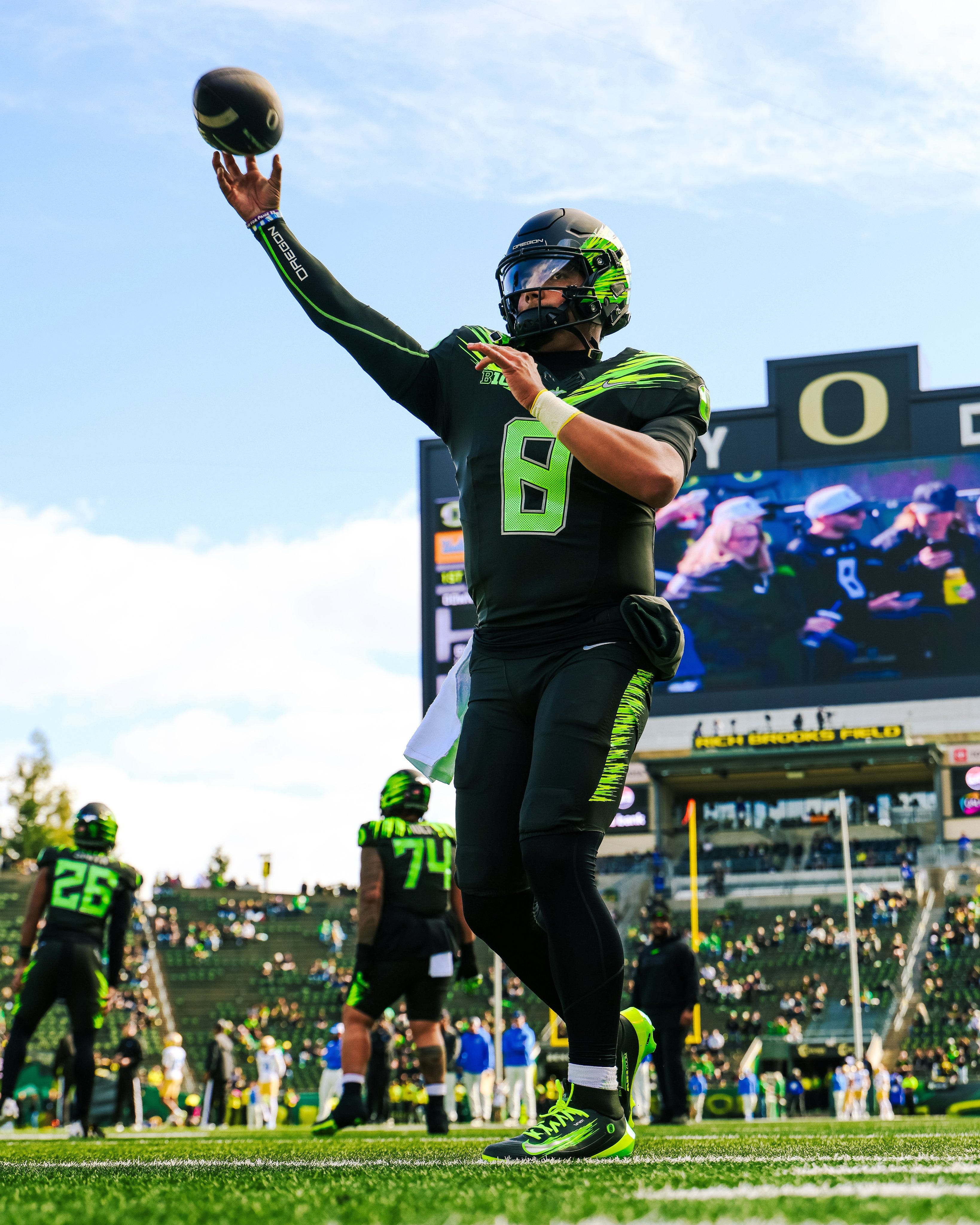
EUGENE, Ore. (AP) — Wayne Knight rushed for 103 yards and a touchdown and added a receiving score as UCLA stunned Oregon 17-15 on Saturday at Autzen Stadium, capitalizing on seven Ducks turnovers and a disjointed offensive performance to hand Dan Lanning’s team a damaging home defeat.
Oregon nearly rescued itself with a fourth-quarter rally behind backup quarterback Brock Thomas, who replaced struggling starter Dylan Raiola and threw a 44-yard touchdown pass to Evan Stewart with 2:16 remaining. But the Ducks failed on the ensuing 2-point conversion, leaving UCLA with a two-point advantage it would protect through one final Oregon possession.
The loss came after a bye week in which much of Oregon’s attention centered on the absence of starting quarterback Dante Moore, who was unavailable following the hit he absorbed against USC two weeks earlier. Raiola, making his first start for the Ducks against a UCLA team coached by Bob Chesney, completed just 6 of 19 passes for 43 yards and two interceptions before giving way to Thomas in the fourth quarter.
Thomas provided the spark Oregon had been missing, completing 11 of 15 passes for 126 yards and a touchdown. His late production, however, could not overcome an offense that failed to sustain drives, repeatedly squandered scoring opportunities and finished just 1 of 12 on third-down conversions.
For UCLA, the victory was built as much on its defense as its rushing attack. The Bruins forced five fumbles and intercepted two passes, limiting Oregon to 56 yards in the first half and repeatedly turning away a Ducks offense that struggled to establish any consistency despite favorable field position and several opportunities created by its defense.
UCLA linebacker J. Woods finished with nine tackles, including two for loss, while the Bruins recorded seven tackles for loss and recovered all five Oregon fumbles. The performance was particularly notable for a defense that entered the contest with questions of its own, but controlled the line of scrimmage for much of the afternoon.
The Bruins finished with 345 yards of total offense, including 140 rushing yards, while controlling possession for more than 39 minutes. Oregon’s defense kept the Ducks within striking distance for much of the game, but the repeated turnovers and inability to sustain possessions ultimately proved too much to overcome.
Knight provided the offensive production UCLA needed, carrying 22 times for 103 yards and scoring on a 35-yard run with 8:08 remaining in the second quarter. His 9-yard touchdown reception from backup quarterback Ty Dieffenbach early in the fourth quarter extended the Bruins’ lead to 17-6 and appeared to put the game beyond Oregon’s reach.
Dieffenbach, who replaced Nico Iamaleava in the second half, completed 3 of 6 passes for 43 yards and the touchdown. Iamaleava threw for 162 yards but was intercepted twice, giving Oregon opportunities to overcome its offensive struggles.
The Ducks initially appeared capable of handling UCLA’s highly regarded rushing attack. The Bruins entered averaging 281.5 rushing yards per game, fourth nationally, but Oregon limited them to 79 yards on the ground in the opening half and 140 for the game.
A’ M auri Washington helped anchor the defensive effort, finishing with five tackles and two pass breakups, while Matayo Uiagalelei recorded two sacks and blocked a second-quarter field goal attempt. Koi Perich led Oregon with 11 tackles and intercepted a pass in the end zone late in the first half, while Jerry Mixon added eight tackles and another interception.
Those performances kept Oregon alive despite an offense that rarely rewarded the defense’s work.
UCLA opened the game with a 62-yard completion from Iamaleava to A. Mizell on its first offensive snap, but Oregon recovered defensively and held the Bruins to a short field goal. The Ducks then took a 6-3 lead when Iamaleava fumbled deep in UCLA territory and Jordon Davison scored on a 1-yard run. Oregon failed on the ensuing 2-point attempt.
That would be the Ducks’ only touchdown until the final minutes of the fourth quarter.
Oregon had another promising opportunity early in the second quarter when Davison took a direct snap in a wildcat formation and broke a 21-yard run to the UCLA 13. But the Ducks returned to the formation on the next play, and Davison fumbled away the possession.
Raiola later lost a fumble while scrambling, and his first interception came after Mixon’s takeaway had given Oregon another chance to generate points before halftime. The Ducks entered the locker room trailing 10-6 despite forcing three turnovers of their own.
The statistical disparity was striking. UCLA outgained Oregon 241-56 in the first half, held a 10-3 advantage in first downs and limited the Ducks to just 20 net rushing yards. Oregon failed to convert any of its seven third-down opportunities before halftime, allowing the Bruins to dictate field position and tempo.
The pattern continued after the break.
Oregon opened the third quarter with another three-and-out before briefly finding some success with a more conventional rushing approach. But a completion to Dakorien Moore ended in another fumble, giving UCLA possession at the Oregon 33.
The Ducks defense answered with a fourth-down stop at its own 3-yard line, only to watch Raiola throw another interception two plays later. UCLA eventually turned the short field into Dieffenbach’s touchdown pass to Knight, building an 11-point lead against an Oregon offense that had shown little ability to overcome even a modest deficit.
The frustration inside Autzen Stadium became increasingly apparent. Boos accompanied the offensive struggles in the first half, and by the end of the third quarter UCLA players were participating in Oregon’s traditional “Shout” celebration while the Ducks gathered quietly along their sideline.
Thomas finally gave Oregon a chance to change the narrative.
After replacing Raiola, Thomas helped move the Ducks into scoring position with a 36-yard completion to Moore, aided by UCLA penalties. Oregon settled for a field goal, cutting the deficit to 17-9 and keeping the possibility of a late comeback alive.
The Ducks defense then forced another punt, giving Thomas the ball at his own 43 with just over three minutes remaining. After moving into UCLA territory, Thomas connected with Stewart over the middle, and the receiver broke through multiple defenders on a 44-yard touchdown that brought Oregon within 17-15.
A UCLA facemask penalty on the conversion attempt moved the ball to the 1-yard line, but the Bruins stuffed Oregon’s run up the middle, preserving their advantage with 2:16 remaining.
Oregon’s defense provided one final opportunity, forcing a UCLA punt that left the Ducks at their own 5-yard line with 48 seconds remaining and no timeouts.
Thomas moved Oregon to its own 37, where a deep pass to a breaking-open Moore fell just beyond the receiver’s reach with 10 seconds remaining. After another incompletion, the Ducks’ final desperation attempt failed as time expired.
Stewart finished with five receptions for 74 yards and the touchdown, while Moore caught four passes for 77 yards. Dierre Hill Jr. led Oregon’s ground attack with 44 yards on 10 carries, and Davison added 41 yards and the Ducks’ first touchdown.
For Oregon, the defeat raised questions extending well beyond the absence of its starting quarterback. The Ducks struggled to protect Raiola, failed to establish a consistent rushing attack and committed the kind of mistakes that made even a strong defensive performance insufficient.
UCLA, meanwhile, did not need an overwhelming offensive performance to secure the upset. Chesney’s Bruins capitalized on Oregon’s mistakes, controlled possession, protected their lead when it mattered most and delivered the defensive stop that ultimately decided the game.
What began as an opportunity for Oregon to demonstrate its progress coming out of a bye week instead became a reminder of how quickly a season can change when turnovers and offensive inconsistency overwhelm a team’s other strengths.
Player of the Game: Wayne Knight, UCLA RB
Knight provided the most consistent offensive production in a game otherwise defined by defensive stops and turnovers. He rushed for 103 yards on 22 carries, scored on a 35-yard second-quarter run that gave UCLA the lead and caught the 9-yard touchdown pass that extended the Bruins’ advantage to 17-6 early in the fourth quarter. His ability to produce against an Oregon defense that otherwise held UCLA well below its season rushing average made him the difference-maker in the upset.
Key Play: UCLA Stops Oregon’s Late 2-Point Conversion
After Thomas connected with Stewart for a 44-yard touchdown with 2:16 remaining, a UCLA facemask penalty moved Oregon’s conversion attempt to the 1-yard line. The Bruins stuffed the ensuing run up the middle, protecting their 17-15 lead. Oregon’s defense managed to get the ball back one final time, but the failed conversion left the Ducks needing another score rather than merely protecting a tie. It was the decisive defensive stand in a game filled with them.
Key Stat: Seven Oregon Turnovers
Oregon committed seven turnovers, losing five fumbles and throwing two interceptions, while UCLA turned the mistakes into 14 points. The Ducks’ defense intercepted two passes and recovered a fumble of its own, but that effort could not overcome an offense that repeatedly gave away possession. Oregon finished with just one third-down conversion in 12 attempts, further magnifying the damage from a turnover margin that ultimately defined the outcome.