


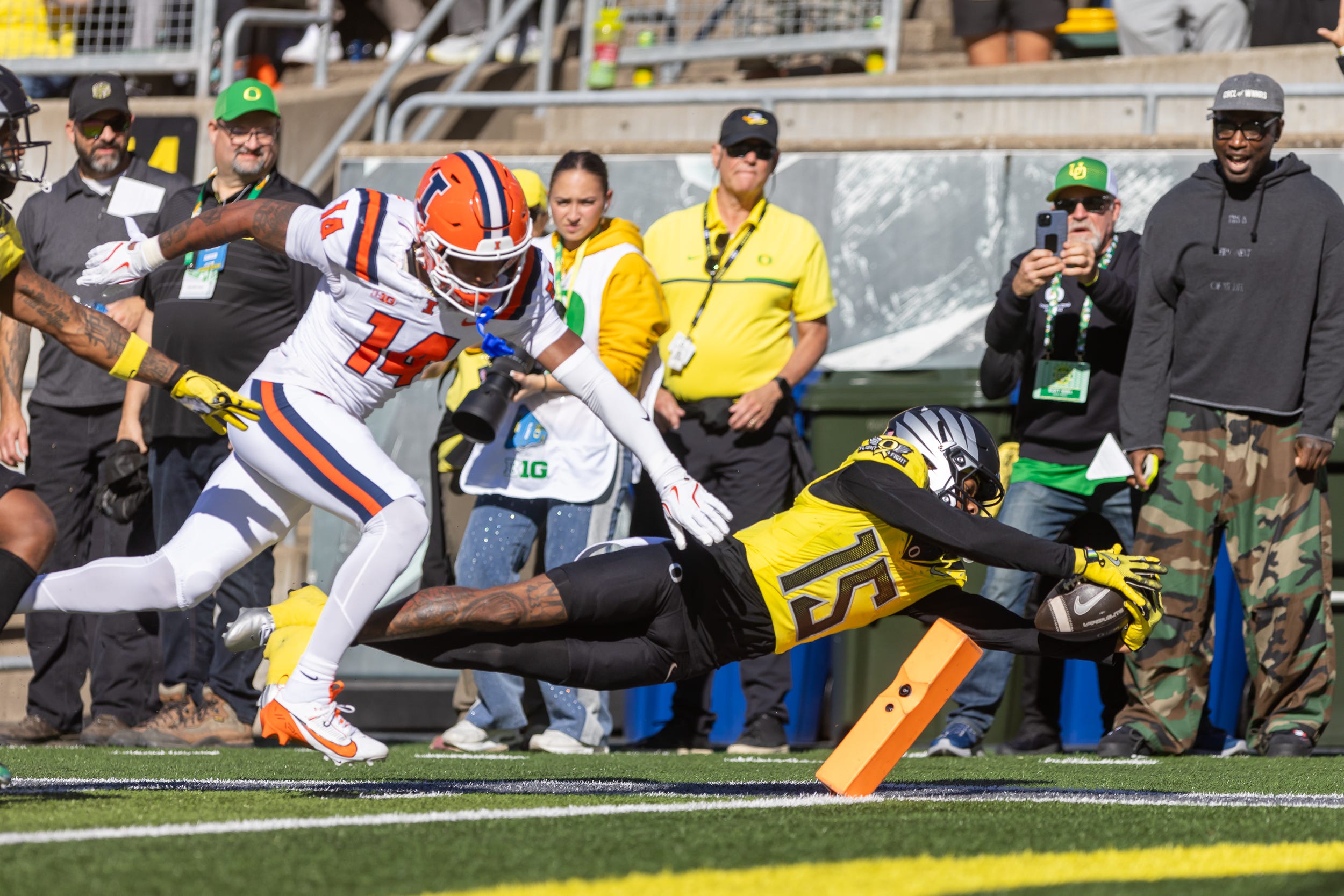
Oregon heads to Champaign with renewed confidence after its comeback against Nebraska, but a rested Illinois team presents a different challenge. A freshman quarterback with an impressive arm, one of the Big Ten’s most productive receivers and a defense looking for answers make this a matchup that deserves a closer examination.
There are moments during a football season when a victory does more than improve a team’s record. Oregon’s comeback against Nebraska last Saturday felt like one of those moments, particularly for a team that had spent the previous week answering questions about its offense, its quarterback situation and whether the season was beginning to drift away from its preseason expectations.
The Ducks responded when they needed to, and now Dan Lanning’s team takes a 4-2 record into Champaign, Illinois, for a Saturday afternoon meeting with a Fighting Illini program that has become considerably more difficult to dismiss under Bret Bielema.
Illinois is 3-3 overall and 1-2 in Big Ten play, although its record tells only part of the story. The Illini have beaten UAB, Southern Illinois and Michigan State while suffering losses to Duke, Ohio State and Purdue. Their most recent appearance was a 38-37 overtime victory at Michigan State, a game that delivered both their first conference victory and a significant complication for the remainder of their season.
Starting quarterback Katin Houser fractured his throwing hand, leaving Illinois preparing to face Oregon with a true freshman likely making his first collegiate start. Yet the Illini have had an additional week to prepare, having enjoyed their scheduled bye while the Ducks were navigating an emotional comeback against Nebraska.
That combination creates an interesting tactical puzzle. Oregon has the better overall roster and the momentum of a significant victory, but Illinois has an experienced coaching staff, several legitimate offensive weapons and the opportunity to build a game plan around a quarterback the Ducks have barely seen.
Saturday’s matchup: Oregon at Illinois, October 24, noon Pacific, Big Ten Network, Gies Memorial Stadium.
Inside the Illinois offense: A new quarterback, familiar weapons
The temptation when evaluating Illinois is to begin and end with the quarterback situation. Houser had thrown for 1,440 yards and 12 touchdowns before his injury, giving the Illini a reasonably productive passing offense capable of moving the football against Big Ten competition.
His absence certainly matters, but the pieces around his replacement are considerably more established than the quarterback himself.
Michael Clayton II: QB
2026 production
6-of-8 passing, 88 yards, 2 TDs
6-foot-4, approximately 210 pounds
True freshman
Clayton’s introduction to meaningful college football was hardly ordinary. Entering against Michigan State after Houser’s injury, the freshman completed six of eight passes for 88 yards and two touchdowns, including a 25-yard scoring strike to Hudson Clement on the first play of overtime.
The performance was particularly interesting because Clayton wasn’t necessarily the obvious next man in line. Carson Boyd was another option in the quarterback room, but Clayton received the opportunity and demonstrated why Illinois believes it has something worth developing.
Bielema has spoken highly of Clayton’s arm strength, and that matters because the challenge for Oregon isn’t simply dealing with an inexperienced quarterback. It’s dealing with an inexperienced quarterback who has enough physical ability to punish an aggressive defense if its coverage responsibilities break down.
The sample size remains extraordinarily small. Eight passes cannot establish how Clayton responds to disguised coverage, pressure packages or the responsibility of making adjustments before the snap. Oregon’s defensive staff will undoubtedly examine his high school background alongside the limited Michigan State footage, but there are limits to what can be learned.
That creates the first important chess match of Saturday’s game. Oregon will want to force Clayton to process more information than he has been required to handle, particularly on third down. Illinois will want to reduce that burden with efficient early-down rushing, manageable passing situations and predetermined opportunities for its experienced receivers.
There is also a danger in becoming too aggressive. A quarterback with Clayton’s arm talent can turn one missed assignment into an explosive play, and Oregon must balance its desire to disrupt the freshman with the discipline necessary to prevent Illinois from finding easy answers.
Aidan Laughery: RB
2026 production
62 carries, 391 yards, 1 TD
6.3 yards per carry
8 receptions, 44 yards
If Illinois intends to make Clayton’s first start manageable, Laughery figures prominently in that plan.
The fifth-year senior has waited patiently for a substantial opportunity, and his production this season reflects a player who has made the most of it. His 6.3 yards per carry is especially noteworthy because it isn’t entirely the product of weaker nonconference competition.
Against Ohio State, Laughery rushed for 113 yards on only 11 attempts, demonstrating that he can create meaningful production even against talented defensive personnel. He also broke a 77-yard touchdown run against Southern Illinois, providing another reminder that Illinois doesn’t need a sustained series of successful rushing plays to generate an explosive result.
The loss of Ca’Lil Valentine to a season-ending injury has increased Laughery’s importance, with Javari Barrett and Jordan Anderson providing depth behind him.
For Oregon, the central question will be whether its defensive front can prevent Laughery from creating favorable second-down situations. A freshman quarterback facing second-and-4 is operating in a different environment from one facing second-and-9, particularly when Oregon can introduce pressure and coverage disguises without worrying as much about surrendering an immediate conversion on the ground.
Winning first down won’t guarantee Oregon controls the game, but losing it repeatedly could allow Illinois to dictate more of the afternoon than the talent comparison might suggest.
Collin Dixon: WR
2026 production
47 receptions, 608 yards, 9 TDs
12.9 yards per reception
6-foot-1, 215 pounds
Dixon might be the most important individual matchup on the field when Illinois possesses the football.
The senior enters Saturday with 47 receptions, 608 yards and nine touchdowns, putting him among the nation’s most productive receivers. His nine touchdown receptions rank third nationally, and he is already within one score of tying Illinois’ single-season school record.
Those numbers represent considerably more than a receiver accumulating touches in an offense that throws frequently. Dixon has developed into a reliable scoring threat, particularly in situations where Illinois needs someone to win an individual matchup rather than simply benefit from an uncovered area of the field.
His physical build allows Illinois to use him in multiple alignments, while his production suggests that defenses cannot simply assume coverage leverage will solve the problem. Against Purdue, he caught 10 passes for 116 yards and a touchdown, demonstrating his ability to remain involved even when the opponent knows where the football is likely headed.
For Oregon, the temptation will be to make Dixon the focal point of its secondary game plan. That is understandable, although completely dedicating coverage resources to one receiver can create opportunities elsewhere.
Hudson Clement has 27 catches for 404 yards and a touchdown, giving Clayton another experienced target. Clement also owns a reception streak extending across 33 consecutive games, and his overtime touchdown against Michigan State demonstrated that he can deliver in critical moments.
Oregon’s secondary will need to find a balance between denying Dixon favorable individual matchups and maintaining enough structural integrity to prevent Clement from becoming the beneficiary of excessive attention.
Inside the Illinois defense: Where the vulnerability begins
Illinois has several talented individual defenders, but its most concerning collective statistic is difficult to overlook.
The Illini have recorded only five sacks through six games, one of the lowest totals nationally. That lack of quarterback disruption represents a potentially significant weakness against an Oregon offense that has experienced considerable inconsistency while navigating its own quarterback transition.
A defense that struggles to generate pressure with its front four is often forced into an uncomfortable decision. It can devote additional defenders to the pass rush, exposing coverage behind them, or prioritize coverage and risk allowing the quarterback enough time to survey the field.
Neither option is particularly attractive against an offense with Oregon’s collection of skill-position talent.
Will Holmes: DE
Holmes has quickly become Illinois’ most disruptive pass rusher after transferring from Utah State. His traditional production of 15 tackles, two tackles for loss and one sack doesn’t immediately suggest a player capable of influencing a game, but his pressure totals tell a more complete story.
Illinois credits Holmes with 17 quarterback pressures, ranking seventh in the Big Ten, even as the defense around him has struggled to finish plays behind the line of scrimmage.
That distinction matters. Sacks represent completed disruption, while pressures often reveal how consistently a defender affects the quarterback’s timing. Holmes has been more productive at creating discomfort than his sack total would suggest, making him a player Oregon cannot afford to overlook simply because Illinois’ team-wide numbers are unimpressive.
The Ducks should examine where Holmes aligns and whether Illinois moves him to exploit particular blocking matchups. His effectiveness could also influence how often Oregon uses additional protection or a running back to assist its offensive tackles.
Still, the larger opportunity belongs to Oregon. If the offensive line can control Holmes without requiring substantial additional help, it should allow the Ducks to release more eligible receivers into routes and stretch a defense that has struggled to generate consistent pressure.
Matthew Bailey: S
Bailey is the kind of experienced defensive player whose significance can be difficult to capture through a single statistic.
The 6-foot-2, 225-pound senior has started throughout much of the previous three seasons and leads Illinois with 41 tackles. He also produced a career-high 14 tackles against Ohio State, illustrating just how involved he can become when opposing offenses consistently reach the second level.
His experience is equally important. Bailey is comfortable playing near the line of scrimmage and has developed into a more capable coverage defender, allowing Illinois to use him in different roles without necessarily telegraphing the defense’s intentions.
The potential vulnerability comes from that versatility. If Oregon can manipulate Bailey’s responsibilities with motion, formation changes and play-action, it may create opportunities behind him. Conversely, if the Ducks become predictable with their early-down tendencies, Bailey has the experience and physicality to anticipate where the football is headed.
Oregon’s offensive staff should treat his alignment as an important piece of pre-snap information rather than assuming every defensive look represents the same coverage or run-support responsibilities.
Juice Clarke deserves attention as well. The defensive back has six passes defended this season, providing Illinois with another player capable of affecting throws even when the pass rush fails to arrive.
The overlooked battle: Special teams and hidden yardage
Perhaps the most interesting statistical contrast in Illinois’ profile has little to do with its offense or defense.
The Illini rank third nationally in punt return average at 24.5 yards, with Mac Resetich accounting for 98 yards on four returns. That is a small sample, but it represents the kind of production that can change field position dramatically without requiring the offense to execute a conventional scoring drive.
Illinois has also punted only 10 times this season, an unusually low figure considering its 3-3 record. Punter Lars Rau has nevertheless shown an ability to place opponents deep in their own territory, with four of his previous six punts landing inside the 12-yard line.
Kicker Ethan Moczulski adds another dimension. He has converted 10 of 12 field goals, including two attempts beyond 50 yards, making Illinois relatively comfortable attempting points from distances that might force other teams into more aggressive fourth-down decisions.
This becomes particularly important in a game involving inexperienced quarterbacks. If either offense struggles to finish drives, the value of field position and reliable kicking increases considerably.
Oregon cannot afford the kind of special-teams mistake that turns a manageable field-position disadvantage into a short-field scoring opportunity.
The War Room: Three matchups that could decide Saturday
1. Oregon’s defensive front against Illinois’ early-down offense
The most obvious advantage Oregon possesses is the potential to make life extraordinarily difficult for a freshman quarterback. But that advantage only becomes meaningful if the Ducks prevent Illinois from establishing a comfortable offensive rhythm.
Laughery’s rushing production suggests Oregon cannot approach this matchup as a simple invitation to blitz. The Illini have enough ability in the backfield to punish undisciplined run fits, particularly if defenders become overly focused on attacking Clayton.
Oregon needs to control the interior, limit explosive runs and use the resulting passing situations to put additional decision-making pressure on Clayton. Players such as Matayo Uiagalelei and Teitum Tuioti become especially important because Oregon’s ability to generate disruption without sacrificing coverage numbers could define the afternoon.
The goal shouldn’t necessarily be to produce a succession of sacks. It should be to make Illinois uncomfortable operating on schedule, forcing Clayton to execute longer drives without the benefit of consistently favorable down-and-distance situations.
2. Oregon’s offensive patience against Illinois’ pass rush
Illinois’ five sacks represent one of the clearest statistical opportunities available to Oregon, but exploiting that weakness will require more than simply calling additional passing plays.
The Ducks have spent much of this season searching for consistency on offense, particularly during stretches when the running game hasn’t adequately complemented the passing attack. Nebraska offered some encouraging moments, although one comeback doesn’t erase every concern that preceded it.
Illinois presents an opportunity to develop that consistency against a defense that hasn’t consistently disrupted opposing quarterbacks.
If Dylan Raiola is again directing Oregon’s offense, the Ducks should have opportunities to create manageable throws while testing the Illini secondary with their receivers. Establishing the running game would also keep Bailey and the linebackers from settling into predictable coverage responsibilities.
The key is avoiding the temptation to force explosive plays simply because Illinois struggles to generate sacks. Oregon needs to make the Illini defend the entire field, sustain possessions and eventually create favorable individual matchups.
3. The turnover battle against Illinois’ discipline
Illinois has committed only four turnovers through six games and is among the nation’s least penalized teams. The Illini average just 4.2 penalties and 38.7 penalty yards per game, placing them near the top nationally in both categories.
That discipline deserves attention because it represents one of the more consistent characteristics of Bielema’s program.
Even when Illinois has struggled to match an opponent’s talent, it generally attempts to avoid making the situation worse through unnecessary mistakes. The problem for Oregon is that a disciplined opponent can remain competitive longer than expected if the Ducks are careless with possessions.
Illinois is also 18-1 over the last three seasons when forcing at least one turnover, a remarkable figure that reflects how effectively Bielema’s teams can capitalize on additional opportunities.
Oregon should be capable of winning this game without taking unnecessary risks. The most direct route is to make Illinois earn its points through sustained offensive execution while refusing to provide the short fields and sudden momentum swings that help an underdog stay within striking distance.
The final assessment: More dangerous than the record suggests
There is a difference between a team that lacks talent and one that hasn’t consistently converted its talent into victories. Illinois belongs much closer to the second category.
The Illini have a productive running back, an outstanding receiver, an experienced secondary leader and several specialists capable of influencing field position. Their quarterback situation introduces considerable uncertainty, but Clayton’s performance against Michigan State offers enough evidence to suggest that Oregon shouldn’t expect Illinois to abandon its passing game altogether.
The bye week also matters. Bielema has had time to reconsider how his offense functions without Houser, while Oregon has been occupied with one of the more emotionally demanding victories of its season.
Still, the fundamental matchup favors the Ducks.
Oregon should possess the better defensive front, greater overall athleticism and enough offensive firepower to challenge a defense that has struggled to create pressure. If the Ducks establish control early, Illinois may find itself asking a true freshman to solve a defensive puzzle considerably more complicated than anything he has encountered in college.
The danger is allowing Illinois to remain comfortable. A manageable rushing attack, two experienced receivers and a relatively disciplined team can keep a game close long enough for a single explosive play or special-teams mistake to change its direction.
Oregon’s comeback against Nebraska demonstrated that this team is capable of responding to adversity. Saturday presents a different kind of test, one that requires the Ducks to carry that resilience into a road environment without waiting for circumstances to become desperate.
The question isn’t whether Oregon can beat Illinois. The matchup strongly suggests it can.
The question is whether the Ducks can play with enough consistency to avoid needing another comeback to prove it.