


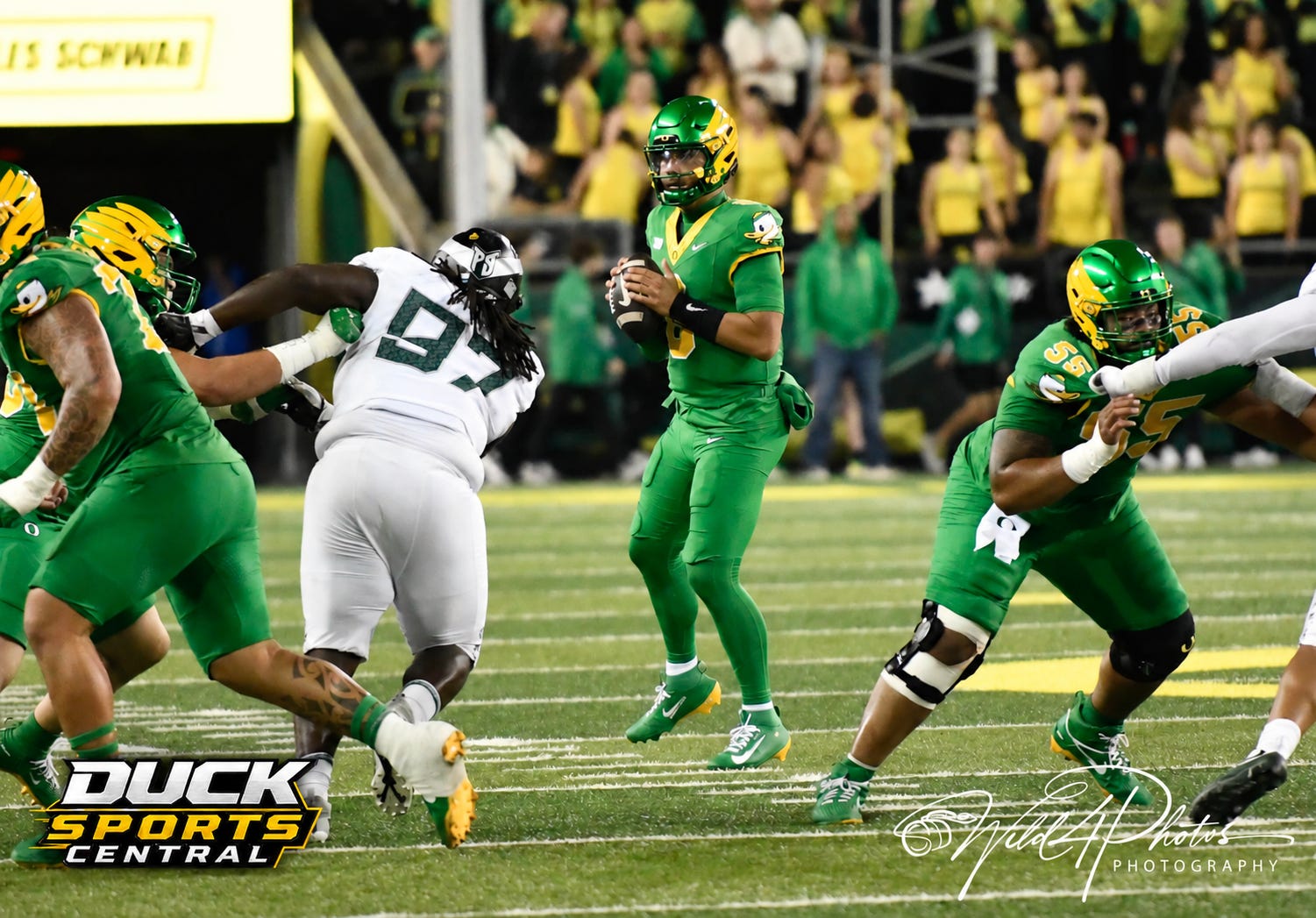
A good self-scout is not a progress report.
It is not supposed to tell a team what it has done well or reassure everyone that the mistakes can be fixed. A self-scout is supposed to identify the patterns that have become visible enough for somebody else to weaponize. It asks what an opponent would circle after four games of film, which personnel groupings have begun to tell a story before the snap and where Oregon’s strengths become less dangerous once the situation changes.
That distinction matters with this team because the four-game averages are impressive enough to hide quite a bit. Oregon is averaging 47.5 points and 505.5 yards, completing 71.7% of its passes without an interception and allowing opponents to convert only 21.2% of their third downs. The Ducks have scored on all 20 red-zone trips and turned 17 of them into touchdowns, while opponents have reached the end zone on only seven of 16 red-zone opportunities. University of Oregon Athletics
Those numbers are real, but Portland State is part of the sample. The more useful evaluation comes from Boise State, Oklahoma State and USC, where Oregon produced three dramatically different efficiency profiles. BCF Toys graded the Boise State game at a positive 0.84 net points per drive, the Oklahoma State loss at minus-1.15 and the USC win at plus-1.56. Net yards per play swung from plus-3.22 against Boise State to minus-3.20 at Oklahoma State and back to plus-1.35 at USC.
That variance is the first thing any opponent would notice.
Oregon’s problem through four games is not that it lacks a high level. The high level is obvious. The question is how easily an opponent can move the Ducks away from it.
Oregon is hardest to defend when the defense cannot identify what kind of snap is coming
The central offensive question is not whether Oregon wants to run or throw. It is whether the defense still has to defend both.
