


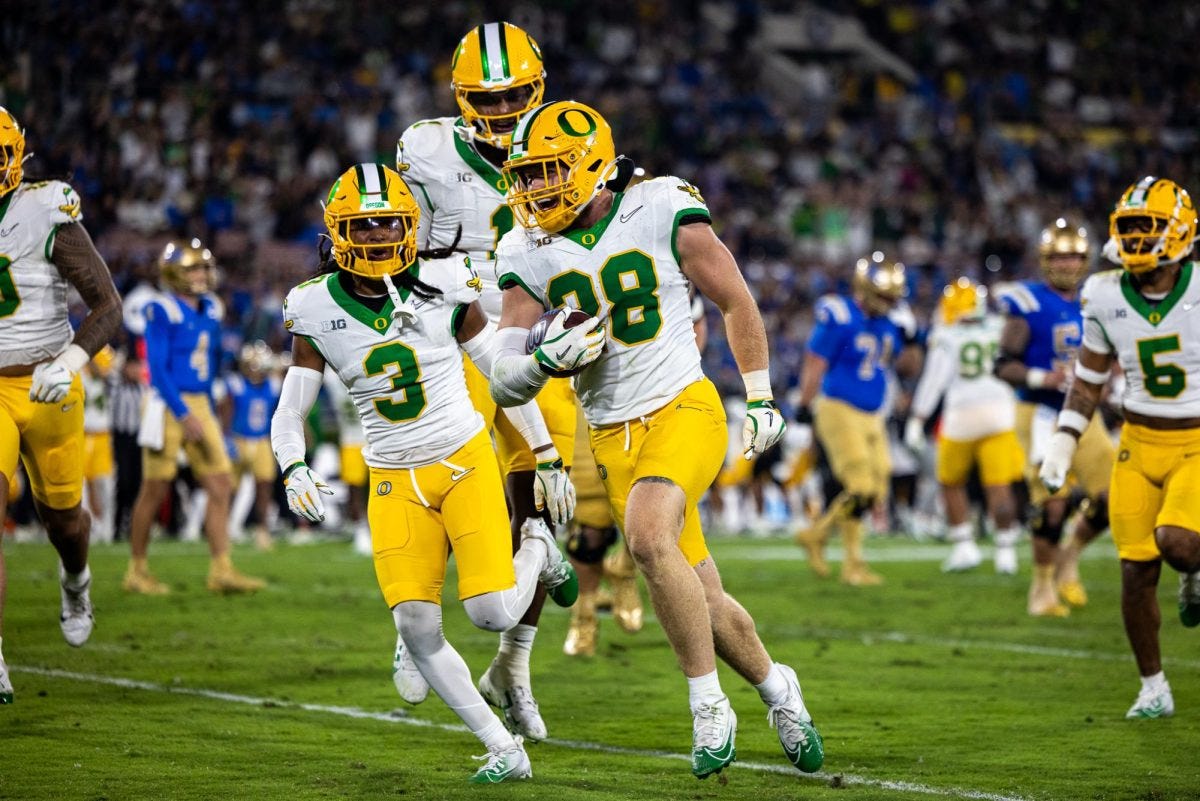
The Wednesday War Room gave us the outline of what Oregon is preparing to see Saturday. Wayne Knight is the centerpiece of one of the nation’s most productive rushing attacks, Nico Iamaleava gives Bob Chesney another runner defenses have to account for and UCLA’s defense has spent four games producing the negative plays and turnovers that make everything else considerably easier.
The Scouting Room is where we can go beyond that outline and start asking why those things have worked. Traditional statistics tell us UCLA runs for more than 280 yards per game, has already scored 18 rushing touchdowns and is allowing fewer than 20 points, but the deeper numbers allow us to separate what is actually driving those results from what may be more dependent upon opponents, game situations or a four-game sample filled with unusually valuable turnovers.
That distinction produces a fascinating matchup because UCLA’s rushing offense is not merely productive. By several measurements, it has been one of the most efficient units in college football, while the passing game has been far more ordinary. Oregon therefore should not confuse UCLA’s ability to present multiple offensive possibilities with the reality that one of those possibilities has carried considerably more value than all the others.
The UCLA defense presents almost the opposite question. The raw results have been excellent, particularly against the run and in generating turnovers, but the opponent-adjusted models are considerably less convinced that the Bruins have played elite defense. Oregon arrives with contradictions of its own, with predictive and possession-based systems seeing a top-10 team while some of the snap-by-snap data remains less convinced about the Ducks’ consistency.
That is what makes Saturday useful beyond the importance of simply winning another Big Ten game. Both teams have spent four weeks building statistical identities, and each is about to test the area where the other has looked most convincing.
