


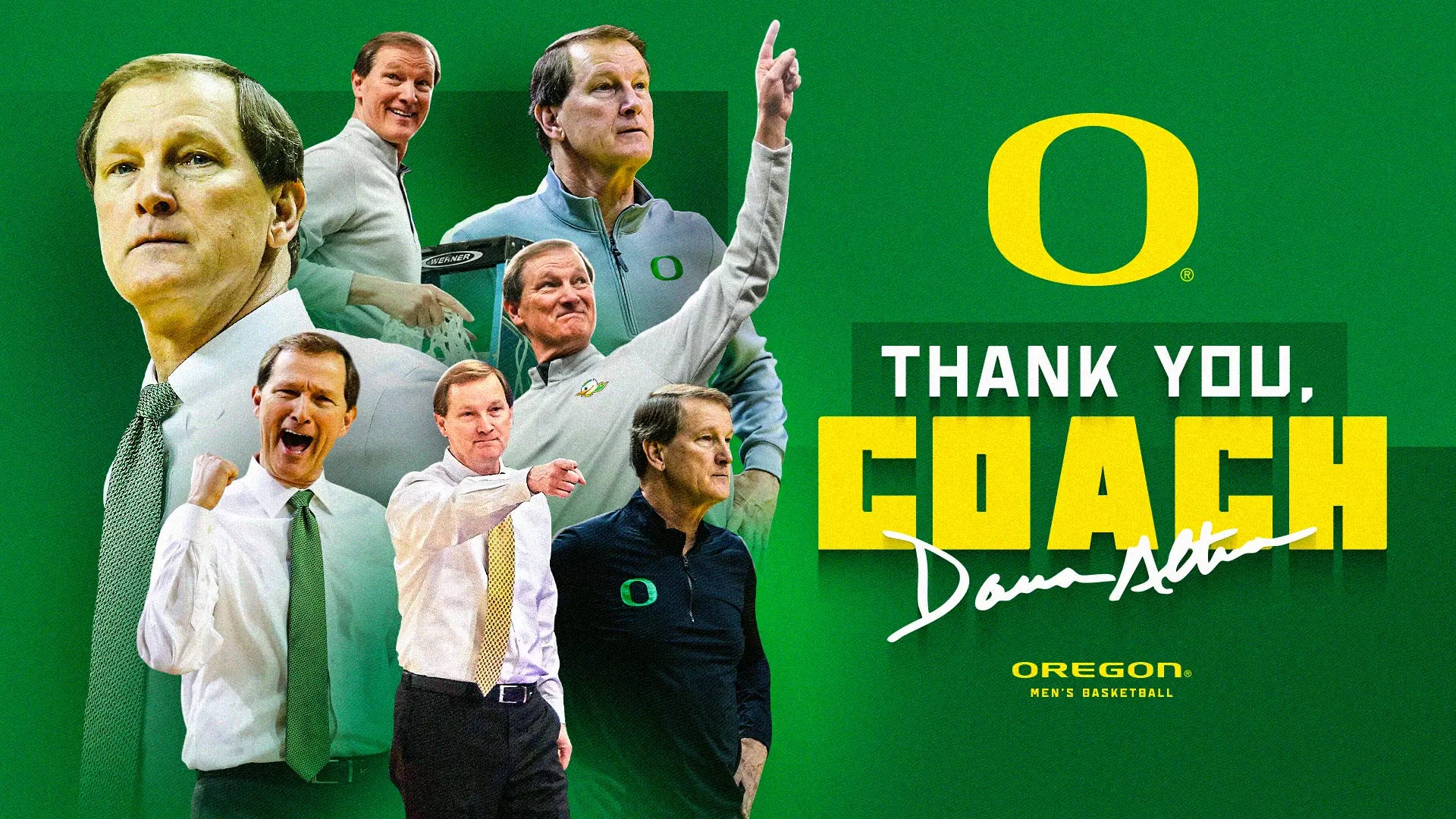
Dana Altman spent 16 years teaching Oregon basketball players to look in the mirror, evaluate themselves honestly and decide whether they were giving everything they had to the program. He demanded that accountability during good seasons and bad ones, through conference championships, NCAA Tournament runs and the inevitable disappointments that accompany a profession in which winning can never be guaranteed. On Wednesday afternoon, the most successful basketball coach in Oregon history explained that he had finally reached a moment when those expectations required something difficult of him.
“I always ask the players to look in the mirror and ask themselves if they’re giving everything they have to be their best,” Altman said, his voice breaking during an emotional retirement press conference. “And for us to be a good team, they have to look in that mirror and be their best. And I looked in the mirror, and I’d be a hypocrite if I lied to myself and said I was the best coach for the job.”
It was an extraordinary admission from a man whose 792 Division I victories, 382 wins at Oregon and 2017 Final Four appearance established him among the most accomplished coaches in the history of college basketball. Yet Altman was not interested in talking about what he had already accomplished as justification for remaining in a job he loved. He was focused instead on what he could still give the young men who had committed themselves to Oregon, and whether the person who had built the program could still meet the standard he believed they deserved.
“I think Tony will do a better job than I would with this team,” Altman continued. “He’s got more energy. He’s ready. The guys believe in him, and I think he’ll do a great job.”
Those words were more than an endorsement of longtime assistant Tony Stubblefield, who will serve as Oregon’s interim head coach for the 2026-27 season. They were an acknowledgment that the university’s next basketball chapter was beginning whether Altman was emotionally prepared for it or not, and that the responsibility for maintaining the standard he established would now fall to someone else.
For Oregon, that creates two conversations that cannot really be separated. One concerns the retirement of the greatest men’s basketball coach the school has ever employed, the circumstances behind his decision and the legacy he leaves behind. The other concerns what happens next, a question that reaches beyond the identity of the next head coach into the university’s financial commitment, its place in the Big Ten and whether the man Altman trusts most might already be the best choice to lead the program.
A decision rooted in an uncomfortable truth
Altman’s explanation began with something Michigan State coach Tom Izzo said last spring about knowing when to retire. Izzo had explained that he would walk away when he no longer believed he could give his athletic director, university president and school every ounce of energy the job required. Altman recognized something in that philosophy, and the question apparently stayed with him through an offseason in which he struggled to recover the energy that had defined his career.
“And I had two weeks off in August, and I thought my energy would return, and it didn’t,” Altman explained. “Some people I trust and truly respect told me just to delegate more and take it easier, back off a little bit. And I tried that for a couple weeks in September, and that’s not me. It’s not what I’ve done for 37 years.”
The experiment involved giving Stubblefield greater responsibility for the defense and assistant Tom Hankins more control over the offense. Altman would take a less active role in the daily operation, allowing his assistants to shoulder responsibilities that he had traditionally assumed himself. It sounded reasonable enough in theory, particularly for a 68-year-old coach who had spent nearly five decades immersed in the daily demands of basketball.
The problem was that it required Altman to become someone he had never been.
“That lasted about two days,” he acknowledged. “It’s just not the way I’ve coached for 37 years. I got a big mouth. I talk all the time. I yell all the time.”
He recognized that the coaches who had worked with him for years could probably see the difference, and he believed the players would eventually recognize it as well. Basketball had always demanded complete engagement from everyone involved, and Altman was unwilling to hold his players to a standard he no longer believed he could meet himself.
“You can’t fool them,” he said. “If you’re not all in, I’d expect them to be all in. And if I didn’t have the energy to do the job, I don’t want to cheat them.”
Health was a consideration, although Altman was careful to distinguish it from a serious medical diagnosis. He acknowledged that a recent physical had raised concerns about his overall health and that the demands of coaching were affecting his sleep. At 68, the physical consequences of the profession had become harder to ignore, even for someone who had spent most of his life operating at an extraordinary level of intensity.
“I’m not as healthy as I should be and not as healthy as I want to be,” Altman said. “Nothing serious, nothing life-threatening, nothing like that, but I’m 68, and I want to hang around for a while.”
Still, he repeatedly returned to the question of leadership rather than suggesting that health was the primary reason for leaving. He pointed to older coaches such as Kelvin Sampson and Rick Barnes, who continue to succeed at the highest level, and acknowledged that age alone did not explain his decision. What mattered was his belief that he could no longer meet the personal standard he had established.
“The main factor is, I looked in the mirror, and I’m not the guy to take these guys where they can get to,” he said. “Guys feed off energy. They feed off confidence. And if I don’t have that energy and that confidence for them to feed off, I’m not the leader.”
That distinction matters because Altman’s retirement arrived at an extraordinarily inconvenient time. Oregon was approaching the beginning of a new season with a largely reconstructed roster, a new collection of young players and a coaching staff that had spent months preparing for the challenge ahead. Walking away in early October created uncertainty that would not have existed had he made the decision in March or April, and Altman never pretended otherwise.
“I apologize to these guys. I feel bad about it,” he said when asked about the timing. “I told them this morning I was sorry that I couldn’t do the job. It’s not ideal, and so I recognize that and I apologize for that.”
Those are not the words of someone attempting to escape accountability. They are the words of a man acknowledging that his personal decision has consequences for others, even while insisting that remaining in the position would ultimately have been the greater mistake.
Questioning the timing is fair. Questioning his honesty is something else.
There will inevitably be speculation about whether the demands of NIL, the frustration of last season or the changing nature of college basketball played a larger role than Altman publicly acknowledged. Those are reasonable subjects for examination, particularly because Altman discussed each of them during his farewell. The responsibility of covering a major coaching transition includes asking difficult questions, even when the answers might be uncomfortable.
But there is a considerable difference between scrutinizing a decision and casually suggesting that the person making it is not being truthful.
Calling Altman’s explanation “unbelievable” and then following that judgment with “but I don’t want to question his honesty” is both intellectually barren and wholly inappropriate. The second statement does not absolve the first, particularly when the insinuation concerns someone whose professional reputation has been established over nearly five decades. If there is evidence that Altman is concealing some materially different explanation, present it. Otherwise, disbelief is not evidence and insinuation is not reporting.
There is also something particularly revealing about the testimony of the person who had the most immediate professional interest in seeing Altman retire. Stubblefield acknowledged that the conversation caught him off guard over the weekend and that his first instinct was not to embrace the opportunity suddenly being presented to him. Instead, he tried to persuade his longtime mentor to remain for another season.
“I really wanted him to take some time and really think about it,” Stubblefield said. “I really wanted him to coach this year. Selfishly, I wanted to see him get to 800 wins. That’s obviously a huge milestone, and I know we didn’t have the type of year that he wanted to have last year. I didn’t want to see him go out on that note.”
Stubblefield also described the competing emotions involved in recognizing that the decision was ultimately Altman’s to make. He understood the professional disappointment of finishing with a losing season and the personal importance of reaching 800 victories, but he could also see what Altman was trying to communicate about his energy and readiness to continue.
“I had to look at it through his lens of how he was communicating with me from an energy standpoint, that he didn’t feel like he could put his best foot forward,” Stubblefield explained. “I didn’t want to be selfish to the extent where I felt like I was pressuring him to do something where he didn’t feel he could put his best foot forward.”
The two men had discussed the possibility of retirement over several days, and Stubblefield said he repeatedly encouraged Altman to reconsider. He also understood that Altman had been attempting to recover his energy for months, had reduced his recruiting travel over the summer and had experimented with delegating more responsibility. Those are specific observations from someone who worked alongside him, not speculation from someone attempting to interpret a press conference.
Altman himself was equally clear that this had not been a decision made carelessly. He consulted his wife Reva, athletic director Rob Mullens, university president Karl Scholz and several people whose relationships with Oregon basketball extended back to his arrival in Eugene. He also sought advice from longtime friends and coaching colleagues before deciding that retirement was the correct choice.
“You don’t leave something that you love doing lightly,” Altman said. “It’s hard to admit that you’ve lost a step, that you’re not the best that you should be. And I guess I had to admit that.”
There is enough in that statement to warrant taking the man seriously, even for those who might have made a different decision. Altman is not obligated to satisfy every outside observer’s expectations about when or how a successful coach should retire. His responsibility was to make the decision he believed was best for himself, his family and the program, then explain it as fully and candidly as he could.
The weight of one difficult season
Altman did not minimize the effect of Oregon’s 12-20 finish in 2025-26, his first losing season in three decades. He acknowledged that losing had become exhausting, particularly because the previous season was such a dramatic departure from the program’s established expectations. For a coach whose teams had almost always found ways to improve throughout the season, the inability to reverse that decline was especially frustrating.
“It took a toll,” Altman admitted. “It definitely was a tough year, and God, I hope you’re not only as good as your last game or your last year, because we weren’t very good.”
He had entered the offseason hoping to build a roster capable of returning Oregon to the NCAA Tournament, and there were indications that the staff had accomplished much of that objective. The Ducks had added athleticism, size, perimeter talent and positional versatility, giving Altman reasons to believe another successful season was possible. But the realization that the roster could be good did not resolve his concerns about whether he was still the right person to coach it.
“Losing’s no fun. Losing takes a toll, especially on these guys,” Altman explained. “I always thought there’d be another one. So losing on these guys is a lot harder than it is because I always had another season to look forward to.”
Eight additional victories would have allowed him to reach 800, a milestone achieved by only a relatively small number of Division I coaches. It would have been a fitting achievement for a career that began in junior college basketball and eventually included successful stops at Marshall, Kansas State, Creighton and Oregon. Yet even that possibility was not enough to persuade him to stay.
“It would have been nice, but that’s selfish,” Altman said. “Even trying to come back if you know you’re not the best is selfish, and this is an unselfish game.”
That may ultimately be the clearest explanation of his decision. Altman spent his career asking players to sacrifice individual recognition for the team’s success, and now he believed that the opportunity to reach a personal milestone was insufficient justification for continuing. The principle that had defined his coaching philosophy had become the standard by which he judged his own departure.
The legacy is considerably larger than 382 victories
Oregon’s basketball history will forever be divided into the years before Dana Altman and the era he established after arriving from Creighton in 2010. Before his arrival, the Ducks had reached the NCAA Tournament 10 times in the program’s history. Under Altman, they made nine appearances, reached five Sweet 16s, advanced to two Elite Eights and returned to the Final Four for the first time since the program won the national championship in 1939.
He also won four Pac-12 regular-season championships and four conference tournament titles, establishing a consistency that fundamentally changed expectations around Oregon basketball. The program became a regular presence in national conversations, developing a reputation for strong postseason performances and a remarkable ability to improve as the season progressed. Even the transition to the Big Ten initially produced another successful season, with Oregon winning 25 games and an NCAA Tournament contest in its first year in the conference.
Mullens described Altman’s statistical achievements as Hall of Fame numbers, but his tribute focused just as heavily on how those accomplishments were achieved.
“Anybody who’s been around Dana will tell you it’s how he did it, not what he did,” Mullens said. “He outworked people. He gave student-athletes a chance and pushed them to develop their full potential on the court, in the classroom and in life.”
Altman was characteristically uncomfortable accepting credit for the program’s success. He repeatedly returned to the players who made it possible, the assistants who helped develop them and the donors whose support allowed Oregon to compete. His recollections were filled with names and relationships rather than a chronological accounting of victories.
“I hope people remember these guys for how hard they played and the love of the game they had,” Altman said. “I don’t know what legacy, other than I worked hard, my teams played hard. I think our teams played hard.”
Some of his most revealing memories involved seasons that fell short of the Final Four. He recalled the 2019 team that struggled through conference play before responding to a demanding stretch of practices and winning 10 consecutive games to reach the Sweet 16. He remembered the 2021 team adjusting after losing N’Faly Dante early in the season, and the 2024 team battling through significant injuries before returning to the NCAA Tournament.
“You don’t measure everything in wins and losses,” Altman said while recalling the 2019 team’s remarkable turnaround. “That resiliency, that effort, belief in the program, belief in what we were preaching.”
He also returned repeatedly to the 2017 Final Four team and the extraordinary sacrifices made by players who understood that team success sometimes required personal compromise. Chris Boucher’s willingness to surrender his starting position when Dillon Brooks returned from injury remained one of Altman’s favorite examples of the culture he had built. So did Jordan Bell’s emotional reaction following Oregon’s narrow national semifinal loss to North Carolina, when Bell blamed himself despite having played an essential role in getting the Ducks there.
“That’s what you remember,” Altman said while discussing Boucher’s decision. “The unselfishness, the team.”
In Altman’s telling, those moments carried meaning beyond the results recorded in the standings. They reflected the relationships, sacrifices and commitment that made coaching worthwhile, and they helped explain why the prospect of leaving the profession was so painful.
“I was just the caretaker,” he said. “Oregon basketball is going to be great moving forward. It was good before I got here, and it’s going to be even better after I leave.”
There was genuine humility in that assessment, although it understates the degree to which Altman changed Oregon’s place in college basketball. He did not simply preserve an existing standard. He created one that future coaches will be measured against, and the challenge facing the university now is determining how to sustain it in an environment that has become considerably more complicated than the one he entered in 2010.
The changing game and the cost of remaining competitive
Altman’s retirement cannot be examined without acknowledging the enormous changes that have reshaped college basketball in recent years. NIL, the transfer portal, revenue sharing and the growing influence of agents have fundamentally altered the relationships between coaches and players. Altman was candid about his frustration with parts of that transformation, even while rejecting the idea that college athletes should not receive financial compensation.
“I said 30 years ago that we ought to be giving the players something,” he said. “You can’t brag about making a billion dollars in your basketball tournament and not give the fellas something.”
His concerns were directed more toward the current structure than the principle of compensation. Altman acknowledged that negotiations with agents had become particularly difficult for him, explaining that his competitive personality often turned financial discussions into confrontations. At times, he admitted, those disagreements had damaged Oregon’s ability to retain players.
“It’s been a hard adjustment for me,” Altman said. “I told you I’m done dealing with agents because all I did was argue with them and got combative, and so then we lost players because I just didn’t want to listen to them.”
He also worried about whether the financial rewards of modern college basketball were changing the motivations that had brought previous generations of players to Oregon. With Bell and former Duck Tajuan Porter now involved in the program, Altman hoped the current roster would recognize that Oregon could provide something more enduring than a financial agreement.
“I hope these guys aren’t here just because we’re paying them,” he said. “I hope they’re here because they want to be their best, they want to get a degree, want to be part of something special. That’s what I hope they’re here for.”
Those comments provide important context for understanding why Stubblefield had already assumed an expanded role in building Oregon’s roster. Altman had increasingly relied on his longtime assistant to navigate negotiations and personnel decisions, recognizing that the relationships and organizational demands of modern recruiting required a somewhat different approach. Stubblefield was not merely waiting for a potential opportunity to become a head coach; he was already handling some of the most consequential responsibilities within the program.
When asked about the process of rebuilding Oregon’s roster, Stubblefield emphasized that the effort involved the entire coaching staff and depended heavily on financial support from the administration and donors.
“Obviously, this has a lot to do with resources,” Stubblefield said. “I’d like to thank them for putting us in a position to build this roster. But it wasn’t just me. We have a great staff.”
He specifically credited Rosemond, Fish and Jamieson for their work, while acknowledging that Altman remained involved in official visits and conversations with recruits and their families. The collective goal was to restore the athleticism and versatility that had been central to Oregon’s most successful teams, creating a roster capable of playing with greater defensive pressure and generating offense through turnovers.
“We really looked at it and said, OK, how can we get this thing back to where we had it from an athleticism standpoint, from a guy that can play interchangeable roles, that can play multiple positions,” Stubblefield explained. “Trying to get up and down, pressing a little bit more, playing at a little faster pace, trying to create some turnovers and score off of our defense and just creating a little bit more havoc.”
That vision had been taking shape long before Altman’s retirement became public. The current roster was assembled with those priorities in mind, and Stubblefield has spent the summer working with many of the players he recruited. His challenge now is translating that personnel strategy into an identity that can survive an unexpected leadership change.
A difficult first assignment for Tony Stubblefield
Stubblefield learned over the weekend that Altman was seriously considering retirement, but the finality of the decision still created an emotional Wednesday morning. Oregon had completed a productive practice and scrimmage before Altman addressed the players, leaving a room full of young men to process news that almost none of them had anticipated. Stubblefield was struck by the reaction, particularly among players who had developed close relationships with the coach.
“It’s something that nobody foresaw coming,” Stubblefield said. “The element of surprise was definitely in the room.”
He explained that the staff had spent nearly every day since June working with the players on the court, in the weight room and during meals, building relationships that were especially important because so many members of the roster had arrived through the transfer portal. That made the announcement more complicated than a simple change on the organizational chart. Altman had been part of the reason those players chose Oregon, and now Stubblefield needed to reassure them that the experience they had been promised remained available.
“I think he feels like he’s letting those guys down,” Stubblefield said of Altman. “Those guys chose to come to the University of Oregon and looked at him as being their coach. And he just didn’t feel like he had enough in the tank to give those guys at the time.”
The immediate concern was roster retention. Because a coaching change can create additional transfer opportunities under NCAA rules, Stubblefield spent much of Wednesday contacting players, parents and agents to explain the situation and outline the program’s plans. He had barely finished those conversations before leaving for Chicago to represent Oregon at Big Ten basketball media days, a responsibility that would have been unimaginable only a few days earlier.
“We had a chance to get the guys together, talk to them about our plan moving forward, me specifically about the plan moving forward with the team,” Stubblefield explained. “Then it was a lot of getting on the phone with their agents, their parents and just going over their plan.”
He reported encouraging early responses from the players and their representatives, although the situation remains fluid. Oregon’s staff must now balance the ordinary demands of preparing for the season with the additional responsibilities of maintaining confidence in a roster that has undergone considerable change. Stubblefield also faces unresolved eligibility questions involving Malique Ewin and Drew Carter, along with decisions about how to fill the vacancy created within the coaching staff.
Yet he expressed considerable enthusiasm about the team itself. Stubblefield believes the current group resembles some of Oregon’s more successful past teams, particularly in its positional flexibility and improved athleticism. He intends to preserve much of the work completed during the summer rather than introduce wholesale changes simply because he has become the head coach.
“We’re not going to change a lot,” he said. “I like what we’ve been doing over the course of the summer, this fall in practice.”
That continuity is sensible, particularly given the limited time remaining before the season. Stubblefield understands the roster, participated in its construction and has established relationships with the players he is now responsible for leading. The greater challenge will be establishing his own authority without losing the culture that has long defined Oregon basketball.
“Obviously, I have to be myself. I can’t be Dana Altman,” Stubblefield acknowledged. “I don’t have 792 wins. I haven’t been the coach of the year. I don’t have a Final Four, a Sweet 16, an Elite Eight. I have to be Tony Stubblefield.”
He was equally clear that becoming his own head coach does not require abandoning the lessons he learned while working for Altman. Stubblefield described his mentor as particularly gifted at developing teams throughout a season, recognizing weaknesses early and gradually turning a collection of players into a cohesive group. That developmental ability, perhaps more than any particular offensive or defensive system, was the defining quality Stubblefield hopes to preserve.
“Coach Altman was a genius at getting teams better over the course of the year,” Stubblefield said. “Our teams in Oregon always made strides. We might not have been on top of our game in November and December, but we took steps to get better every day.”
He also intends to emphasize defensive effort, unselfish offense and the collective responsibility that made Altman’s best teams so difficult to beat. The return of Bell and Porter to the staff provides another connection to that culture, giving current players access to former Ducks who experienced postseason success and understand what representing Oregon can mean beyond the court.
For a program trying to maintain stability through an unexpected transition, those connections could prove particularly valuable.
What Oregon does next is about more than a name
Mullens has announced that Oregon will conduct a national search for its permanent head coach following the 2026-27 season, and that is the appropriate institutional response to a retirement of this magnitude. The university should evaluate the available market, examine its financial position and determine what kind of coach is best equipped to sustain the standard Altman established. But the most important part of that process may be understanding what Oregon can realistically offer and what kind of candidate represents the right fit.
There will undoubtedly be speculation about established national coaches, including familiar names whose résumés suggest they could immediately restore Oregon to national prominence. That speculation is inevitable whenever a prominent job becomes available, but it should not be confused with a realistic understanding of the current coaching market. Oregon is not going to simply identify an existing elite head coach at another well-funded national program and lure him to Eugene with a sufficiently attractive offer.
That is not how the economics of modern college basketball work, particularly when many of the most successful coaches already enjoy substantial salaries, competitive roster budgets and institutional support built around basketball as a primary athletic investment. Oregon has an extraordinary athletic brand, excellent facilities and the resources associated with Phil Knight’s longstanding support, but those advantages do not mean the university is prepared to engage in a financial bidding war with the wealthiest basketball programs in the country.
Football remains Oregon’s primary athletic investment, and there is little reason to believe that allocation of resources will change dramatically simply because Altman has retired. That does not mean the university lacks ambition in basketball or intends to accept mediocrity. It means the next coach must be selected with a realistic understanding of what Oregon can provide and what it will take to build a sustainable winner in the Big Ten.
Altman acknowledged that reality when discussing the program’s resources.
“We’re not at the top of the league. We’re not at the bottom,” he said. “I know if we didn’t have great fans and great boosters, we couldn’t do it.”
He also defended Stubblefield’s previous tenure at DePaul through the lens of institutional investment, arguing that the former Blue Demons head coach had been placed in a difficult position. Altman pointed to Kelvin Sampson’s philosophy that a school’s expectations should reflect the financial resources it provides, an observation that applies far beyond Stubblefield’s experience in Chicago.
“If you don’t have any money,” Altman said, “the school’s expectations should match their financial commitment.”
That may be one of the most consequential observations made during the entire afternoon. Oregon can hire an outstanding coach, but sustainable success will depend on more than the person drawing up plays on the sideline. The program must also provide the recruiting resources, player compensation, personnel infrastructure and administrative support necessary to compete with the strongest basketball programs in its conference.
Mullens acknowledged that challenge when asked about basketball’s place within an athletic department where football consumes so much attention and financial investment. He emphasized that basketball can also be an important economic engine for Oregon and discussed potential revenue opportunities, including floor sponsorships and jersey patches, that could strengthen the program’s competitive position.
“We’re going to explore any and every opportunity to give this program the opportunity to compete at the highest level,” Mullens said. “The standard hasn’t changed. The goal hasn’t changed.”
Those are encouraging words, but the eventual commitment will be measured in the resources provided rather than the ambition expressed during a press conference. If Oregon intends to compete for Big Ten championships, it must build the financial and organizational foundation that makes those aspirations realistic. That responsibility belongs to the university regardless of who occupies the head coach’s chair.
Oregon should be looking for a type, not a famous name
The most useful comparison for Oregon’s coaching search may come from within its own athletic department, although not because the basketball program should expect to replicate football’s financial model. Dan Lanning was not an established national championship-winning head coach when Oregon hired him. He was a highly regarded assistant whose energy, recruiting philosophy, competitive instincts and organizational vision suggested he was prepared to build and lead a major college program.
That is the type of candidate I would expect Oregon to prioritize in basketball. The university does not necessarily need someone who has already won hundreds of games at a major conference institution, particularly if acquiring that coach would require a financial commitment beyond what Oregon intends to make. It needs someone capable of building a program with the energy, recruiting expertise and leadership necessary to thrive in college basketball’s changing environment.
An ambitious assistant from an established national power could fit that description, as could a younger head coach who has consistently developed players and overachieved with limited resources. The common characteristics would be more important than the name: an understanding of modern roster construction, strong recruiting relationships, the ability to develop talent, a clear basketball identity and the organizational skills required to manage a program that has become considerably more complex than it was a decade ago.
The next coach must also understand Oregon’s particular advantages. Altman repeatedly praised the university’s facilities, its position in a major conference and the broader athletic culture that surrounds the basketball program. He viewed Oregon as a place where athletes from different sports pushed one another toward excellence, creating an environment that made the university special beyond any individual team.
“This is a great place,” Altman said when asked what advice he would offer the next coach. “We’re in a great conference, obviously. We’ve got tremendous support. We’ve got great facilities.”
The next coach should recognize those advantages and understand how to sell them to players, families and recruits. Just as importantly, that person must have the patience to build a lasting culture rather than treating Oregon as a temporary stop on the way to something supposedly more prestigious.
There is an argument that Oregon should search nationally for the next version of Dana Altman, but the more practical objective is finding a coach who embodies many of the same qualities in a profession that now requires a different set of skills. Altman’s greatest teams were rarely assembled simply by collecting the most celebrated players. They were built by identifying talent, developing relationships, teaching unselfish basketball and finding ways to make the whole greater than the sum of its parts.
The next successful era will almost certainly require those same principles, supplemented by a much more sophisticated approach to recruiting, player compensation and roster management.
And that brings the conversation back to Tony Stubblefield.
Why this is Stubblefield’s job to lose
There is a tendency whenever a major coaching position becomes available to immediately begin compiling lists of potential replacements, often without giving meaningful consideration to the person already entrusted with leading the program. Oregon has made clear that Stubblefield will have the 2026-27 season to demonstrate what he can accomplish, but his candidacy deserves to be evaluated as more than a temporary arrangement.
From where I sit, this is Stubblefield’s job to lose.
That assessment is not based on sentimentality or an assumption that loyalty should outweigh results. Stubblefield’s record at DePaul will remain part of his résumé, and Oregon should examine that experience seriously when evaluating whether he is prepared to become the permanent head coach. But his circumstances in Eugene are fundamentally different from those he encountered in Chicago, and the advantages he brings to the current situation should not be dismissed.
He already understands Oregon’s basketball culture because he helped create much of it. He has relationships with the coaches, administrators and donors who support the program, and he was deeply involved in constructing the roster he is now responsible for leading. He also has something an outside candidate cannot immediately duplicate: the unequivocal confidence of the most successful coach in school history.
Altman made that confidence clear throughout his press conference, repeatedly rejecting the suggestion that Oregon should be concerned about the quality of the staff taking over.
“What I’m not going to apologize for is that staff that’s going to take over,” Altman said. “They’re good. These guys, they bust their tail and they are in place.”
Altman was particularly direct when discussing Stubblefield’s experience at DePaul. He argued that the program had not provided sufficient financial support to meet its expectations, and he insisted that the results there should not overshadow the coaching ability he had personally observed for more than a decade.
“I think he got a raw deal there,” Altman said. “I know what he can do. I’ve watched him for 13 years. He’s been on my staff, and I watched his team that first year at DePaul. They played their ass off. So I got no doubts what he’s going to do for this team.”
Stubblefield himself offered a balanced assessment of his previous head coaching experience. He acknowledged the disappointment of not winning more games but emphasized how much the experience taught him about managing a program, leading a staff and handling the responsibilities that extend far beyond coaching basketball.
“There’s a big difference in them six inches as an assistant and moving over to that other chair,” Stubblefield said. “It’s much more than just coaching your team. It’s the staff, meeting with donors and just running the program.”
That experience could prove valuable now that he inherits a program with established expectations and a roster designed around a specific basketball identity. Stubblefield will need to demonstrate that he can manage the broader responsibilities while maintaining the developmental culture that made Altman’s teams successful. He also must establish that he can recruit and retain players independently of his longtime mentor, particularly in an environment where roster stability can disappear quickly.
The evidence will come over the course of the season. Does Oregon defend with the energy Stubblefield expects? Does the team improve as the season progresses, as Altman’s best teams so often did? Does the roster remain committed through adversity, and can Stubblefield turn a collection of talented individuals into a team capable of competing in the Big Ten?
Those questions should determine his future, not simply the presence of more recognizable names in a potential national search.
If Stubblefield produces a significant turnaround, demonstrates a sustainable approach to roster construction and proves he can lead Oregon through the challenges of a Big Ten season, the university would need a compelling reason to replace him. A different coach would have to represent a clear improvement, not merely the promise of something new.
There are financial considerations attached to that decision, too. Replacing Stubblefield could create another period of roster uncertainty, potentially requiring Oregon to rebuild relationships with players and agents while navigating another transfer cycle. Continuity alone is never sufficient justification for retaining a coach, but continuity combined with demonstrated progress and institutional alignment can become a considerable advantage.
Perhaps most importantly, Stubblefield already appears to understand the kind of coach Oregon should be seeking. He wants a team that defends aggressively, shares the basketball, plays with energy and develops an identity built around collective effort. He understands the demands of modern roster management and has already demonstrated a willingness to assume the difficult financial conversations that Altman increasingly found exhausting.
“I’m kind of a passionate, energetic type of guy, and I want guys that have energy,” Stubblefield said. “I want guys that are going to lay it on the line and play as hard as they can for that name on the front of that jersey.”
That is a philosophy Oregon fans should recognize, even if the personality delivering it will be different from the one they have watched for 16 years.
Stubblefield also intends to keep Altman involved, at least to the degree his former mentor is comfortable remaining connected to the program. He acknowledged that the possibility of continued guidance was among the most reassuring aspects of the transition.
“I would be foolish not to use Dana Altman as a resource,” Stubblefield said. “I’m probably going to use him more than what he wishes he had committed to.”
There is something fitting about that arrangement. The man who spent 16 years building Oregon basketball may no longer be responsible for every practice, substitution and late-game decision, but his knowledge and experience do not disappear simply because he has stepped away from the sideline.
The last lesson
Near the end of Wednesday’s press conference, Altman returned to the people who had shaped his career. He talked about Mitch Richmond, the extraordinary talent he encountered early in his coaching journey, the mentors who had given him opportunities and the administrators who believed he could succeed at each stop. He reflected on the remarkable path from junior college basketball to the Final Four, acknowledging that he had been fortunate to spend his professional life doing the one thing he always wanted to do.
“I’m so grateful,” Altman said. “I’d have been happy as hell coaching junior college ball. I just wanted to coach.”
He also acknowledged the sacrifices required to build that career, particularly the family moments he had missed while spending long hours in the office or traveling to games and recruiting visits. At 68, with a wife who had supported him throughout that journey and grandchildren now part of his life, he was beginning to think differently about the time he had remaining.
“My one regret, not being there all the time as a father,” Altman said. “I’m not going to make that mistake as a grandpa.”
That may explain the decision more clearly than another hour of speculation ever could. Altman had spent nearly five decades chasing the next victory, preparing for the next opponent and worrying about whether the players under his care were doing everything necessary to succeed. He had reached a point where continuing that pursuit required sacrifices he was no longer prepared to make, even though he knew stepping away would be painful.
“I’m going to be miserable,” he admitted when discussing life without coaching. “Not going to practice every day, not being around the fellas. I’m going to miss that, and I’m going to miss being with the coaches every day.”
He will undoubtedly continue watching Oregon basketball, analyzing defensive mistakes and wondering why someone committed an unnecessary turnover. The yellow legal pads may finally get a rest, but the habits formed over 46 years in coaching will not disappear overnight. Neither will the relationships he developed with players, assistants and supporters who came to regard his presence as an essential part of the program.
For Oregon, the transition begins with a different kind of responsibility. Stubblefield must establish himself as the leader of a team that has already experienced considerable change, while Mullens and the university must determine how to sustain a successful basketball program within the financial realities of modern college athletics. The decisions made over the coming months will reveal whether Oregon intends simply to preserve what Altman built or invest in a future capable of expanding upon it.
There is no guarantee that Stubblefield will become the permanent head coach, just as there is no guarantee that a national search would produce someone better equipped to lead the program. But there is a clear opportunity in front of him, and the coach who knew him best spent much of his final afternoon explaining why he believed Stubblefield was ready.
Altman leaves behind 382 victories, a Final Four appearance and a basketball culture that transformed what Oregon fans believed their program could achieve. He also leaves behind a lesson that reaches beyond wins and losses, one that requires the same honesty from a coach that he spent his career demanding from his players.
For the first time in 16 years, the responsibility for carrying that standard forward belongs to someone else. Whether Tony Stubblefield ultimately keeps the job or Oregon decides to pursue a different direction, the next chapter will be measured against the one Altman spent so long creating.
And perhaps that is the greatest tribute Oregon can pay its departing coach: not merely remembering everything he accomplished, but making certain that the standard he established remains worth pursuing long after he has left the sideline.