


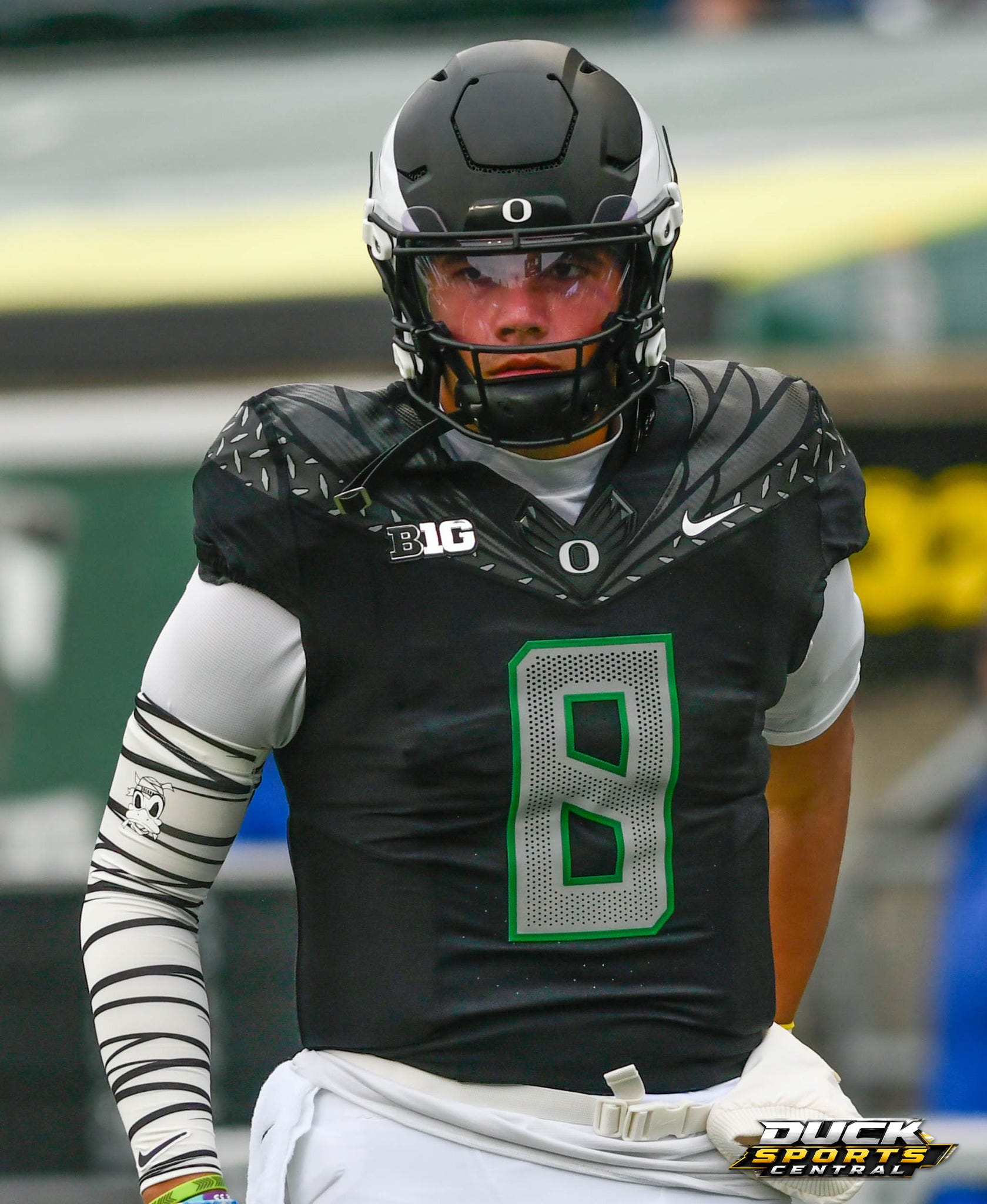
For much of Saturday afternoon, Oregon looked like a team running out of answers. Northwestern controlled the opening half, the Ducks struggled to find any offensive consistency, and even the atmosphere inside Autzen Stadium seemed to reflect the disappointment surrounding a season that had begun with considerably greater expectations.
Then, almost unexpectedly, Oregon found something that had been missing. The offensive line began creating opportunities, Dylan Raiola looked increasingly comfortable, Brandon Smith provided an explosive rushing threat and a defense that had struggled to get off the field finally made enough plays to preserve a 34-26 victory.
The question is whether that second half represented the beginning of a genuine turnaround or simply another brief glimpse of the team Oregon was supposed to be all along.
We may find out relatively quickly. The Ducks head to Columbus next Saturday to face an Ohio State team that suffered its own disappointing result over the weekend, falling 30-18 at USC. The Buckeyes remain one of the country’s most talented teams, but with starting quarterback Julian Sayin sidelined by an injury and true freshman Luke Fahey now directing the offense, Ohio State is confronting some of the same challenges Oregon has experienced this season.
That makes this week’s 3-2-1 particularly interesting. Oregon finally has something positive to build upon, but the next opponent is unlikely to offer much room for the inconsistencies that have defined the season.
3 Things We Learned
1. Oregon’s offensive identity may finally be taking shape
The most encouraging part of Saturday’s comeback wasn’t Raiola’s 336 passing yards or Dakorien Moore’s 128 receiving yards and two touchdowns. It was the way Oregon began connecting its running and passing games, something that had been conspicuously absent during much of the season.
Smith’s 82 rushing yards on eight carries provided a different dimension to the offense, particularly with his ability to change direction and turn modest openings into explosive gains. The offensive line also appeared more comfortable, benefiting from consecutive games with the same starting combination.
That relationship became especially apparent on Raiola’s 75-yard touchdown pass to Moore. Dan Lanning explained afterward that Northwestern’s boundary safety had been aggressively supporting the run, creating an opportunity for Oregon to attack the space behind him with play-action.
The play wasn’t simply a matter of superior athletes making something happen. It was an example of an offensive concept creating a favorable matchup through the threat of something else, and for an offense that has struggled to establish any dependable structure, that is potentially significant progress.
2. Raiola’s confidence is becoming as important as his arm talent
There has never been much reason to question Raiola’s physical ability. His arm talent and capacity to make difficult throws have been evident, but his struggles with timing, confidence and decision-making have made the transition into Oregon’s starting role considerably more difficult than anticipated.
Saturday offered evidence of a quarterback beginning to understand how to manage those challenges. Raiola completed 22 of 31 passes for 336 yards and three touchdowns without an interception, but the more meaningful development was his increased decisiveness as the game progressed.
He revealed afterward that he has begun using breathing and humming techniques to help regain his focus between plays, something that aligns with Lanning’s emphasis on maintaining emotional consistency regardless of the previous outcome.
Raiola also benefited from improved protection and the return of a credible running game, reminders that quarterback development rarely occurs independently of everything happening around him. His performance didn’t erase the difficulties of recent weeks, but it provided a much stronger foundation than Oregon had entering Saturday.
3. The defensive concerns remain despite the second-half recovery
Northwestern gained 456 yards, and quarterback Aidan Chiles repeatedly exposed Oregon’s difficulty containing mobile quarterbacks. The Wildcats converted six of nine third downs before halftime, extending possessions and preventing Oregon’s offense from developing any rhythm.
The adjustments after halftime were meaningful. Oregon limited Northwestern to 172 yards and six points over the final two quarters, generated three sacks and forced the Wildcats into field goal attempts rather than allowing them to finish drives with touchdowns.
But the first-half problems cannot simply be dismissed because the Ducks eventually found answers. Oregon frequently generated initial pressure without maintaining contain, while the secondary struggled when Chiles extended plays and forced defenders to maintain coverage longer than anticipated.
Chris Hampton’s defense has enough talent to perform better than it did during the opening 30 minutes. The next challenge is establishing that level of execution before an opponent has already seized control, particularly against an Ohio State offense that still possesses elite skill-position talent despite its quarterback change.
2 Questions Going Forward
1. Will Oregon commit to what worked, or return to searching for answers?
Perhaps the most frustrating aspect of Oregon’s offensive struggles has been the tendency to find something effective and then drift away from it.
Saturday’s second half demonstrated that a more complementary approach can work with Raiola at quarterback. Smith’s emergence provided another option in the backfield, while improved offensive-line continuity allowed Oregon to develop the running game without relying exclusively on individual effort.
Yet the final rushing numbers still revealed considerable inconsistency. Oregon gained only 108 net rushing yards, with Smith accounting for 82, and too many attempts were stopped near the line of scrimmage.
There is a difference between producing explosive plays and establishing a dependable offense. The Ducks need both, particularly against an Ohio State defense that has consistently demonstrated an ability to limit opponents’ rushing production.
2. Can Oregon carry its newfound confidence into an environment where adversity is inevitable?
Lanning has spent much of the season discussing the importance of responding appropriately when things go wrong. He acknowledged last week that Oregon had not always handled those moments particularly well, allowing mistakes and disappointing outcomes to affect its energy and execution.
The Northwestern comeback demonstrated progress, but it occurred at home against an opponent that allowed Oregon to recover from a difficult opening half.
Ohio Stadium presents a different challenge. The Ducks will face a talented opponent, a hostile environment and a team motivated to respond to its own disappointing performance.
There is also an interesting parallel between the programs. Oregon has been forced to adjust to the loss of Dante Moore, while Ohio State is now attempting to maintain its offensive identity without Julian Sayin. Both teams are asking relatively inexperienced quarterbacks to manage difficult circumstances while surrounded by talented rosters that entered the season with championship expectations.
The most important question may not be whether Oregon can match Ohio State’s talent. It is whether the Ducks can maintain the same offensive confidence and defensive discipline when the circumstances become uncomfortable.
1 Early Look Ahead: Ohio State Has Talent, but a Very Different Quarterback Situation
Saturday, Nov. 7 | Ohio Stadium, Columbus | 3:30 p.m. ET, CBS
Ohio State enters the week at 6-2 overall and 4-1 in Big Ten play after Saturday night’s 30-18 loss at USC. The Buckeyes had won five consecutive games following a narrow 24-23 loss at Texas in September, including victories at Iowa and Indiana, before the Trojans exposed some of their own inconsistencies.
But perhaps the most important development entering the Oregon matchup is the absence of Julian Sayin.
The Buckeyes lost their starting quarterback to an injury to his throwing arm during their October 17 victory at Indiana. With Sayin sidelined indefinitely, Ohio State turned to true freshman Luke Fahey, who earned his first career start Saturday against USC and is expected to remain the starter against Oregon.
Fahey, a former three-star prospect from Mission Viejo, California, completed 21 of 38 passes for 260 yards and one touchdown without an interception against the Trojans. Those numbers were respectable for a freshman making his first start on the road, but Ohio State struggled to finish drives despite moving the football effectively.
The Buckeyes accumulated 464 total yards, including 204 rushing yards, but managed just 18 points. They settled for four field goals before Fahey finally connected with Jeremiah Smith for a one-yard touchdown with 2:12 remaining in the game.
That performance revealed both the promise and the limitations of Ohio State’s new offensive situation. Fahey demonstrated the ability to move the football and make throws within the offense, but the Buckeyes struggled to translate that production into touchdowns when the field became compressed.
It would be a mistake, however, to assume the quarterback change makes Ohio State an easy opponent.
The Buckeyes still possess one of the country’s most talented receiving corps, led by Jeremiah Smith, and running back Bo Jackson gives them a legitimate rushing threat. Jackson gained 121 yards on 21 carries against USC, while Smith caught 10 passes for 83 yards and a touchdown.
Ohio State’s defense also remains formidable, particularly against the run, where the Buckeyes have generally limited opponents to fewer than 100 yards per game entering the USC contest.
The matchup that interests me most this early is whether Oregon can force Fahey to carry the offense rather than allowing Ohio State’s running game to establish control.
Against Northwestern, the Ducks struggled to contain Chiles and repeatedly allowed third-down conversions that extended drives. Fahey presents a different challenge, but the Buckeyes’ running game and receiving talent remain capable of exploiting defensive mistakes.
Oregon’s defensive priority should be making Ohio State earn its production through sustained execution rather than allowing explosive gains and favorable down-and-distance situations. If the Ducks can limit Jackson and force Fahey into predictable passing situations, they may be able to create the kind of pressure that disrupted Northwestern during the second half.
Conversely, Oregon’s offense must find ways to establish its own rushing credibility against a defensive front that is considerably more talented than Northwestern’s. If Ohio State can eliminate Smith’s cutback opportunities and force Raiola into obvious passing downs, the Ducks could find themselves confronting many of the same problems that have plagued their offense throughout the season.
There is also an intriguing psychological dimension to the matchup. Ohio State entered the USC game ranked among the nation’s elite, while Oregon entered Northwestern simply trying to prevent its season from deteriorating further.
Both now approach Saturday needing to prove something, with two quarterbacks facing similar demands under very different circumstances.
The Inside Read
Oregon’s victory over Northwestern didn’t answer every question surrounding the program, but it did change the conversation. For the first time in weeks, the Ducks can point toward actual progress rather than simply promising that improvement is coming.
The offensive line looks more settled, Raiola has a performance worth building upon and Smith’s emergence creates another opportunity to develop a more functional rushing attack.
Ohio State, meanwhile, is discovering some of the same uncomfortable realities Oregon has faced following a major injury at quarterback. The Buckeyes remain extraordinarily talented, but the transition from Sayin to Fahey has introduced uncertainty into an offense that was built around a more experienced and established starter.
That doesn’t necessarily make the trip to Columbus easier, but it does create a different matchup than anyone would have anticipated when the season began.
The most important takeaway heading into Columbus is that both teams are trying to establish offensive consistency under circumstances neither expected. Oregon finally found some answers Saturday, while Ohio State is still searching for its own.
Which team handles that challenge more effectively could go a long way toward determining what happens next weekend.