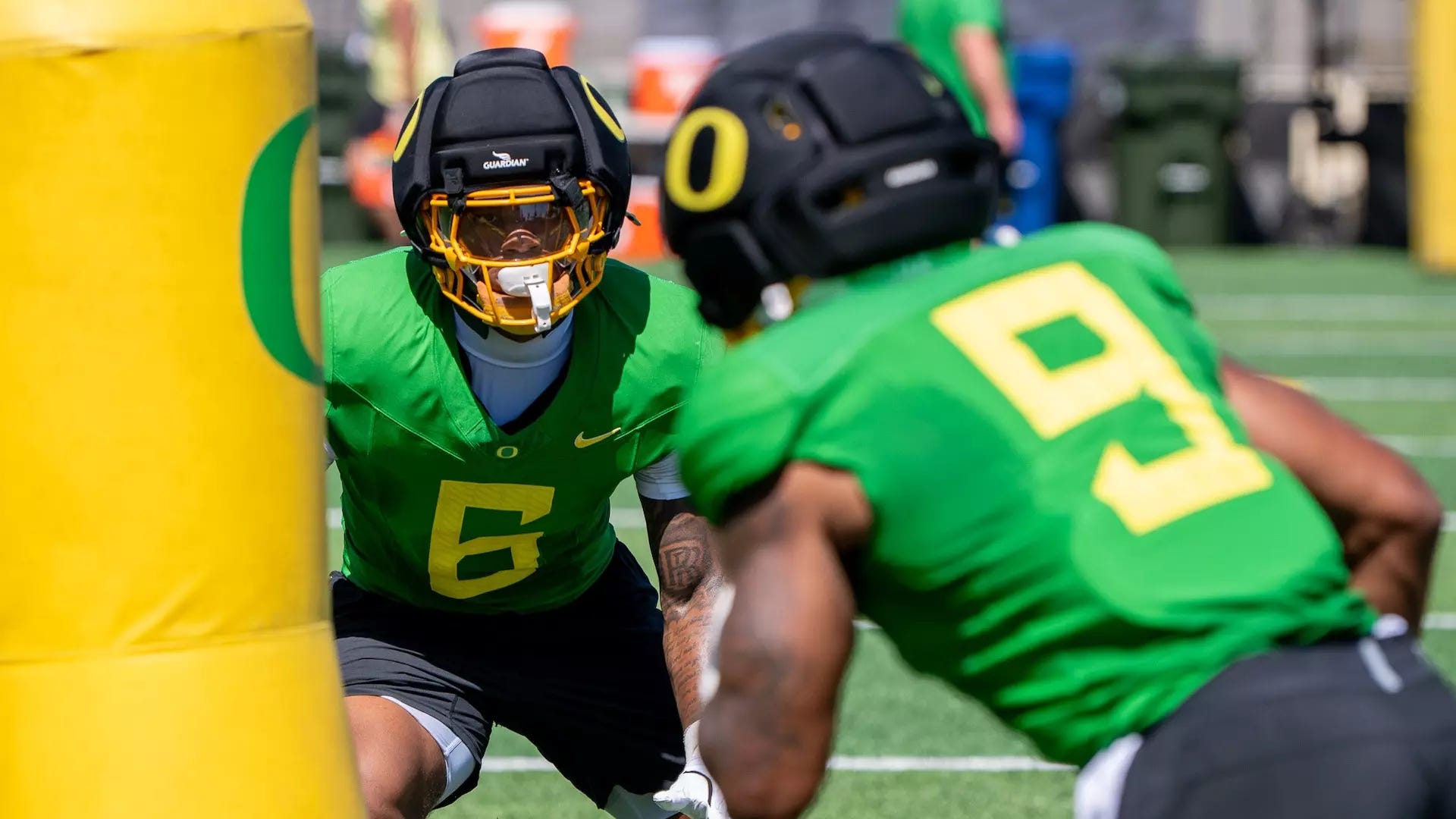
The defense answered the offense with third-down and red-zone stops, special teams produced its cleanest scrimmage yet, Evan Stewart delivered in the final period and Oregon emerged relatively healthy from what Dan Lanning expects to be its last major live-tackling session before the season. The offensive line remains unsettled, but Lanning made clear that practicing against Oregon’s defensive front is supposed to make the eventual games feel easier.
Oregon entered its second fall scrimmage with a growing list of questions, but Dan Lanning’s immediate assessment Saturday started with something much simpler. The Ducks competed, tackled live for what will probably be the final extended period before the opener and emerged relatively healthy, which allowed Oregon to accomplish something it increasingly has to balance as the season gets closer: create enough real football to produce honest evaluation without unnecessarily spending bodies in August.
“Good scrimmage today, some good work,” Lanning said. “It’ll be the last time that we really get a lot of live tackling in practice before we get to a game. Ultimately, guys came out relatively healthy.”
There was another part of Lanning’s opening that deserves attention because it connects the physicality of the day to a theme Oregon has been talking about since Media Day. He said there were “some really good examples of protecting their teammates and not taking shots that were unnecessary,” which is a different kind of physical maturity than simply proving who can hit hardest.
At Media Day, Lanning said Oregon’s identity would not be reinvented by some dramatic schematic change. He wanted fall camp to solidify what has already won games for the Ducks, specifically the ability to block, tackle and execute at a high level while maximizing fundamentals, technique and effort. Saturday gave Oregon one final extended opportunity to evaluate those fundamentals through real tackling, but it also tested whether the connection Lanning has spent months emphasizing could survive the violence of an actual scrimmage without players losing sight of the fact that the opponent across from them was still a teammate.
The result was not simply another collection of August repetitions. Scrimmage Two produced a different winner than Scrimmage One and, in several areas, a much clearer picture of what Oregon corrected during the week.
The defense flipped the result, and the reason was finish
Lanning was unusually direct about which side won Saturday.
“I’d say last scrimmage, I’d say the offense got the better of the defense,” he said. “I’d say today the defense got the better of the offense.”
That does not mean Oregon’s offense spent the afternoon going nowhere. Lanning said the offense “had some good drives” and was able to create rhythm, but the next part of his assessment is where the scrimmage becomes much more significant.
The offense did not finish those opportunities.
“We had some good drives, put together some rhythm, but didn’t capitalize, able to finish on those drives,” Lanning said, before noting that the defense also created takeaways.
That immediately returns Oregon to one of the most persistent themes we heard before camp ever started. At Media Day, Ify Obidegwu was asked what the defense could take from last season’s disappointing finish, and he kept returning to the same word. “Really just, I’ll probably just say just finish, like finishing,” Obidegwu said, specifically pointing toward fourth-quarter performance and red-zone defense as areas Oregon needed to improve.
Chris Hampton carried that language into the opening week of camp. His defensive standard was never simply about installing more calls or creating more pressure. Oregon had to convert disruption into finished plays and become significantly better in the red zone, with Hampton repeatedly emphasizing that the Ducks needed to “sack the quarterback and finish.”
Saturday provided actual evidence in precisely those situations.
Asked what allowed the defense to control the second scrimmage, Lanning immediately identified “third down stops, red area stops.” He also thought the defense continued attacking the football well, saying there were balls Oregon was able to get out and noting that the same emphasis had shown up in the first scrimmage.
That is meaningful because the defense did not simply win more isolated plays Saturday. It apparently won the plays that end possessions.
Third down gets the offense off the field. Red-zone stops keep points off the scoreboard. Takeaways end drives immediately. Those are the situations that turn defensive talent into winning defense, and they are also the areas Oregon spent the offseason identifying as places where last year’s performance had to improve.
Lanning was not ready to call the defensive day complete, however, because he thought the run defense still left something on the film.
“I think we still got to get better against the run based on what I saw today,” he said, while repeatedly qualifying all of his initial observations with the reminder that the staff still needed to watch the tape.
That is an important distinction. Oregon’s defense may have won Scrimmage Two, but Lanning did not describe the result as arrival. The defense got stops, attacked the football and won the day while still leaving another obvious correction for the next week of practice.
Oregon’s offensive line picture is narrowing without becoming settled
The offensive line remains the position where people most want Lanning to provide a definitive answer, and Saturday did not produce one.
There has been movement. Lanning acknowledged that “there’s some that have made it more clear with the way that they compete and their consistency,” but he also said other players are still trying to establish what the best version of themselves looks like.
“I don’t think there’s any clear decisions, especially without watching the film, on these are the first five or these are the guys that are going to be able to rotate in,” Lanning said. “We still got to watch that film and assess it. Plenty of time to figure that out.”
The distinction becomes important when comparing that answer to what Lanning said at Media Day. He was already envisioning the possibility of six, seven or even eight offensive linemen rotating during the season, with individual roles growing according to how players performed once they received them. That was never presented as evidence that Oregon could not find five players. Lanning said the staff had enough confidence in the talent already in the room that it did not feel compelled to reach into the portal simply to manufacture answers.
Fox Crader described the eventual standard even more simply at Media Day. “The best five are going to play,” he said, adding that the linemen understood they had to put egos aside and allow practice to determine the outcome. Crader also said, “I believe everybody we need is in the room right now,” while pointing toward younger players pushing the veterans every day.
Saturday suggests Oregon is now somewhere between those two ideas.
Lanning said the staff already has “a clear picture” of which linemen are realistically in the competition. What remains unresolved is how sharply that group separates and whether Oregon ultimately settles on five primary players or enters the season comfortable rotating more.
“When it becomes more defined and when it’s very clear, it’s when it makes it easy,” Lanning said. “But I wouldn’t say it’s to that point yet.”
That is not the same thing as saying Oregon has no idea what it has. The pool has narrowed, but the hierarchy has not completely separated.
Oregon’s defensive front is making the offensive-line evaluation harder in exactly the way Lanning wants
One of the most useful answers of the entire interview came when Lanning was asked whether practicing against Oregon’s experienced defensive front makes it difficult to evaluate younger offensive linemen.
His answer was essentially the opposite.
“I think it makes it clear what the standard is,” Lanning said.
That sentence connects almost perfectly to what Oregon’s offensive linemen were saying at Media Day. Crader talked about practicing every day against what he believes is one of the best defensive fronts in the country and said Oregon constantly repeats the idea that “practice is going to be harder than the game.”
Lanning used almost identical language Saturday.
“It doesn’t matter who lines up against us,” he said. “We’re going to go against some really good D-lines this year. And we want it to be harder in practice than it is in the game. So if that’s a challenge, that’s a positive.”
That does not mean every lost offensive-line rep can be dismissed because Oregon’s defensive front is good. If the same protection problems continue appearing once the season begins, nobody will care that they were exposed first by Matayo Uiagalelei, A’Mauri Washington, Bear Alexander or the rest of Oregon’s front.
What the competition does provide is a much more demanding evaluation environment.
An offensive lineman who demonstrates he can consistently function against Oregon’s defensive front gives Terry considerably more meaningful evidence than someone succeeding in protected drills against inferior competition. Lanning also turned the standard back onto the defensive line, saying there is an expectation for what that group “should look like play in and play out if they are what they say they are.”
That is the useful tension inside Oregon’s line-of-scrimmage battle. The offense cannot use the quality of the defense as an excuse, while the defense cannot use its reputation as proof. Both sides have to keep earning the evaluation.
The special teams response was tangible
If the offensive-line picture remained complicated, special teams produced one of the cleanest answers of the day.
“The kicking game was much better today,” Lanning said.
Rocco Graziano went 4-for-4, Gage Hurych also performed well and Oregon had better punt locations. Lanning later added that the Ducks attempted three kicks from beyond 50 yards and did not repeat the kickoff out of bounds that appeared during the first scrimmage.
That response is important because special teams was one of the areas Lanning immediately identified for correction after Scrimmage One. The Ducks did not need a philosophical adjustment during the week. According to Lanning, the improvement may have been considerably simpler.
“I don’t think it’s anything that these guys are doing different,” he said. “Maybe it’s a level of focus when they’re out there.”
That fits the way Oregon has prepared Hurych for this opportunity. At Media Day, he pushed back against the idea that he lacked meaningful experience, saying, “Experience is something that people say I lack, but I got a lot of it last year.” He also explained that one of the biggest parts of his preparation is deliberately putting himself into “game mode in practice” so the transition feels more familiar when the situation becomes real.
Joe Lorig later revealed how intentional that preparation has been. Oregon has spent years manufacturing pressure situations and finding real-game repetitions for Hurych because the staff did not want his first important kick to arrive only after Atticus Sappington was gone.
Scrimmage One created some inconsistency. Scrimmage Two provided a better response, including long attempts and a more game-like operation. That is exactly what August is supposed to do.
Koi Perich is beginning to sound like part of the defensive leadership structure
Lanning also offered one of his strongest evaluations yet of Koi Perich, and what stood out was not simply the physical play.
“I really heard his voice out there today,” Lanning said. “He’s been physical since the day he got here.”
Perich has improved in several areas since arriving, but Lanning said Saturday was one of the first days where he particularly felt the transfer’s presence, both through communication and the way he finished plays.
That is worth connecting to Oregon’s larger leadership conversation because Lanning has spent the entire month searching for more players capable of carrying the standard onto the field. After Practice 1, he challenged veterans who survived the opening workout by asking, “Who’d you bring with you?” and said Oregon needed to create more alphas during camp.
Perich’s evaluation Saturday sounded like another example of that standard becoming football rather than terminology.
Communication from the secondary affects everyone. A safety who understands what is coming, gets people aligned and communicates quickly can solve problems before the snap that never appear in a box score.
Lanning still stopped short of declaring the evaluation complete.
“I’m still going to watch the film,” he said. “I’m sure there’s some things for him to clean up, but he’s been a really pleasant surprise for us.”
That combination of praise and correction has been Lanning’s default setting throughout camp. Good performance earns more responsibility, not exemption from evaluation.
Jerry Mixon and Devon Jackson give Oregon multiple answers at linebacker
Lanning was similarly positive about Jerry Mixon and Devon Jackson at inside linebacker, though his most important point concerned the room rather than either individual.
“They’ve done a good job,” he said. “I think that’s one of those positions where we have multiple guys that are playing above-the-line football there that can help us, and those two included.”
That phrase, above-the-line football, has been one of the most important clues in understanding how Oregon views depth. The objective is not simply to identify starters and backups. The staff wants to know how many players can enter a game without forcing the standard to change.
That matters particularly at linebacker because communication has been a recurring theme all week. Brian Michalowski described Mixon as a player whose knowledge and voice could connect the entire defense, while Mixon talked about the need to “flip the switch” between his quieter personality away from football and the communication required once he steps onto the field.
Saturday gave Lanning another opportunity to hear whether those voices survive a more game-like setting, and his answer suggests they did.
Evan Stewart’s camp keeps adding evidence
The Evan Stewart conversation has become remarkably consistent.
Lanning said before camp that Stewart had attacked the offseason. Dante Moore used even stronger language at Media Day, saying Stewart had “probably had the greatest offseason I ever seen” because of the early mornings, late nights and the way he pushed both himself and the team. Moore also described a relationship with Stewart that extends back to Texas and praised the leadership Stewart brought throughout the offseason, saying it matters when someone other than the quarterback is comfortable leading the team.
Two scrimmages into fall camp, Lanning’s evaluation has not changed.
“He’s had really good camp,” Lanning said. “He’s played really well.”
Stewart did not receive as many targets Saturday, which actually fits Ross Douglas’ explanation from Practice 13 that Oregon does not necessarily need a permanent No. 1 receiver dominating the football every day. The offense wants enough answers that the defense can dictate where opportunities appear without removing Oregon’s ability to punish the adjustment.
Stewart still found his moment.
“I don’t think he got quite as many targets today, but he came up with a really big play in our game-on-the-line period there at the end,” Lanning said. “He’s done a really good job, and obviously those guys have a unique connection.”
The “those guys” are Stewart and Dante Moore, and that connection has been developing long before Saturday.
At Media Day, Moore called the relationship with Stewart something that had come “full circle” after knowing and throwing with him in Texas years earlier. He also described Stewart’s leadership as visible in team runs, walkthroughs and throughout the offseason rather than something limited to receiving production.
Saturday added another football moment to that relationship. On a day when the defense won most of the larger battle, Moore and Stewart still produced when Oregon deliberately created a game-on-the-line situation.
Practice has to become the game for Stewart and Gatlin Bair
Stewart and Gatlin Bair share an unusual problem despite arriving at it through completely different circumstances.
Neither has played an actual football game in more than a year.
Ross Douglas talked Friday about Bair needing to reacclimate his body to football after two years away, including contact, change of direction and the physical experience of catching through defenders. Stewart’s absence came from injury rather than time away from the sport, but the challenge of recreating game speed remains similar.
Lanning said the solution is to make practice as close to the missing experience as possible.
“Making practice as much as possible like a game, right? Recreating those moments,” he said.
Saturday was intentionally built to do that.
Lanning said Oregon divided into a “combat group” and a “Fighting Ducks group,” creating teams and operating special teams as though the Ducks were actually playing a game. That structure was not just for entertainment or competition. It was designed to make the organizational demands, transitions and pressure resemble Saturday football closely enough that players without recent game experience could begin replacing what they have missed.
“A lot of that operation today was to help create that,” Lanning said. “So those guys have had a lot of snaps in practice, and those have to qualify.”
That phrase captures a large part of Oregon’s developmental philosophy.
Practice repetitions have to qualify as preparation. That is why the caliber of the opponent matters, why live tackling matters in controlled doses and why Oregon deliberately creates game-on-the-line periods rather than treating every August snap as interchangeable.
Trent Ferguson is becoming another offensive-line name worth tracking
One of the more specific individual evaluations Saturday involved local offensive lineman Trent Ferguson.
Lanning’s first memory of Ferguson was unusual.
“Maybe the first film I saw was him playing lacrosse, which is interesting because he’s a huge guy,” Lanning said.
What has kept Ferguson in the conversation is considerably more conventional.
“Trent has an unbelievable work ethic,” Lanning said. “He puts in the time. He spends a lot of effort. And he’s one of those guys that’s been big for a long time and now has really grown into his body. He can move people up front. He’s had a good fall camp.”
Ferguson’s emergence has already been visible inside the offensive-line room. Earlier in camp, A’lique Terry told the story of Dave Iuli coming out of practice talking about how well Ferguson had played, saying, “Man, Trent balling. Trent playing with some power.”
That does not make Ferguson one of the starting five, and Lanning went out of his way Saturday to avoid creating a depth chart before reviewing the film. It does make him part of the reason Oregon can continue talking seriously about more than five playable linemen.
The grading standard did not change for Scrimmage Two
The first scrimmage gave us perhaps the clearest evaluation framework of camp when Lanning said Oregon would judge players by two questions: Are you accountable, and are you capable?
He has not changed it.
Asked whether the final major live-tackling session required a different grading system, Lanning said it would be “graded the same way” as the first scrimmage.
The physical evidence simply becomes harder to manufacture once Oregon stops taking players to the ground.
“We’ll still have some tackling drills and things that we do,” Lanning said. “You have to do that every single day in practice. But as far as tackling guys to the ground, there’s something to be said for who can get guys down, who can break tackles. And in moments like this, I think that shows up a little bit more.”
That makes the film from Saturday particularly valuable.
Oregon can continue teaching tackling technique. It can continue thudding runners, working leverage and practicing pursuit. But there are certain questions that only reveal themselves completely when a defender has to finish a tackle and a ball carrier is genuinely trying to break it.
Scrimmage Two provided one of the last large samples Oregon will get before somebody in a different uniform supplies the answer.
Oregon is getting closer to opponent preparation, but Lanning still wants Oregon studying Oregon
The calendar is beginning to change.
Lanning said Oregon has already completed some preliminary opponent work during the summer and will begin moving deeper into game planning toward the end of next week. Until then, the emphasis remains internal.
“It’s still going to be more about Oregon than anybody else,” Lanning said.
That may be the cleanest way to understand where the Ducks stand following Scrimmage Two.
The defense winning Saturday matters, but not because Oregon needs to declare one side of the football ahead of the other. Special teams improving matters because the operation was more focused. The offensive line remaining unsettled matters because there is still evidence to evaluate before Oregon begins distributing game-week repetitions more narrowly.
Even the individual praise came attached to a larger standard. Perich communicated and finished. Stewart produced late despite fewer targets. Ferguson’s work ethic has translated into a strong camp. Mixon and Jackson are part of a linebacker room with multiple players functioning above the line.
None of those evaluations required Lanning to declare Oregon ready.
That would actually contradict what he told us at Media Day, when he said fall camp was about solidifying an identity rooted in blocking, tackling, execution, fundamentals, technique and effort rather than inventing something entirely new.
Scrimmage Two gave Oregon another measurement against that standard.
The Ducks emerged relatively healthy from their final extended live-tackling work. The defense answered a first scrimmage won by the offense with third-down stops, red-zone stops and takeaways. Special teams improved. The offensive line moved closer to definition without reaching it, while the defensive front continued providing exactly the kind of uncomfortable practice environment Lanning wants.
There are still corrections ahead, particularly Oregon’s run defense and the offense’s inability to finish promising drives Saturday. There is also enough positive evidence that the discussion can now begin shifting from what this roster might contain toward what Oregon is actually preparing to use.
Lanning will watch the film before making any of those decisions final, and that restraint is probably the most appropriate conclusion to a closed August scrimmage.
The picture is clearer, even if it is not finished yet.


