


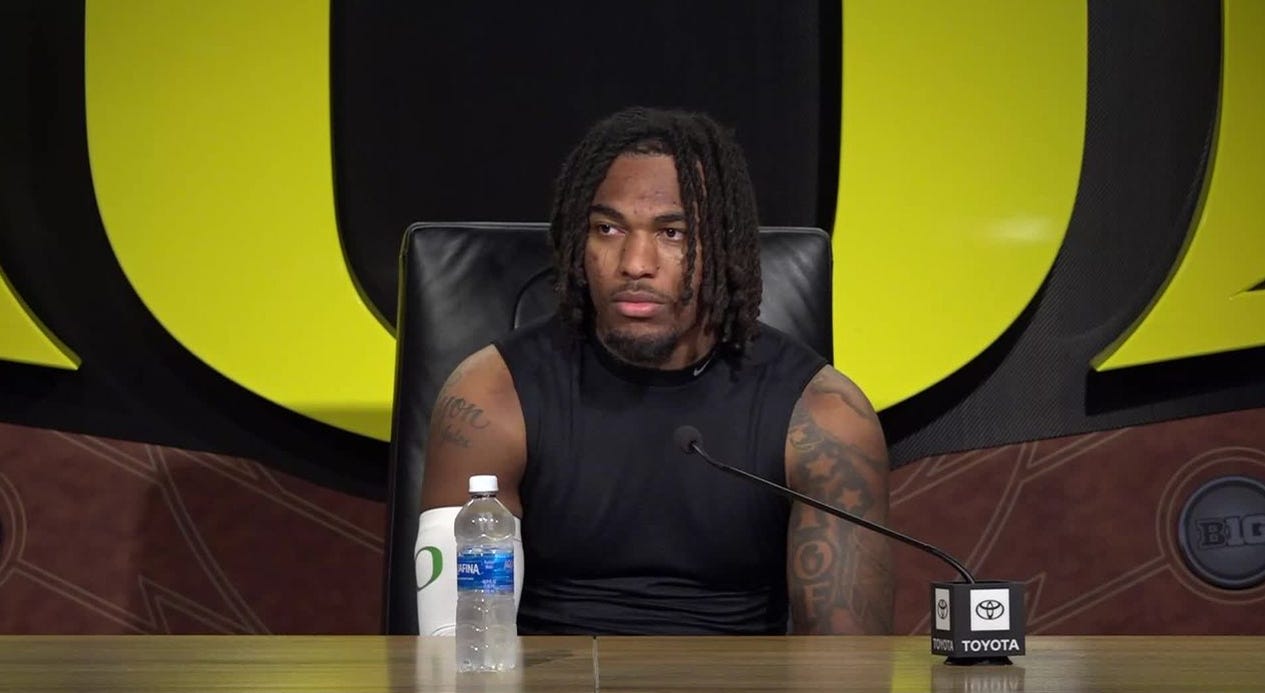
As Washington week reaches its final preparations, Lanning offered a closer look at the adjustments behind Oregon’s offensive improvement, while Raiola and the defense explained what must carry over against the Huskies.
After spending much of the past month watching Oregon work its way through offensive inconsistency, changing personnel and some fairly significant adjustments to the coaching structure, I found Dan Lanning’s explanation of the running game’s recent improvement particularly interesting Wednesday.
He didn’t point to Brandon Smith’s emergence, the return of Simeon Price or even the offensive line finally developing some continuity. Instead, he discussed the identification of defensive fronts, where the offensive line establishes its blocking points and how receivers are creating additional yardage by finishing blocks downfield. It wasn’t the kind of explanation that generates much excitement during a press conference, but it probably tells us more about why Oregon’s offense has improved than simply pointing to the rushing totals from the past few games.
And the timing matters because Washington comes to Autzen Stadium with a defense capable of creating negative plays and forcing quarterbacks into mistakes, along with an offense that can look ordinary for extended stretches before Demond Williams Jr. turns a broken play into something entirely different. Wednesday’s conversations with Lanning, Dylan Raiola and linebacker Dylan Williams provided a more detailed look at what Oregon has been working to improve, offering considerably more than the familiar discussion about the rivalry and everything riding on Saturday’s outcome.
The running game is improving because Oregon is eliminating confusion
When Lanning was asked about Oregon’s improved rushing production, he began with the communication required to get everyone working from the same blocking assignments.
“A lot of it starts with when we’re on the same page of where we’re at, where we’re ID’ing the Mike and where we’re taking our points and how we’re blocking certain fronts,” Lanning said. That may sound like a relatively small detail, but it gets to something we’ve watched Oregon struggle with at different points this season.
Identifying the Mike linebacker establishes the offensive line’s reference point for its blocking assignments. When an offense doesn’t make that identification consistently, the players can have a perfectly reasonable play called and still fail to execute it because they’re working from different understandings of whom they’re supposed to block.
Against Washington, that becomes particularly important because defensive coordinator Ryan Walters has enough versatility in his personnel to change the appearance of the front and create uncertainty before the snap. Safety Alex McLaughlin can operate near the line of scrimmage, threaten pressure or drop into coverage, forcing Oregon to recognize where defenders are aligned and how they’re likely to respond.
Lanning also discussed the value of reducing unnecessary complexity in the running game, explaining that “you can carry certain plays out of a ton of different formations, but that quickly can change where your spots are right in the run game and where you’re going.” An offense can show several formations while running essentially the same concept, but every adjustment can affect the angles and assignments involved.
When those changes become too complicated, players can spend more time identifying their responsibilities than actually executing them. We’ve seen Oregon become more effective at avoiding those problems recently, particularly when the Ducks have committed to attacking what the defense is allowing rather than searching for opportunities that aren’t developing.
Against Michigan State, the offense struggled through much of the first half before adjusting its approach and establishing the running game. The improvement wasn’t simply the result of different players carrying the football, as Oregon became more effective at putting those players in situations where they could succeed.
But Lanning also pointed toward another development that has become increasingly noticeable, and it involves players who don’t usually receive much credit for rushing production.
“I really think a big separator is how you block on the perimeter, which I think we’ve grown a ton in that area,” he said. “Really Nebraska game on, of how we want to be able to block on the perimeter and what that looks like. Wide receivers creating explosive plays because their ability to go get on a second hat at the next level.”
I think that’s one of the more important parts of Oregon’s offensive improvement because a running back can make the correct read and get through the first level of the defense, but what happens next often depends on whether the receivers continue working downfield. We’ve seen Oregon turn several ordinary opportunities into explosive gains because players who weren’t getting the football were willing to finish their assignments.
That’s especially relevant against Washington, whose defense has been effective stopping running plays near the line of scrimmage. Oregon may not consistently create enormous openings against the Huskies, but if the offensive line identifies the front correctly, the back makes the appropriate read and the receivers finish their blocks, the Ducks can still manufacture productive gains.
Raiola credited Poncho Laloulu with helping the offensive line develop the communication necessary to make those assignments work.
“Poncho’s done a great job with that unit,” Raiola said. “He’s got a young guy on his left. He’s got a newer guy to his right coming into this season. He does a great job of leading those guys forward and keeping them on the same page with communication.”
That’s a useful reminder that the improvement we’ve seen isn’t necessarily about Oregon suddenly becoming more talented. The Ducks have had talented offensive linemen throughout the season, but they’re becoming better at working together, recognizing defensive looks and executing with fewer moving parts. Saturday will provide a good test of how much of that improvement has become dependable.
Jay Johnson has given Oregon something it was missing
We’ve spent considerable time discussing the adjustments to Oregon’s offensive coaching structure, but Lanning offered one of his better explanations Wednesday of what Jay Johnson has brought to the position. Interestingly, he didn’t begin with play design or some particular concept that has made the offense more productive.
He talked about Johnson’s ability to manage the different ideas coming from the offensive staff and determine which ones actually belong in the game plan.
“I just think until you’re in that position, and his position was different when I was with him at Georgia, the management of people and the uniformity of how he takes ideas in that room and he’s able to simplify it, really able to push the pulse of too much, not enough,” Lanning said. That gets to something I’ve always considered important when evaluating offensive coaching.
There are plenty of coaches capable of designing creative plays, and most offenses have more potential answers than they could reasonably practice during a week. The challenge is deciding which answers your players can execute well enough to make them useful on Saturday.
An offense doesn’t necessarily improve because it adds more to the playbook. Sometimes the better decision is identifying what works, preparing a few adjustments for the problems an opponent might create and allowing the players to operate without constantly sorting through additional responsibilities.
Lanning believes Johnson has become particularly effective at making those decisions.
“Where do we need an answer? And I think he’s done a really good job of simplifying really what we’re trying to accomplish every week. What do we have to be prepared for that they’ve shown?”
Lanning also praised Johnson’s preparation and his willingness to make changes when the original game plan isn’t producing the intended results.
“He does an outstanding job watching film. He’s really good at staying on task. And then in game, I think he’s done a really good job of the adjustments that have to be made to the game plan or to have answers for how a team’s attacking us.”
I thought the Michigan State game provided a useful example of that approach because Oregon spent the first half struggling to develop consistent passing opportunities and protect Raiola. Rather than continue forcing an approach that wasn’t working, the Ducks adjusted and began attacking the areas where Michigan State was vulnerable.
The challenge against Washington will be making those decisions quickly enough that an early struggle doesn’t put Oregon in a difficult position. Walters has enough defensive flexibility to create confusion, particularly when McLaughlin becomes involved near the line of scrimmage, and Oregon will need answers for those looks without becoming so concerned with everything Washington might do that it loses sight of what its own players do best.
That balance between preparation and execution may be Johnson’s most important contribution this week. Oregon has already demonstrated that it can make successful adjustments during a game, but Saturday will test how quickly the Ducks recognize when those changes are necessary.
Raiola’s development has become more deliberate than simply avoiding mistakes
One of the more revealing moments of Wednesday’s availability came when Raiola was asked whether he recognized how well he’d been playing during Oregon’s winning streak. He seemed genuinely uninterested in discussing individual recognition, instead describing how he reviews his performances and prepares for the next opponent.
“Every single game, I always go back and watch the game at least three times,” Raiola explained. “The first game, I kind of just watch, obviously in my head, I know our big plays. And the second time, this is a negative. And then the third time is really like, all right, this is my plan of attack for this upcoming week and weeks to come.”
I found that explanation more interesting than another discussion about his growing confidence because Raiola is separating the process of reviewing what happened from identifying mistakes and then determining what needs to change. The first viewing allows him to understand the performance, the second concentrates on what went wrong and the third turns those observations into a plan for improvement.
That doesn’t guarantee better quarterback play, but it provides some insight into how he’s approaching the responsibility. We’ve watched Raiola become more effective at protecting the football and recognizing when an opportunity isn’t available, and Wednesday he acknowledged that those improvements required him to confront some problems in his own preparation.
“You look back at it and you just see you got to look yourself in the mirror and tell yourself, am I doing everything I can to intentionally focus on protecting the football? And I didn’t think I was doing enough of that.”
That’s a meaningful admission from a quarterback whose earlier turnovers contributed to some of Oregon’s offensive difficulties. Raiola specifically referenced the UCLA game, when the Ducks’ turnover problems threatened to overwhelm everything else they accomplished, and said ball security has since become an emphasis throughout the team rather than simply something the quarterbacks discuss during their meetings.
Washington will test how much that approach has improved because the Huskies have intercepted 13 passes this season, and their defensive backs have demonstrated the ability to punish quarterbacks who make poor decisions against disguised coverage. Raiola knows what he’s facing, having previously encountered Walters’ defense.
“They got tremendous ball skills at the DB level,” Raiola said. “They got really good players that can make plays, and if you’re slipping and you’re slacking, they can make you pay.”
But he also made an important distinction about how Oregon should respond, explaining that the quarterback still has to be willing to make throws when opportunities are available.
“Don’t play cautious, but you know you’re in the back of your mind. You’re aware of it. And so like every game, ball security is at a premium.”
I think that’s the correct approach because there’s a difference between protecting possession and becoming afraid to throw the football. If Raiola becomes so concerned about Washington’s interception production that he hesitates against legitimate opportunities, the Huskies have already accomplished part of what they wanted.
The goal is to recognize what the defense is doing, understand which throws are available and avoid trying to manufacture something when Washington has taken away the original read. And with the Ducks’ running game becoming more dependable, Raiola shouldn’t have to carry the entire offense through difficult passing situations.
That’s where his film preparation, the offensive line’s communication and Johnson’s simplified game plans begin working together. Each contributes to giving Raiola a clearer understanding of what the defense is doing and how Oregon can respond without placing the football at unnecessary risk.
Oregon’s interior defensive line could be the difference against Williams
Much of the conversation surrounding Washington’s offense has centered on Demond Williams Jr. and Oregon’s ability to keep him contained. That’s understandable considering how dangerous the quarterback becomes when he escapes pressure, but Lanning offered an explanation Wednesday that gets closer to where the responsibility actually begins.
He was asked about the contributions of A’Mauri Washington and Bear Alexander, two interior defensive linemen whose impact doesn’t always appear in the traditional statistics. His response went directly to the role they play in maintaining the structure of Oregon’s defense.
“You talk about growth of a defense. It doesn’t happen without interior defensive line,” Lanning said. “That’s the secret sauce, your ability to stop the run. You know, you have gaps, leverage blocks, eliminate and really create a wall inside.”
That explanation becomes particularly important against a quarterback like Williams because it’s easy to focus on the edge rushers, who are often the players most likely to produce a sack. But if the interior defenders abandon their assignments, the quarterback may simply escape through the space they’ve created.
Lanning made an interesting observation about why the best defensive tackle play doesn’t always produce impressive individual statistics.
“That’s not always a production position. It’s not one that’s going to stack stats. And if they are, they’re probably chasing plays. And if they’re chasing plays, then they’re probably giving up explosives.”
I thought that was one of the better football comments of the afternoon because it explains something that isn’t always obvious when we’re evaluating defensive performance. A defensive tackle can play an outstanding game without recording many tackles, particularly when his responsibility involves occupying blockers, maintaining leverage, preventing an interior rushing lane from developing or allowing a linebacker to make the play.
When those responsibilities are handled correctly, the defense functions as intended. When a player abandons his assignment in pursuit of an individual statistic, he can create precisely the kind of opening Williams is capable of exploiting.
Lanning described Alexander and Washington as players who have become increasingly effective at “farming their land,” maintaining their responsibilities while continuing to provide the physical presence needed to disrupt an offense. He also emphasized their ability to handle double-team blocks, push the pocket and free teammates to make plays.
Those contributions help explain why Oregon’s linebackers have become increasingly effective, and Dylan Williams described how the defensive tackles create opportunities for the players working behind them.
“One thing about A’Mauri and Bear, they’re going to for sure cause havoc and they’re going to do their job at a high level,” Williams said. “They’re quick to adjust to it and quick to get aligned to it.”
That communication will be particularly important Saturday because Williams acknowledged Oregon has spent additional practice time preparing for the Washington quarterback, including individual drills and team periods designed to reinforce containment responsibilities. The emphasis isn’t simply on chasing Williams when he leaves the pocket, but recognizing where he’s likely to escape and maintaining the defensive structure that prevents those opportunities from developing.
Against a quarterback who can turn a missed assignment into a 30-yard gain, Oregon’s interior defensive play may be just as important as the pressure generated by Uiagalelei and the edge rushers. And the better the interior defenders handle those responsibilities, the less Oregon will have to depend on another defender abandoning his assignment to account for the quarterback.
Dylan Williams is learning to start without the benefit of watching first
Another interesting part of Wednesday’s defensive discussion concerned the changing responsibilities at linebacker. Dylan Williams has played meaningful snaps throughout the season, but Jerry Mixon’s absence has changed when he enters games and how quickly he’s expected to recognize what opposing offenses are doing.
Previously, Williams often had the opportunity to watch the first few series and gather information from teammates before taking the field.
“Usually when I was coming in second, third series, I’d get a feel from Devon Jackson or Jerry,” Williams explained. “Just ask them how things are looking out there. What are they getting from the game or what are they seeing out there? So I can go out there and try to apply it.”
That advantage largely disappears when you’re responsible for starting the game, and Williams now has to recognize those tendencies himself, communicate assignments and make adjustments before Oregon has had much opportunity to see how the opponent intends to attack.
“Now it’s just making sure I’m ready to go out there and start fast,” he said. It’s a relatively simple explanation of a much larger responsibility, particularly against an offense that can use backfield action and a mobile quarterback to challenge a linebacker’s initial read.
Lanning praised Williams’ physical approach and the development that has allowed him to handle a larger role.
“He’s extremely physical, right? He’s a see ball, get ball guy,” Lanning said. “When it’s on the perimeter, you know that he has the speed and athleticism to go get it down. He’s violent at the point of attack.”
But Lanning also acknowledged the learning curve involved in playing linebacker at Oregon, where the position requires considerably more than reacting to the football. Williams has had to overcome injuries, develop a better understanding of the defense and prepare for opportunities that weren’t always immediately available.
That connects to another player Lanning discussed Wednesday, Devon Jackson, who represents one of the more unusual examples of continuity from the beginning of Lanning’s tenure. Jackson committed to Oregon before the coaching change and remained with the program while much of the roster evolved around him.
Lanning described Jackson as someone whose development required patience rather than immediate success.
“He’s one steady constant,” Lanning said. “And he’s also a great example of a guy that didn’t see immediate rewards and immediate benefit. He had to develop over time and he’s gotten better and better.”
Williams credited Jackson with helping him understand the position after arriving at Oregon, particularly when he was still learning the responsibilities and expectations of the defense. That experience becomes important against Washington, whose backfield movement and quarterback mobility will require Oregon’s linebackers to recognize what they’re seeing without losing their assignments.
The defensive tackles can make those responsibilities easier by controlling the interior, but the linebackers still need to understand where they belong and how their assignments change with Washington’s formations. It’s another example of how Oregon’s depth has become more important than simply having enough talented players available.
The Ducks need players who can understand and execute assignments even when circumstances change, and Williams is now being asked to demonstrate that ability from the opening possession. The experience he’s gained throughout the season should help, but Washington’s offense will provide a different test of how quickly he can recognize what an opponent is attempting to accomplish.
Washington’s passing game creates problems beyond the quarterback
Lanning also offered a useful assessment of Washington’s receiving group, particularly the way Fisch uses his tight ends and different passing concepts to create explosive opportunities. The Huskies have several productive receivers, but Lanning emphasized the variety of ways Washington can get the football to its playmakers.
“I think one thing that’s unique is how they utilize the tight end in the pass game,” Lanning said. “We’ve seen a lot of teams that don’t, right? But this is truly a shot team. They have a ton of success with shots and screens, and they do a good job of getting ball in hand to playmakers.”
That description tells us something about how Washington may attempt to attack Oregon’s defense because the Huskies don’t necessarily need to build every successful possession through a conventional passing progression. They can use screens to get the football out quickly, challenge the secondary vertically when the coverage presents an opportunity and involve their tight ends in ways that force linebackers to account for another receiving threat.
Those concepts can become especially effective against a defense concerned about Williams escaping the pocket. An aggressive rush can become vulnerable to screens, while defenders who move forward too quickly can create opportunities for the Huskies to attack downfield.
Lanning also noted Washington’s ability to turn catches into additional yardage, which places another responsibility on Oregon’s secondary. The Ducks have been excellent limiting passing production during the past two games, but Washington presents a different combination of threats than Michigan or Michigan State.
The challenge isn’t simply covering receivers until Williams reaches the end of his initial progression. Oregon’s defenders have to maintain their assignments when the quarterback extends plays and finish tackles when Washington gets the football into space.
The most important part may be recognizing how the Huskies are attempting to influence the defense before the ball is even thrown. If Oregon becomes too aggressive pursuing Williams, Fisch can attack the areas defenders have abandoned, while an overly cautious approach may allow Washington to find more manageable opportunities underneath.
That’s why the communication Lanning and Williams discussed Wednesday matters so much. Oregon needs to defend the entire play rather than simply win the first few seconds of it, particularly against an offense capable of attacking different areas of the field depending on how the defense responds.
Lanning wants the players to recognize the occasion without playing differently
There was no shortage of discussion Wednesday about the emotions surrounding Saturday’s game. The rivalry, Senior Day and the postseason implications all provide reasons for players to approach the week differently, particularly after everything Oregon has experienced during the past month.
Lanning doesn’t believe those emotions should be ignored, but he also doesn’t want them determining how the Ducks play.
“Football is an emotional game, but the emotion is not what’s going to win the game. It’s the execution,” Lanning said. “Play the game, not the occasion. And you get to celebrate those moments after the game if you take care of business.”
I thought that was an appropriate way to frame what Oregon faces Saturday because the Ducks don’t need to pretend Washington is another ordinary opponent. Raiola certainly wasn’t interested in suggesting the Huskies would approach the game without recognizing what they could take away from Oregon.
“There’s no secret about what happened and what lies in front of us,” Raiola said, referring to the results that have improved Oregon’s conference championship opportunities. “Washington wants nothing more to come in here and throw a dent in what we got going on. So we got to come with it. I know my guys will. And honestly, they’ll probably throw some punches, too. So we got to be ready for a heavyweight fight.”
That acknowledgment is important because there is a difference between respecting the emotional significance of a rivalry and allowing it to interfere with preparation. Raiola said Oregon addressed the stakes early in the week rather than attempting to ignore them, with the players understanding what’s available if they win while recognizing Washington has its own reasons for wanting to disrupt those opportunities.
Once the game begins, however, Raiola believes the focus has to return to the responsibilities the Ducks have spent the week preparing to execute.
“When the ball’s kicked off, all the emotion, all the hate, everything’s just, everything’s like, all right, it’s football now,” Raiola said. “You got to focus on football.”
After listening to the football details throughout Wednesday’s availability, I thought that statement carried more meaning than another reminder to stay focused. Oregon can spend the entire week discussing its postseason opportunities, the history of the rivalry and everything the players have overcome, but none of those things will identify Washington’s defensive front, create the correct blocking angle or keep Williams from escaping through an abandoned rushing lane.
Those responsibilities still have to be handled on the field, and while the Ducks have become considerably better at making adjustments during their four-game winning streak, Washington presents some problems that could make mistakes more costly than they were against Michigan State.
Raiola may have provided the best explanation of what Oregon needs when he described how easily players can complicate a game by becoming distracted by everything surrounding it.
“If we make it harder than it is, that’s where we fall into trouble,” he said. “So it’s keep it simple.”
There’s a considerable amount of football preparation behind those few words, particularly when considering how Oregon’s responsibilities have changed throughout the season. The offensive line has become more effective communicating its assignments, the coaching staff has worked to simplify the offense and the defense has developed a better understanding of how individual responsibilities contribute to the larger structure.
Saturday will test those improvements against an opponent that would enjoy nothing more than ending Oregon’s regular season with a rivalry loss. And after everything the Ducks have experienced this year, the difference between recognizing those responsibilities and executing them may determine whether Oregon gets another opportunity to play for a Big Ten championship.