


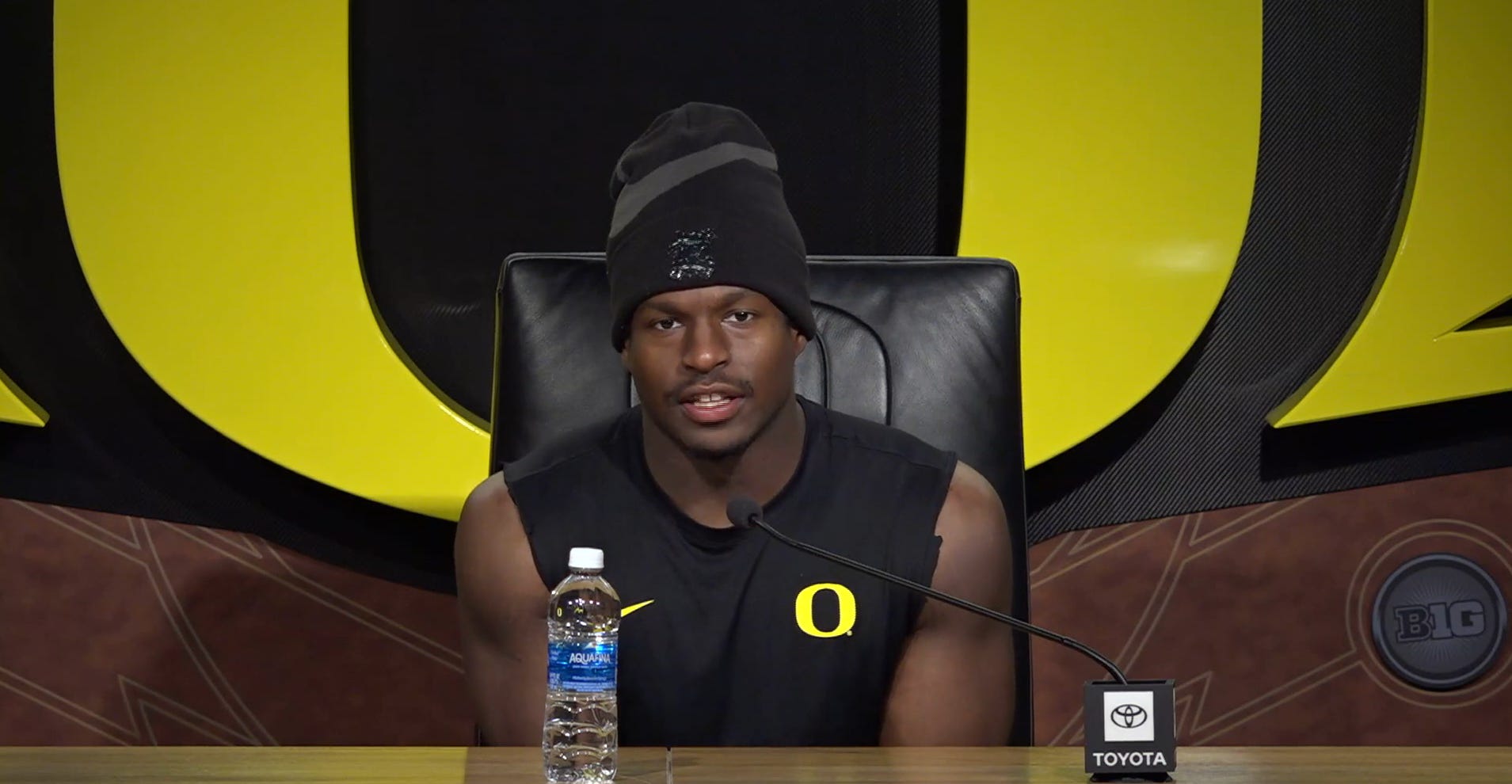
Injuries have reshaped the Ducks’ backfield and defensive front, placing new demands on veterans who have spent much of the season preparing for different roles. Tuesday’s interviews revealed why those adjustments could be critical against Washington.
There was a point during Tuesday’s interviews when Simeon Price said something that probably deserves more attention than the two touchdowns he scored against Michigan State. After spending most of his final college season dealing with injuries, Price explained why he refused to let his frustration become somebody else’s problem. He understood the coaches still had games to prepare for, the younger running backs still needed to develop and Oregon’s season wasn’t going to stop simply because his own wasn’t unfolding the way he’d envisioned.
“The sun’s going to rise and it’s going to set,” Price said. “The world’s going to keep spinning.”
It’s an interesting perspective from someone who finally got his opportunity last Friday, particularly when you consider how much Oregon’s running back situation has changed over the past few weeks. And as I listened to Price, Jamari Johnson and Matayo Uiagalelei discuss the season, I kept noticing variations of that same idea. Oregon has been forced to change personnel, responsibilities and expectations, sometimes with very little warning, but the work itself hasn’t changed.
That’s an important distinction as the Ducks prepare for Washington, and one that goes beyond the familiar conversations about the rivalry and postseason implications. Tuesday’s interviews offered a better understanding of how Oregon is handling the personnel changes that have become increasingly important to its success.
Price’s patience has become important to Oregon’s changing backfield
When Price arrived in January, he wasn’t expecting to spend most of his final college season watching other players carry the football. He had already experienced enough of college football to understand how quickly circumstances could change, having previously played at Mississippi State and other programs. But after a strong spring, he believed he had an opportunity to become a meaningful part of Oregon’s offense.
An injury during the opening practices of fall camp changed those plans. Price attempted to return, aggravated the injury and missed additional time, leaving him in an unfamiliar position as the season continued without him. “I had a lot of high expectations for myself,” Price said Tuesday. “Obviously, this team had a lot of high expectations.”
His comments became considerably more interesting when he explained how he handled the frustration. He recognized that his personal disappointment couldn’t become something that affected everyone around him.
“I think as people, we tend to feel like we always matter. I’m not saying that we don’t matter, but you have to understand that that sun’s going to rise and it’s going to set. You know, the world’s going to keep spinning. All these coaches have jobs to do. These players have jobs to do.”
Rather than withdraw from the running back room, Price decided to become another resource for the younger players. His college experience included the death of coach Mike Leach during his time at Mississippi State, extended periods of uncertainty in the transfer portal and the personal adjustments that come with changing programs. Those experiences weren’t necessarily what he expected to bring to Oregon, but they became useful when he couldn’t contribute on the field.
“I said, if I can’t make an impact off the field, I’m going to pour into those guys emotionally, mentally, in any way I can,” Price explained.
That’s worth remembering now that Oregon’s running back rotation looks considerably different from the one projected before the season. Dierre Hill Jr. left Friday’s game against Michigan State with an injury, while Jordon Davison has also been dealing with a health issue. Lanning declined Monday to offer a specific update on either player, instead pointing toward Wednesday’s availability report. In their absence, Brandon Smith delivered 121 yards and two touchdowns on 14 carries, while Price scored twice in his first meaningful opportunity of the season.
What interested me was how Price described Smith’s development. He recalled the freshman’s first team-period carry during spring practice, when Smith escaped a tackle near the line of scrimmage and accelerated down the sideline. Price remembered the reaction among the other running backs when they realized what the youngster might eventually become.
“We all kind of looked at each other and was like, oh, okay,” Price said. “Once he gets the playbook, he’s going to be special. And that’s exactly what you’re seeing right now.”
Price described Smith as smooth, agile and difficult to tackle, qualities we saw against Michigan State. But that first spring carry also illustrates the distance between showing natural ability in practice and becoming a dependable contributor in meaningful games. Smith has developed throughout the season while more experienced players have helped him learn what Oregon expects, and now the freshman is being asked to produce at a time when the Ducks cannot afford much offensive inconsistency.
Price’s experience becomes equally important in that environment. Against Michigan State, he demonstrated that the months spent recovering hadn’t prevented him from preparing for an opportunity, and with Washington approaching, Oregon may need more from him than originally anticipated. There’s also a personal element to the situation, considering Price grew up watching Marcus Mariota and De’Anthony Thomas, imagining what it might be like to play for Oregon. After traveling a considerably longer road than he anticipated, his first carry as a Duck ended in the end zone.
“It was a special moment,” he said, reflecting on an opportunity that had seemed increasingly uncertain as the season progressed.
The emotion was understandable, but the football significance is just as important. Oregon needs running backs it can trust, and Price has spent most of the season preparing for precisely that responsibility without knowing whether the opportunity would ever arrive.
Oregon’s recovery wasn’t built around waiting for someone else to help
One of the more revealing parts of Tuesday’s availability concerned the Illinois loss and how Oregon approached the weeks that followed. Johnson acknowledged he was angry after the defeat, believing the Ducks had lost a game they should have won. But he wasn’t particularly interested in revisiting the disappointment beyond what could be learned from it.
“After that game, I just wanted to get back to the drawing board and just focus on the next game that we had in front of us,” he said.
Price provided additional context about Lanning’s message to the team, particularly the importance of recognizing what Oregon could still influence.
“It started with Coach Lanning,” Price explained. “He said, all right, guys, like, we’re not in control, so what do we do now? You know, again, like, we’re not going to sit here and sulk. We’re not going to sit here and think that our season is over. We still have a lot more games to play. And however it shakes out, it shakes out.”
There’s a useful distinction in that message. Oregon could no longer control every outcome that might determine its postseason opportunities, but it still controlled how it practiced, how it prepared and what happened during its own games. That became the approach the players described Tuesday, with Price explaining how each victory gave the Ducks another reason to continue trusting the work, gradually creating the momentum that has carried them into Washington week.
“We’ve taken that approach, and game by game, you know, all right, we took care of business this week. Let’s go take care of business next week. And then it was just a snowball effect.”
We’ve seen enough of this season to recognize that Oregon’s improvement hasn’t been entirely psychological. The offensive adjustments have mattered, the running game has become more productive and the quarterback play has been more consistent. But those improvements required a team willing to continue working after losing some control over its own postseason possibilities.
Now the situation has changed again, with other results over the weekend improving Oregon’s conference championship opportunities. That creates a different kind of challenge for a team that has spent several weeks playing with little margin for error, and Johnson was asked about the players’ reaction to those developments, particularly the possibility that defeating Washington could send Oregon to the Big Ten Championship Game.
“Nothing. We haven’t got to Saturday yet, so we just preparing and preparing until that Saturday hit at 4:30.”
That’s a much more revealing answer than another discussion about how excited the players are to have something meaningful at stake. The Ducks have spent much of the past month trying to avoid becoming distracted by circumstances they cannot control, and now they have an opportunity to benefit from that discipline rather than abandon it because the postseason picture looks more favorable.
Tuioti’s injury has changed Uiagalelei’s job at the worst possible time for mistakes
One of the more important developments in Oregon’s defense hasn’t necessarily shown up in the statistics. With Teitum Tuioti unable to finish the season because of injury, Matayo Uiagalelei has assumed a larger responsibility for communicating calls and making sure the defensive front is properly aligned, a significant adjustment considering the opponent Oregon faces Saturday.
Uiagalelei explained that Tuioti had been one of the most important communicators along the defensive front, even though his quiet personality didn’t necessarily suggest someone who would naturally embrace that role.
“Teitum, you know, he’s a pretty quiet guy, but on the field, he’s like the main one who’s communicating for the front,” Uiagalelei said. “So taking on that role, making sure that, you know, I got to make sure the whole front knows what the play is, you know, knows how to align.”
That responsibility extends beyond simply relaying the call. Proper alignment is particularly important against Washington quarterback Demond Williams Jr., whose ability to escape the pocket can expose even small mistakes in a defensive front. A defender lined up incorrectly, an edge rusher who gets too far upfield or an interior player who abandons his lane can provide Williams with enough space to create a significant gain, and Uiagalelei has experienced that challenge firsthand.
He acknowledged Oregon’s previous success generating pressure against Williams but was careful not to suggest the Ducks have discovered some dependable formula for stopping him.
“I think he’s definitely gotten better every year,” Uiagalelei said. “And man, even though I feel like we’ve done a good job of containing him, he still made a lot of plays and he still escaped. Whether it’s taking off and running it or getting out the pocket and throwing it, he just has a real crazy ability to cause missed tackles and just looks like Houdini out there.”
That’s an important distinction when discussing Oregon’s defensive approach. A sack represents one successful play, while containing a mobile quarterback requires defenders to maintain their responsibilities repeatedly, including on plays when the initial pass rush doesn’t reach him. Uiagalelei said the Ducks have been emphasizing the need to keep Williams inside the defensive front rather than allowing him opportunities to escape.
“Focus on D-line, you know, caging the QB,” he said. “And I mean, that’s really the best way to try and do it in the game, is showing it in practice.”
I think that approach makes sense, but it also raises an interesting strategic question about how Oregon distributes its containment responsibilities. Devon Jackson has the athleticism to serve as a quarterback spy, and there will almost certainly be situations when assigning an athletic linebacker to account for Williams makes sense. But I would hesitate to make that a permanent responsibility.
If Jedd Fisch knows Jackson is assigned to Williams on every obvious passing down, Washington can begin designing ways to influence his positioning through motion, route combinations and backfield action. The Huskies wouldn’t necessarily need to block Jackson to create a problem, because they could force him to choose between remaining attached to the quarterback and responding to another offensive threat.
I’d prefer an approach that allows Oregon to vary the responsibility based on formation, down and distance, personnel and the escape lanes Washington is attempting to create. That doesn’t mean every play needs a designated spy, either. Sometimes disciplined rush lanes and sound second-level coverage provide a better answer than removing a defender from another responsibility, particularly against a quarterback who can also create problems through the passing game.
The important part is making sure Oregon’s defenders understand who accounts for Williams on each call, and that brings us directly back to Uiagalelei. Taking over Tuioti’s communication responsibilities isn’t simply another example of a veteran demonstrating leadership. Against Washington, it could influence whether Oregon’s defensive front is positioned correctly before the snap and whether its players maintain the discipline needed to keep Williams contained.
With a quarterback as dangerous as Williams, that’s a responsibility Oregon cannot afford to get wrong. The Ducks will need to combine their ability to generate pressure with an understanding that leaving the wrong escape lane open can undo everything the pass rush accomplished.
The offensive details Johnson noticed help explain the improvement
Johnson’s interview wasn’t particularly complicated, but several of his observations help explain why Oregon’s offense has become more productive. He wasn’t surprised by Smith’s performance against Michigan State, having watched the freshman develop since fall camp.
“I’ve been watching him since fall camp, so it’s not really a surprise of what he’s doing right now,” Johnson said. “But he’s a baller, man. Young guy just running around, cutting off guys, breaking tackles, and I can’t wait to see how he is in a couple years.”
More interesting was Johnson’s description of the relationship between Oregon’s offensive players and quarterback Dylan Raiola.
“Dylan is a great player, and he feeds off of us just like we feed off of him,” Johnson explained. “So if he sees us down, sloping around, he’ll do the same thing and vice versa.”
That’s a useful observation considering everything Raiola has experienced since taking over the starting job. We’ve spent considerable time discussing his development as a quarterback, particularly his improved understanding of the offense and ability to protect the football. Those are important parts of his growth, but Johnson’s comments suggest the energy and confidence of the players around him also influence how effectively the offense operates.
There is a difference between understanding a playbook and feeling comfortable directing an offense under pressure. Raiola has become increasingly responsible for both, and Johnson believes his confidence is contagious when the group is playing well. The same connection between individual responsibility and collective production appeared in Johnson’s comments about Jalen Lott.
“Jalen Lott has grown up a lot as a football player and as a person,” Johnson said. “On the field, he understands that he has to block in order for him to get the ball. So he want that ball. So he’s going to block his tail off to get it.”
There’s some humor in the explanation, but it also tells us something about Oregon’s offensive development. The Ducks have talented receivers who understandably want opportunities to make plays with the football, but the running game has benefited considerably from their willingness to contribute when they aren’t the intended target.
Against Michigan State, Oregon’s backs were able to turn several productive runs into explosive gains because receivers continued working downfield. That’s the kind of improvement that can be overlooked when the conversation focuses primarily on personnel changes, play calling or the quarterback. Oregon’s offensive resurgence hasn’t come from one adjustment, but from several parts of the offense becoming more dependable, including some responsibilities that don’t generate individual statistics.
Against Washington, those details will matter. The Huskies will challenge Raiola with varied coverage looks, and Oregon will need to establish enough offensive balance to avoid becoming predictable. The backs need to recognize and attack the available lanes, the receivers have to finish blocks and Raiola must continue making good decisions when the defense takes away his initial options.
Those aren’t particularly glamorous assignments, but they’ve become an important part of why Oregon is playing better football. And against a Washington team capable of creating problems on both sides of the ball, Oregon will need that attention to detail throughout the game rather than simply during stretches when the offense is finding success.
Senior Day provides a different perspective on what these players have built
Uiagalelei has spent his Oregon career helping establish a defensive identity that looks considerably different from the program he grew up watching. He remembered Marcus Mariota, LaMichael James and De’Anthony Thomas as some of the players who drew his attention to Oregon, although he acknowledged that he didn’t fully understand the significance of the Washington rivalry until he was older.
Now he is preparing for what could be his final game at Autzen Stadium, and the realization hasn’t completely settled in.
“I don’t even know if it’s really hit me yet,” Uiagalelei said. “Like, think about, you know, it’s probably the last time I’m going to play in Autzen Stadium. But, man, that is crazy to hear that.”
There’s something meaningful about that perspective from a player who has been part of Lanning’s effort to build Oregon into a more physically demanding football program. The Ducks haven’t abandoned the speed and explosive offense that helped establish their national identity, but Uiagalelei believes the physical approach on both sides of the football has become equally important.
“Oregon, we still have that flash,” he said. “Like, you know, we’re going to be trying to be the fastest team out there. But on our offense, you’re going to see a physical group of guys who can run the ball down your throat. And that translates to the defense.”
Uiagalelei has also experienced the personal cost of a long season. He arrived at Oregon alongside Tuioti, and the two developed through the program together. Now Tuioti won’t be able to finish the season on the field, leaving Uiagalelei to carry additional responsibilities while preparing for a Senior Day that won’t unfold quite the way either player expected.
“It sucks. It hurts my heart that he can’t play,” Uiagalelei said. “But, shoot, he’s still in the facility. He’s always around, you know, coaching us, coaching the young guys.”
That observation connects to something Price said earlier in the afternoon. Both players described situations where contributing to the team required something other than playing football. Price eventually returned and scored two touchdowns against Michigan State, while Tuioti continues helping the defensive front even though his season is over.
It’s easy to recognize those contributions after the team starts winning again. The more difficult part is continuing to make them when nobody knows whether the season will provide another meaningful opportunity, and Uiagalelei believes Oregon has demonstrated that kind of commitment throughout the year.
“Everybody always would say culture. Like, it’s a word that’s thrown around a lot,” he said. “And it’s easy to have culture when it’s going good, but when it’s going bad, you know, that’s when you really see, like, what your culture is about.”
I thought that was probably the most important observation from Tuesday’s interviews. Culture is one of the most frequently used words in college football, often repeated without much explanation of what it actually means. But Uiagalelei wasn’t describing something theoretical. He was talking about a team that lost its starting quarterback, experienced significant offensive problems and watched injuries alter the responsibilities of players throughout the roster.
Oregon didn’t respond perfectly, and the difficulties of the season aren’t erased simply because the Ducks have found their way back into the conference championship conversation. But the players continued working, younger contributors became more dependable and veterans accepted responsibilities they hadn’t expected when the season began.
That history gives Saturday’s rivalry additional meaning. Price experienced the intensity of Mississippi State’s Egg Bowl against Ole Miss before arriving in Eugene, and he acknowledged that Oregon’s players have helped him understand the history with Washington. Lanning has also discussed the rivalry with the team, making sure even the newcomers understand why the game matters.
“I’m a Duck through and through, even though I got here in January,” Price said. “And yeah, there’s no love lost.”
Uiagalelei wasn’t particularly interested in pretending Saturday is just another game, either.
“It is a bigger game,” he acknowledged. “Especially because it’s, you know, UW. But, shoot, we’ve been attacking. We’ve been ready to attack. Once we do the ceremony or whatever, you know, all that stuff is over. It’s time to put the ball down and play.”
I think that’s a fitting way to approach a game that carries so much significance for Oregon. The seniors have earned the opportunity to appreciate what they’ve experienced in Eugene, and there’s nothing wrong with acknowledging the emotion of facing Washington with postseason implications still on the line.
But the things that brought Oregon back into this position weren’t particularly complicated. They were the willingness to accept changing roles, help teammates develop and continue working when the season wasn’t unfolding the way anyone anticipated. After everything the Ducks have experienced, Saturday will provide one more opportunity to find out how much those lessons have actually mattered.
And against Washington, the difference between understanding those responsibilities and executing them could determine whether Oregon’s season continues into the Big Ten Championship Game.