


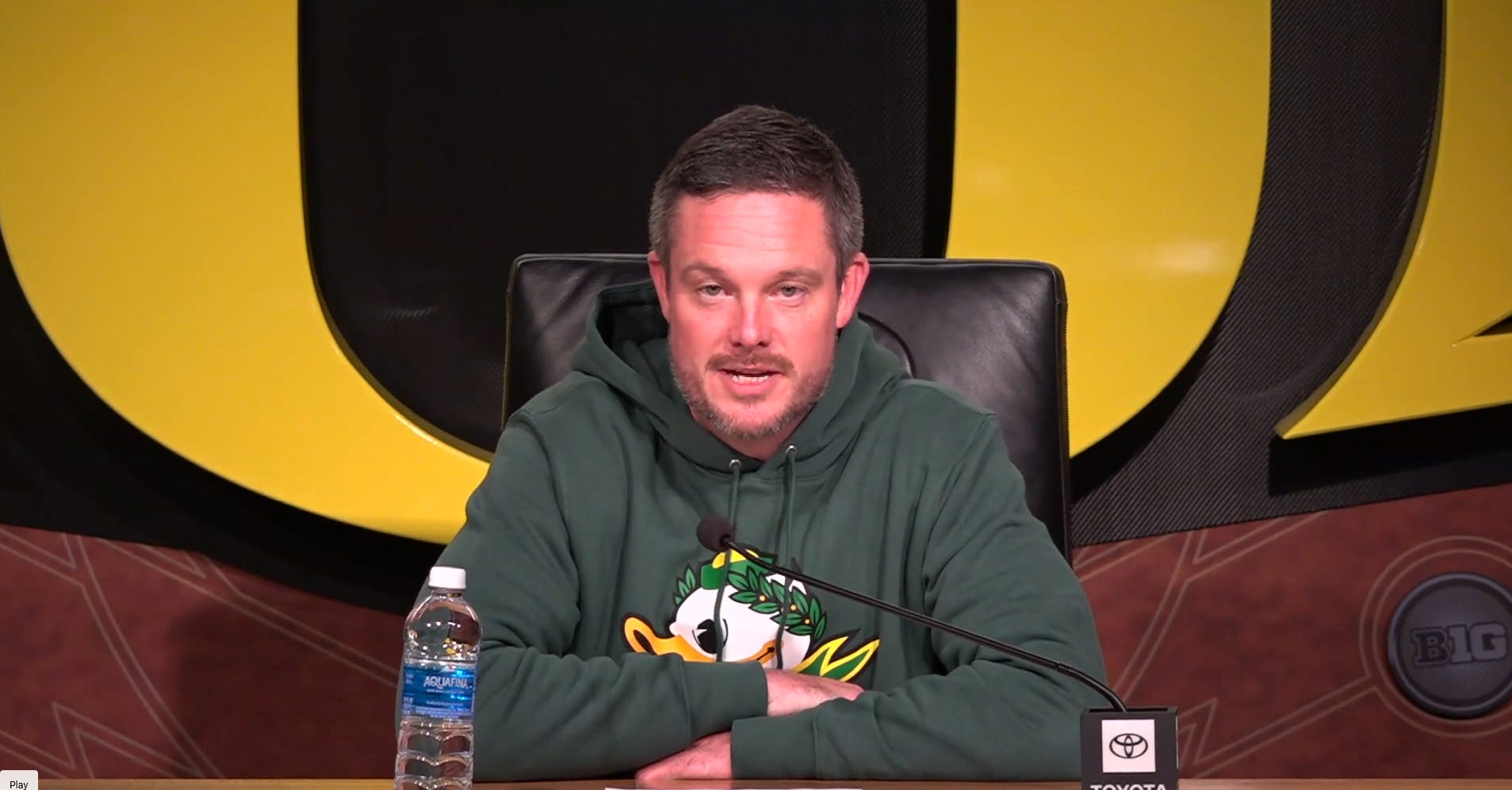
Four months after challenging his players to take ownership of the program, Lanning is seeing the results. But the road from fall camp to rivalry week has been far more complicated than anyone expected.
When Dan Lanning opened fall camp in August, he spent considerable time discussing the kind of football team he wanted Oregon to become. The Ducks had plenty of talent, returning experience and the expectations that come with another College Football Playoff appearance, but Lanning wanted something that wasn’t going to show up on a depth chart.
He wanted players who could hold one another accountable, veterans who understood their responsibility to younger teammates and a team capable of maintaining its standards when things inevitably became uncomfortable. Nearly four months later, Oregon has experienced more than its share of those moments.
Injuries have reshaped the roster, the quarterback situation changed dramatically, and the offense underwent a coaching adjustment nobody anticipated when fall camp began. There was also a stretch when the questions surrounding Oregon’s direction became considerably louder than the confidence everyone expressed in August.
Yet the Ducks enter Washington week riding four consecutive victories, their postseason ambitions restored and an opportunity to finish the regular season playing their best football. Listening to Lanning on Monday, I kept returning to those August conversations. Much of what he said sounded familiar, but the circumstances have given those words considerably more meaning than they carried before anyone had played a game.
The player-led team has finally faced adversity
Following Oregon’s first fall practice on August 5, Lanning challenged his veterans with a question that became one of the more interesting themes of camp: “You were able to make it. Who did you bring with you?”
I liked that question because it placed responsibility on players who had already established themselves. Lanning wasn’t asking whether they could handle their own assignments. He wanted to know whether they could help someone else reach the same standard.
By the end of camp, he believed that was beginning to happen.
“We talked about player-led as we came in,” Lanning said during his final August availability. “That’s starting to really show itself. Throughout fall camp, I think it’s shown itself.”
He described players requesting extra repetitions, challenging teammates and asking coaches to make practice more demanding. Poncho Laloulu wanted the crowd-noise speakers moved closer to the offensive line, while others were demanding additional work when practice periods were supposed to end.
Those were encouraging signs, but August doesn’t tell us much about how a team will respond when the season stops cooperating. Oregon has now experienced injuries, changing roles and disappointing performances, all circumstances capable of testing the relationships and accountability Lanning wanted to establish.
When asked Monday how he intended to keep his players focused amid the rivalry, Senior Day and postseason implications, Lanning returned to the lessons of the past month.
“Just remind them of reality. You know, it wasn’t that long ago that we were kind of thrown out to the curb and that’s all changed because they were able to focus on what’s right in front of them. And I think that’s the secret here, is to continue to do what you’ve done the last few weeks and focus on what you control and what you’re in charge of and do a good job in those moments.”
Oregon’s turnaround has involved substantial coaching adjustments and improved execution, so I wouldn’t suggest leadership alone explains what has happened. But the ability to remain connected when things weren’t going well was precisely what Lanning wanted to establish in August. The Ducks have now been through enough to know whether those expectations were more than something that sounded good during preseason interviews.
Consistency is still the unfinished part of the equation
One of Lanning’s more revealing observations from his final fall camp availability concerned practice consistency.
“The piece that I’ve seen with this group throughout fall camp that sticks out to me is we’ve stacked really good practices back to back to back,” he said. “And I think that’s hard to do in fall camp when it becomes monotonous.”
He described a team that wasn’t allowing one successful scrimmage to become an excuse for an ordinary practice the following Monday. Veterans were setting the pace, and younger players were learning what the standard required.
That consistency didn’t carry seamlessly into the regular season. Oregon struggled through stretches when the offense couldn’t establish an identity, and the execution didn’t always resemble the confidence everyone described during camp. The past four weeks have been considerably better, although Lanning isn’t ready to suggest the Ducks have solved everything.
“We’re playing much better than we did certainly early in the season,” Lanning said Monday. “I think we’re much more in sync. That being said, there’s still gaps that we can close, and I think that’s the piece that’s important for us, is to know exactly where we’re at, where can we improve, our players identify it, our coaches identify it, and make sure that we have a plan to go do that.”
Friday’s 45-7 victory over Michigan State provided a pretty good illustration. Oregon struggled with pass protection and offensive rhythm during the first half before adjusting its approach and overwhelming the Spartans after halftime. The response was encouraging, but nine penalties and three first-half sacks offered reminders that winning comfortably doesn’t necessarily mean playing consistently.
I’ve always believed one of the differences between talented teams and dependable ones is how quickly they recognize what’s going wrong. Oregon has become much better at making corrections, but against Washington, the Ducks may not have the luxury of spending an entire half searching for answers.
Raiola’s August development has become Oregon’s November necessity
When fall camp began, Dylan Raiola wasn’t preparing to lead Oregon’s offense. Dante Moore held that responsibility, and Raiola was working through a developmental process that required patience from a player accustomed to considerable expectations.
Following the first major scrimmage, Lanning described Raiola’s improvement from spring as “night and day.” At the time, it was an encouraging evaluation of a talented quarterback learning a new system, although nobody knew how important that preparation would eventually become.
Now Raiola is leading Oregon through its most consequential stretch of the season, and his improved decision-making has been an important part of the winning streak. Monday, Lanning acknowledged the progress while emphasizing how much responsibility rests with his quarterback.
“I think there’s even a higher level for him to operate, and he’d be the first one to tell you that. So he’s done a good job of it. I think one of the biggest things is how he’s protected the ball in the pocket, not just having two hands on the ball in those moments, making sure that we’re not putting the ball in jeopardy in the passing game, getting us in the right call or the right run check.”
Washington presents an interesting challenge because of its ability to disguise coverage and create turnovers.
“Obviously Washington is a really advantageous defense. They’ve, I think they have 17 interceptions this year. And that’s because they pitch a lot of different looks, right? And you’ve got to be able to decipher what it is. Coach Walters does a really good job of changing the picture consistently for the quarterback.”
Michigan State made Oregon’s passing game uncomfortable by keeping defenders behind receivers and forcing Raiola to work through his progressions while the pocket deteriorated. Washington can create similar problems, with additional coverage disguises designed to influence what the quarterback believes he’s seeing.
Lanning believes Raiola’s growing understanding of defensive structure can help counter that approach.
“If he’s able to take the information, we’re able to give him concepts that he can execute at a high level, I think he knows where to go with the ball. And if it’s not there, he knows that if we can play another down, that’s just as important as seeing the ball go in the air and be in jeopardy.”
That final point may be the most significant development in Raiola’s game. His arm talent was never the question. Oregon needed him to recognize when an opportunity wasn’t available and understand that protecting the football sometimes accomplishes more than attempting a difficult throw.
Four consecutive games without an interception suggest he’s making progress. Washington will provide a much more demanding examination of how well those lessons have taken hold.
The offensive adjustments have an interesting connection to fall camp
One of the more useful August conversations came from then-offensive coordinator Drew Mehringer, who was asked about expanding Oregon’s offense.
“Complexity is a little bit of a double-edged sword,” Mehringer said. “You could run 100 million plays. How many reps are you going to get all those plays? So how well do you think they are going to get executed in the game?”
I thought that was a particularly sensible answer because offensive creativity means very little when players can’t execute what they’re being asked to do. Oregon spent camp exploring personnel combinations and developing versatility, but the season eventually forced the coaching staff to confront that problem under considerably different circumstances.
Monday, Lanning discussed how Jay Johnson and the offensive assistants have approached those adjustments, particularly the contributions of Ko.
“Jay’s walking in and operating an offense that he hasn’t necessarily been in. And maybe that’s where a lot more voices start to contribute. And Ko is certainly one of those.”
“He’s extremely intelligent. He’s been around almost every position on our team on that side of the ball. He played here. It means a lot to him. But he understands, you know, how do we move elements on our offense to be able to handle blocking a certain picture? What’s an RPO that we can add that fits to this look?”
Lanning also credited Johnson for drawing on the experience of the coaches around him and giving players clearer offensive answers.
“I think Jay’s done an unbelievable job of just leaning into everybody in that room and their expertise of what do our players do well? What fits our scheme? How can we navigate that and really give it into clear pictures? So Ko has had a huge contribution to that as well as everybody else in that room.”
That emphasis on clear pictures connects directly to Mehringer’s August comments. Oregon doesn’t necessarily need a larger collection of plays. It needs players who recognize what the defense is doing and can execute the appropriate answer without making the situation more complicated than necessary.
We saw that against Michigan State, when the Ducks abandoned their unsuccessful attempts to manufacture passing opportunities and attacked what the Spartans were conceding on the ground. The coaching structure has changed, but the fundamental challenge hasn’t. Oregon is simply getting better at recognizing the answers available to it.
August’s depth chart has become November’s insurance policy
In our final preseason 3-2-1, I predicted Oregon’s November rotation wouldn’t look much like the one we expected when the season began. That wasn’t particularly bold considering the number of younger players pushing for opportunities, but the circumstances that have made some of them important have been more difficult than anyone would have preferred.
Lanning made it clear during camp that playing time wasn’t permanent simply because a player opened the season in a particular position.
“Guys’ roles, just like last year, roles can change throughout the season,” he said. “I like that we have a lot of guys that are available. I like how they’re growing quickly.”
Brandon Smith was already appearing in late-August conversations, although there was little reason to believe he’d become one of Oregon’s most important offensive contributors during the closing weeks of the regular season. With Dierre Hill Jr. leaving Friday’s game against Michigan State and Jordon Davison also dealing with an injury, the Ducks needed production from players whose opportunities had been limited.
Smith responded with 121 yards and two touchdowns on 14 carries. Simeon Price scored twice, while Da’Jaun Riggs continued demonstrating the patience and footwork that have made him an increasingly useful contributor.
Lanning wasn’t surprised by the response, pointing to the preparation that allowed those players to contribute when the opportunity appeared.
“I think they’ve shown it, right? When their number’s been called, whether that’s Brandon, whether that’s Dink, whether that’s Simeon, all those guys that have been able to step out there on the field, go execute your job at a high level.”
“Obviously Brandon had an outstanding game, had some big runs for us this last week. Simeon was able to punch in the end zone. So I think all those guys have added a lot of value. And like I’ve always said it, don’t wait for your opportunity. Be ready when your opportunity comes.”
Smith’s biggest contributions came when Oregon needed something beyond routine production. His 19-yard run from the Ducks’ own five-yard line late in the second quarter helped rescue a possession that eventually produced Gage Hurych’s fake field goal touchdown. His 48-yard run in the third quarter immediately answered Michigan State’s only scoring drive.
Those were important plays from a young running back who had spent much of the season preparing without knowing when his opportunity would arrive. Lanning declined to provide updated injury timelines for Hill and Davison on Monday, indicating he would wait until Wednesday’s availability report. Their status remains uncertain, but Oregon has considerably more evidence of what its younger backs can accomplish than it did a few weeks ago.
The same development has appeared at receiver, where Lanning praised Jalen Lott’s blocking and Gatlin Bair’s growing understanding of his responsibilities.
“I think our wide receivers have realized if you have 65 plays in a game, you might, if you’re having a great day, get to see five of those become catches to you, which means there’s another 60 plays that you can impact the game in the way that you play without the ball. And they’ve really taken some pride in that.”
We saw that against Michigan State, particularly when Dakorien Moore and Jeremiah McClellan delivered important blocks on productive Smith runs. The willingness to contribute without the football has become an important part of Oregon’s offense, and it’s something that goes beyond the individual statistics we tend to emphasize when evaluating talented receivers.
Washington will test Oregon’s discipline in ways Michigan State couldn’t
Lanning was especially complimentary of Washington quarterback Demond Williams Jr., whose mobility presents a challenge Oregon hasn’t consistently encountered this season.
“We haven’t played anybody quite this year that’s like Demond. He’s a different level. And he’s playing, right now, really high-level football. Obviously, he’s like a running back in the backfield.”
“I think with Jaden and some of the other pieces coming back for them, they’ve been able to add a little bit more to that run game that makes them more dynamic. But he’s as challenging as anybody to keep boxed up. We’ve had to play him before. And when he gets loose, it’s an issue. And he’s got great speed and athleticism.”
That brought me back to something defensive coordinator Chris Hampton emphasized during fall camp. “We have to sack the quarterback and finish,” Hampton said. “Our players also have to finish better.”
Oregon has improved considerably at generating penetration and controlling opposing running games, but Williams creates problems that can’t necessarily be solved through aggressiveness alone. Losing contain or abandoning a rush lane can turn a successful defensive call into an explosive gain, particularly against a quarterback capable of extending plays long enough for receivers to uncover.
And with former Oregon running back Jaden Lamar returning to Washington’s offense, the Huskies have another option capable of punishing a defense that becomes overly focused on the quarterback.
But I thought the more revealing part of Monday’s conversation concerned the emotional challenge of playing Washington on Senior Day. Lanning has spent much of his tenure discussing how to maintain intensity without allowing emotion to interfere with execution.
“I think in different moments in the game, it requires a different level of focus and a different level of intensity. Ultimately, there’s moments that you can coach extremely hard. There’s moments that you want your players playing loose.”
“I always say that you’re going to follow your temperament. I think there’s moments in games where it’s not always going your way and you need to be calm within the chaos too. So I think all those things can be reflected in the way we coach, but I certainly enjoy coaching with a little bit of juice.”
That balance becomes particularly important when the opponent is Washington and the game carries consequences beyond the rivalry itself. The Ducks committed nine penalties against Michigan State, and while those mistakes weren’t enough to change the outcome, Washington is far less likely to allow Oregon to overcome similar opportunities without consequences.
The Huskies are also coming off a victory over Indiana that has provided their own program with considerable confidence. Lanning acknowledged Monday that Washington has improved substantially, particularly on the road and during the fourth quarter.
Oregon won’t need any additional motivation Saturday. What it needs is the discipline to handle that emotion without undermining the work that has brought the Ducks back into the postseason conversation.
The final read
When I went back through our fall camp coverage, I was struck by how many of the questions we were asking in August have found at least partial answers during the past month.
Would the veterans maintain the standards Lanning wanted when things became difficult? Could the younger players develop quickly enough to contribute when injuries changed the rotation? Would the offense find a way to use its talent without becoming unnecessarily complicated?
Those questions were largely theoretical when Oregon began practicing. Now we’ve watched the Ducks work through them, and the team preparing for Washington looks considerably different from the one that struggled earlier in the season.
The best example may be Poncho Laloulu, whose development Lanning discussed Monday as Oregon prepares to recognize its seniors.
“Poncho’s been unbelievable here, and everybody sees the piece on the field. The part they don’t see is the piece behind closed doors, his mentorship for young players, the voice that he’s really gained over time, the work ethic that he has, and the intelligence.”
“He’s one of the guys that’s always challenging every player to do a little bit more. He’s one of the guys, when I’m talking to a freshman, they mention, yeah, Poncho said that I should do this. He’s a coach on the field for us. And he’s just an unbelievable human.”
Those comments took me back to Lanning’s question from the first practice in August: Who did you bring with you?
Laloulu appears to have provided a pretty convincing answer, and the contributions from younger players throughout the roster suggest he isn’t alone. That doesn’t mean Oregon has become everything Lanning envisioned before the season began. The mistakes against Michigan State and the challenges Washington presents make it clear the Ducks still have work to do.
But there’s a difference between talking about accountability during fall camp and demonstrating it when a season begins moving in the wrong direction. Oregon has spent much of November showing what that difference looks like, and with Washington coming to Autzen Stadium, the Ducks have one more regular-season opportunity to demonstrate how much of what Lanning envisioned in August has become reality.