


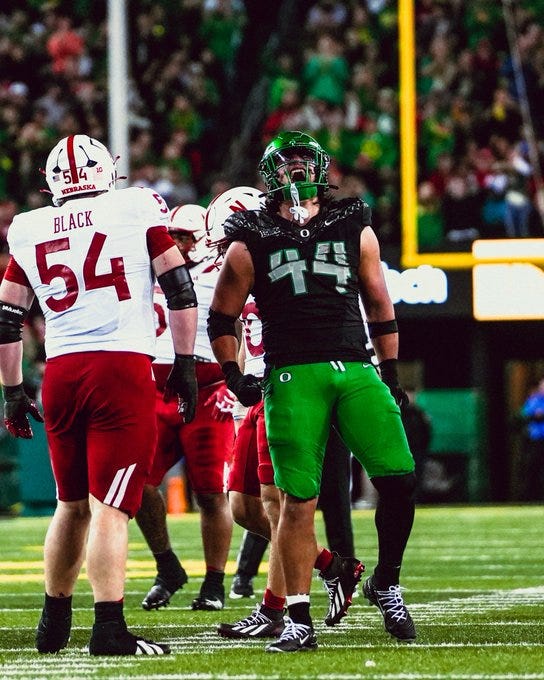
EUGENE, Ore. — For most of Saturday night, Oregon looked like a team running out of answers. Its offense was stagnant, its quarterback situation increasingly unsettled and a defense playing some of its best football of the season seemed destined to be wasted by another remarkably ineffective offensive performance.
Then Dylan Raiola returned to the field, and for the first time in nearly two weeks, the Ducks found something resembling life.
Raiola, whose disastrous first career start against UCLA a week earlier had prompted another quarterback change, came off the bench to engineer two fourth-quarter scoring drives, finding Jamari Johnson for the winning touchdown with 28 seconds remaining as Oregon rallied past Nebraska 17-14 at Autzen Stadium.
The victory improved Oregon to 4-2 and prevented a third loss in a season that began with national championship expectations but has increasingly become a struggle to establish even a functional offensive identity.
Following a four-year stretch in which Dan Lanning compiled a 47-8 record, the Ducks entered Saturday facing questions that extended well beyond the availability of injured starting quarterback Dante Moore. Oregon had struggled to establish a consistent running game, its offensive line remained unsettled and the explosive plays that once defined the program had largely disappeared.
Those problems were on full display against Nebraska, which held Oregon to just 51 yards and two first downs in the opening half. Walk-on quarterback Brock Thomas, making his first career start, completed just 6 of 15 passes for 30 yards before halftime as the Ducks went 0 for 7 on third down.
Nebraska (record unavailable) was hardly an offensive juggernaut itself, but Anthony Colandrea and the Cornhuskers found enough opportunities to build a 14-6 lead heading into the fourth quarter.
The difference, ultimately, was Raiola.
The former Nebraska quarterback entered to begin the fourth quarter and completed 11 of 18 passes for 59 yards and a touchdown while helping Oregon produce 11 unanswered points. His numbers were modest, but his ability to extend plays, make timely decisions and convert critical downs transformed an offense that had spent three quarters accomplishing almost nothing.
Oregon’s first possession with Raiola consumed 7 minutes, 42 seconds and covered 69 yards in 17 plays. Brandon Smith provided two important 13-yard runs, while Raiola converted a third down with his legs before the Ducks settled for Gage Hurych’s third field goal, a 37-yarder that narrowed Nebraska’s lead to 14-9 with 7:18 remaining.
The defense, which had spent much of the evening keeping Oregon within striking distance, delivered another stop to give Raiola one final opportunity.
Taking possession at his own 18-yard line with 5:31 remaining, Raiola directed the Ducks on an 82-yard drive that required several conversions under increasingly desperate circumstances.
He found Jalen Lott on third-and-3 to extend the possession, then connected with Lott again on fourth-and-3 at the Nebraska 33. Oregon later converted another fourth down on a wildcat run, moving into goal-to-go territory as the clock slipped under 40 seconds.
Raiola initially appeared to deliver the winner on a perfectly placed fade to Dakorien Moore, sending the Autzen crowd into celebration before replay overturned the touchdown.
One play later, Raiola stepped up against pressure and found Johnson for the score with 28 seconds remaining. He followed with a two-point conversion pass to Hudson Lewis, extending Oregon’s lead to 17-14 and leaving Nebraska with little time to respond.
Colandrea completed a 27-yard pass to Jacory Barney Jr. in the closing seconds, but the Cornhuskers could not complete the comeback.
For Oregon, the dramatic finish provided a reprieve from what had been another deeply concerning offensive performance.
Thomas finished 9 of 20 for 54 yards and an interception. Oregon managed just 113 passing yards between its two quarterbacks, and even with the fourth-quarter improvement, the Ducks averaged only 3.2 yards per offensive play.
The rushing attack showed signs of improvement after halftime, with Dierre Hill Jr. finishing with 67 yards on 14 carries and Smith adding 29 yards on six attempts. Oregon finished with 129 rushing yards after managing only 21 in the first half.
The Ducks converted just 3 of 16 third downs, although their perfect 3-for-3 performance on fourth down proved decisive.
The offensive struggles were particularly frustrating because Oregon’s defense repeatedly provided opportunities for the Ducks to take control.
Teitum Tuioti recorded two sacks and 2½ tackles for loss, while Nasir Wyatt added another sack and two tackles for loss. The Ducks finished with three sacks, eight tackles for loss and held Nebraska to 78 rushing yards on 33 attempts.
Oregon’s defensive front controlled much of the first half, consistently generating pressure while the secondary limited opportunities downfield. Ify Obidegwu intercepted Colandrea early in the second quarter, giving the Ducks possession at the Nebraska 14-yard line after a punt had pinned the Cornhuskers deep in their own territory.
But Oregon immediately squandered the opportunity when Jordon Davison fumbled on the ensuing play, with Nebraska recovering.
It was a sequence that captured the frustration of the night. Each time Oregon’s defense or special teams created an opportunity, its offense seemed incapable of taking advantage.
Nebraska finally broke through late in the first half after converting a third-and-22 with a 31-yard pass and another third down on a 17-yard Colandrea scramble. Colandrea eventually found Kwazi Gilmer for a touchdown, giving the Cornhuskers a 7-0 halftime advantage.
The Ducks benefited from a Nebraska punting mistake early in the third quarter, taking possession at the Cornhuskers’ 19-yard line after the punter’s knee touched the ground while fielding a low snap. Oregon managed just one yard before Hurych converted a 36-yard field goal.
Another promising Oregon possession ended with a second field goal, cutting Nebraska’s lead to 7-6, but the momentum quickly shifted again.
A tipped Thomas pass was intercepted, and Nebraska capitalized on the ensuing possession. Isaiah Mozee broke free for a 26-yard run to the Oregon 9 before Colandrea scored on a quarterback scramble, extending Nebraska’s advantage to 14-6 with seven seconds remaining in the third quarter.
Colandrea finished 18 of 33 for 156 passing yards, one touchdown and one interception. Gilmer led Nebraska’s receivers with six catches for 74 yards and a touchdown, while Colandrea added 38 rushing yards and another score.
The Cornhuskers’ defense was formidable throughout the evening. Owen Chambliss recorded 15 tackles and two tackles for loss, while Ceyair Benning contributed 12 tackles, 2½ tackles for loss and a forced fumble. Donovan McDougle III added 13 tackles and an interception.
Nebraska recorded 11 tackles for loss and held Oregon to just two first downs before halftime, but could not prevent the Ducks from converting the fourth downs that ultimately determined the outcome.
For Lanning, the victory offered both relief and another reminder of the challenges facing a team that entered the season with considerably higher ambitions.
Oregon has now struggled through consecutive games with two different starting quarterbacks, raising questions about an offensive system that has failed to consistently protect its passers, establish the running game or create favorable situations for its playmakers.
Raiola’s fourth-quarter performance demonstrated that the Ducks still possess enough talent and resilience to manufacture a victory under difficult circumstances. It did not resolve the larger questions about the offensive line, quarterback development or the limitations that have become increasingly apparent in Moore’s absence.
What Saturday did demonstrate was that Oregon’s defense remains capable of keeping the Ducks competitive, even when the offense provides little assistance.
For most of the evening, that seemed unlikely to be enough.
In the final 28 seconds, it finally was.
Game honors
Player of the Game — Dylan Raiola, Oregon QB
Raiola’s final numbers — 11 completions on 18 attempts for 59 yards and one touchdown — hardly tell the story. After struggling badly against UCLA a week earlier, the sophomore entered with Oregon trailing by eight and directed two fourth-quarter scoring drives. His decision-making, poise under pressure and execution on critical downs provided the difference in a game Oregon appeared destined to lose.
Key Play — Raiola’s fourth-down completion to Jalen Lott
Facing fourth-and-3 at the Nebraska 33-yard line with the game on the line, Raiola found Lott on a well-executed route just beyond the first-down marker. The completion extended Oregon’s final possession and provided the opportunity for Johnson’s winning touchdown moments later. Without that conversion, the comeback likely ends there.
Key Stat — Oregon converts 3 of 3 fourth downs
The Ducks finished a miserable 3 of 16 on third down and managed just 242 yards of total offense, but converted all three fourth-down opportunities. Those conversions, including two on the decisive fourth-quarter touchdown drive, allowed an offense that had struggled all night to finally produce the points it needed to win.
What a game. Still lots of questions but it's a bit easier when you win.