


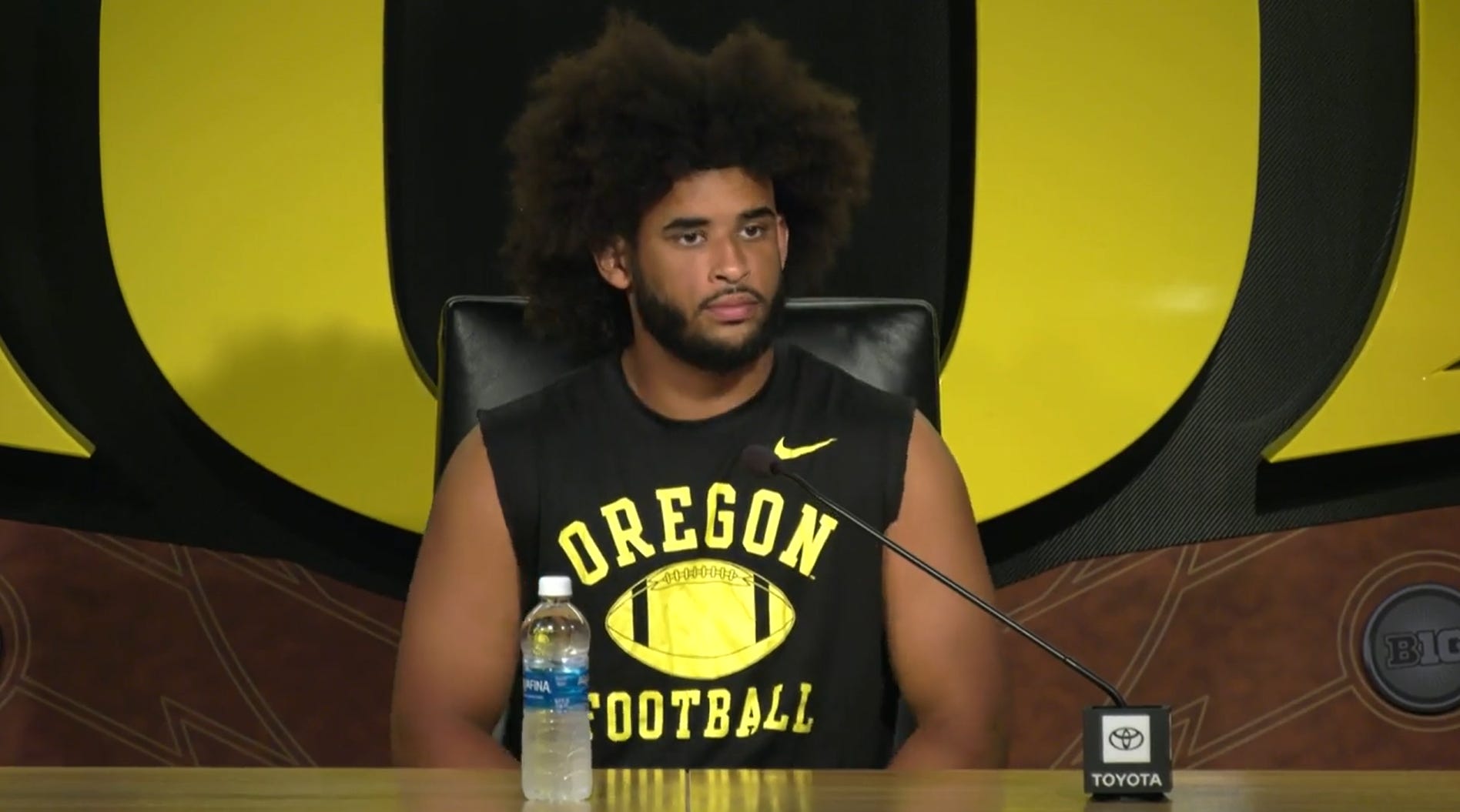
Dan Lanning was more candid than usual this week as the Ducks worked through a shortened turnaround, and Oregon’s players kept coming back to the same conclusion: many of the problems that surfaced at Oklahoma State had already started showing themselves before the game.
There will not be another Oregon football media availability this week. The Ducks play Portland State on Friday night, which compressed everything after Saturday’s loss at Oklahoma State into a few days of film, practice, corrections and, at least publicly, some fairly uncomfortable conversations about how Oregon reached this point.
That probably makes these interviews more useful than they might normally be during a week in which Oregon is preparing to play an opponent it should handle comfortably.
Duck Sports Central is a reader-supported publication. To receive new posts and support my work, consider becoming a free or paid subscriber.
There was not much interest Tuesday in pretending Oklahoma State was simply one bad Saturday that came out of nowhere. Dan Lanning had already started moving away from that explanation after watching the film, and several of Oregon’s veteran players took it another step. They kept coming back to practice habits, leadership, details and mistakes that were tolerated during the week and eventually became much more expensive when the Ducks reached Stillwater.
Lanning was also noticeably more candid than he typically is in these settings.
He called the Oklahoma State loss “by far the worst performance that we’ve had since I’ve been here.” He described Oregon’s pass protection as “poor, really poor.” He acknowledged that the Ducks were “outcoached” and “outplayed,” admitted his late fourth-down decision was wrong and, perhaps most significantly after spending an entire offseason talking about this being a player-led team, said Oregon has not gotten enough leadership through the first two games.
That last part seemed to land.
What happened Saturday was already happening in practice
There was a fairly revealing moment Monday when Lanning was asked how Oregon’s much-discussed player leadership should manifest itself after a loss.
“At this point, there’s been a lack of leadership, right? Myself included,” Lanning said. “I think, so one, it starts with accountability, but it’s got to show up. So again, can’t talk about it. You got to see it, right? You have to see it. So we haven’t seen it to this point.”
The important part came a few sentences later.
“We didn’t practice well enough last Wednesday to think we’re going to have a great performance on Saturday,” Lanning said. “Mistakes you make in practice, they’re going to show up, and somebody has to speak on it, right? Coaches have to speak on it. They have to demand it. Players have to do it, right? And we all own that. We all wear that.”
That was considerably different from trying to explain Saturday through a handful of missed tackles, penalties or schematic surprises.
Poncho Laloulu went even further because he apparently saw some of it happening before the Ducks ever left Eugene.
“During last week’s practice, I kind of got on the mic and kind of got on the guys,” Laloulu said. “There’s some kind of lackadaisical stuff going on, and it showed up in the game. Whatever you do in practice is going to lead up into the game. So the habits that you create in practice, it’s going to show up right there on Saturday.”
That connects directly back to something Teitum Tuioti said while the Oklahoma State loss was still fresh. Tuioti talked about Oregon killing itself with penalties and individual players not doing their jobs, including himself, before saying the correction had to begin immediately in practice. He also wondered aloud whether Oregon had been too lackadaisical or had spent too much time listening to the preseason attention surrounding a defense many of us expected to be among the best in the country.
A few days later, Laloulu essentially described seeing the same warning signs.
“I just could tell just based off how people are just performing in practice and based on how they’re just, you know, moving,” he said. “That’s something, you know, me as a leader, I have to step in, you know, tell them, ‘Hey, got to wake up.’”
Laloulu kept returning to that point throughout his interview. Asked about offensive-line inconsistency, he talked about leaders holding players accountable and “not letting the little things … out the cracks.” Asked about correcting the offensive line before Oregon eventually travels to USC, he quickly pushed the discussion back to the current week.
“Right now we’re not worried about L.A.,” he said. “Right now we focus on us.”
That sounded a lot like Dante Moore’s description of what practice has looked like since Saturday.
Moore called Oregon’s long-term objectives its “telescope goals” and the immediate work its “microscope goals,” which was probably the best description Tuesday of what Lanning has been asking from his team.
“We’ve been attacking every single day, trying to win the day, find our mistakes at practice,” Moore said. “Sometimes redoing the play over again, pausing that period to communicate, talk as a team. And I kind of feel like that’s just huge. We’re just finding little details because little details can turn to big things, big issues.”
Devon Jackson offered another detail that caught my attention. Oregon is not simply correcting mistakes later in the film room.
“If we see a mistake, we’re fixing it on the spot,” Jackson said. “That may make practice a minute or two longer, but it needs to be done. No more mistakes, no more errors, no more slip-bys are allowed to happen.”
We hear variations of that every football season. After what happened Saturday, however, Oregon has given us a reason to pay closer attention to it this time.
Player-led suddenly means something different
One of the central themes of Oregon’s fall camp was that Lanning believed this team had become increasingly player-led.
There were good reasons for him to feel that way. Veteran players were asking for more work during camp. They wanted extra repetitions. At times they did not want practice to end. Lanning pointed to players correcting one another and talked repeatedly about the importance of the coaches eventually having to say less because the standard was being carried by the locker room.
Two games into the season, he has changed the tone considerably.
“I didn’t see enough leadership in the game,” Lanning said. “There wasn’t enough.”
He was careful to separate that from effort.
“We have players that absolutely care, right?” Lanning said. “I didn’t watch the game and say, ‘Man, there’s no effort here.’ I didn’t watch the game and be like, ‘This guy’s trying to screw up.’ I didn’t watch that.”
Then came perhaps the more useful distinction.
“Being careless and caring are two different things,” he said. “Being careless at moments, that showed up in the game. And then leadership has shown up, but it’s got to show up more.”
That seemed to be the uncomfortable middle ground Oregon was trying to work through this week. Nobody who spoke suggested that the locker room had fractured or that players had stopped caring. In fact, every indication was almost the opposite. The problem was that caring about the result had not consistently translated into the level of preparation and execution required to produce it.
The players did meet without the coaches after returning from Oklahoma.
Nobody was particularly interested in sharing the specifics, but Moore described the meeting as more conversational than confrontational.
“The player-led meeting was great,” he said. “I feel like, you know, every team needs it. Just to communicate, debrief, talk about the thoughts everybody’s having in their heads.
“Wasn’t much screaming going on. It was just trying to get on the same page with everybody. And I feel like it was very important because we needed it.”
Jackson also acknowledged the meeting while declining to reveal much about what was discussed.
“We met and we talked about it, and things will definitely be different from here on out,” he said.
Later, Jackson offered a little more insight into the larger conversation.
“Remember our why as a team,” he said. “And individually, it doesn’t matter. I don’t even speak personally. I don’t even got no individual goals, to be honest with you. Everything I want to do this year is for the team. Like, I’ve been here long enough. I’ve been close.”
There is no way for us to know from outside the building exactly what changed in those conversations, and a player meeting after a loss is only meaningful if something actually changes afterward.
Lanning essentially made that point himself.
“The guys have the right mindset,” he said. “But again, those are words, right? There was action today. There was a good practice today. And then, again, we’ll see what the response looks like.”
That is probably the proper place to leave it until Friday.
The little things are becoming fairly large things
Oregon has talked a lot about returning to the basics this week, but “basics” can sometimes become one of those football words that explains everything without really explaining anything.
This time there were specifics.
Lanning started with first down.
“One of the big clear ones is we don’t win on first down,” he said. “And when you don’t win on first down, on defense or on offense, you put yourself in bad situations on second and third down.”
Offensively, he described Oregon as “feast or famine” and said the Ducks have to become more creative in the running game. Defensively, he pointed to tackling and an inability to create enough negative plays.
There are also the penalties. Oregon was hurt by them against Boise State and again against Oklahoma State, which Lanning viewed as evidence that some problems were not actually being corrected.
“When one guy jumps offsides in one game and then turns around and jumps offsides in the next game, his level of focus isn’t where it needs to be,” he said.
Then there is the issue Oklahoma State players raised after the game about Oregon tipping run and pass through pre-snap tendencies.
Lanning did not dismiss it.
“In general, you have tendencies at times,” he said. “They’ll show up. We have to do a better job policing that for sure.”
There are occasions when an offense can intentionally establish a tendency and use it against a defense later, which Lanning also noted. But he acknowledged this was something Oregon addressed after reviewing the Oklahoma State game.
Moore did not appear particularly bothered that the Cowboys had talked publicly about it.
“I’m glad they brought it up,” he said. “I’m glad that they, you know, got it all into the media. … It just shows me as a player that, you know, I have things that I need to fix, and every player has it.”
The quarterback has his own corrections.
Moore admitted there were throws Saturday when he did not completely trust what he was seeing.
“There were some throws where I second-guessed myself, knowing that I told myself whenever I throw the ball, I want to have full confidence and full just trust in myself,” Moore said. “And I second-guessed a lot of throws.”
Later, he took responsibility for the larger operation.
“There was a lot of misreads, a lot of misthrows,” Moore said. “It all falls onto me. There were some times where it was miscommunication. It all falls on me.”
That does not mean everything actually belongs to the quarterback, and Lanning certainly did not evaluate the pass protection that way.
“Poor, really poor,” Lanning said when asked specifically about it. “Especially when you talk about three-man rush losing, right? It’s not good.”
Lanning talked about giving the tackles more help from the guards, putting Laloulu on an island more often and using chips when needed. Moore, meanwhile, pointed to his own responsibility for identifying fronts and helping set the protection before the snap.
There was a similar level of specificity around fourth down. Oregon is 0-for-6 this season, and Moore said the Ducks have been intentionally creating fourth-and-3, fourth-and-5 and other situations during practice so those moments do not feel foreign when they return.
Lanning took his own accountability one step further when he revisited the fourth-down decision late against Oklahoma State.
“Wrong decision on my part,” he said.
He even pushed back against the analytics defense coaches sometimes use after an unsuccessful fourth-down attempt.
“Numbers might say, ‘Hey, that’s the right decision.’ It’s the wrong decision. It didn’t work.”
That answer stood out because Lanning is generally willing to explain the reasoning behind an aggressive decision and live with the outcome. This time he still explained why he made it, but he did not use the process to insulate himself from the result.
It was part of a broader availability in which Lanning seemed less interested than usual in sanding down the rough edges of the evaluation. Oregon was outcoached. Oregon was outplayed. The protection was poor. Leadership had not been good enough. His decision was wrong.
There was not much ambiguity.
Now Oregon has to put something different on film
A short week might actually be useful after a game like this because Oregon has not had much time to sit around and discuss what happened.
Lanning said he was anxious to play again. Moore said the players have been “practicing our asses off.” Jackson described the current feeling inside the program as “a fire on your seat,” while Laloulu offered perhaps the most grounded assessment of where Oregon sits after two games.
“Right now, currently, that is our resume,” Laloulu said. “That is what we are right now based off what we just played and how we showed up this past Saturday.”
That is probably a more useful starting point than anything Oregon believed about itself in August.
The Ducks can still believe they have enough talent. They can still believe the offensive line problems are fixable, that the defense can become what it was expected to be and that a loss in September does not have to determine what happens in November or December.
But the most interesting thing about this week was how little anyone seemed interested in selling that possibility.
Jackson said Oregon has to “determine who we want to be.” Laloulu kept dragging the conversation back to practice. Moore talked about correcting the next throw, the next protection and the next detail. Lanning repeatedly refused to move the discussion toward Oregon’s larger goals because, as he put it, none of those goals matter if the Ducks continue playing the way they have played.
Portland State provides the next opportunity Friday night, but the opponent almost feels secondary to the larger question this week.
Oregon spent much of August talking about a player-led team, high standards and practices designed to make Saturdays easier. Two games into the season, the Ducks have been forced to confront the possibility that some of those things existed more consistently in conversation than they did when they were actually required.
There are signs Oregon recognized that this week. The players met. Practices have stopped for immediate corrections. Veteran leaders are talking more. Lanning sounds considerably less interested in protecting anyone, including himself, from uncomfortable evaluations.
Whether any of that matters will become much easier to judge Friday.
As Lanning said at the beginning of the week, Oregon can say it has responded, but that is no longer enough.
“You have to prove it,” he said. “You can’t just say it. You got to show it.”
Good stuff Scott. Like anything we we do personally or professionally, some level of preparation is required. When you cut corners preparing it bites you every time.
Very hard lesson learned. (I hope)