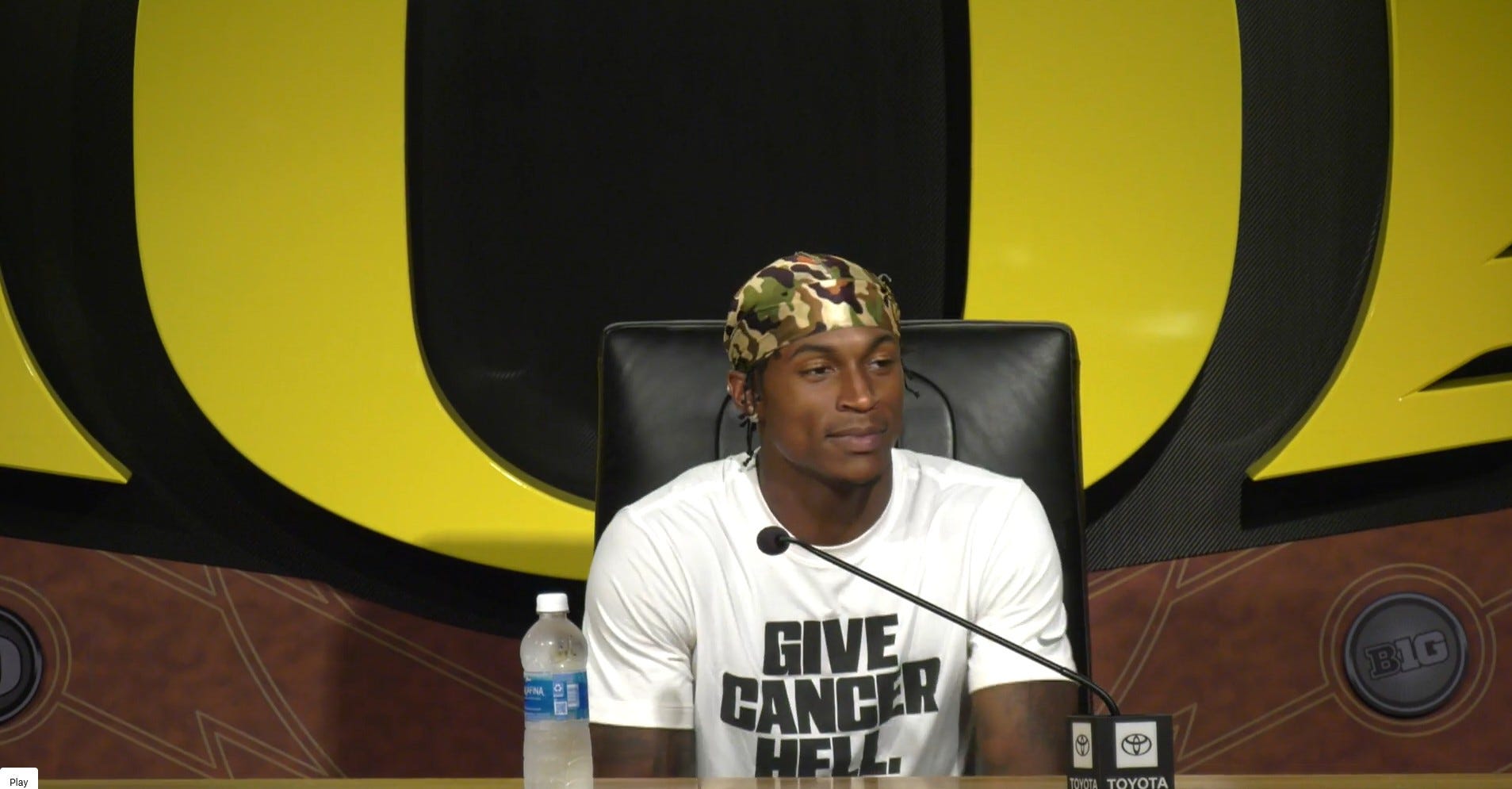
Drew Mehringer still has an idea board full of possibilities, but Monday’s interviews with Mehringer, Evan Stewart and Poncho Laloulu offered a better clue about what Oregon’s offense may actually look like when the games begin.
I went into Monday expecting most of the conversation to come back to what Dan Lanning said after the second scrimmage. The offense had moved the football but did not finish enough drives, the offensive line was still sorting through combinations and Lanning had again talked about the value of practicing against a defensive front that is supposed to make Saturdays easier.
We got plenty of that, but I thought the three interviews went somewhere a little more interesting. Drew Mehringer, Evan Stewart and Poncho Laloulu were talking about different parts of the offense, yet they kept coming back to how much Oregon can ask players to do without slowing them down and how much trust is required before all of those possibilities can actually become part of the offense.
I think that may be one of the better clues we have gotten about where Oregon is headed. The Ducks may not be trying to become more complicated by adding an endless number of plays; they may be trying to make the same personnel capable of giving them more answers.
Mehringer has plenty of ideas, but the question now is whether Oregon needs them
The last time we heard extensively from Mehringer earlier in camp, he called complexity a “double-edged sword.” Oregon can carry as much offense as the coaches can dream up, but every additional play also takes repetitions away from something already in the offense, and eventually the value of having another answer becomes smaller than the value of executing the answers you already have.
Monday, Mehringer gave us a pretty good look at what that process actually looks like inside the offensive staff room.
“You know, I think that it’s always a fine line and a balance of, you know, we could do this. And really the question is, do we need to do it?” Mehringer said. “There’s always ideas. Like I have an idea board in the offensive staff room where guys are like, ‘Hey dude, this play would be awesome.’ Right? And you’re like, ‘Okay, great. Like, what are we going to put that in?’ You know, I don’t know.”
I like that answer because it sounds a lot different from a coordinator trying to prove how much offense he knows. Mehringer obviously has no shortage of things he would like to try, but the season is close enough now that “that would be a cool play” is probably not a good enough reason to spend practice time on it.
He also made clear that the extra offseason time has allowed Oregon to work through much more than plays. The Ducks have had time to cover situations, what they want players to see and how they want them to respond when the defense gives them something different, which sounds more useful at this point than simply putting another formation into the playbook.
Mehringer’s description of the offense’s progress made the same point. Earlier in camp, a receiver might have been thinking mostly about whether he lined up correctly and ran the corner route he was assigned. Now the standard has moved considerably beyond that.
“You start to see guys start to get comfortable in what they’re being asked to do,” Mehringer said. “You start to see the fundamentals and details of, it’s not just that they’re going in the right way, right? They’ve got great hand placement. They’ve got great footwork, right? There’s great communication on, you know, when the defense changes or blitzes or whatever it is, right, what communication has to go on. So it’s more than just lining up out there and saying, ‘Hey, I got a corner route.’”
That is a pretty big difference from where an offense usually starts in August. Knowing what you are supposed to do is one level; understanding enough of the whole picture to know what changes when the defense moves is something else entirely.
It also sounds a lot like what Mehringer was telling us earlier in camp about using players rather than sheer play volume to create multiplicity. Dierre Hill Jr. was one example then because Oregon can put a player with his skill set in different places and change the way a defense has to account for him without necessarily installing a completely different offense.
Stewart may now be another example.
Stewart is playing more positions than he did in 2024
Mehringer was asked what Stewart had done to earn his role back after missing last season, and the answer went much further than saying he got healthy. Mehringer said Stewart’s talent was never really in question, but the year away created an opportunity to change some things that needed to change.
“When Evan was coming back in January, I remember talking to him, and I was like, ‘Hey, this is what’s going to happen moving forward for you. And this is the stuff that you’ve got to get better at,’” Mehringer said. “And let’s look at this from just the year of 2026, and let’s look at this as it pertains to your football career moving forward after that. Here’s all the areas you’ve got to grow and improve.”
Mehringer then said Stewart changed “almost all of his work habits” and has had an “unbelievable camp,” but the part I found most interesting came at the end of the answer.
“He’s worked his tail off,” Mehringer said. “He’s playing a number of different positions for us right now, more than he did for us in 2024. So I’m really excited about the season that he’s going to have for us and very proud of him for the way that he’s worked.”
That last part feels important.
Oregon already knew Stewart could run routes and make difficult catches. If he can now move around the formation more than he did the last time he played, Mehringer has another way to change the picture for a defense without changing personnel or reaching deeper into the idea board.
That also helps explain why Mehringer’s comments about complexity sound different now than they did when camp began. More offensive knowledge in the players can create more possibilities without requiring more calls.
Trust may be the actual separator in some of these competitions
Mehringer gave us one of the better answers of the day when he was asked how freshman Messiah Hampton can separate himself in a receiver room this deep. He did not talk about a particular route, speed or some big play Hampton has made in practice.
“I think for anybody at any position, Messiah included, the separation factor is just simply what you do on the field,” Mehringer said. “For a lot of people, it’s the other 10 guys on the field trust you. You’re going to be in there. You’re going to make plays. And Messiah has come along. He’s had a really great last week, and I think he’s doing some really, really good things for us.”
Then Mehringer gave an answer that probably applies to considerably more than Hampton.
“I tell everybody the answer to every single question that you’ll ever have in football is play well,” he said. “Coach, how do I get drafted? It’s play well. How do I get playing time? Play well. It’s all the same.”
The trust part is what stayed with me because Poncho came back to almost the same idea later when talking about freshmen on the offensive line.
Poncho remembered being in their position four years ago, with older players standing between him and the field, and said he tells the younger linemen that the opportunity being available does not mean anyone is going to give it to them.
“I kind of told them, though I had older guys in front of me, I wanted the spot and I wanted to play,” Poncho said. “I didn’t want to be on the sidelines. And I wanted to make sure that I had the trust from the coaches and Coach Lanning and everybody that was here and let them know that they can trust me. When I go out there, I’m going to do my job.”
Poncho continued by bringing it back to all of the work they have already done.
“We’ve been preparing this whole year through winter workouts to spring ball, then to summer and then into fall camp,” he said. “We shouldn’t have any fear about anything. Just trust your technique and fundamentals and just trust the guys beside you.”
Those answers fit together almost too well.
The depth chart most of us want to see is a list of names. The one Oregon is building may have more to do with which player can enter a game without the other 10 guys wondering whether he is going to recognize the same pressure, make the same adjustment or understand why the call changes when the defense moves.
That becomes even more important as opponent preparation begins.
Monday looked like the response Lanning wanted after Scrimmage Two
Lanning said Saturday that the defense got the better of the offense, and Mehringer did not spend any time trying to explain away the result. His answer about Monday was pretty straightforward.
“I think our theme after that was reset, refocus, and those guys did that, I thought,” Mehringer said. “I thought we had a much better day today. The execution and detail and all the things that you’re looking for were a lot higher.”
Stewart was even less diplomatic about which side has been winning lately.
“A whole lot of back and forth competing, for sure,” Stewart said. “Some days, I ain’t going to lie, early on, offense was winning. But lately, defense has been whooping us, I ain’t lying. But it’s been good competition. It’s been evened out. And it’s always nice knowing that you have a good offense and a good defense because we can play off each other. And then when you tag in special teams, it’s like, yeah, got a pretty good team.”
I would not read too much into whether the offense or defense has accumulated more wins during camp. Oregon’s defensive front has been one of the most consistently praised groups on the roster, and the whole point of Lanning wanting practice to be harder than the game is for that group to expose problems before an opponent does.
Poncho certainly sounds as if he sees it that way.
“It feels amazing. It feels great,” Poncho said when asked about finally getting closer to preparing for another team. “I’m thankful and grateful, like I said, to go up against guys like that every single day. It kind of prepares me so I know, like, go through practice right now, so when game time comes, I’m ready to prepare because I already went through this type of look.”
He then went through some of the players the offensive line sees every day, including Bear Alexander, A’Mauri Washington, Matthew Johnson and Tank Jones, before coming back to how much he values those daily battles.
“Just going against them every single day, you know, in the trenches, battling head to head is amazing,” Poncho said. “So I’m just thankful that I get to go against the guys every single day.”
The part we will not know until the season begins is whether all of that difficulty actually transfers. Monday was encouraging because Mehringer thought the details improved immediately after a scrimmage in which Oregon did not finish enough drives, but the proof eventually has to show up against someone wearing a different uniform.
Stewart sounds much further along than simply being healthy again
There was a point in the spring when most of the Stewart conversation was about the green jersey and whether he would be ready to handle everything once Oregon turned the contact back on. He does not sound like a player who is thinking much about that anymore.
Stewart admitted that the opener is starting to affect his sleep a little bit.
“I’m a little bit jittery right now,” Stewart said. “Just late-night sleeps, just thinking about it, waking up, just hoping the day gets closer. I mean, yeah, just counting the days down. Just a blessing to be here, honestly.”
When he was asked about going from spring to fall camp and proving he could handle the work again, Stewart pointed to the obvious change.
“In the spring, it was more like they had me in a green jersey. Everybody was saying he’s in a different jersey, but now they took the green jersey off, and this fall camp has been very action-packed for me, for sure,” Stewart said. “So, yeah, just taking on a bigger role and really filling in those shoes, it’s been elite.”
The time away does not seem to occupy much space in his head anymore either. Stewart said that once he got back on the field in spring it felt like he had never really left, and the accumulation of practices against good competition has brought back most of the comfort he needed.
Mehringer sees the comeback a little differently because he has watched what Stewart changed away from the actual routes. He talked about Stewart’s confidence, but also made a distinction between confidence and arrogance that probably says more about where Stewart is now than any camp stat could.
“Evan does not lack confidence at all,” Mehringer said. “I feel like Evan walks around with that all the time. Evan’s grown so much in the sense that his cockiness doesn’t turn into arrogance at all, and his ability to go do it, but he wants to be coached and he wants to get better and he wants to develop. He doesn’t want to walk off the practice field and nobody said anything to him about how he can improve his performance.”
Mehringer also described a player who rarely has a bad day emotionally.
“He’s got a big smile on his face. He dances,” Mehringer said. “He’s a stud. I love being around Evan.”
That personality came through when Stewart explained why he approaches football with so much joy. He said the game is hard enough that he does not see any reason to make it heavier than it already is, and he likes being the player somebody else can look at during a difficult day and remember to relax a little.
Poncho added another layer that I do not think we had heard before Monday.
He said Stewart has become one of the voices of the offense.
“I’ve seen Evan in the treatment room. I’ve seen Evan with the young guys, just coaching them up on the field, off the field,” Poncho said. “And just seeing him grow in that role, because usually Evan, everybody knows Evan usually is the guy. So for him to sit out this past year kind of really taught him and I think kind of humbled him in a way.”
Poncho then pointed to the change he can actually hear at practice.
“Now I can hear Evan’s voice out at the field where it’s no longer just me and Dante,” Poncho said. “Everybody knows Evan is that guy. And when Evan speaks, it has a lot of volume behind it.”
That may be one of the better Stewart developments from the entire interview.
Oregon is not simply getting the receiver it lost after 2024. The Ducks may be getting a more versatile receiver, a better practice player and someone who now carries enough experience in the room that younger players are listening when he says something.
Stewart’s connection with Dante Moore is probably beyond the chemistry stage
We have heard about Stewart and Moore working together throughout the offseason, but Stewart gave his strongest description yet of where the relationship stands.
“I would say we’ve been hot, for sure,” Stewart said. “I was talking about him the other day with my pops. I actually don’t think I’ve had this type of connection with a quarterback in a minute, dating back to high school, honestly. He throws a very nice ball. He knows what’s going on. He’s very elusive. He’s a gamer, so it’s fun to play with a guy like him for sure.”
Stewart finished the answer with something that probably captures his excitement better than anything else he said Monday.
“This fall camp has really showed me what I was missing out on last year,” Stewart said. “So I can’t wait.”
That is considerably more than two players saying they have good chemistry.
Mehringer has already said Moore’s football knowledge is among the best he has been around, while leadership has been one of the biggest areas of growth for the quarterback. A’lique Terry has talked previously about Moore and Poncho understanding enough of the offense to have conversations that go well beyond their own assignments, which gives Oregon two experienced players in the middle of the operation while the line around them is still being sorted.
Now add a healthy Stewart who is lining up in more places and believes he has one of the better quarterback connections of his career. We will see how it looks once a defense starts game-planning specifically to take him away, but the foundation sounds considerably further along than it did even in spring.
The offensive line is still being sorted, but the cross-training has not stopped
Lanning said Saturday that some offensive linemen have begun separating themselves through consistency, but Poncho did not make it sound like Oregon has simply settled on five and closed the competition. He said the group is still “trying to figure out who’s going to be on that field,” and the standard he keeps coming back to is the one established by the linemen who came before this group.
Poncho mentioned Jackson Powers-Johnson, Steven Jones and Josh Conerly Jr. as players he learned from, and his description of the standard was not complicated.
“It’s a big standard,” Poncho said. “You want to make sure that we’re protecting the guys at all costs and just making sure that we set the law firm, you know, that’s what we are. So we want to make sure we set things straight.”
What I found more revealing was how much movement is still happening behind the obvious competition.
Poncho said Tommy Tofi has played all four offensive-line positions other than center. At center, Oregon has been working Bryce Boulton, Devin Brooks and Koloi Keli, while some of the guards are also getting work there as Oregon tries to make sure the best five eventually get onto the field.
“Just seeing those guys battle every single day, because at the end of the day, we want to make sure the best five is out there,” Poncho said. “And right now, I’d probably say we got probably one of the best O-line groups I’ve been around where a bunch of guys can step up and play at any time. So that’s what I’m very excited to see.”
That is a pretty strong endorsement from somebody who has been part of several good offensive lines at Oregon.
I still think the cohesion question matters because A’lique Terry has been talking about finding the right mesh and eventually “gluing” combinations together since the first half of camp. But Poncho’s answer sounds much more like Oregon is sorting through useful options than searching for enough capable linemen to survive.
Poncho is becoming part coach for a reason
Mehringer called Poncho “the rock, the apex” of the offensive line earlier in camp, and Monday gave us more context for what that actually looks like within the room.
Poncho was asked whether he feels almost as much like a coach as a player at this point, and he did not shy away from the responsibility.
“I’m just grateful and thankful for that opportunity, really, because I was once in their shoes before,” Poncho said. “So being able to lead and help those guys out in terms of whatever it is, whether we’re off the field or on the field, just helping them out in life and in the game means a lot. And I’m very big on pouring back into the youth and into the younger guys, so I want to make sure I can lead like that and lead by example and just having that servant leadership mindset.”
That showed up several times in the interview.
Poncho talked about Tommy Tofi and Manny Iheanacho constantly asking questions instead of sitting quietly in the back of the room. Tommy has had more time in the program and Poncho sees a significant difference from when he arrived, while Manny’s ability to answer questions after arriving during the summer has stood out because of how quickly he has absorbed the offense.
Michael Bennett III is approaching the process similarly.
“He got the brains. He picked up things kind of quick, I’m not going to lie,” Poncho said. “Just seeing the way he comes in, attacking every single day and the questions he has, like after probably every rep or whatever, he’ll come up and ask me a question. And I like that because that means he’s into it. He wants to learn. He wants to understand our scheme better.”
That seems to be the common thread in this offensive-line competition. The physical ability gets a player into the conversation, but the people earning trust are the ones moving beyond memorizing their own job and beginning to understand what the rest of the line is doing.
Poncho is in a pretty good position to teach that because he already had to learn it himself.
The receiver room may be even deeper than the names we have been talking about
Most of the receiver conversation has centered on Stewart, Jeremiah McClellan, Dakorien Moore, the other established rotation players and Gatlin Bair. Monday gave us another name worth keeping in the notebook with both Mehringer and Stewart talking about Messiah Hampton.
Mehringer said Hampton has had a really good week, while Stewart said he saw signs as far back as winter workouts and spring that Hampton had a chance to help.
“He’s maturing a lot,” Stewart said. “I already knew he was kind of going to be a good player for us in the spring, coming early in winter workouts. Him and Hudson Lewis, they’re like a dynamic duo. They work together. They’re workhorses for sure. And Messiah just came in and put down his head and worked every single day.”
Stewart also offered a useful explanation for why Bair appears to be catching up after so much time away from football.
“Gatlin’s very smart,” Stewart said. “That’s one thing that definitely helped him out whenever getting back and knocking the rust off because, I mean, the physicality for Gatlin, it was always going to be there. So the mental that Gatlin got has definitely helped him, and he’s definitely stepping up and making plays.”
Mehringer’s answer about the entire room also sounded a lot like Ross Douglas did last week. He likes the talent, but he was much more interested in making sure nobody reduces the position to running routes and catching passes.
“Ross coaches them hard too,” Mehringer said. “They’re not just pretty boys out there. They’ve got to be tough and play tough. They’ve got to block in the run game and do all the stuff necessary for us to be able to win games in a variety of fashions.”
Mehringer has no problem acknowledging what the group can do with the football either.
“I do think any of them can go change the game,” he said. “And to be honest with you, that’s been our expectation of them. Like when you’re out on the field, you’re supposed to do this because you’re good enough to do it. So we’re going to hold you to that standard.”
That probably gets closer to what Douglas meant when he said Oregon does not necessarily need a traditional No. 1 receiver. It is not about avoiding a hierarchy because everybody needs to feel good; it is about having enough complete players that the offense can take the answer the defense gives it.
Tight end may be one place where patience is still required
Mehringer also gave us a useful explanation for why the tight end picture may take longer to sort out than some other positions. He said tight ends develop a little more slowly because, other than throwing the football, they are asked to do almost everything else in Oregon’s offense.
“There’s a lot of skill and a lot of knowledge you’ve got to acquire,” Mehringer said. “All three of those kids have done a really, really good job. Really, not even three, but there’s a bunch of them now, five or six. But they’ve done a really good job. I think it’s a really good room that will continue to develop and get better.”
That is also probably worth remembering when we start judging freshman roles in a couple of weeks.
Mehringer still believes “if you’re good enough, you’re old enough,” but he also acknowledged Monday that freshmen rarely arrive as finished products. They go from being one of the best players in high school to suddenly being surrounded by players who were every bit as accomplished, while also carrying far more scheme than they ever had before.
Oregon’s depth gives the staff some room to let that process happen rather than forcing young players into roles simply because they were highly recruited.
What I think we actually learned Monday
I expected Monday to be mostly about how the offense responded to Scrimmage Two and whether the offensive-line competition had finally started producing a clear five. We got some information on both, but I think the better story was underneath those answers.
Mehringer still has plenty of ideas. What has changed is the question he is asking about them. Oregon does not seem particularly interested in adding something simply because it can; the staff wants to know whether the idea is necessary and whether the players can execute it without sacrificing the detail they have spent August building.
Stewart fits directly into that because he is playing more positions than he did in 2024. Tommy Tofi fits it because he can work at four offensive-line spots. Poncho is helping younger linemen understand enough of the offense to earn the trust of the people beside them, while Mehringer’s answer about Messiah Hampton suggested that the real separator is whether the other 10 players believe you will do your job when the picture changes.
That is where I think Monday gave us something we had not quite heard this clearly before.
Oregon may enter the season with a lot of offense available to it, but Mehringer does not sound interested in winning by having the thickest playbook in the conference. He sounds much more interested in having players who understand the offense well enough that the same personnel can create different problems from one snap to the next.
If that works, Oregon can look complicated to the defense without feeling complicated to itself.
And that is probably a much more dangerous kind of complexity.