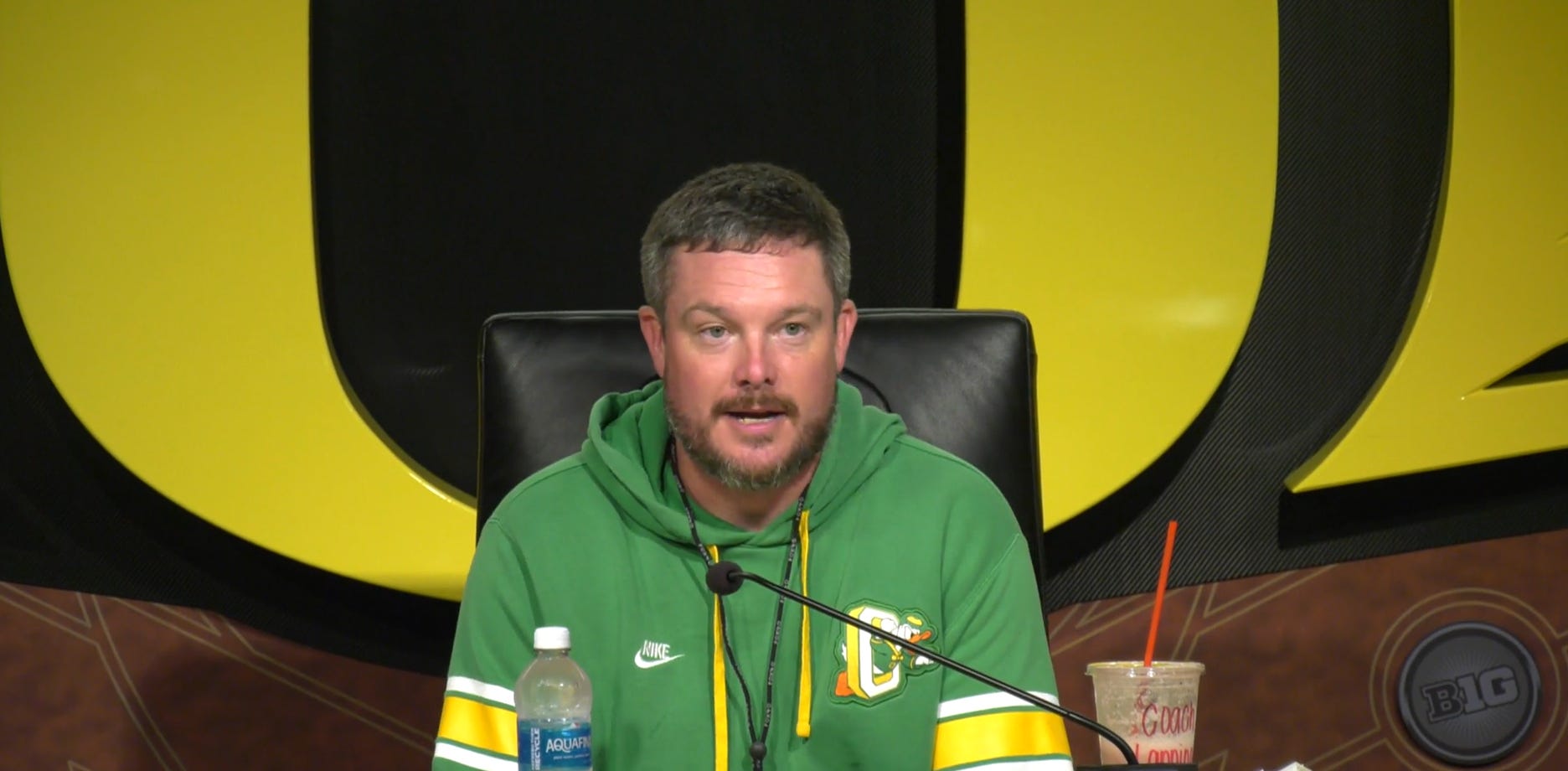
Player-led leadership, difficult practices, daily improvement, competition and staying focused on what is directly in front of them have followed Oregon from Media Day through three weeks of camp. The difference now is that Lanning is starting to see the players deliver those messages themselves.
There probably was not going to be some enormous revelation Wednesday. Oregon is close enough to the season that the coaches are not about to give away a depth chart, Dan Lanning was not going to preview the Boise State game plan before game week officially begins, and most of the questions we have spent August asking are going to need an actual football game before they can be answered completely.
That made Lanning’s final availability before game week a little different from the others. Rather than learning something completely new about Oregon, I thought we got a chance to look backward at almost three weeks of fall camp and see which of the things Oregon talked about before the first practice actually survived it. The answer, at least from Lanning’s perspective, starts in almost exactly the same place the month began.
“We talked about player-led as we came in,” Lanning said. “That’s starting to really show itself. Throughout fall camp, I think it’s shown itself.”
That is a pretty good place to start a review of this camp because player-led leadership was never supposed to be a slogan Oregon hung on the wall in August. The point was eventually to reach a stage where coaches did not have to manufacture every ounce of urgency, toughness or accountability. Wednesday, Lanning gave us some actual examples.
“Whether it be a toughness standpoint, somebody goes down on a play and they wave off a substitution and say, ‘No, I’m going to stay in there.’ I saw that today with Dakorien,” Lanning said. “Whether it’s Poncho, we’re doing crowd noise period and he says, ‘No, I want the Turtlebox right up on us.’ Or there’s a period we don’t have scripted for crowd noise and the players are calling for it, calling for an extra rep.”
Three weeks ago, Oregon was talking about creating more alphas and asking players, “Who did you bring with you?” Now Lanning is describing players asking the coaches to make practice more difficult. That feels like progress.
The player-led idea finally has some football attached to it
We have spent a lot of August writing about fellowship, leadership and connection, but those things only matter if they eventually become visible when football gets uncomfortable. Lanning has been consistent about that from the beginning.
After the first practice, one of the things he talked about was creating more players capable of leading rather than allowing responsibility to live with only a handful of established veterans. His “Who did you bring with you?” question was really about whether Oregon’s best players could elevate somebody besides themselves. That idea has surfaced in almost every position room since.
Poncho Laloulu has talked about pouring what he has learned back into the younger offensive linemen. A’lique Terry described him taking younger players under his wing rather than worrying only about his own place in the lineup. Ross Douglas has talked about receivers contributing without the football. Rashad Wadood described a team where players genuinely want to become better for one another.
Now the examples are becoming less philosophical. Poncho does not merely tell us he wants the offensive line prepared for difficult environments. He asks Lanning to turn the crowd noise up. Dakorien Moore does not simply talk about toughness. Lanning sees him wave away a substitute. Players are asking for another repetition when the period is supposed to be over.
“There’s a lot of examples of it,” Lanning said. “A guy calling somebody else out, right? And I think you see a lot of that consistently on our team right now.”
That last part probably matters most. Any player can have one leadership moment during a three-week camp. Lanning is talking about seeing enough of them that he considers it part of the personality of the team.
There is still a big difference between doing that in August and doing it after a difficult loss, an injury or a reduced role in October. We have talked about that throughout camp too. But Oregon wanted evidence that the responsibility was beginning to move from the coaches to the players, and Lanning sounds like he believes he has seen it.
The defining characteristic of this camp may have been the absence of the bad day
One of Lanning’s more interesting answers Wednesday came when he was asked what he hopes this particular Oregon team eventually becomes known for. He did not give it a nickname or make some grand prediction about what the Ducks will look like in December. He talked about practice.
“The piece that I’ve seen with this group throughout fall camp that sticks out to me is we’ve stacked really good practices back to back to back,” Lanning said. “And I think that’s hard to do in fall camp when it becomes monotonous.”
I think that is worth remembering because we have heard versions of it from several coaches during camp. Tony Tuioti talked earlier this month about Oregon having a scrimmage on Saturday and then coming back with what he called an “elite practice” Monday. That surprised him because the natural response after a physical scrimmage is often for a team to drag a little when it comes back to work.
Lanning said Wednesday that has not been typical of this group.
“You have a great scrimmage, Mondays, because it might be down a little bit,” he said. “That hasn’t been the case with this group. They come out and they work on Monday, right? Okay, we have a really good Monday. What’s Tuesday going to look like? They come out and they have a really good Tuesday.”
Then he offered a final evaluation of Wednesday.
“I thought today was one of our better practices of the year and it was shorter, but these guys really attacked it with an intent and a focus,” Lanning said. “So being able to put great days back to back to back is something that this group’s really been able to do a good job of.”
That does not sound particularly exciting compared with a depth-chart announcement. It may be much more important. Oregon has enough talent that a great practice should not surprise anybody. The harder part is eliminating the practice where the team believes yesterday’s work somehow bought it the right to be average today.
That idea has followed us through camp. Mehringer called the offense a meritocracy and said players have to earn their roles every day. Lanning reduced evaluation after the first scrimmage to whether players were accountable and capable. Earlier this week, Mehringer’s response to an offensive practice that needed improvement was “reset, refocus.”
There has been very little language suggesting Oregon believes it has arrived. That may be intentional considering how much everyone outside the building keeps telling the Ducks they should accomplish.
The veterans appear to be setting the temperature
Lanning was asked whether Oregon’s experience has something to do with its ability to stack those practices. His answer was pretty straightforward.
“I think that there’s a benefit when veterans know how to work and what it looks like and hold people to that,” Lanning said. “Because everybody that’s just got here is looking around to see, okay, what’s everybody else doing? I’m going to kind of match that temperament.”
That may be one of the biggest differences between this roster and some of the earlier versions of Oregon under Lanning. There are players entering their third and fourth seasons inside the program who no longer need somebody to explain what an Oregon practice is supposed to look like.
Poncho knows. Matayo Uiagalelei knows. Teitum Tuioti knows. A’Mauri Washington knows. Jerry Mixon knows. Dante Moore has now spent multiple years inside the system, even if his path to becoming the starter was different. Those players become the visual instruction manual for everyone else.
“When you have guys that have been here and they are realizing what’s in front of them and what they have to attack,” Lanning said, “they pull everybody along or push everybody in front.”
That takes us all the way back to the beginning of camp again. “Who did you bring with you?” only works if the veterans know where everybody is supposed to be going. Three weeks later, Lanning seems much more comfortable that they do.
Dante Moore may be at his best when Oregon lets Dante Moore be Dante Moore
There have been several versions of the Dante Moore story during camp. We have talked about his command of the offense, his relationship with the players around him, his increased leadership and the difference between entering camp as the unquestioned starter rather than competing for the job.
Wednesday, Lanning added something a little less technical: joy.
“I think he’s gone through phases here throughout fall where it’s like, okay, I’m completely focused on what my job is,” Lanning said. “But part of being Dante, what makes him so special is being Dante.”
That is an interesting distinction. Quarterback preparation can become so serious that the process begins removing some of the instinct and personality that made the quarterback successful in the first place. Lanning does not want that with Moore.
“When he’s out there playing with joy, playing with confidence, knowing, ‘Hey, I’ve been through this a million times,’ we’ve given him a ton of different looks this fall that he hasn’t really seen consistently before,” Lanning said. “And I think that’s been really good for him as a player.”
That connects pretty directly to what Mehringer has been telling us. Earlier in camp, he called Moore’s understanding and football knowledge some of the best he has been around. More recently, Mehringer described the offense progressing from merely knowing a route or assignment to recognizing what the defense is showing and deciding what the offense wants to do about it.
Lanning is describing the emotional side of the same progression. Moore has seen enough looks that the answer does not have to feel new.
“When he’s out there playing with joy and has a level of focus and is demanding of the guys around him,” Lanning said, “we really separate as a team.”
That is a significant statement about a player whose position touches almost everything the offense does. Lanning also resisted turning Moore’s personality into some universal leadership requirement.
“I think it’s important for every player to be themselves,” he said. “Everybody’s got to figure out where they operate at the best level.”
For Moore, that apparently means the Ducks do not want to coach the joy out of him while trying to increase his command. There is a balance between playing loose and playing careless, and Lanning believes Moore is learning how to live in the right place between them.
The receiver room still sounds like a problem of abundance
We have probably written more about Oregon’s receivers than any offensive position during camp, and Wednesday did not change the basic conclusion. There are a lot of them.
Lanning was asked specifically about the players beyond the obvious top names, and he rattled through several without much hesitation.
“I think Messiah’s really come on the last few days,” Lanning said. “You’ve seen that from him. Jalen’s certainly had some flash plays to stick out. Gatlin’s had those. I mean, there’s several guys that have been able to do that. Iverson.”
The interesting part came next.
“We’ve got a really good group of wideouts,” Lanning said. “It’s going to be, okay, how do we figure out how to use these guys to their best ability and where do they fall in?”
That is almost exactly where Ross Douglas left the conversation last week. Douglas does not believe Oregon needs to manufacture a permanent No. 1 receiver because he thinks several players can become the primary answer depending on the play and matchup. He has talked about finding the best collection of five skill players, not merely identifying a fixed receiver rotation.
Mehringer has approached it similarly. His standard has been meritocracy, and his question about younger players has often come back to whether the other 10 players trust them enough to put them on the field.
Lanning added another wrinkle Wednesday by reminding everyone that September roles are not necessarily November roles.
“Guys’ roles, just like last year, roles can change throughout the season,” he said. “You see Malik Benson playing now on Sundays, right? And his role wasn’t big when the season started. It was huge before the season ended.”
That may be an especially important message for this receiver room. There are not enough targets to keep everybody statistically satisfied every week. Jalen Lott may flash in camp and still have Saturdays where he does not see the football. Messiah Hampton can make a jump and still be behind experienced players. Gatlin Bair’s speed can be obvious without requiring Oregon to build an entire package around him immediately.
The role in September is not necessarily the ceiling.
“I like that we have a lot of guys that are available,” Lanning said. “I like how they’re growing quickly.”
For a room this crowded, that is probably the healthiest way to look at it.
Practice was supposed to be harder than the game, and Oregon kept trying to manufacture that
One of the most consistent Lanning themes throughout August has been his desire to make practice more difficult than anything Oregon will encounter on Saturday. That started with the roster.
The offensive line has spent camp dealing with A’Mauri Washington, Bear Alexander, Matthew Johnson and the rest of a defensive front Oregon believes should make everybody across from it better. Poncho talked earlier this week about the benefit of seeing that level of player every day.
Wednesday, Lanning talked about another way Oregon has tried to create difficulty: noise.
The practice itself was shorter and more of what Lanning called a “spider’s practice,” but Oregon spent significant time working with crowd noise.
“We did a lot of crowd work noise today, and guys handled that really well,” Lanning said.
The special-teams component matters because game pressure is difficult to replicate when the stadium is empty. Oregon has tried anyway.
“A lot of our periods are going to end with, hey, offense is down three, so this is a kick situation at the end,” Lanning said. “We have pressure kicks throughout practice. Again, we try to make it harder in practice than it’s going to be in a game.”
That fits what Joe Lorig told us earlier in camp about manufacturing pressure before specialists actually inherit the job. It also helps explain why Oregon does not simply send the field-goal unit onto an empty field for a kicking period.
“It’s not just, okay, field goal, let’s go do field goal unit,” Lanning said. “They show up throughout practice, same thing with punt. So we try to create those pressure situations throughout.”
The results have not been perfect.
“At times we’ve handled it really well, at times we could be better,” he said. “But overall it’s been good.”
That might be as useful as another glowing evaluation. Pressure practice should occasionally expose a problem. If nothing ever goes wrong, Oregon probably has not made the situation difficult enough.
The coordinators have been practicing too
One of the better themes from early camp came when Mehringer talked about how working against Chris Hampton makes both coordinators better. They can request looks from one another, challenge each other with unscripted calls and find answers before another coaching staff forces them to do it during a game.
Hampton gave us his side of that Tuesday, talking about how open Mehringer has been to giving the defense the personnel grouping, pressure response or look it needs. Lanning said Wednesday that the coaches have been using camp in much the same way as the players.
“Part of being a great coach is also being like a lifelong learner,” Lanning said. “And I think we got two coaches in those positions with a great support group.”
He also emphasized that neither coordinator operates as though the title means the room stops contributing.
“They hear the voice of everybody in the room,” Lanning said. “They do a great job of taking feedback, accepting that and saying, okay, how can I make sure I incorporate it?”
Then there is the actual practice component.
“We’ve had a ton of situations where they’re calling it like it’s a game throughout practice and they’re learning from it,” Lanning said. “They’re making notes. They’re saying, ‘Hey, I could have done this better or I could have improved here.’ We talked through it as a staff and we watched film together and evaluate it.”
That is an important part of the camp story because Mehringer and Hampton are both entering the season in expanded roles. They have spent August installing systems, but they have also spent August rehearsing decisions.
There will eventually be a third-and-6 where the headset clock is running and neither coordinator gets 10 minutes to discuss the perfect answer. Oregon has tried to create those moments before Boise State does.
The transition to Boise State has started, but Oregon is not quite done with Oregon
After the second scrimmage, Lanning said the Ducks would begin moving toward opponent preparation later in the week while still keeping much of the work focused internally. That remains the plan.
“We’ll start as a coaching staff getting a little bit more focused on first opponent,” Lanning said. “But as players in general, it’ll be a little bit more still about us until we shift into that game-week mode.”
That is probably the clearest sign that fall camp is ending. The install becomes a game plan. The competition becomes a rotation. The mistake that gets corrected tomorrow eventually becomes the mistake that costs yards on Saturday.
Oregon will begin exposing players to some things the coaches believe they will see, but Lanning does not want every remaining practice snap to become Boise State-specific yet.
“We’ll expose them to a little bit of details, stuff that we think are going to show up,” he said. “Maybe not so much curtailed to just Boise or first opponents, but things that we need to make sure that we still clean up this week.”
That last part may be more important. There is still Oregon work left.
The players are excited. Lanning acknowledged that the closer the game gets, the harder that becomes to ignore.
“You’re always excited,” he said. “The closer you get, the more excited you get, right? I mean, that’s human nature.”
His next question is the one that matters.
“Are we prepared? Are we ready for that excitement that comes along with that?”
Lanning thinks Oregon is close. Not finished. Close.
The building outside gave Lanning a pretty good metaphor for the team inside
Lanning gets asked enough philosophical questions that he usually has an analogy ready, but the construction surrounding Oregon’s facility gave him a particularly fitting one Wednesday. He called it the difference between telescope goals and microscope goals.
“Obviously that building is not going to be done tomorrow, but it lets you know where we’re heading and what we’re building,” Lanning said. “And there’s something really cool happening there, but there’s work that’s done on that building every single day to make it elite.”
Then he connected it to the team.
“That same thing’s happening with our program right now,” Lanning said. “We have goals that we want to be able to accomplish. On the same note, we got to focus on what’s in front of us right now to be able to do it.”
That may be the cleanest summary of Oregon’s entire August. The telescope goal is obvious. Nobody needs Lanning to say “national championship” every morning for the players to understand what people expect from this roster. They know where Oregon finished the last few seasons. They know how the roster has been built. They know what is being said nationally.
The microscope has been much smaller. Win today’s rep. Find the best five offensive linemen. Finish the drive. Protect the football. Get off the field on third down. Make the pressure kick. Bring somebody with you. Ask for another rep.
Those things do not sound anything like a national championship. That is probably why Lanning keeps talking about them.
Fall camp began with possibilities. It ends with responsibility
When Oregon opened camp, almost everything was expansive. There were six to eight offensive linemen who might be above the line. Receivers were competing across the room. Young defensive backs were trying to prove they could handle responsibility. The quarterback room had unusual depth. Mehringer was talking about all the things Oregon could potentially do with versatile personnel.
Three weeks later, the questions have narrowed. Who can the other 10 players trust? Which offensive linemen actually fit together? Which receivers can contribute when they do not get the ball? Which defenders can execute the call consistently enough that Hampton does not need to protect them? Which specialists can handle the kick when the situation has been made uncomfortable? And maybe most importantly, which players can carry the standard without a coach standing beside them?
Lanning opened Wednesday by calling it a good day overall. The practice was short, the Ducks worked noise and situational football, and there was no dramatic proclamation that camp had produced the finished product. That would have been inconsistent with almost everything he has said for three weeks.
Instead, he sounded like a coach whose team is approaching the point where preparation has to become performance.
“I mean, you become a better team each and every day,” Lanning said while looking back at camp. “There’s been really good back and forth, whether it’s offense, defense, special teams. I think in all those areas, we’re proving it in a lot of situations that we’re making sure we expose our players to.”
Then he gave the assessment that probably matters most entering the final days before game week.
“Overall, I think we have a group that’s hungry and working really hard.”
That sounds remarkably similar to the team Oregon wanted to build when everyone gathered for Media Day three weeks ago. The difference is that Lanning has now watched it practice. And perhaps the best sign of what happened during those practices is that some of the messages we spent August hearing from the coaches are starting to come back through the players.
Turn the noise up. Give us another rep. I’m staying in.
That may be about as good a place as any for fall camp to end.