
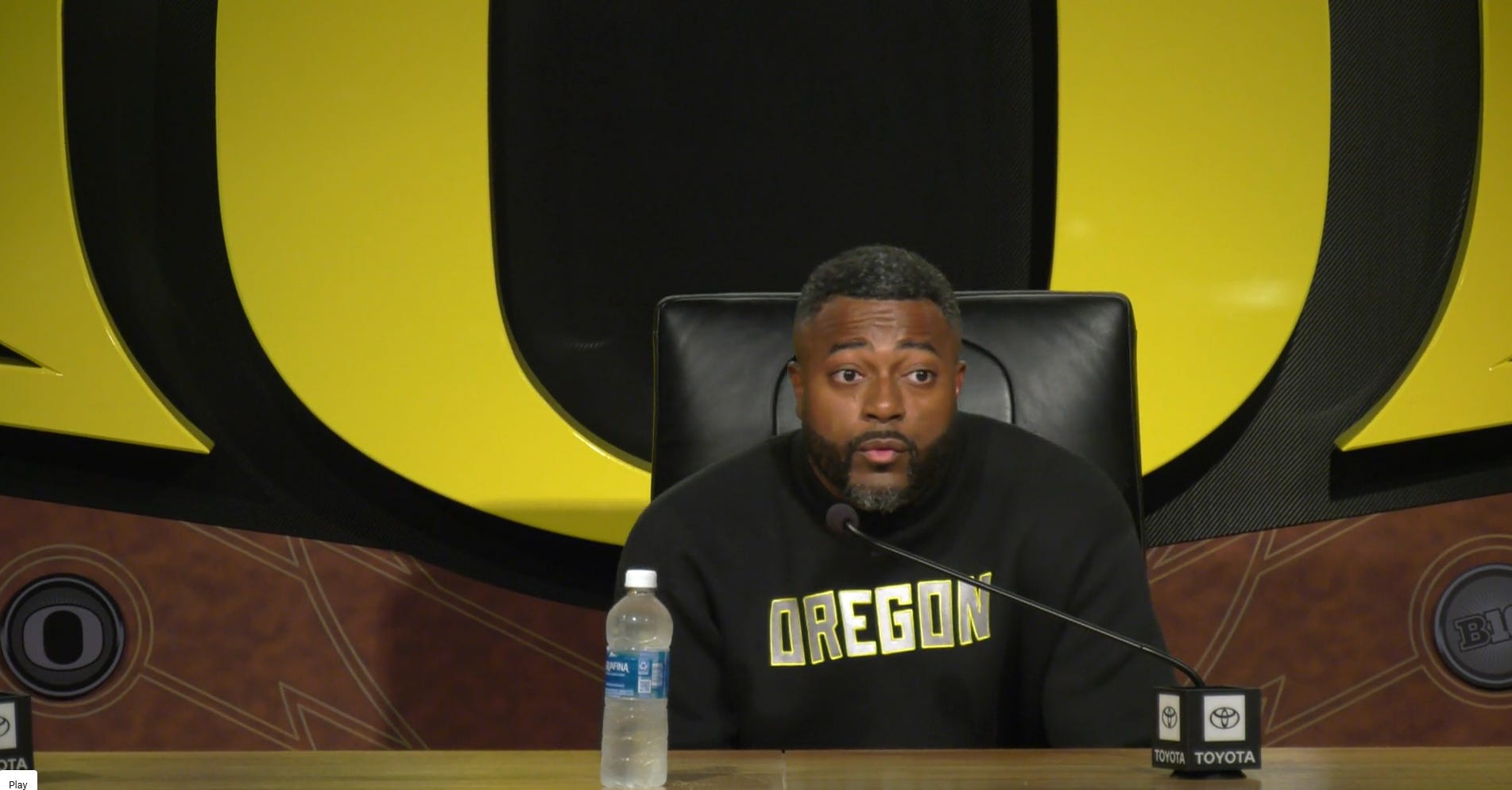
Ross Douglas sees a collection of receivers who can hurt defenses in different ways, Jack Smith calls the tight end a “second quarterback,” and Jeremiah McClellan says every day in Oregon’s receiver room feels like a game. Thirteen practices into camp, the Ducks are beginning to reveal a passing-game philosophy built as much around versatility, selflessness and shared responsibility as catches and touchdowns.
For most of fall camp, Oregon’s passing game has been discussed through the names that make it exciting. Evan Stewart is back. Dakorien Moore has another year in the system. Jeremiah McClellan continues ascending. Gatlin Bair possesses rare speed. Jalen Lott has repeatedly forced his way into conversations about Oregon’s young players, while Iverson “Strap” Hooks brought experience into a room already filled with talent. At tight end, Jamari Johnson returned as the established veteran while Andrew Olesh, Marcus Dixon, Kendre Harrison and AJ Pugliano gave Oregon several very different developmental possibilities behind him.
Practice 13 finally gave us a better picture of how Oregon intends to fit those pieces together, and the answer is more interesting than identifying a traditional WR1 or determining which tight end sits second on a depth chart. Douglas repeatedly resisted rigid labels Friday, whether he was asked about a No. 1 receiver, the number of wideouts he wants in his rotation or whether Hooks should be considered a slot receiver. Smith did essentially the same thing from the tight end perspective, describing a position Oregon asks to block, protect, run routes, understand screen timing and process enough of the offense that he views the tight end as something close to a second quarterback.
The underlying idea is familiar because Drew Mehringer introduced it early in camp. Oregon wants enough multiplicity to create answers without building an offense so complicated that execution suffers. Mehringer called complexity a “double-edged sword” after Practice 3 and talked about the balance between giving a defense multiple problems and making sure the players receive enough repetitions to execute those answers correctly.
Practice 13 showed what that philosophy may look like at the receiving positions. Oregon is not necessarily trying to find one receiver who has to dominate targets or one personnel grouping it has to live inside. The Ducks appear to be building toward a collection of receivers and tight ends capable of changing the offensive picture according to the defense while maintaining one expectation regardless of who receives the football.
Douglas summarized it better than anyone when he was asked whether Oregon has a true No. 1 receiver.
“I don’t really worry about that, whether who’s one, who’s two, who’s five,” Douglas said. “It don’t really matter. I think we have a collection of really good guys who could play winning football for us.”
That may be the most important receiver statement we have heard all camp.
Oregon may not need a traditional No. 1 receiver
There is a natural temptation to take a room this talented and rank it. Stewart looks like the obvious candidate to become the marquee name because we already know what his high-end ability looks like. McClellan emerged down the stretch last season and continues receiving increasingly strong evaluations. Moore has explosiveness Oregon wants to maximize, while the younger players continue creating pressure from underneath.
Douglas does not appear particularly interested in solving the room that way.
“Anyone could be the number one in that moment,” he said. “It’s just whoever has a hot hand at the time. Maybe it’s dictated by defense. Maybe they’re taking away a certain player and another guy, kind of that’s his day.”
The second half of that answer is where the offensive possibilities become much more interesting. Douglas is not simply saying Oregon has several good receivers and does not care who gets credit. He is describing a passing game capable of allowing the defense to help determine where the production comes from.
If an opponent devotes additional coverage toward Stewart, Oregon wants another player capable of punishing the adjustment. If a matchup favors McClellan inside, the offense does not need to force targets elsewhere simply because somebody carries a higher profile. A defense that changes personnel or leverage to handle one receiver may create an entirely different opportunity for a tight end.
“I don’t think we necessarily need to have a true number one,” Douglas said. “I think we have a collection of guys who could hurt you in multiple ways.”
That fits Mehringer’s larger offensive vision much better than a traditional target hierarchy would. Early in camp, he said wide receivers had to earn everything because “it’s a meritocracy,” even using Wally Pipp and Lou Gehrig as an example of what can happen when one player leaves an opportunity available for another.
Nearly two weeks later, Douglas sounds less interested in establishing an order than maximizing the players who survive that competition.
The most important receiver statistic may involve the plays when he never touches the ball
Douglas provided perhaps the best explanation yet of what Oregon means by playing winning football at receiver when he was asked what he wants to see from the room in Saturday’s second scrimmage.
He brought up a study he did with his receivers using Ja’Marr Chase. Even during a season in which Chase won the receiving triple crown, Douglas noted that he played roughly 1,100 snaps and received 183 targets.
Douglas’ conclusion was not about Chase’s production. It was about all the other plays.
“Eighty-three percent of the time he played, he didn’t have the football,” Douglas said. “So that’s a big monster in our room. Like, what impact are you making on the field when you do not have the football?”
That question may ultimately determine how deep Oregon’s receiver rotation becomes.
A talented receiver can create separation. Oregon has plenty of those. A young player can make an extraordinary catch during fall camp and demonstrate why he was highly recruited. The harder evaluation is whether he can remain valuable during the overwhelming percentage of offensive snaps when Dante Moore is throwing somewhere else or the offense is running the football.
Douglas specifically pointed toward blocking and route responsibility.
“What is your impact in the run game?” he said. “What is your impact on a route that you might have to run to get somebody else open?”
McClellan spoke about the same standard from inside the room and made it sound less like an occasional coaching emphasis than part of the group’s identity.
“We embrace that a lot,” McClellan said. “Just blocking without the ball, like turning our body up when we don’t have the ball, things like that. I would say it’s in our nature just to be physical in that room.”
That physicality matters because explosives do not always belong to the player who produces the yardage. A running back turning a short gain into 30 yards may owe part of the play to a receiver removing a defensive back from the alley. A tight end can become the beneficiary of a route designed to occupy a safety, just as the tight end’s route can create space for a receiver elsewhere.
McClellan understands that connection.
“Always making sure we’re blocking to create those explosive plays for our backs, tight ends, things like that,” he said. “It’s amazing.”
Douglas wants that mentality to become one of the defining features of the room.
“Just really make us a selfless room,” he said, “so we could become one of the most dependable units on the offense.”
That last word may matter even more than explosive.
Oregon entered camp with very little question about whether the receiver room contained enough athletic ability. The question was whether all of that ability could become dependable football, something that requires much more than catching passes.
Jeremiah McClellan is becoming the clearest example of the complete standard
Lanning provided important context earlier this week when he was asked why McClellan continues standing out.
He did not begin with catches.
Lanning pointed toward how much stronger McClellan has become at the point of attack, describing an area that was once a weakness as something that became a weapon last season and has continued developing this fall. “He’s playing with violence,” Lanning said, while also pointing toward McClellan’s speed in and out of breaks and increased leadership.
Douglas’ explanation Friday showed how that progression developed.
“Experience is your best teacher,” Douglas said.
McClellan accumulated more than 500 snaps last season and became increasingly important as Oregon moved deeper into the year. Douglas believes those repetitions created momentum that carried through winter conditioning, spring football and now into fall camp.
“He played big for us down the stretch, and it’s kind of carried over momentum into how he practiced in the winter, when it was winter conditioning, how he practiced in spring ball and how he’s practicing now in fall camp,” Douglas said. “So he’s just a guy who’s still ascending. He’s getting better every single day.”
McClellan, predictably, did not frame his own camp around becoming Oregon’s No. 1 receiver. Asked directly whether he feels positioned to take that role, he immediately moved the answer back toward the offense.
“I’m not sure,” McClellan said. “I’m just here to really just help the offense as much as I can possible. I know we’re going to have a crazy talented receiver room right now, so I’m just here to help the offense as much as I can.”
That answer fits the player Lanning and Douglas have been describing. The next step for McClellan is not simply accumulating more receptions than he did a year ago. Oregon wants him becoming the kind of receiver whose presence makes the offense function even on the plays when his name never enters the box score.
“Every day is going to be a game” inside this receiver room
McClellan also provided perhaps the best description of what Oregon’s receiver competition actually feels like from the inside.
“The most exciting part about being in a talented room like this is just being able, you have to bring your A game every single day,” he said. “You have to come out here and compete every single day. Every day is going to be a game.”
That is almost exactly what Mehringer wanted when he described the room as a meritocracy after Practice 3. Oregon did not recruit the younger receivers simply to create future depth, and the veterans do not retain jobs because of age or previous production. Mehringer said there were no solidified jobs at the time and made clear that everyone had to continue earning what came next.
The interesting part is that McClellan does not experience the competition as isolation.
“You can pick up things from everybody in the receiver room,” he said. “I pick up a lot of things from Stu to Corian. We just help each other out in so many different ways.”
That is an important detail in a room where the competition is becoming increasingly real. Stewart, Moore, McClellan, Hooks, Bair, Lott and the rest are not competing for abstract recognition. Oregon eventually has only so many receiver snaps and only one football.
The room is nevertheless sharing information.
McClellan also mentioned how the different coaches see the players through different lenses, giving a receiver multiple forms of correction rather than one voice prescribing one way to play the position. That begins to sound very similar to what Jack Smith described with the tight ends, where coaching responsibility spreads across the offensive staff because the positions intersect so frequently.
The more Oregon’s skill players understand the total offense, the less the structure has to depend upon a fixed lineup.
Evan Stewart is no longer simply the returning star
Stewart’s presence changes the ceiling of the receiver room, but Douglas spent as much time talking about his leadership as his ability.
“Definitely seen it continue,” Douglas said when asked whether Stewart’s offseason focus had carried through camp. “It’s been like that ever since he decided to come back, since January. So he’s had a great attitude, great mentality. He’s been a really good leader for our guys in the room.”
That continues a theme that was already evident by Media Day. Stewart’s teammates described someone who had attacked conditioning, walkthroughs and offseason work with uncommon urgency after deciding to return, with that commitment visible enough that his leadership became part of the story before Oregon ever practiced in August.
What we have heard since camp began has only strengthened that picture. The reports surrounding Stewart’s performance have been exceptional, but the more consequential development may be that Oregon appears to be getting both versions it wanted: the player capable of changing a coverage structure and the veteran capable of helping establish the receiver-room standard.
McClellan’s response Friday captured both.
“Having Evan back out there is amazing,” he said. “Evan’s a game changer.”
But McClellan also placed Stewart inside the larger group rather than above it, talking about the benefit of having him back alongside the rest of Oregon’s established weapons. That is consistent with Douglas’ refusal to identify a singular No. 1.
Stewart does not become less dangerous because Oregon has other answers.
The other answers may make him harder to take away.
Dakorian Moore is beginning to look more comfortable inside the offense
Douglas’ update on De’Corian Moore was less dramatic than some of the camp praise surrounding other receivers, but it may be equally meaningful.
“My expectation of Dakorian is just for him to be the best version of himself,” Douglas said. “He’s more comfortable in our offense and more comfortable in Oregon, and you can just start to see him just have a better understanding of what we’re trying to do offensively and just what it kind of takes to be a really good football player.”
That sounds like a player moving from talent toward command, something Oregon has emphasized with many of its second-year players.
The first year often answers whether the physical ability translates. The second begins revealing whether the player understands enough of the larger offense to become more than a collection of individual plays.
Douglas has repeatedly resisted boxing receivers into narrow positional definitions, which means comfort in the offense matters even more. Oregon wants receivers capable of learning multiple responsibilities because changing where a player aligns changes the defensive picture without forcing the Ducks to substitute.
Lanning introduced that concept at the beginning of camp when he discussed mental acuity and the value of players capable of handling multiple responsibilities. Mehringer added the warning that multiplicity only helps if Oregon can maintain execution.
Moore’s growing comfort is therefore part of a larger offensive goal.
The more he understands, the more Oregon can ask him to do.
The young receivers are being “forged through the fire”
Douglas does not sound particularly interested in protecting Oregon’s freshmen from difficult repetitions.
Asked about bringing along a group that includes several first-year players, he described his developmental philosophy directly.
“I think you learn by doing, and I believe in forging people through the fire,” Douglas said.
Oregon has the defensive personnel to make that fire unusually hot.
Douglas pointed toward the quality of the corners, nickels and safeties the young receivers see every day and the coaching staff developing them. Football provides far fewer actual games than sports such as basketball or baseball, so the enormous majority of a player’s development occurs on the practice field.
That makes the quality of the opponent across from him particularly important.
“Our young guys get to go against some of the best players in the country,” Douglas said. “Just the opportunity for them to practice against the good players that we have has definitely expedited their growth, and they’re getting close to game ready.”
That fits what we heard from Oregon’s defensive backs at Media Day, when the secondary described the receiver group as explosive, fast and talented enough that going against it every day should prepare the defense for Saturdays.
The developmental benefit works in both directions.
A freshman receiver does not get many empty repetitions at Oregon. If he runs a poor route, an elite defensive back is capable of punishing it. If his release is inefficient, the corner across from him has enough ability to expose it. If he loses focus at the catch point, another highly recruited athlete is trying to take the football away.
Douglas appears to believe those difficult repetitions accelerate the process rather than slow it.
Jalen Lott’s developmental clock started later, but Oregon keeps seeing the ability
Douglas separated Gatlin Bair and Jalen Lott because their timelines are different.
Bair arrived early enough to participate in spring practices and the installation work that came with them. Lott did not have that advantage.
“His first practice at Oregon was fall camp practice number one,” Douglas said. “So he had to get used to our intensity, just what we’re asking him to do with and without the football and how we play offense.”
The physical flashes arrived before complete comfort.
Dante Moore said earlier this week that Lott caught his attention on the very first practice when he made a move and extended for a football in a way that did not look normal for a freshman. Moore acknowledged that the playbook could still leave Lott “swimming around” at times, but he also said the freshman has been adding film work, meetings and extra post-practice repetitions with him.
Douglas now sees the comfort beginning to catch up.
“He’s gotten a lot more comfortable as training camp went on,” Douglas said.
That does not mean Oregon has declared him game ready or assigned a role, but the developmental direction is clear. The ability got him into the conversation; understanding the offense and functioning without the football will determine how long he stays there.
Gatlin Bair is no longer simply an athlete returning to football
Bair may be one of the most fascinating developmental projects in the entire offense because Oregon is trying to turn extraordinary athleticism back into football ability after an extended absence from organized football.
Douglas was candid about the transition.
“He didn’t play football for two years,” he said. “Going through spring, it’s just like, okay, I got to get used to my body moving like this again. I got to get used to this hard transition. I got to get used to feeling contact when I catch the football.”
Those were not weaknesses in Bair’s athletic profile. They were the predictable consequences of a player having to reacclimate to the sport itself.
“Experience is your best teacher, and you get better at playing football by playing football,” Douglas said.
McClellan has watched the same process occur from inside the room.
“Early on you could tell he was still, like, getting back into it,” McClellan said. “Now he’s playing football. Like, now he’s being more of a football player.”
That distinction is important because nobody has ever needed a stopwatch to establish that Bair is fast.
Douglas called him “one of the best athletes on our team,” describing a player who is big, fast, explosive, capable of jumping and conditioned enough to repeat those efforts. McClellan provided the visual evidence with one of the lighter moments of the afternoon.
Asked whether Bair really hit 24 mph, McClellan did not hesitate.
“Yes. Yes, 24 miles an hour,” he said. “He’s a speed demon for sure.”
McClellan then revealed that he had hit 23.3 mph during the same session and still found himself reacting to Bair.
“I was like, ‘Whoa,’” McClellan said. “Gat was sliding. He was definitely sliding that day.”
The speed is spectacular, but the more important line came later when McClellan described the offense slowing down for Bair.
“He’s starting to know what he’s doing on different, like, all of his assignments and things like that now,” McClellan said. “So he’s really growing right now, and he has to just keep growing.”
That may be the real Bair story through Practice 13.
Oregon already knows how fast he can run.
Now he is becoming a receiver again.
Hudson Lewis and Messiah Hampton are quietly making their own progress
McClellan also offered strong reviews of two other young receivers who have received considerably less attention than Lott and Bair.
“Hudson Lewis is doing a great job,” McClellan said. “He’s had an amazing fall camp.”
Lewis arrived during the summer rather than benefiting from spring practice, yet McClellan believes he has picked up the offense well. Messiah Hampton had a different developmental runway because he participated in spring and has been able to build from that experience into August.
“Messiah Hampton is doing an excellent job too,” McClellan said. “He had an amazing transition from spring until now.”
Those names matter because Douglas refuses to establish an arbitrary rotation number.
His goal is not to decide in advance that Oregon needs six playable receivers and then force the room into six slots.
“My goal every single season, my goal is to maximize every single player in the room,” Douglas said. “If that’s three, then it’s three. If it’s six, then it’s six. If it’s seven, then it’s seven.”
That puts the burden back on the players.
“If they can play winning football for us,” Douglas said, “they’ll be out there for us.”
Mehringer’s meritocracy has not gone anywhere. Practice 13 simply gave it a more flexible endpoint.
Iverson Hooks is another reason Oregon does not want receiver labels becoming limitations
Hooks provides perhaps the clearest example of Douglas’ resistance to positional boxes.
Asked whether the UAB transfer should be viewed primarily as a slot receiver, Douglas rejected the premise.
“I look at wide receivers like wide receivers are a skilled position,” he said. “So I don’t want to pigeonhole anybody into, you know, okay, this is a slot guy, this is an outside guy.”
Douglas believes Hooks possesses enough quickness and explosiveness to work in different environments. Those traits can help him release against coverage outside, but they also translate to short, intermediate and deep routes from the slot.
“I think Strap has a multifaceted skill set,” Douglas said.
The developmental challenge has been adjusting to Oregon’s practice standard.
“It’s different here at Oregon than it is at other institutions,” Douglas said, pointing toward the intensity of practice, the level of competition and the habits required simply to thrive through the workload.
That continues what Mehringer said after Practice 3. Hooks arrived because Oregon already believed he was good enough to help, not because the staff wanted a long-term developmental project, but he still had to expand what he understood and adjust to what the Ducks were asking.
Douglas believes that improvement has been visible from the first spring practice through Practice 13.
The important part is that Oregon is not asking Hooks to become one narrow thing.
It is trying to discover how many things he can do well enough to help.
Jack Smith sees tight end as “the second quarterback”
Everything Douglas said about receiver versatility becomes even more interesting when placed beside Smith’s description of Oregon’s tight ends.
“To me, tight end, in a sense, is really the second quarterback,” Smith said.
His reasoning has nothing to do with throwing the football.
“We ask our guys to do a lot, whether it’s pass pro, run blocking, routes, screen timing, all that stuff,” Smith said.
That description fits the way Oregon has talked about the position since Media Day. Lanning pointed toward Jamari Johnson’s ability to align as a wide receiver, in the backfield or as a conventional tight end and said the rest of fall camp would determine which players behind him could earn similar opportunities.
Johnson himself explained why his quarterback background helps him process the position. At Media Day, he said playing quarterback taught him to understand where everyone is supposed to be rather than seeing a play only through his own assignment.
Smith is now trying to develop an entire room capable of handling a broader version of that responsibility.
His own coaching background helps explain why. Smith has worked around multiple offensive position groups and learned under several coaches before taking over the tight ends. Instead of viewing those experiences as unrelated stops, he sees them as preparation for a position that intersects with almost everything Oregon does.
“We all coach each other’s dudes,” Smith said. “It’s a team deal.”
That may be one of the more revealing offensive comments of the day.
Oregon does not want a receiver who understands only receiver football or a tight end whose knowledge ends with his own route. The more overlap exists between positions, the easier it becomes for the Ducks to change formations, responsibilities and personnel pictures while keeping the same players on the field.
Smith simply calls the finished product “the Oregon offense.”
“We got the answers to everything,” he said. “At the end of the day, football is football. We’re going to go out there and it’s our job to just execute those plays.”
That is Mehringer’s complexity argument distilled to its endpoint.
Have answers, but execute them.
Jamari Johnson is becoming the bridge between Oregon’s tight end generations
Smith did not inherit a completely new room. Johnson and AJ Pugliano already knew the offense, while the newcomers arrived at different points of their own development.
That created an immediate coaching challenge.
“New guys, they got to learn the basics,” Smith said. “And then Jamari and AJ, they’ve been here and they’re at a little bit different level in the start.”
Smith’s solution has been to use the veterans as extensions of the coaching staff.
“I want them to teach in the meetings,” he said. “I want them to be the ones coaching on the sidelines at times.”
That is exactly what Lanning was already seeing from Johnson before fall camp. During spring, Lanning called him “extremely consistent,” praised his leadership and described him as “a coach on the field,” noting that Johnson was beginning to do for younger tight ends what players such as Terrance Ferguson, Patrick Herbert and Kenyon Sadiq had previously done for him.
Smith is intentionally extending that responsibility.
When Oregon two-spots practice and the tight ends are split between fields, Smith cannot be everywhere. He wants Johnson or Pugliano capable of recognizing something and giving a younger player the correction before the coach gets there.
“I’ve talked to JJ about that,” Smith said. “I was like, ‘Hey man, like I would love for you to, if you got something that you want to say, like speak up, man.’”
That gives Johnson’s leadership football value beyond setting an example.
He is becoming part of how the position gets coached.
Marcus Dixon’s defensive experience continues becoming part of his tight end identity
Smith was careful not to provide a depth chart behind Johnson, but he offered useful context on Marcus Dixon.
Dixon said at Media Day that his time playing defensive end changed how he sees blocking, describing football as a game of aggression and leverage. He also talked about working on his receiving ability while learning from teammates with different strengths.
Smith believes the development has continued.
“Marcus has done such a good job of, like you said, attacking his strengths and also attacking his weaknesses,” he said. “The growth that he’s made since he’s been here in both facets has really been fun to watch.”
That phrase, both facets, is exactly what matters at Oregon.
A tight end who can catch but cannot function in the run game tells the defense something. A blocker who becomes almost exclusively an attached player can do the same.
The more complete Dixon becomes, the less Oregon has to announce what it intends to do when he enters the game.
That is where tight end versatility becomes schematic leverage.
Andrew Olesh is making the transition from talent to complete tight end
Olesh gives Smith another developmental profile.
He entered Oregon after beginning his college career elsewhere and had to translate what he already knew into an entirely different offensive language.
“He’s just another kid that loves football,” Smith said. “It’s been fun for me to see him learn a new scheme coming from another college where he has a whole other scheme and now learning ours.”
Smith specifically praised the mental progress.
“I think he’s taken awesome leaps from the mental side of things in terms of the playbook itself,” he said.
The physical development has not been confined to the receiving part of his game.
“His ability to run around,” Smith said, “and really also made leaps in the run game as well, which has been fun to watch.”
That matters because Olesh’s reputation as a receiver has never been particularly difficult to understand. The more important question is whether Oregon can trust him across enough situations that defenses cannot treat his presence as a personnel clue.
Practice 13 suggests the answer is moving in the right direction.
Kendre Harrison is still being evaluated as a football player, not a basketball athlete
Kendre Harrison may possess the most unusual physical profile in the room, but Smith continues bringing the conversation back toward football.
“What I love about Kendre is he’s a competitor,” Smith said, before joking that Harrison still has not beaten him in a game of H-O-R-S-E.
The larger transition is more serious. Harrison spent much of his high school career balancing basketball and football, while Oregon has spent the past several months asking him to commit himself to the daily demands of one college sport.
“For any freshman, there’s always a transition period of it becoming almost like a job in a sense nowadays,” Smith said. “But he’s really taken to that challenge.”
Smith declined to say whether Harrison will play a significant role this season, reminding everyone that even Johnson still has to prove himself every day and that Oregon remains in fall camp. That caution is useful because Harrison’s physical ability makes it easy to jump ahead of the developmental process.
The reports throughout the year have consistently suggested that Harrison’s combination of size, ball skills and athleticism can create immediate matchup problems. The remaining work is becoming dependable enough in all the things Oregon asks of a tight end that the offense does not have to limit the call sheet when he is on the field.
Smith sees real progress.
“Just seeing where he was four or five months ago to where he is now has really been a pleasure to watch,” he said.
That is probably the correct place to leave the evaluation before Scrimmage Two.
The ceiling is obvious.
Saturday provides another test of the floor.
Oregon’s personnel flexibility may make the WR/TE distinction increasingly blurry
Douglas was asked how Oregon would respond if injuries again created a need for more two-tight-end personnel, as happened at times last season. His answer revealed how the staff appears to think about the offense more broadly.
“Whatever best 11 players that help us win football games and score points, that’s who will be out there,” Douglas said.
He did not limit the answer to receivers.
“Whatever collection of five skilled players, we have a lot of capable people, not just in my room, but running backs and tight ends.”
That may ultimately be the most important connection between Douglas’ interview and Smith’s.
Oregon does not appear to be building an offense in which three wide receivers, one tight end and one running back must always form the best skill combination. It is trying to develop enough people across all three rooms that Mehringer can choose the five whose abilities best attack the problem the defense presents.
Some weeks that may mean three receivers.
Another matchup could make two tight ends more valuable.
Johnson’s ability to align in several places means Oregon can shift from one picture to another without necessarily substituting. A receiver such as Hooks can move inside or outside. McClellan can affect the run game even when he is not targeted. Bair’s speed can force defensive space even on a play designed for somebody else.
The possibilities become difficult to defend only if the players remain dependable enough that Oregon does not have to sacrifice execution to access them.
That has been Mehringer’s warning since Practice 3.
Practice 13 showed the personnel that could make the theory work.
Scrimmage Two will evaluate everything except the easy numbers
Both Douglas and Smith were asked what they want from Saturday’s second scrimmage, and neither began with receiving production.
Smith wants “clean football.”
“Play clean, come out healthy,” he said. “Obviously, we want to have explosive plays as many as we can and touchdowns in my room, as well as the whole offense. So really, I hope that we go out there and there’s good back and forth for the entire team standpoint. But it boils down, in my mind, to us just playing clean, doing our job and executing.”
McClellan used almost identical language.
“Just go out there and do our job and do our assignment and play fast,” he said. “If we go out there and do that, we should just be fine.”
Douglas wants the evaluation to extend beyond what everyone else will notice.
“Everyone will see the catches, the yards, the touchdowns, the drops, whatever negative plays are,” he said. “But we’re trying to eliminate bad football every day.”
That means Saturday’s receiving evaluation should not begin by asking who caught the most passes.
Did the receivers block when the ball went somewhere else? Did they run routes with the discipline required to create openings for teammates? Did young players operate quickly enough within the offense that their athletic ability could actually appear? Did the tight ends handle their protection and run-game responsibilities well enough that Oregon could remain multiple without sacrificing execution?
Most importantly, did the group become more dependable from the first scrimmage to the second?
Douglas framed that directly.
“We just want to get better from scrimmage one to scrimmage two,” he said.
That makes Saturday another checkpoint rather than a final answer.
Practice 13 may have clarified the receiving corps without clarifying the depth chart
After thirteen practices, we still do not have a traditional answer to the simplest receiver question.
Who is Oregon’s No. 1?
Douglas does not seem particularly concerned about finding one, and after listening to all three interviews Friday, I am increasingly convinced that may be the point.
Stewart can be a game changer without needing every game to become the Evan Stewart game. McClellan can continue his ascent by becoming more dependable on the majority of snaps when he never touches the football. De’Corian Moore can become more dangerous as his understanding catches up with his ability, while Hooks gives Oregon another receiver whose value increases if he can move around rather than being labeled a slot.
Behind them, Bair is turning elite athleticism back into football instinct. Lott is trying to accelerate a developmental clock that did not begin until Practice 1. Lewis and Hampton are quietly accumulating evidence of their own, while the entire group is being tested daily against a secondary good enough to punish mistakes immediately.
The tight end room adds another layer because Johnson can function almost anywhere, Dixon brings a defender’s understanding of physicality, Olesh is becoming more complete and Harrison gives Oregon a matchup profile unlike almost anyone else in the group. Smith views the position as a second quarterback because the Ducks expect tight ends to understand enough football to make all of those responsibilities coexist.
Taken together, the picture looks less like a depth chart and more like a toolbox.
That does not mean roles will remain undefined forever. September will eventually require Oregon to determine which players receive the most meaningful repetitions, and Scrimmage Two should move that process forward.
What Practice 13 made clearer is the standard those players have to meet before the roles matter. Douglas wants receivers who can play winning football whether they get seven targets or none. Smith wants tight ends capable of participating in nearly every part of the offense, not specialists who force the play caller to reveal his intention.
McClellan may have summarized the entire environment with the simplest phrase of the day.
“Every day is going to be a game.”
That is what Oregon has created inside its receiving corps. The competition is deep enough that every practice repetition matters, but the offense is being built so the eventual reward does not have to be becoming the guy.
The reward is becoming one of the players Oregon can trust when the defense takes somebody else away.
If the Ducks can reach that point across both receiver and tight end, the question facing opponents may become much more difficult than identifying Oregon’s No. 1.
It will be deciding which answer to take away when Oregon believes it has several.


