


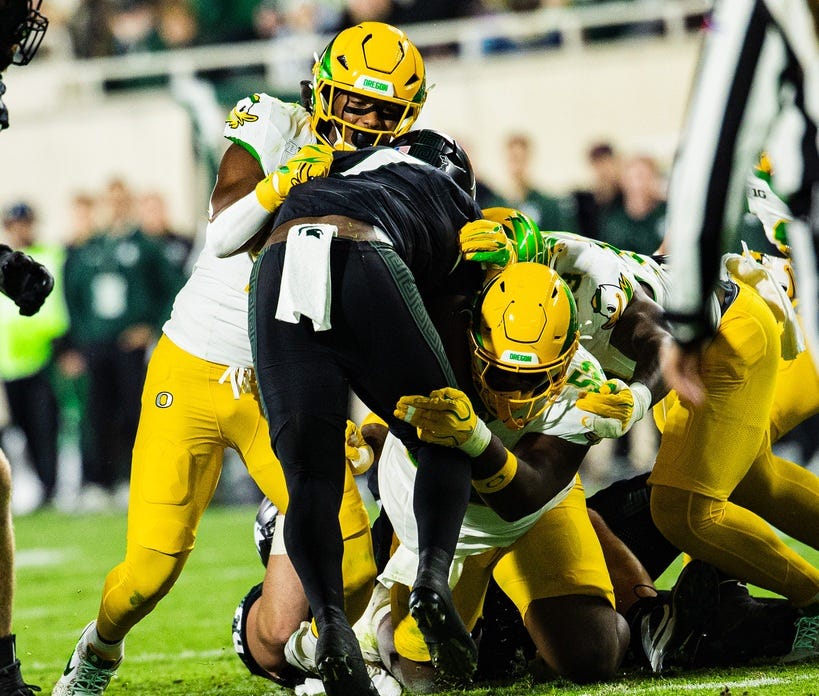
EAST LANSING, Mich. — The final score gave the impression of a comfortable night for Oregon, but the postgame interviews after Friday’s 45-7 victory over Michigan State revealed something much more interesting than a routine road win. The Ducks had encountered a defensive approach that disrupted their passing game, surrendered three first-half sacks and struggled to establish the offensive rhythm that had helped fuel their recent winning streak.
What followed was the kind of response Dan Lanning has been looking for as Oregon approaches the final stages of the regular season. The Ducks adjusted, found success running the football and scored 28 second-half points while limiting Michigan State to 200 total yards for the game.
But there was another theme that emerged from the postgame interviews, one that may prove just as important as the improvement on the field. Players were willing to acknowledge their mistakes, accept responsibility and discuss what still needs to improve, even after a 38-point victory.
That combination of confidence and accountability has become increasingly noticeable over the past several weeks, and it was evident in the way Oregon’s coaches and players evaluated Friday night’s performance.
Lanning sees progress, but also another level
Lanning was generally pleased with his team’s performance, particularly the adjustments that allowed Oregon to control the second half. But he was equally clear that the final score did not represent the ceiling of what this team can accomplish.
“Overall, pleased with the performance and think that there’s still a whole other level of us that could have shown up. They were obviously playing a brand of football, trying to play keep away in some ways, and a ton of respect for Coach Fitzgerald, but they were letting the clock tick down. We knew that we had to take advantage of opportunities to be able to go out there and score, and I think once we kind of figured that out, the way we were able to play allowed us to go out there and show what I think we are, which is one of the best teams here down the stretch, and we always said we want to play our best ball in November.”
Michigan State’s approach was evident throughout the first half. The Spartans held the football for 16:38, and their defense frequently used disciplined coverage behind pressure packages that prevented Oregon from consistently generating explosive passing plays.
The Ducks managed just 181 yards before halftime, with Raiola completing 13 of 22 passes for 117 yards. That changed considerably after Oregon committed to the running game on its opening possession of the second half, producing a 75-yard touchdown drive on which 10 of the 11 plays were runs.
Lanning explained how Michigan State’s defensive approach helped create those opportunities.
“Early on, I think, one, they were playing softer, making sure that they were behind the ball, so it’s hard to hit some shots on a team like that. I know we took some opportunities early, and then the protection for us didn’t hold up as long as it needed to hold up, and we weren’t able to get rid of the ball as opposed to taking a negative play. So that’s somewhere that we have to be better.”
“I also think there was some that really set up some of our run game, the success we were able to have in the run game with the way that they were playing at the back end. So they play off each other. I think good teams can do both. They can run the ball and they can pass the ball effectively. We’re pretty balanced today from both standpoints. But like you said, the pass wasn’t showing up early and then it became more available once our runs started having a lot of success.”
That balance ultimately produced 234 passing yards and 188 rushing yards, with Oregon converting 10 of 15 third downs and finishing 6-for-6 in the red zone. The Ducks also finished with 13 explosive plays totaling 261 yards, compared with only three for Michigan State.
Lanning was particularly encouraged by the way his players responded when the game demanded something different from them.
“I think our players want to be coached, and I think that they know what they’re capable of, and they’re starting to see it, and belief gets created when you start to play to a certain level, and they hold themselves to a certain expectation, and there’s room for improvement. And even down here in the stretch, it’s going to be about, can we play our best ball, continue to move forward, and there’s moments where we can be better than we were, and our guys want to be coached in those moments. They want to see an opportunity to improve, and we’ll see if we can continue to do that.”
Raiola and the importance of offensive accountability
One of the more revealing developments came from Raiola’s assessment of the offensive line and the conversations that occurred when Michigan State’s pressure began disrupting the passing game.
The Ducks surrendered three sacks for 24 yards in the first half, including a particularly damaging sequence when an illegal snap and subsequent sack left Oregon facing second-and-20 from its own five-yard line late in the second quarter.
Rather than placing responsibility entirely on the protection, Raiola acknowledged his own role while explaining the accountability within the offense.
“Yeah, regardless what happens, like I know all those guys on a personal level, and, you know, they always know I want the best for them. And I don’t think a little passion in conversations is too bad. They responded very well, as you saw in the second half, and I’m proud of those guys. There’s a few moments where I could have maneuvered the pocket a little bit better, but that’s what watching film and growing is for, and get ready for next week.”
The second-half improvement was considerable, with Oregon’s running backs benefiting from better blocking angles and increasingly effective work at the second level. The Ducks also found more opportunities for Raiola to operate outside the pocket, where his accuracy throwing on the move became an important part of the offense.
But Raiola rejected the suggestion that the passing game had necessarily been struggling because of mistakes alone.
“I wouldn’t call them issues. I would just say their game plan was don’t let us pass the ball, which is why we rushed for, I don’t even know where it’s at. We rushed for a lot of yards and we started to find our rhythm a little late, later than last week. But overall, I’m proud of this team, proud of this win. I think there’s a lot to grow from and there’s a lot to celebrate in terms of growth.”
Perhaps the most encouraging development was Raiola’s continued ability to protect the football. He finished without an interception for the fourth consecutive game, although he acknowledged there were still throws he would like to have back.
“I’m confident. You know, if you go back over the four games, there’s some throws where I’m like, oh, that could have been a pick, that could have been a pick, but without beating myself up too much, I feel like at this point that I should know when I can cut one loose or if I need to hold back. And there are a few times today, two to be exact, where I wish I did something different with the ball.”
“It’s balancing being aggressive but also being smart because when we don’t turn the ball over, our defense plays tremendous and we don’t put them behind the eight ball.”
That discipline has become increasingly important to an Oregon team capable of generating explosive plays without forcing unnecessary risks. Against Michigan State, Raiola ultimately completed 21 of 34 passes for 234 yards and a touchdown, finding Dakorien Moore for a spectacular 31-yard score early in the fourth quarter.
Smith’s opportunity becomes a breakthrough
The game’s most significant individual performance belonged to Brandon Smith, who rushed for a career-high 121 yards and two touchdowns on 14 carries after Dierre Hill Jr. left the game with an injury.
Smith’s 19-yard run from Oregon’s own five-yard line late in the second quarter helped rescue a possession that eventually produced the fake field goal touchdown. His 48-yard run late in the third quarter, displaying excellent balance and footwork near the sideline, provided the decisive response after Michigan State had cut Oregon’s lead to 24-7.
For Smith, the performance represented the payoff from weeks of preparation behind more experienced players.
“Yeah, I know my moment’s going to come eventually. Unfortunately, it had to be with someone going down. But, I mean, Dierre’s a good guy, a good person. He always carried me on his shoulder. I mean, I just want to be under his wing and get the ins and outs of college football, and he does a great job of that. But, I mean, for myself, just being prepared for my moment.”
Asked specifically about his remarkable run along the sideline, Smith credited a lesson reinforced throughout practice.
“I mean, yeah, in practice, I always hear Coach Stamps just yelling, finish, finish, finish your runs. And that’s kind of what played through my head going down the sideline, just kind of understanding I’ve got to finish my runs. You know, no running back wants to go out of bounds. Of course, you want to fight extra, but also possession over gains. So I just want to make sure I have my ball security right and finish my run. And, I mean, fortunately, he went for a big one.”
Lanning credited Smith’s increasing workload for helping prepare him to take advantage of the opportunity. He also offered some encouragement regarding Hill’s injury, although the medical evaluation was still ongoing.
“It’s been great that Brandon’s been getting more and more reps, you know, throughout the season here to allow him to go and perform like he was able to perform. It was an outstanding run there on the third down there on our sideline. I thought he did a great job. Dierre, you know, was out this game, but I don’t anticipate this being a long-term injury. Obviously, we’ll evaluate it. You know, everyone’s different, so I have to get an update from our medical staff.”
Smith’s emergence came alongside another encouraging contribution from Simeon Price, who scored twice on one-yard runs. Lanning praised Price’s willingness to embrace his role despite injuries and limited opportunities earlier in the season.
Hurych and the play three years in the making
If Smith supplied the most important individual performance, Gage Hurych delivered the night’s most memorable moment.
With seven seconds remaining before halftime, Oregon lined up for an apparent 33-yard field goal attempt. Instead, Hurych took the flip, followed a block from Jamari Johnson and fought his way into the end zone for a 15-yard touchdown that extended the Ducks’ lead to 17-0.
Lanning revealed that the fake was something Oregon had identified as a potential opportunity specifically because of how Michigan State approached end-of-half situations.
“We honestly felt like this is one of the harder teams to actually execute a field goal fake against. They present a lot of different looks, really challenging. But the one time that we felt like, hey, a fake was there, would be at the end of the half, either the end of the second quarter or the end of the fourth quarter, where they were in more of a block mentality.”
“Gage has said, if we ever call it, I’m going to score. And he did that today. So it was awesome to see the guys go out there and execute and do it at a high level.”
Hurych confirmed that he had been waiting years for the opportunity.
“I have absolutely been waiting. I don’t think it puts any more pressure on me. I think it actually helps me. But, I mean, I’ve told the guys from the beginning, literally three years ago, I was like, if I ever get that call, I promise you I’m scoring. You can ask anybody. I’ve said that for three years straight.”
The execution required more than simply catching Michigan State by surprise. Johnson’s block created the initial opening, but Hurych still had to navigate contact and maintain his balance as he approached the goal line.
“The timeout that they called actually kind of helped me because it calmed me down a little bit. The first time I went out there, my heart was beating out of my chest. But yeah, I saw Jamari kick the guy out, so I knew I had to cut in. I was kind of hoping that I didn’t get touched by the other guys, but I had to break a couple tackles and get in.”
The touchdown capped a 13-play, 85-yard drive and became part of a decisive 17-point stretch spanning the end of the second quarter and the opening possession of the third. It also reflected Oregon’s willingness to use preparation and calculated aggression to create an advantage when conventional offensive execution had been difficult.
Washington accepts responsibility for the defensive lapse
Oregon’s defense limited Michigan State to 80 rushing yards on 37 attempts, forced two turnovers and surrendered just seven points. But A’Mauri Washington was not particularly interested in celebrating those numbers.
Washington finished with seven tackles and 1.5 tackles for loss while consistently creating penetration in the Spartans’ running game. His offsides penalty on fourth down, however, extended Michigan State’s only touchdown drive, and he was quick to acknowledge the mistake.
“We definitely left some plays out there, though, man. I feel like we could have did way more. I still don’t think they should have got seven points. I definitely had something to contribute with them seven points, though, man. But it’s just like, when we play against teams, we know we can do certain things that we just have to get out there and do it. It just comes with a level of focus, amount of strain. Everything that they put on us, we just need to put it together. That’s all it is.”
Washington also explained how his approach to mistakes has evolved, particularly after experiencing similar offsides penalties earlier in the season.
“This time when it happened, I’m like, it happened. It’s a penalty. Now let’s get these dudes off the field. You know what I mean? I’m like, they’re in the red area. I’m like, let’s force a field goal. Let’s block the field goal. You know what I’m saying? Like, it happened. Let’s go to the next thing.”
“I’m going to hold myself accountable all the time, though, for it, though, man. It’s stupid penalties. It costs seven points, you know what I mean?”
Lanning shared that frustration, pointing to Michigan State’s scoring drive as the defensive possession that will receive the most attention during film review. The Spartans needed 13 plays and seven minutes to cover 67 yards, benefiting from multiple Oregon penalties along the way.
“I think that drive had three penalties in it. It had some missed tackles. But I’m proud. I thought Coach Hampton called a great game. I thought Jay did a great job on offense and a collaborative effort there on both sides of the ball. But we have to be able to be a team that the standard’s always the same regardless of who’s in, regardless of the situation. And there’s that one drive that’s going to be a letdown that we’re going to coach really hard.”
The next test of Oregon’s growth
Oregon’s victory provided another example of a team increasingly comfortable responding when its initial plan encounters resistance. The Ducks were far from perfect, particularly in pass protection and penalty discipline, but they also demonstrated that their confidence is becoming rooted in execution rather than simply the scoreboard.
Raiola believes that progression is beginning to reflect the standard Lanning established before the season.
“I just think that guys are starting to see, like, when we play to our standard and it’s a simple way of doing it. It’s just each guy doing their job. It’s cliche, but that’s just what it is. And, yeah, I think we’re starting to play our best football towards the end, and that’s what Coach Lanning was wanting. He told us that before the season even started. And, you know, hopefully we get in this thing because there’s a lot of guys in that locker room that put a lot into it.”
For Oregon, the next opportunity comes against Washington at Autzen Stadium, where Senior Day and the implications of the final regular-season game will provide plenty of motivation. Lanning made it clear that he expects the atmosphere to reflect the rivalry.
“No love lost, right? A lot of respect for their team and the way they operate. I know they have talent up there and they can do it at a high level, but really looking forward to getting into evaluating them and preparing for what it’s going to take to have success there. Counting on our fans to be really annoying and really ornery when we get into that stadium and making that atmosphere so special like it always is at Autzen.”
The challenge now is to carry the execution of Friday’s second half into a complete performance against Washington. The Ducks have shown they can make adjustments, respond to mistakes and generate momentum when the game demands it, but their own evaluations suggest they believe there is still considerable room to improve.
Approximately 2,000 words. Interview quotations are kept in substantial passages, with light punctuation and transcription cleanup for readability.