


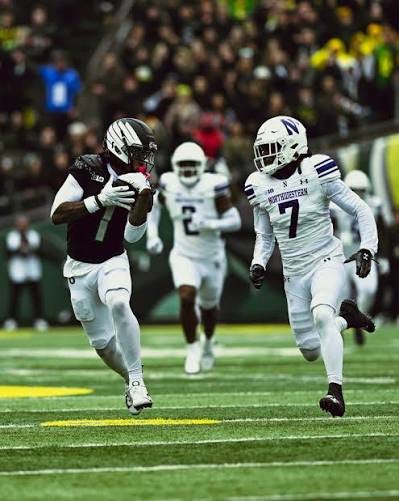
After a week of difficult conversations, a coaching change and renewed emphasis on playing without fear, Dan Lanning’s Ducks found their footing against Northwestern. The victory revealed what changed, what remains unfinished and why the players believe there is still something worth fighting for.
EUGENE, Ore. — Somewhere between a first half that looked painfully familiar and a fourth quarter that sounded like the Autzen Stadium of old, Oregon rediscovered something Dan Lanning had spent much of the previous week trying to bring back to his football team.
It wasn’t simply confidence, although Dylan Raiola certainly played with more of it as Saturday’s game against Northwestern progressed. It wasn’t necessarily execution, either, because the Ducks still made enough mistakes to keep the outcome uncertain until the closing moments. What began to emerge was a willingness to play aggressively without allowing the consequences of failure to dictate every decision that followed.
For a team that had spent much of the season struggling to reconcile enormous expectations with increasingly disappointing performances, that represented a meaningful departure from what had become familiar.
Oregon trailed Northwestern 20-6 with less than two minutes remaining in the first half, and there was little reason to believe the Ducks were about to produce their most encouraging offensive performance in weeks. The Wildcats had controlled possession, repeatedly escaped difficult third-down situations and looked considerably more organized offensively than a team that had just dismissed its coordinator.
Yet Oregon’s eventual 34-26 victory was built on precisely the response Lanning had demanded during the week.
“There’s a lot of people that fold up in that moment,” Lanning said afterward. “There was zero quit from our guys. They just kept feeling like it was one more play they had to go make.”
The significance of that response extended beyond the final score. For much of the season, Oregon had appeared to struggle with the emotional weight of its own mistakes, allowing one unsuccessful possession or defensive breakdown to influence the next. Lanning had acknowledged Wednesday that his team still had difficulty handling adversity, particularly when the energy and confidence of a good moment disappeared.
Saturday provided a test of that concern almost immediately, and the Ducks failed the early portion of it badly. What mattered was that they eventually responded, something Lanning believes reflects a quality that had not entirely disappeared despite the season’s frustrations.
“They’re not quitters. We got winners in that locker room,” he said. “And again, that’s not always reflected in the scoreboard. That’s not always reflected in reality.”
For Lanning, that determination is developed long before the stadium lights come on. It is built through the daily willingness to confront shortcomings, accept coaching and continue preparing when the results suggest the effort isn’t producing enough progress.
“It’s reflected in the way they practice Monday, Tuesday, Wednesday, Thursday,” he said. “It’s reflected in us being really honest with each other and living in reality.”
That distinction became the foundation of nearly every conversation following Saturday’s victory. Oregon hadn’t solved all its problems, and nobody inside the program suggested otherwise. But the Ducks finally offered evidence that confronting those problems could produce something more meaningful than another week of promises.
Letting Go of the Fear of Failure
The most consequential change may have taken place before Saturday’s kickoff, when Lanning and his offensive staff committed to restoring some of the aggressiveness that had gradually disappeared from Oregon’s approach.
The dismissal of Drew Mehringer was the most visible consequence of the offensive struggles, but Lanning had made clear during the week that the problems were not confined to one individual. Oregon had become hesitant, inconsistent and increasingly dependent on difficult passing situations to produce offense.
That hesitation was especially apparent in recent fourth-down decisions, where Lanning acknowledged afterward that he had occasionally abandoned the aggressive philosophy that helped define his coaching approach.
“There’s a couple fourth downs in that game that I normally would have gone,” he said, referring to the Illinois game. “Again, we were playing not to lose and playing small ball, and that’s not what we do.”
The challenge was finding a way to restore that mentality without confusing aggression with recklessness. Oregon couldn’t simply begin taking unnecessary chances and expect different results. The coaching staff needed to identify opportunities within the opponent’s defensive structure, prepare the players to execute them and accept the consequences when those opportunities appeared.
Saturday’s offensive plan reflected that approach, even when the results were uneven. The Ducks attempted a halfback pass, incorporated a reverse, pushed the football downfield and eventually began using tempo to establish a rhythm that had been conspicuously absent.
Lanning believed eliminating some of the pauses between plays helped the offense find that rhythm, even if the adjustment placed greater demands on the players.
“I think us not huddling up every play I think helped,” he said. “Certainly, I think it demanded a little bit more of our players, which they are certainly capable of.”
Still, the clearest example of Oregon’s renewed approach came early in the fourth quarter, when the Ducks faced fourth-and-goal trailing 23-20.
A field goal would have tied the game, and given Oregon’s offensive difficulties throughout the afternoon, accepting those points would have been understandable. Instead, Lanning chose to trust an offense that had finally begun demonstrating some consistency, and Brandon Smith rewarded the decision with the touchdown that gave Oregon its first lead.
The call carried additional significance because the staff had considered using the same concept earlier in the possession. Lanning explained that Jay, who led the offensive play-calling effort, initially wanted to use the eventual touchdown play on second down before being talked out of it.
When the moment arrived again, the staff trusted the original instinct.
“Our mindset was, hey, we’re either going to punch this in, you know, or they’re going to have to drive 99 yards bringing it back,” Lanning said.
The players had already embraced that mentality. Raiola said there was never any question about whether the Ducks would attempt to score once they reached the critical fourth-down situation, because the approach had been established during preparation.
“Going into this game, we were going to be aggressive. We’re not living in the past. We’re going to worry about the present and the future,” Raiola said. “When we ran the play before, we knew what we were going to do on 4th.”
There was a freedom in that certainty that had been missing from Oregon’s offense. The Ducks were no longer approaching every difficult situation as another opportunity for something to go wrong, and Raiola believed that mindset helped restore an essential part of the team’s identity.
“We weren’t going to go down without swinging,” he said. “And I think that kind of got lost a little bit. I don’t think it completely lost it, but we got back to our DNA.”
That didn’t mean Oregon suddenly stopped making mistakes. The offense still struggled early, lost a fumble on its opening possession of the second half and nearly surrendered another opportunity late with a poorly executed swing pass. The difference was that those mistakes no longer seemed capable of preventing the next successful play.
Confidence Begins With the People Around You
Raiola’s transformation was among the most noticeable developments of the afternoon, but the quarterback was reluctant to frame his performance as an individual breakthrough.
He finished with 336 passing yards and three touchdowns, including the 75-yard connection with Dakorien Moore that gave Oregon an eight-point advantage late in the fourth quarter. More importantly, he appeared increasingly comfortable making decisions as the offense began creating more favorable situations around him.
Lanning has watched that confidence develop unevenly during a season in which Raiola has been asked to operate within an offense that has struggled with consistency, injuries and changing expectations. The quarterback’s talent has never been the central question, but his ability to maintain trust in his reads and execution has been tested repeatedly.
“He is a guy that feeds off of his confidence,” Lanning said. “But he made some big-time throws today. Put balls in spots where our guys could get it and nobody else could.”
Raiola has begun approaching that challenge with a deliberate effort to control his emotional state during games. Rather than allowing a missed opportunity to linger into the next possession, he has incorporated techniques designed to bring his attention back to the immediate responsibility in front of him.
“I’ve actually started doing a bunch of breathing and humming and different tactics,” he said. “And it just really helps me come back to center and really focus back on the next play.”
That approach reflected the same message Lanning had emphasized earlier in the week about controlling effort and preparation rather than becoming overwhelmed by outcomes. For Raiola, however, confidence also comes from the players surrounding him, particularly a receiving corps capable of turning difficult throws into successful plays.
The touchdown connections with Moore and Jamari Johnson demonstrated a level of trust that had not always been evident in previous games. Raiola credited the weekly preparation with Oregon’s quarterback coach, particularly the detailed work on fade routes and ball placement, for creating opportunities to execute those throws when they mattered.
The improvement was also tied to greater consistency along the offensive line.
For the first time this season, Oregon had started the same offensive-line combination in consecutive games, allowing a group that had struggled with personnel changes to begin developing more dependable communication and an understanding of each other’s tendencies.
Fox Crader believed that continuity was becoming increasingly important.
“I think that’s a big part of all line play is just having chemistry with the guys you’re out there on the field with, knowing each other’s weaknesses, each other’s strengths,” Crader said.
The improvement wasn’t simply a matter of the same five players lining up together. It involved learning how teammates react when assignments become difficult, recognizing where help might be necessary and trusting that the player beside you understands his responsibility.
Raiola pointed specifically toward center Poncho Laloulu, whose leadership helps maintain that connection across the offensive front.
“We know who’s going to be out there. We know each other’s strengths and weaknesses,” Raiola said. “Our center, Poncho, does a great job of he knows every single one of those guys inside and out.”
Crader also sees that understanding developing in freshman Tommy Tofi, whose progress has become increasingly visible as his responsibilities have grown.
The transition hasn’t been easy. Crader described the challenges facing a young offensive lineman learning to compete against experienced college defenders, but said Tofi has become more intentional in his preparation, particularly in the film room.
“I told him the quickest way that you’re going to learn this playbook is if you draw the plays yourself and you get that experience,” Crader said.
That attention to detail has begun translating onto the field, although Crader remains realistic about the work ahead for both Tofi and the line as a whole.
“Obviously, there’s a lot of stuff to clean up still,” he said. “But once we get those things down pat, he’s going to be a special player for real for a long time, too.”
Saturday’s offensive improvement was not simply the result of better blocking or a quarterback suddenly finding his confidence. It was the product of several parts of the offense beginning to function together, allowing Oregon to establish a relationship between its running and passing games that had too often been missing.
And perhaps nobody benefited more from that opportunity than Brandon Smith.
The Players Who Were Ready When Their Moment Arrived
When Jordon Davison and Dierre Hill Jr. were unable to continue handling their usual responsibilities because of injuries, Oregon suddenly found itself relying on running backs who had not received the same volume of practice repetitions.
For Smith and Da’Jaun “Dink” Riggs, that meant executing assignments they had primarily prepared for mentally rather than through extensive physical repetitions during the week.
Lanning believed their response reflected both the preparation of the players and the work of the coaching staff to ensure the offense could continue functioning when its original personnel plan changed.
“They had to get the mental rep. Right. And be able to execute the mental rep,” Lanning said. “And they did an outstanding job of that.”
Smith provided the most noticeable spark, gaining 82 yards on just eight carries while demonstrating an ability to accelerate through openings and change direction when the original rushing lane was unavailable.
His 35- and 31-yard runs were particularly significant because they helped create something Oregon’s offense had been missing: a legitimate rushing threat that Northwestern could no longer afford to ignore.
Lanning saw something more important than the production itself.
“That’s all you want as a coach is a guy that, you know, not necessarily begging for their opportunity, but ready when their opportunity comes,” he said.
Smith’s preparation had already made an impression on his teammates. Raiola described a freshman who consistently challenged defenders during practice and continued finishing runs even after the initial contact that would ordinarily end a controlled repetition.
“Just the way they train themselves is awesome, and it gives us a lot of confidence,” Raiola said. “Brandon’s special, and he makes a lot of guys miss.”
That confidence extended to the offensive line, where blocking for Smith presented a different challenge because of his willingness to cut back against the original direction of a play.
The linemen couldn’t necessarily anticipate exactly where Smith would finish, but their responsibility remained the same: execute the assignment, sustain the block and trust the runner to take advantage of the space.
Lanning noted that the effort extended well beyond the offensive line, with receivers working downfield to extend runs and linemen continuing to chase the play after their initial assignments were complete.
That willingness to finish was evident when Raiola moved downfield to help block during one of Smith’s explosive runs.
The quarterback didn’t consider it unusual. He saw it as part of the responsibility he owed teammates who were making the same effort on his behalf.
“I’ll do anything for this team,” Raiola said. “I’ll lay my body on the line.”
For an offense that had appeared disconnected during much of the season, those moments of shared effort offered a different picture. Smith wasn’t simply producing yards because he was more talented than the defenders attempting to tackle him. He was taking advantage of opportunities created by teammates who had begun playing with a greater sense of collective purpose.
Lanning expects that production to result in more opportunities for the freshman.
“His role will continue to grow with this team,” he said. “He’s obviously very capable, and I’m excited about what he was able to accomplish today.”
Moore’s Growth Is Becoming More Than Potential
Dakorien Moore’s performance represented another important step in a development process that has included some difficult lessons during his first two seasons at Oregon.
Earlier in the week, Moore had spoken about arriving in college football without fully understanding the emotional challenges awaiting him. The confidence that accompanied his celebrated recruitment had not disappeared, but the experience of injury and adversity had forced him to develop a greater appreciation for preparation, recovery and the responsibilities that exist outside the moments of individual recognition.
Saturday provided an opportunity to see some of that growth translate into production.
Moore caught seven passes for 128 yards and two touchdowns, including a 75-yard score that emerged from the relationship between Oregon’s improving rushing attack and the downfield opportunities it created.
Lanning believes the receiver’s maturation has been reflected in his approach to coaching.
“Dakorien has grown into a guy that really wants to be coached,” Lanning said. “He wants the pressure. He wants it on his back.”
The coach also understood Moore would be frustrated by the third-quarter fumble that gave Northwestern possession in Oregon territory. Rather than treating the mistake as evidence of an individual failure, Lanning acknowledged the need for the staff to continue improving the way it teaches ball security.
That balance between accountability and support has become increasingly important for a player whose responsibilities continue to grow.
“When he practices, the way he’s capable of, he can have really big games,” Lanning said. “And obviously, he had a big game today and was certainly a difference maker for us.”
The most consequential play came with Oregon holding a precarious 27-26 lead after Northwestern had converted a long field goal early in the fourth quarter.
Lanning explained that the Ducks had identified Northwestern’s boundary safety as a defender who aggressively supported the run, creating a potential opportunity for a play-action shot behind him.
The concept depended on the credibility of Oregon’s running game. With Smith beginning to produce explosive rushing gains, the defense had to respect the possibility of another run, creating the space Raiola needed to find Moore downfield.
“It was just a great read,” Lanning said. “A read that at times we’ve missed this year where it’s like, no, we’re throwing for the shot.”
The play also demonstrated how preparation can provide confidence without guaranteeing the outcome. Raiola explained that the concept had been carried forward from the previous season, waiting for the right defensive look to become useful.
When that look finally appeared, the quarterback trusted the read, the offensive line provided the protection and Moore finished the touchdown.
For Raiola, the result was an unusually simple scoring possession.
“I like one-play drives, 11 seconds,” he said. “It’s a lot less thinking and stress.”
The confidence between quarterback and receiver was evident throughout the afternoon, but Raiola emphasized that his trust extends to Oregon’s receiving group as a whole.
“He just has awareness for the football when it’s in the air,” Raiola said of Moore. “I trust him just as much as I trust JJ, as much as I trust Evan.”
That trust works in both directions. Johnson described Moore as a teammate who inspires additional effort from the players responsible for creating space after the catch, recognizing that the receiver’s explosiveness can change the outcome of a play in an instant.
“That’s my dog, man,” Johnson said. “Every time he gets the ball in his hands, it’s electric.”
Moore’s afternoon ended with a frightening moment when he absorbed a substantial hit while returning a punt late in the game. Lanning was optimistic about the receiver’s condition afterward, explaining that Moore had experienced pain but was already insisting he could return.
“He told me when he’s laying down on the ground, I’m ready for the next play,” Lanning said. “I’m like, well, you’ve got to come out for one, right, at least.”
It was a fitting illustration of the competitive growth Lanning had been describing, even as the staff remained responsible for protecting a player who had become an increasingly important part of Oregon’s offense.
A Defense That Had to Learn as the Game Unfolded
The offensive improvement would have meant considerably less without Oregon’s ability to adjust defensively after a first half in which Northwestern quarterback Aidan Chiles seemed capable of extending almost every important possession.
The Wildcats gained 284 yards before halftime and repeatedly punished Oregon when its initial pass rush failed to contain Chiles. The quarterback created problems both with designed concepts and improvised movement, escaping pressure and finding receivers who had uncovered themselves as plays developed.
Lanning explained that Northwestern’s offense presented an unusually difficult preparation challenge because its varied rushing concepts and play-action packages required Oregon to defend multiple approaches from similar formations.
The difficulty became especially pronounced when the Ducks attempted to contain Chiles without sacrificing the edge pressure needed to disrupt Northwestern’s passing game.
“When you designate a hat to go spy him and take him away, then you lose a little bit of the edge pressure that you can generate,” Lanning said. “You can’t really do both.”
There were moments when Oregon had a defender in position but failed to finish the play, and others when Northwestern’s design created an advantage before the ball was snapped.
The Wildcats’ first-quarter touchdown pass to Griffin Wilde offered an example of the latter. Northwestern used a formation variation that challenged Oregon’s coverage rules, producing a long touchdown that Lanning ultimately attributed to a coaching answer that needed to be better.
“The rules that we carried in, that’s not our player’s fault,” he said. “That’s one that we could have been more sound in and how we did it.”
Lanning credited Kelly’s staff for recognizing the opportunity and exploiting it. The adjustment afterward was important, but Northwestern had already established considerable momentum.
The Ducks eventually began finding more effective ways to pressure Chiles and reduce his success on third down, limiting Northwestern to 172 yards and six points in the second half.
Koi Perich believed the improvement was less about discovering an entirely new defensive approach than executing the responsibilities the players already understood.
“Just execution. This whole week was about execution, being in the right play, doing your job,” Perich said.
The freshman acknowledged that the first-half performance had fallen short of that standard, whether through defensive backs losing position, Chiles escaping containment or Northwestern simply making plays.
Brandon Finney Jr. viewed the challenge similarly, emphasizing that defenders couldn’t allow the quarterback’s mobility to distract them from their individual assignments.
“There’s people that are meant to catch the QB,” Finney said. “Us as DBs, we got to do our job of cover, so that’s all we can do.”
Finney credited defensive coordinator Chris Hampton with simplifying the approach against Northwestern’s complicated offense. Rather than attempting to match every variation with additional complexity, Oregon focused on establishing clear rules and demanding disciplined execution.
That approach also reflected the emotional message Lanning had delivered throughout the week.
“We really like honed in on like not playing off of juice, not playing, not getting too high, not getting too low,” Finney said.
The defense was still far from flawless after halftime, but it began making the plays that had been missing earlier. Oregon generated three sacks, forced Northwestern to settle for field goals and eventually produced the stops necessary to preserve the lead.
There was an important distinction between playing with emotion and allowing emotion to govern performance. Oregon’s defense had spent much of the first half reacting to Northwestern’s success, but gradually began functioning with greater discipline as the game progressed.
“Execution and effort,” Finney said. “That’s how simple we kept it this week.”
The Play That Almost Went Wrong
Even after Oregon had completed its comeback, the Ducks still needed one final offensive play to preserve the victory.
Northwestern had been forced to punt, and Oregon faced the task of securing a first down that would prevent the Wildcats from receiving another opportunity.
The offensive staff called a backside bootleg designed to give Raiola a relatively simple choice. If the intended receiver was clearly available, he could throw. If not, he was expected to keep the ball and run.
The play didn’t unfold exactly as designed.
Johnson believed his responsibility was to draw defenders away from Raiola, creating space for the quarterback to run. Instead, Raiola saw an opportunity to deliver the football and trusted Johnson to make a difficult catch.
“I was a little in shock because I thought I was just going to, you know, go to probably draw some defenders with me so he could run,” Johnson said.
The tight end adjusted when the ball arrived, completing the reception and giving Oregon the first down it needed.
“But he ended up throwing it and I was like, oh, I got to catch it,” Johnson said. “So I caught it.”
Lanning admitted afterward that the decision carried considerably more risk than the staff had intended, and Raiola apparently recognized the same thing immediately.
“He told me as soon as he came off the field, he’s like, I owe you one,” Lanning said. “I know that was a little bit careless.”
Raiola approached the question with some humor, acknowledging that the outcome had made the decision much easier to defend.
“I’m glad it worked out because I might not be here if it didn’t work out,” he joked.
But the sequence also reflected the confidence Oregon had rediscovered. Raiola wasn’t simply trying to avoid making a mistake. He was trusting a teammate to finish a play that offered the opportunity to secure the victory.
Perich appreciated the decision for an entirely practical reason. The successful conversion meant Oregon’s defense didn’t have to return to the field for another possession.
“That’s Dylan and probably one play that summarizes him,” Perich said. “He’s a playmaker, and ultimately he goes out and wins the game.”
Northwestern’s Perspective: A Game That Got Away
The emotional contrast between the two locker rooms was significant.
While Oregon celebrated a comeback that offered some relief from the disappointments of the season, Northwestern believed it had allowed an important opportunity to slip away.
Wildcats coach David Braun opened his postgame remarks by crediting Oregon’s effort, but there was little satisfaction in describing a game his team had controlled for much of the opening half.
“We came here expecting to win, and you got a team in there that’s absolutely crushed with the result,” Braun said.
The disappointment was particularly pronounced because Northwestern had repeatedly created situations in which it could have extended its advantage. The Wildcats moved the ball effectively, established control of possession and produced a series of scoring opportunities, but too many drives ended with field goals rather than touchdowns.
Braun also believed his defense failed to maintain the momentum established by the offense.
“There was opportunities for us to get stops on defense up by two scores to really keep momentum, hold that momentum,” he said.
Oregon’s explosive plays were especially damaging. Smith’s runs created favorable situations, while Raiola’s connection with Moore produced the kind of quick touchdown Northwestern generally emphasizes preventing.
“That’s not our brand of football,” Braun said. “We don’t give up explosive plays. And there’s too many explosives, especially in the second half.”
Braun had anticipated that Oregon would emphasize running the football and attacking downfield following its coaching change. The overall approach wasn’t a surprise, but the Wildcats struggled to consistently defend the combinations Oregon eventually developed.
“We felt really confident that they’d be committed to running the football, that they would be committed to pushing the ball downfield with the talented athletes that they have on the perimeter,” he said.
Northwestern’s inability to maintain control also changed the circumstances for Chiles and the offensive line. As Oregon took the lead, the Wildcats were increasingly forced into obvious passing situations, allowing the Ducks’ defensive front to become more aggressive.
Braun believed those circumstances helped explain why Oregon generated more pressure late in the game, but he remained frustrated that Northwestern hadn’t done more to prevent the situation from developing.
For the Wildcats, the larger lesson was that establishing an early advantage doesn’t guarantee the rest of the afternoon will unfold as expected.
“We don’t necessarily control if we’re going to start fast or not, but what we can control is our urgency, our focus, the way that we carry ourselves,” Braun said.
It was a perspective remarkably similar to the one Lanning had emphasized throughout the week, although the two coaches were considering it from opposite sides of the final score.
The Next Test of Oregon’s Resolve
Oregon’s victory offered relief, but Lanning wasn’t interested in allowing the final result to become a substitute for honest evaluation.
The coach acknowledged that the Ducks had come closer to producing the complementary performance he has been seeking, with the offense generating explosive plays, the defense improving after halftime and special teams contributing useful field position.
“I felt like that’s the closest we’ve been to a complete performance,” he said. “That being said, there’s a lot of things that we can still do a lot better.”
The remaining concerns are significant, particularly with Ohio State awaiting Oregon next week. The Ducks cannot afford another first half in which the defense repeatedly fails to get off the field, nor can they assume that explosive offensive plays will compensate for persistent execution problems.
There are also injuries to manage, including the leg injury that prevented Davison from returning and the physical concerns surrounding Hill. Lanning indicated that more information about Davison’s condition would likely become available during the team’s Wednesday update.
But the most important development may be how Oregon’s players have begun responding to the demands placed upon them.
Raiola spoke about teammates who could easily become discouraged by the season’s trajectory, particularly players approaching the end of their college careers. Instead, he said he continues to see a group committed to one another and to the program despite the difficulties surrounding them.
“These dudes love Oregon. They love each other,” Raiola said. “And it’s always about us. And then they just fight for each other.”
That commitment had been difficult to recognize through much of Saturday’s opening half, when Northwestern appeared better prepared and more capable of executing its plan. It became considerably more visible as the Ducks fought their way back, with players stepping into unfamiliar roles, the offensive line beginning to function more cohesively and the defense making the adjustments necessary to preserve the victory.
Lanning believes the challenge now is to resist evaluating that progress entirely through the satisfaction of winning.
“We can’t really focus on outcomes,” he said. “Let’s focus on things that can make us better.”
The head coach intends to allow the team a brief opportunity to enjoy Saturday’s victory before returning to preparation for Ohio State, where the margin for the kind of mistakes Oregon made against Northwestern will likely be considerably smaller.
“You don’t get an opportunity to make mistakes like that against great teams like Ohio State,” Lanning said. “So we’re going to have to have our best.”
For now, Oregon has something it hasn’t possessed much of in recent weeks: evidence that its preparation, difficult conversations and willingness to change can produce a meaningful response.
But Lanning understands that resilience isn’t measured by one successful afternoon. It is tested repeatedly, particularly when the circumstances become difficult again, and the coach’s final observation offered perhaps the most appropriate perspective on what Saturday’s victory actually means.
“They responded today,” he said. “We’ll see how they respond to the next time.”