


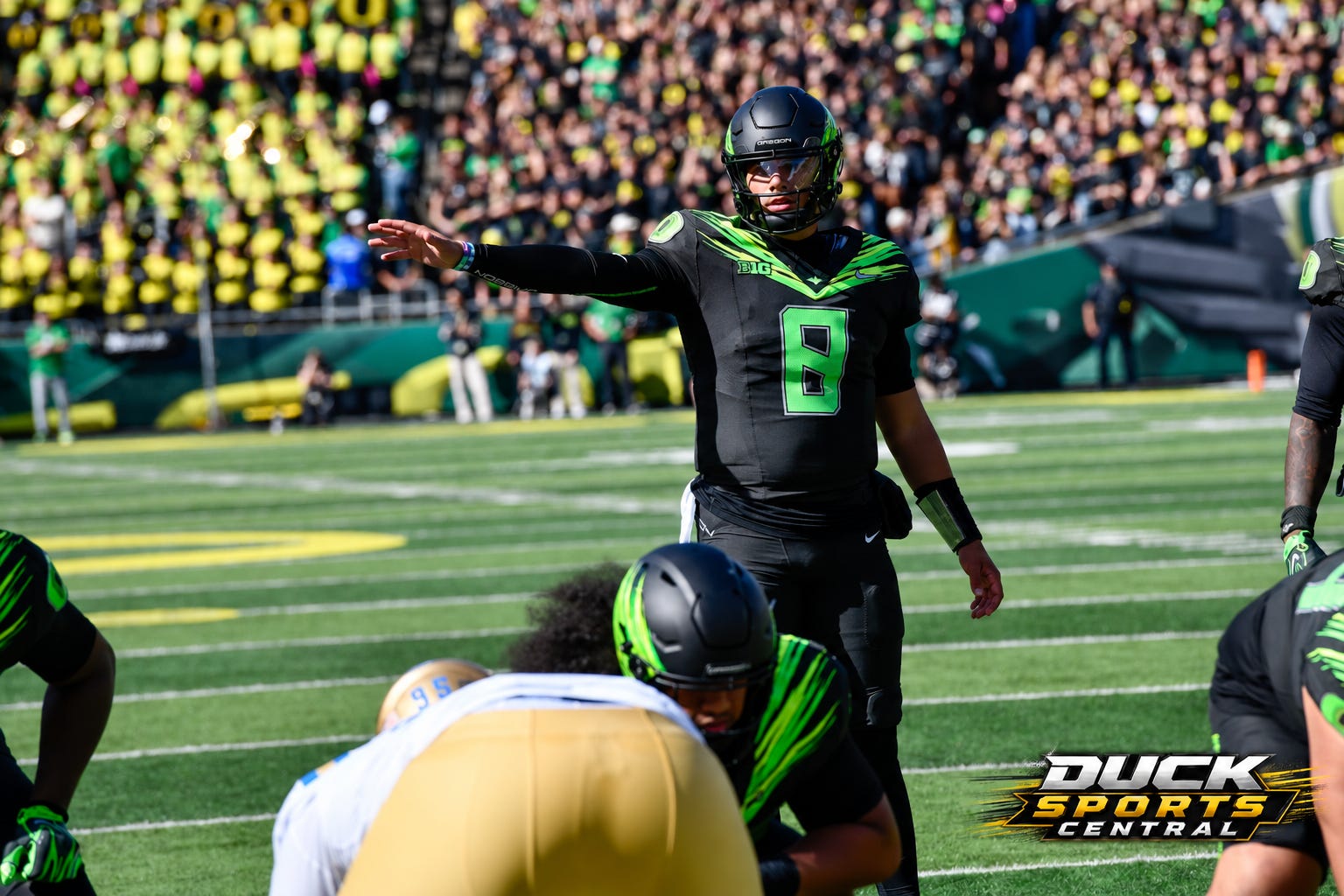
EUGENE, Ore. — There are losses that can be explained by a handful of plays, moments when an otherwise sound performance is undone by a missed assignment, a turnover or an opponent making one more play when it matters. Then there are losses that demand a much broader examination of what a team has become, how it prepares, and why the product that appears on Saturday bears so little resemblance to the one coaches and players believe they have spent the week building.
Oregon’s 17-15 loss to UCLA on Saturday at Autzen Stadium belonged much closer to the latter category. The Ducks committed seven turnovers, converted just one of 12 third-down opportunities and managed only 73 rushing yards against a Bruins defense that controlled the line of scrimmage for much of the afternoon. A late rally behind Brock Thomas nearly erased an 11-point fourth-quarter deficit, but the failed 2-point conversion following Evan Stewart’s 44-yard touchdown left Oregon chasing one final possession that ultimately produced nothing.
Afterward, Dan Lanning, Teitum Tuioti, Koi Perich, Dylan Raiola, Stewart and Thomas offered different perspectives on how the game unraveled. Their explanations were not always identical, particularly when it came to the difference between preparation and execution, but together they painted a picture of a program struggling to translate its expectations into consistent performance.
Perhaps the most revealing part of the afternoon came in how little anyone tried to explain away the result. There were acknowledgments of UCLA’s quality, reminders of the work that had gone into preparation and expressions of confidence that Oregon could still become a good football team, but nobody who stepped in front of the microphones suggested the performance was acceptable.
Lanning: The Problems Go Beyond One Position
Lanning opened his postgame remarks with an acknowledgment that Oregon had failed in virtually every area necessary to win, even as its defense repeatedly created opportunities to keep the game competitive. The coach pointed to the very first play, a 62-yard UCLA completion that eventually produced a field goal, as an example of how even the relatively successful portions of Oregon’s performance contained mistakes that mattered in a two-point game.
“Obviously, disappointing result. Always want to thank our fans for being outstanding,” Lanning said. “Obviously, UCLA played a good game and never have been in a situation where we turned the ball over that much and still have an opportunity to have success there in the game. But we weren’t successful on offense in any phase tonight. You know, obviously didn’t really get into a rhythm, weren’t able to create success there.”
Lanning was particularly direct about the turnovers, an issue that overwhelmed whatever progress Oregon made defensively. The Ducks lost five fumbles and threw two interceptions, repeatedly placing their defense in situations where a single mistake could produce points.
“You got to protect the ball, right? And you can coach it and you can say it, but if it shows up, you’re not coaching it well enough, you’re not doing a good enough job there,” Lanning said. “We were atrocious on third down, right? We didn’t have any success on fourth down.”
The offensive problems were not confined to the quarterback position, even if Raiola’s performance became the most visible example of Oregon’s struggles. The Ducks failed to generate consistent movement along the offensive line, could not establish a reliable rushing attack and spent much of the afternoon facing obvious passing situations against a UCLA secondary that made finding open receivers difficult.
Asked about the offensive line, Lanning acknowledged that the group’s development had fallen short of the standard established in previous seasons. Oregon entered the year needing to replace three NFL-bound offensive linemen, and the staff had expressed confidence that it could develop the replacements already within the program.
“Our players have to play better. We have to coach better. I think that’s part of it,” Lanning said. “I think we all knew that it wasn’t going to be the same experience to align that we had this past year, but we felt comfortable. If you look at the history of us developing there at that position and what it’s become over time, it’s always gotten better towards the end of the season and it’s improved.”
That historical confidence has not yet produced the expected results. Oregon was still adjusting its offensive line combination Saturday, including another personnel change early in the second half, and the Bruins were able to generate pressure even without consistently committing additional defenders to the pass rush.
“We’ve always been one of the better teams at protecting the quarterback. It hasn’t been good enough this year. And running the ball, we haven’t been as effective this year. All those things tie together,” Lanning said. “Your passing game compliments your run game, right? Your run game compliments your pass game and your ability to protect the quarterback. I think we have to look at all that stuff really critically and make sure that we can continue to improve.”
The offensive struggles also brought questions about the play-calling, particularly after Oregon found some success using two-back rushing formations in the second half. Those moments were brief, however, and the Ducks repeatedly interrupted promising possessions with turnovers.
Lanning acknowledged that the staff may have been too slow to make adjustments, pointing specifically to formations that produced better rushing opportunities. When asked whether the offensive play-calling responsibilities could change, he declined to rule out a broader evaluation.
“I have to definitely evaluate the game first, go back and look at it. We didn’t have success on offense. So I think you have to look at all things, right?” Lanning said. “You have to look at all things. Was it the calls? Was it the way we operated in practice? Certainly, was it the way we operate in the games? But everything has to be up for evaluation.”
That answer carried considerable significance because Oregon’s problems have extended beyond one disappointing offensive performance. The Ducks have shown flashes of the team they expected to become, including moments against USC two weeks earlier, but those performances have not developed into a dependable identity.
Lanning believed the additional preparation afforded by the bye week would allow all three phases to come together against UCLA. Instead, the offense produced its least convincing performance of the season before Thomas entered the game.
“I felt like this was going to be the game based on our prep where all three phases really came together. And obviously it didn’t with offense today,” Lanning said. “It’s all come together for us quite a bit in the past. It hasn’t so far this year. We got to continue to figure out what that looks like.”
Raiola Takes Responsibility for a Difficult First Start
Much of the attention leading into Saturday centered on Raiola, who was making his first start at Oregon while Dante Moore remained unavailable following the hit he absorbed against USC. Raiola had provided encouraging moments in relief against the Trojans, creating optimism that the Ducks could continue moving forward offensively while Moore recovered.
Against UCLA, that optimism quickly disappeared. Raiola completed six of 19 passes for 43 yards, threw two interceptions and lost a fumble before being replaced by Thomas in the fourth quarter. Several passes sailed beyond their intended targets, while others fell short, and the inability to establish a rushing attack left Oregon increasingly dependent on a passing game that was not functioning.
Raiola did not attempt to place responsibility on his offensive line, receivers or the coaching staff. Instead, the sophomore quarterback offered perhaps the most direct assessment of any Oregon player who spoke after the game.
“I thought we had two great weeks of practice, great weeks of prep,” Raiola said. “Sometimes the ball doesn’t go your way sometimes, but, you know, I got to do a better job of rallying the guys and making a play or getting us going to flip the switch because, you know, it was really one play away from going the other way. But, I mean, you can’t turn the ball over. I was reckless with the ball today, and you can’t win football games like that.”
One of the questions surrounding Raiola’s performance was whether UCLA had confused him with its coverage or whether the opportunities were available and he simply failed to execute. Raiola believed the latter was closer to the truth, explaining that the offensive opportunities were there but that he did not make the throws required to sustain drives.
“I mean, I thought I saw the field well. I mean, people probably said I didn’t because of the way I played, but I thought I saw it well, and I wasn’t really confused,” Raiola said. “It was just I got to make throws. When I got my receivers win, my O-line gives me time. Like, you can’t ask for anything more, and that was all game. So I got to be better. Teams count on me to make those plays, and, you know, I let them down today.”
Lanning, however, was unwilling to let Raiola carry the entire burden for what happened. While acknowledging the quarterback’s performance was inadequate, the coach accepted responsibility for the way Oregon prepared him and the situations in which he was asked to operate.
“He wasn’t good enough today. I think he can acknowledge that. But we didn’t prepare him to be good enough today. We didn’t put him in positions to have success that he needs to have,” Lanning said. “And we need the best version of Dylan moving forward. Two weeks ago, he was phenomenal, right? And earlier in this year, I think he’s received a lot of praise.”
The contrast between the quarterback’s assessment and his coach’s explanation was revealing without necessarily being contradictory. Raiola saw missed throws and poor decisions that belonged to him, while Lanning saw an offense whose inability to run the ball, create favorable down-and-distance situations and protect its quarterback made those decisions more difficult.
Lanning also recognized the potential psychological consequences of the performance, particularly for a quarterback who had already dealt with a significant injury during his college career. He said his immediate priority was to find Raiola after the press conference and make certain the sophomore understood he retained the support of the program.
“He has to know that we have a team here that’s here to support him. We have a coaching staff that’s here to support him and just wants to see him continue to improve and get better and give him some of his confidence back,” Lanning said. “Because certainly he’s lost some of that today. If he pays too much attention to the news, he’s going to lose some more of that, right? If he just goes out there and works and focuses on improvement, then he’s got a chance that he can continue to become a good player.”
Raiola’s decision to speak after the game provided another glimpse into his response to the disappointment. Rather than avoiding the attention surrounding his performance and eventual benching, he explained that facing difficult circumstances publicly was part of the responsibility that came with being a quarterback.
“I mean, I got a younger brother, and, you know, he looks up to me, and, I mean, this isn’t just football. This is life, and tough situations happen, and you got to own them,” Raiola said. “There’s no running around them. There’s no dodging them. The product we put out there, the product I put out there, is I got to live with that. I mean, I got to own everything, take it on the chin, and move forward.”
Thomas Provides a Spark, but Not a Rescue
When Thomas entered the game in the fourth quarter, Oregon’s offense had spent nearly three quarters failing to generate sustained production. The Ducks had scored only six points, were trailing by 11 and had shown few signs that they could consistently move the ball against a UCLA defense that had controlled the afternoon.
Thomas changed the immediate rhythm of the game, completing 11 of 15 passes for 126 yards and leading scoring possessions that brought Oregon within two points. His 44-yard touchdown pass to Stewart with 2:16 remaining briefly brought Autzen Stadium back to life and gave the Ducks a chance to force overtime before UCLA stopped the ensuing conversion attempt.
The junior quarterback described his assignment in relatively simple terms. Rather than attempting to manufacture a dramatic comeback on every snap, Thomas wanted to execute the offense and allow successful plays to build on one another.
“They just wanted me to play clean, go in there and operate, do what I can do,” Thomas said. “And I’m trying to get this team a little spark here and there.”
Thomas said the most important part of entering the game under those circumstances was avoiding the temptation to make the moment larger than it needed to be. Having previously been called upon in difficult situations, including against Wisconsin last season, he understood that the offense needed composure as much as it needed production.
“I mean, I think just not making the moment bigger than it is. I mean, going in there, if you’re frantic, freaking out, thinking about a million different things at quarterback, you’re not going to be successful,” Thomas said. “And I think going in there with a clean mind, just trying to calm myself down, get in there and trusting the guys that I got around me and going in there with the most confidence I can.”
His message to the offensive huddle reflected that approach. With Oregon struggling to establish any consistency, Thomas emphasized concentrating on the next assignment rather than the deficit or the number of opportunities already lost.
“I think just taking it one play at a time, I kind of told him, let’s go in here, let’s go operate this play right now, and then we’ll stack another one, keep stacking plays,” Thomas said.
The quarterback change naturally raised questions about whether Thomas should have entered earlier and what the depth chart might look like if Moore remains unavailable against Nebraska. Lanning acknowledged the legitimacy of the first question, explaining that the staff had continued to believe Raiola could make the plays Oregon needed until another turnover made a change necessary.
“Yeah, it’s probably a fair question,” Lanning said. “You can always go back and say, hey, we should have done that earlier. If you knew that turnover was coming, you would have done that earlier, right? We felt like that’s a play that we’ve seen Dylan make a lot in practice, and he didn’t make that play today.”
Lanning said Thomas’ performance warranted evaluation heading into the next game, but he would not commit to a quarterback decision before reviewing the film and assessing Moore’s availability. He also made clear that Moore’s recovery would not be rushed simply because the Ducks needed improved quarterback play.
“It’s a continued discussion. I don’t want to put words in my mouth or Dante’s on that,” Lanning said. “It’s something we’ve said from the beginning that we’re going to move with an abundance of caution, continue to get eval and check, but it won’t be just a sprint, just to say, okay, he’s back out there no matter what.”
For Thomas, the possibility of an expanded role did not alter his immediate perspective. He credited the preparation required of a backup quarterback and remained focused on correcting the mistakes that had contributed to the loss.
“I think just going into this next week learning from what mistakes we had in the game and just going and trying to operate as best I can next week,” Thomas said.
A Defensive Effort That Still Fell Short of Its Own Standard
For much of Saturday’s game, Oregon’s defense appeared to be the only unit capable of keeping the Ducks competitive. UCLA entered with the nation’s fourth-ranked rushing offense, averaging 281.5 yards per game, but Oregon limited the Bruins to 140 yards on 47 carries while recording seven tackles for loss and repeatedly disrupting the passing game.
The defensive front generated pressure, the secondary created turnovers and the Ducks produced several critical stops despite repeatedly being placed in poor field position. Oregon intercepted two passes, including Perich’s takeaway in the end zone late in the first half, while Jerry Mixon added another interception and Matayo Uiagalelei blocked a field goal attempt.
Yet when Tuioti was asked about the frustration of watching the offense struggle while the defense delivered one of its better performances, he rejected the suggestion that his unit had done enough to win. Oregon allowed 17 points, and by the standard Tuioti said the defense had established for itself, that remained unacceptable.
“I’ll just say at the end of the day, man, although we did a good job on defense, we didn’t do a great job. We didn’t live up to our own expectations,” Tuioti said. “17 points is too much for us. Our standard is 13 points or less. So us as a defense has to do better. And that starts with me as a leader, all of us as leaders. And it starts up front, man, with big guys.”
That standard helps explain why the defensive players did not appear interested in assigning responsibility for the loss elsewhere. Despite UCLA’s 39-minute advantage in possession time and the repeated short fields created by Oregon’s turnovers, the Ducks defense continued to produce meaningful stops into the final minutes.
Tuioti credited the defensive front for its ability to affect the quarterbacks throughout the game, particularly during a third-quarter sequence in which Oregon forced UCLA into fourth-and-31 following consecutive disruptive plays. Those moments reflected the kind of pressure the Ducks expected to generate entering the season.
“I think up front, I think we did a good job of affecting quarterback, whether that’s batted balls, hurries, pressures, and sacks, finishing sacks,” Tuioti said. “I think we did a good job as a whole this game.”
Perich, who finished with 11 tackles and an interception, was similarly unwilling to claim that Oregon had reached its potential defensively. Asked about slowing UCLA’s rushing attack, he emphasized the importance of evaluating the film before assigning grades or making definitive judgments.
“Obviously got to look at film, see what everybody did. You can’t really assess that when you’re not thoroughly looking at everybody, but I think we did a decent job,” Perich said. “Just got to keep on getting better throughout the week, and we’ll do that on Nebraska next week.”
The larger issue, however, was that even the defense’s best moments could not entirely compensate for the offense’s failures. UCLA scored its final touchdown after Oregon’s second interception of the afternoon, and the Bruins consistently benefited from field position created by the Ducks’ inability to protect the ball.
Lanning acknowledged that the defense and special teams had played well enough in stretches to give Oregon a chance, but argued that the repeated turnovers made it nearly impossible to maintain that advantage.
“Ultimately, protecting the ball is what you’re going to look back and see this game,” Lanning said. “Like, you can’t turn the ball over and give a short field to your defense, you know, repeatedly, and that happened multiple times. If those things don’t happen, which they did, so you can’t say that they didn’t, but we were playing well enough on special teams, well enough on defense that we make these guys go a long field, that we have a better opportunity.”
Stewart Sees a Team Too Focused on Results
One of the more interesting perspectives came from Stewart, whose fourth-quarter touchdown nearly gave Oregon an opportunity to escape with a victory. Stewart finished with five catches for 74 yards, but his postgame comments focused less on individual production than on the way the Ducks have approached a season that began with championship expectations.
Asked whether players had become too focused on themselves, Stewart offered a different diagnosis. In his view, Oregon’s attention had shifted too heavily toward the outcomes it wanted rather than the details required to produce those outcomes.
“Honestly, as a team, I feel that we’re too focused on the outcome,” Stewart said. “We definitely as a team just need to hone in on the details and just getting better, like truly. And not worrying about what anybody else thinks outside of the building and just honing in with each other and just really buying into each other and just the craft that we do every single day.”
That assessment offered a different way to consider the disconnect between Oregon’s practice reports and its Saturday performances. Lanning repeatedly said the preparation had been good, while the players described a team that continued to work hard and believed it had the necessary talent to succeed.
Stewart’s comments suggested that effort alone was not the central question. The challenge was whether the Ducks were giving enough attention to the specific details of their assignments instead of allowing the pressure of preseason expectations and weekly results to dominate their thinking.
As one of the older players in Oregon’s receiver room, Stewart also emphasized the importance of supporting younger teammates through adversity. He specifically discussed his conversations with Dakorien Moore, drawing on his own experience playing for Texas A&M before transferring to Oregon.
“I mean, for DK, it’s like, I mean, I was kind of very similar to DK. He had an All-American season, freshman All-American season last year. I did that, too, when I was at A&M,” Stewart said. “And, I mean, what I try to tell him is the difference is that you was on a winning team. Like, I wasn’t a part of a winning team. So it’s like, you should be happy about that. It’s a lot of things that come with winning that you can’t get from losing.”
That experience also shaped Stewart’s reaction to Raiola’s struggles. Rather than treating the quarterback change as an indictment of one teammate, Stewart emphasized that the offense retained confidence in all its quarterbacks and that supporting Raiola remained a responsibility of the entire team.
“Dill’s hard on himself, as any of us are. He knows he didn’t play up to his part, and all we could do was just sit there and support him, because we understand how it is, especially when you don’t play as well as you want to play,” Stewart said. “Of course, he felt like he let us down in certain ways and stuff, but we always going to lift him up. He’s our teammate, so we never turn our back on him.”
The message was echoed by Thomas, who praised Raiola’s character and expressed confidence that his teammate would respond productively to the setback. Rather than engaging in speculation about a potential quarterback competition, Thomas described Raiola as someone who would use the experience to improve.
“He’s great. I mean, he knows he didn’t have his best day, and, I mean, he’s going to respond better than anyone, in my opinion,” Thomas said. “I think he’s a great kid, great guy, fun to be around. I mean, I’ve loved him ever since he came in here, and I think he’s going to do great.”
The Leadership Test Begins Now
Perhaps the most significant thread running through every interview was the question of how Oregon would respond to a season that has already moved away from its original expectations. The Ducks entered the year with aspirations of competing for a national championship, but the loss to UCLA has placed their College Football Playoff prospects in jeopardy and reduced their margin for error.
Lanning did not attempt to preserve the championship discussion as the team’s immediate focus. Instead, he acknowledged that Oregon no longer controls its own playoff destiny and said the most important measure of the program would be how its coaches and players handled the disappointment.
“We’re fighting an uphill battle now, right? And it’s, again, you can’t look, you know, 10 weeks ahead. You have to look at what’s in front of us right now,” Lanning said. “We don’t control our destiny anymore, right? It’s not necessarily just up to us, but we do control how we respond.”
For Lanning, that response carries a personal dimension. He described the loss as an opportunity to demonstrate the kind of leadership he expects from his players, explaining that his own reaction would matter both inside the football program and to his family.
“There’s defining moments in a man’s life and how you respond,” Lanning said. “The way that I’m going to respond to this is really important to me because I want my three boys to see how do I handle this moment. I want our team to see how do I handle this moment. It’s really easy to fold up. It’s really easy to separate and not be tight and connected in these moments. That’s not going to be my response.”
Tuioti expressed a similar sense of responsibility, acknowledging that Oregon’s veteran players needed to do more than simply maintain their individual standards. The Ducks needed leaders capable of bringing the rest of the roster along with them, particularly when games became difficult.
“I think that we just got to come out and just have more juice, have more energy throughout games, man,” Tuioti said. “I feel like sometimes that throughout the game, whether it’s good, whether it’s bad, I think sometimes we get too honed into our own selves when we got to really bring everyone along with us. And that starts with me as a leader. It starts with all of our vets here, we’ve got to bring people along.”
That connection between individual responsibility and collective performance has become increasingly important for Oregon. The Ducks have demonstrated that they can produce high-level moments defensively and that their offense has enough individual talent to make explosive plays, but they have not consistently combined those elements into complete performances.
Asked how close Oregon remained to becoming the team it believed it could be, Tuioti maintained that the potential had not disappeared. His answer, however, also highlighted the difference between possessing the necessary pieces and getting them to function together.
“I think we’re right there. We just got to put it all together now,” Tuioti said. “Offense is electric when they’re electric. Defense is dominant when they’re dominant. But we just got to put it together now. We got to have it at the same time. And today, we could have done better on both sides. But once we put it together, I think we’ll be a great team.”
Perich also stressed the importance of the work already taking place inside the program, explaining that the disappointing result did not mean the Ducks had stopped preparing or competing. His comments reflected the belief that Oregon’s response would be determined by maintaining that work rather than allowing the loss to fracture the team’s approach.
“I think our whole team is grinding at practice every day. Obviously, not the result we want. But that doesn’t take away from the effort we give in practice each and every day,” Perich said. “We coming in ready to work, and we’re going to keep on getting better.”
Nebraska Brings Another Difficult Test
Oregon will not have much time to dwell on the defeat before another significant challenge arrives at Autzen Stadium. Nebraska comes to Eugene next weekend, adding another layer of intrigue to a matchup that could feature Raiola facing his former program, depending on Moore’s availability and the Ducks’ quarterback evaluation.
Raiola acknowledged that playing against Nebraska would carry personal meaning because of the relationships he developed during his time in Lincoln. He spoke positively about Matt Rhule and the Nebraska coaching staff, but insisted that his immediate concern was finding a way to prepare Oregon for its next opportunity.
“Coach Rhule gave me a chance my first two years of college. Nothing but love and respect for him,” Raiola said. “For two years, that was my home. And I truly feel like that. I have relationships I still have on the team.”
Whether Raiola, Thomas or Moore ultimately starts, the larger questions surrounding Oregon’s offense will remain. The Ducks need improved offensive line play, a more dependable rushing attack, better ball security and an approach that creates manageable situations rather than repeatedly placing its quarterbacks in difficult circumstances.
Lanning acknowledged that the team’s goals must now become more immediate, with improvement taking precedence over the championship expectations that accompanied the start of the season.
“That’s not the motivation right now. The motivation right now is for us to get better, right?” Lanning said. “And again, those are awesome goals to have, but we’re not in the situation where we get to say that’s a goal for us right now. The goal for us right now is to continue to improve and get better.”
There was a time earlier this season when Oregon’s problems appeared to be the kinds of issues that could be resolved through development, experience and the natural progression of a team finding its identity. Saturday’s performance made that explanation more difficult to accept without a corresponding change in what happens on the field.
The Ducks have reached a point where the language of improvement must be accompanied by evidence of it. Seven turnovers are not simply an unfortunate collection of isolated mistakes, nor is a 1-for-12 performance on third down something that can be explained entirely by the absence of a starting quarterback. Those numbers reflect deeper problems with execution, consistency and the ability to make successful decisions under pressure.
Lanning and his players were united in their belief that the program still possesses the talent, leadership and work ethic necessary to become a better team. What remains uncertain is whether those qualities can be translated into the kind of complete performance Oregon has been searching for since the season began.
Stewart perhaps captured the immediate challenge most clearly when he discussed the importance of changing the team’s focus. The Ducks cannot recover the opportunities they have already lost, but they can determine whether the disappointment becomes another chapter in an increasingly frustrating season or the point at which their attention finally shifts from what they expected to accomplish toward the work necessary to accomplish something meaningful.
“Everything is not, I wouldn’t say, out the picture. I mean, we can always make history,” Stewart said. “But, I mean, it just might just be different how we do it now, you know, than the way we pictured it. But, I mean, we still got faith in everybody.”
For Oregon, that faith will face another test next Saturday. The response will need to be visible in the details of the game itself, not simply in the confidence expressed afterward.