


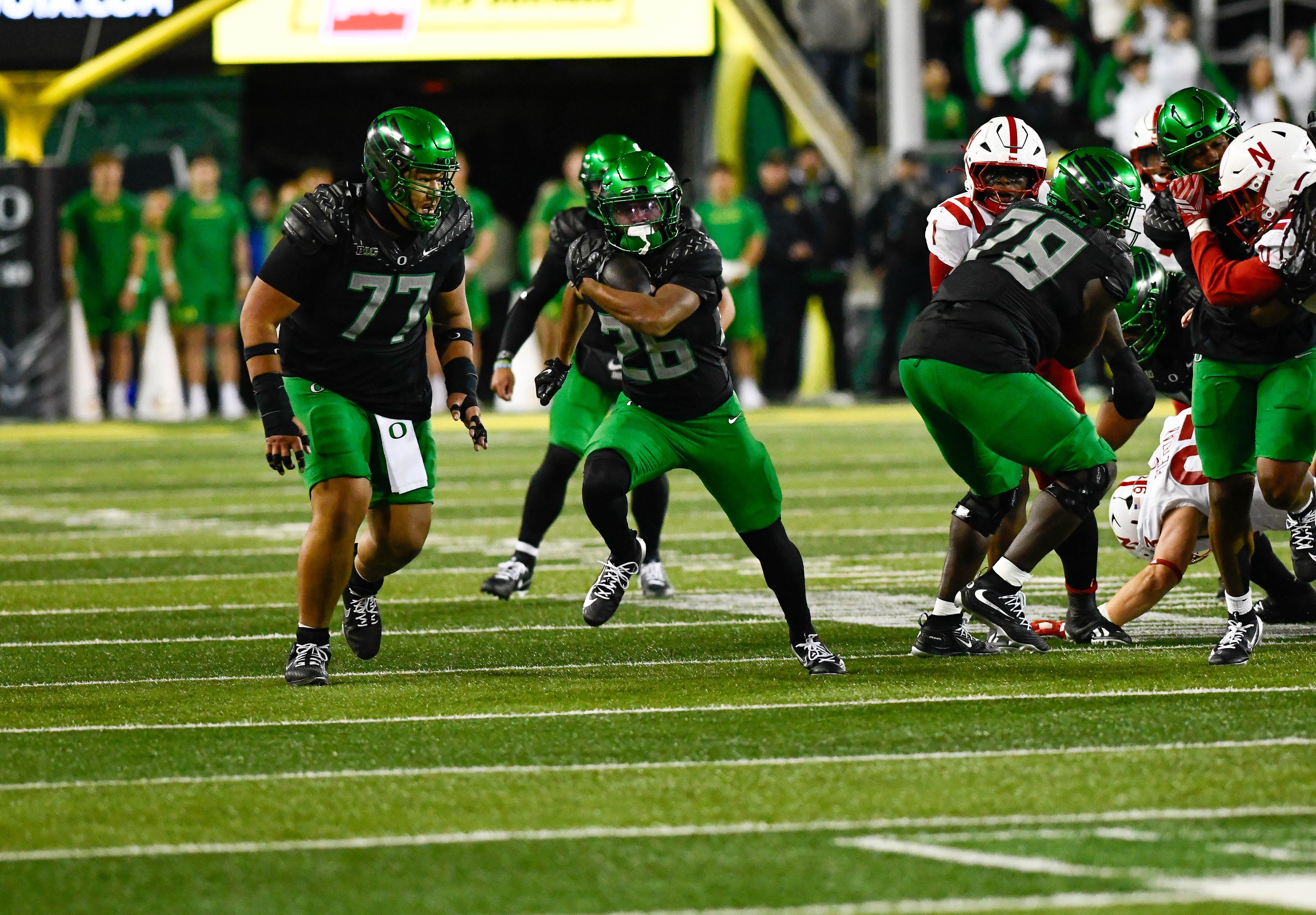
EUGENE, Ore. — Oregon’s victory over Nebraska was hardly the kind of performance Dan Lanning envisioned when the season began, but the Ducks’ dramatic fourth-quarter comeback provided something the program desperately needed following its disappointing loss to UCLA. For a team struggling to establish an offensive identity, overcome significant injuries and find dependable production from its quarterback position, Saturday night’s 17-14 victory represented both a welcome result and another reminder of how much work remains.
The Ducks managed just 91 yards of offense through three quarters before Dylan Raiola came off the bench to direct two scoring drives, including an 82-yard possession that ended with his touchdown pass to Jamari Johnson with 28 seconds remaining. Oregon’s defense delivered another outstanding performance, holding Nebraska’s running game largely in check and repeatedly giving the offense opportunities to recover from its struggles.
Afterward, Lanning acknowledged that Oregon’s offensive performance remained well below expectations, explained why Brock Thomas earned the starting assignment and detailed the circumstances that eventually led to Raiola’s return. The players described a locker room that remained united despite the uncertainty surrounding the quarterback position, while Nebraska coach Matt Rhule offered his own perspective on the defensive battle and the adjustments that ultimately determined the outcome.
Lanning Explains Why Thomas Started and What Led to the Change
The quarterback decision had been the dominant storyline throughout the week, particularly after Thomas nearly rescued Oregon against UCLA when Raiola struggled through the worst performance of his college career. Thomas earned the opportunity to make his first career start against Nebraska, but the Ducks were unable to establish any offensive rhythm with the walk-on quarterback leading the unit.
Thomas completed 9 of 20 passes for 54 yards and an interception before Raiola entered to begin the fourth quarter. While the final numbers were disappointing, Lanning explained that the decision to start Thomas reflected the coaching staff’s emphasis on protecting the football after Oregon’s mistakes against UCLA.
Asked what Thomas demonstrated during practice to earn the starting assignment, Lanning offered a detailed explanation of the evaluation process and the circumstances surrounding the decision.
“He protected the ball. I told Dylan the same thing throughout the week. Why did we lose last week? We didn’t score. We didn’t necessarily get yards, but he protected the ball better than Dylan in practice. I said at the beginning of the week that we were going to evaluate practice and determine who wasn’t putting the ball in jeopardy. We feel like we have a strong defense and good special teams, so we want to put ourselves in a position to protect the football. The fumble was really hard for me to understand. I think we had two calls in this game that, if they had been called differently on the field, would have resulted in a different outcome after replay. I’m not complaining about officiating at all because that job is extremely hard, but I think there were two calls—their touchdown and that fumble—where I don’t know if the outcome would have been different if they had been called the other way on the field. Those were tough breaks. Ultimately, it came down to plays that put the ball in jeopardy and how things looked throughout practice. I told both guys they had to be ready. We also had other packages ready that we didn’t use tonight, but we worked really hard. It’s almost like the Hudson Lewis example: Hudson didn’t play much tonight, but his contribution mattered when he got the opportunity to do his one job for the team. That’s what led to the decision, and that’s how it played out. We’ll reassess and compete again this week to see where things stand moving forward.”
The explanation provided important context for a decision that drew increasing criticism as Oregon’s offensive struggles continued. Lanning was attempting to balance the need for offensive production with the importance of avoiding turnovers, particularly given his confidence in the defense and special teams. That approach, however, proved insufficient when Oregon could not establish a running game or create enough favorable passing situations to sustain possessions.
The decision to return to Raiola ultimately reflected the need to change the circumstances rather than simply assign blame to Thomas. Lanning described telling Thomas that the coaching staff needed to generate an offensive spark, emphasizing that the change was not necessarily a reflection of poor individual decisions. He also praised Thomas for accepting the decision and maintaining his support for his teammates.
The way Raiola handled his own disappointment throughout the week became another important part of Lanning’s postgame message. The Oregon coach acknowledged that asking a young quarterback to respond maturely to losing his starting position was a significant challenge, particularly after the emotional experience of the UCLA game.
“That’s really hard. We had a great meeting on Thursday, and I told him where I was leaning with my decision. He had been competing, and it’s not like you announce to the team what you’re going to do before that. I explained why, and I told him he’s 21 years old and I’m asking him to have the experience and calluses of a 40-year-old. That’s really hard, but I promised that if he handled this the right way, it would be the best growth he’d ever experience. He was unbelievable about it. I think everybody has self-doubts or thoughts about how things should be in that moment, and a lot of people don’t necessarily get second chances. Dylan got a second chance to go out there tonight and execute for us when he was ready, and I’m proud he was able to do that.”
The contrast between Raiola’s struggles against UCLA and his composure during the fourth-quarter comeback was particularly noticeable. He appeared more decisive with the football, demonstrated greater awareness when facing pressure and used his mobility to create opportunities that had been largely unavailable earlier in the evening. Although he completed just 11 of 18 passes for 59 yards, his ability to sustain possessions proved far more important than his statistical production.
Lanning described the difference in Raiola’s approach, particularly his willingness to use his legs and accept responsibility for converting critical situations.
“I thought he did an incredible job. I think he soaked it in for a little bit, and you guys probably recognized that he’s pretty good on the stage after that first first down. I think he also knows what people say about him. There were multiple times before the play started when he said, ‘I’m going to get you the hard yard, Coach. Don’t worry about calling that.’ We called an outside play where the quarterback was a running threat, and Dylan hasn’t really been a running threat for us this year. That was part of the benefit of doing it in that situation: they probably weren’t going to see him that way, so we wanted to see if he could take advantage of it. I thought he did that extremely well. He made an early scramble that mattered. We didn’t do anything on third down tonight, and some of that was by design. Our goal offensively is to avoid putting the ball in jeopardy, and third-and-long is the most common turnover down in football. Sometimes a punt isn’t the worst thing that can happen. We need a better plan and have to improve in that area, but we didn’t want to turn the ball over to a good team and give it a short field. We converted three of three fourth downs today, which hasn’t been the case for us this season. We have to keep getting better, but there was some growth and certainly some opportunities.”
Lanning’s comments revealed an offensive approach that prioritized avoiding catastrophic mistakes, even when that meant accepting limited production on third down. Oregon’s inability to consistently create manageable situations remained a problem, but the fourth-quarter improvement demonstrated that the Ducks could still sustain possessions when the running game became more effective and Raiola made the necessary decisions.
For the Oregon coaching staff, the challenge moving forward will be determining whether the fourth-quarter success reflected a meaningful improvement in execution or simply a temporary solution discovered under desperate circumstances.
Raiola Describes the Emotional Journey and His Relationship With Thomas
For Raiola, Saturday’s comeback carried a significance that extended beyond his previous connection to Nebraska. In the span of three weeks, he had experienced the excitement of Oregon’s victory over USC, the disappointment of being replaced during the UCLA loss and the frustration of losing his starting assignment before facing his former team.
Speaking alongside Johnson and Dakorien Moore after the game, Raiola described the emotional challenges surrounding those experiences and the importance of maintaining his commitment to the team.
“Yeah, UCLA was very uncharacteristic, I’ll say. I rarely talk about myself, but I will say that was very uncharacteristic of me to play like that. I felt horrible. I let these guys down. These guys put so much time in. You know, these guys got futures in the league and they decide to come back and, you know, you have a performance like that. You know, you got to take it on the chin and you got to grow. And it was all about growth. I mean, you go from USC to, all right, you get benched. So now everybody’s coming after you, you know, death threats, this and that. And then I don’t even know. I’m not even on social media, so I couldn’t tell you. I don’t care. It’s all about my family. It’s all about these guys in this locker room and us winning football games. And, you know, whatever that takes, I owe it to these guys. I owe it to our fans. And we’re going to keep doing whatever it takes to win because I love these dudes and nothing else matters to me than them.”
The quarterback also described how his faith helped him manage the disappointment of losing the starting position, emphasizing that he had no intention of allowing his personal circumstances to affect his relationship with Thomas or the rest of the offense.
“Yeah, well, my faith in Jesus Christ is always going to keep me steady. That’s one thing I know that I can always fall back on. And honestly, that’s what helped me get through this week. And, you know, look, I came into this week knowing I had to compete. And ultimately Coach Lanny made a decision and I wasn’t going to pout. I wasn’t going to, you know, be miserable to be around. I wanted to make sure Brock knew what he was doing, what he did, and all these guys. And we just rallied. We rallied around each other. And when you find our connection that tight, it turned into a victory. And this is one, and we got to keep building on it.”
The relationship between the two quarterbacks was particularly notable because both had experienced being replaced during consecutive games. Raiola explained that the support they offered one another never changed, even as their individual responsibilities shifted.
“Yeah, so last week when I got told I was being pulled, Brock was getting warm, and then I told him before he got out, like, you got it, bro. Be confident. Let it rip. And then leading this whole week, we’ve been pushing him. We’ve been growing and getting better. I told somebody out there, but we’re never wishing each other do bad. That’s one of my best friends. We truly love each other. When I got my number called today, he just gave me a hug and said, you got it, bro, let it rip. It’s the same message. I don’t know why we respond and we go play really good after being pulled or whatever, but Brock’s special. I’m glad to call him a friend. I’m glad to call him a brother.”
Raiola also acknowledged the personal circumstances surrounding a game against the program where he began his college career. While the matchup generated considerable attention because of his transfer, he emphasized that his preparation centered on Oregon rather than the identity of the opponent.
“Yeah, for me, I knew beforehand there was going to be emotions. There was going to be stuff going through my head. And I got with Coach Love and how to like reset my mind. And I got this Oregon Ohana bracelet on my wrist. And I just lift it up and I let it hit me. And that’s just my mental reset. This game was never about them. It was always about Oregon. It was always about us and us getting back on track to playing our brand of football. So that helps. Having these two studs right here make my job easy. So Corey texted me, said what goes up must come down. So that gives me a lot of confidence.”
The significance of Raiola’s return extended beyond his final touchdown pass. Lanning said the quarterback remained engaged on the sideline throughout the first three quarters, helping Thomas prepare for Nebraska’s defensive looks and communicating with the coaching staff about possible adjustments. That preparation became essential when Raiola was finally called upon to lead an offense that had struggled to produce anything meaningful.
The final quarter demonstrated the value of that preparation, but both Raiola and Lanning acknowledged that the quarterback competition remains an ongoing process rather than something permanently settled by Saturday’s outcome.
Oregon’s Offensive Adjustments Finally Produce Results
The dramatic finish should not obscure the magnitude of Oregon’s offensive struggles during the first three quarters. The Ducks managed only 51 yards before halftime, failed to establish consistent movement at the line of scrimmage and appeared uncertain about which concepts offered their best opportunity to produce sustained drives.
The coaching staff experimented with different personnel combinations, wildcat formations and alternative rushing concepts throughout the evening. Many of those adjustments produced limited results, but Oregon eventually began finding success when it returned to more familiar blocking schemes and created opportunities for its running backs to generate positive yardage.
Lanning explained that Nebraska presented defensive looks that required Oregon to adjust during the game, particularly against formations the Ducks had previously used successfully.
“As the game goes on, you start to find the answers for certain coverages and looks. We’ve seen different things in every game this year, as every coach does, but we’ve also seen some things that weren’t necessarily on film. Nebraska played empty formations differently tonight than we had seen in other games. Empty has always been a pretty good package for us, but they did some things differently. Sometimes you have to work through the game to figure out your options and solutions, and we were able to find some of those. We had some plays circled as must-calls in this game, and we didn’t get to some of them because we just didn’t have enough plays on the field. I think all those things factored into it. We got a feel for what was happening and were able to do a little more in our passing attack once Dylan got in there, which I think allowed us to have some success.”
The running game became particularly important once Raiola entered, allowing Oregon to extend possessions without relying exclusively on its passing attack. Dierre Hill Jr. finished with 67 yards on 14 carries, while Brandon Smith contributed 29 yards on six attempts, including several important gains during the fourth-quarter comeback.
Lanning described the adjustments in formations, motion and running back positioning that helped the Ducks develop more consistent production late in the game.
“We were able to do some things with shifts and motion that allowed us to build off some of the other things we did in the game. We also did some different things with the running back’s alignment that we thought we could take advantage of. It took us a while to find it, but it was positive. Brandon Smith is going to be a really good player, and I’m super excited about him. He’s been good for us throughout the season. We knew at some point his number was going to be called and he would have opportunities, and I think that showed up a little bit tonight.”
Moore acknowledged that attempting to modify an offense in the middle of the season presents significant challenges, particularly when injuries have removed several important contributors. He also suggested that the coaching staff’s adjustments eventually helped Oregon rediscover concepts the players felt comfortable executing.
“Yeah. Obviously, it’s very hard, especially being an offensive coordinator, head coach. Being that you’ve got to manage things on offense and defense as a head coach, it’s very hard. Of course, I feel like it makes it just a tad bit easier when you got the players that he have with him. But we got players that’s down right now, so that makes it even harder. So we just got to find, like I said, our DNA plays that we can go to whenever we need to. And I feel like we found them plays tonight. And ultimately, that carried us down the field, and we got the dub with it. So that’s all that matters.”
The comments provided an interesting perspective on the offensive adjustments because they reflected a player recognizing both the difficulty of making changes and the value of returning to concepts that fit the available personnel. Oregon’s late production was hardly explosive, but it demonstrated that a more dependable running game and improved execution could create enough opportunities for the Ducks to sustain possessions.
Whether those adjustments become a permanent part of the offensive approach remains to be seen, but the fourth-quarter improvement gave the coaching staff a starting point for its preparations for Illinois.
Lanning Details the Final Drive and Oregon’s Red-Zone Strategy
Oregon’s winning possession began at its own 18-yard line with 5:31 remaining and required the Ducks to cover 82 yards against a Nebraska defense that had controlled the game for most of the evening. Raiola converted a critical third down with a completion to Jalen Lott, then returned to Lott on fourth-and-3 to extend the possession as Oregon worked its way into scoring territory.
The Ducks eventually reached the red zone, where the coaching staff faced the difficult balance of managing the clock, selecting the proper personnel and finding plays capable of producing a touchdown rather than another field goal.
Lanning explained how those considerations shaped Oregon’s approach, including the decision to use timeouts to ensure the proper personnel were available for specific situations.
“We were in and out of the huddle depending on the situation, and we were pretty aware of what was happening. Once we got into the red zone, we had plays we liked out of certain personnel groupings and others we didn’t. When we started using timeouts, they knew we probably weren’t going to run the ball anymore. Unless you’re at the one- or two-yard line, you’re limited in what you can call, especially when we hadn’t consistently run the ball effectively. We had calls we liked out of different groupings, so we changed personnel groupings. I ended up using timeouts because I would have loved to save them, but it was more important to have the right people on the field for the situation. Once we got inside that last first down, we knew we had time, but our options were limited. We practiced the menu of plays we had for that situation. We call that situation ‘Ozone’—it’s either us or nobody. In the red zone, the idea is that if a receiver is open, we throw it to him. If not, we put the ball where only our guy can catch it or nobody can. I thought Dylan did a really good job of that in that moment, and our guys executed the plays pretty well.”
The final sequence included an apparent touchdown to Moore that was overturned after replay, followed by Raiola stepping up against pressure and finding Johnson for the go-ahead score. The Ducks then converted a two-point attempt on a pass to Hudson Lewis, extending their lead to 17-14 and forcing Nebraska to pursue at least a field goal on its final possession.
Raiola praised the communication between the coaches and players during those closing moments, emphasizing that Oregon continued preparing for every possible outcome even after taking the lead.
“Yeah, it worked out for us that DK’s catch was out of bounds. It allowed us to run some more time off the clock. Our play calling was elite in that situation. And Coach Lanning, Coach Drew, and Coach Koa, everyone was very communicative on what we wanted to get accomplished. And so everyone was dialed in. And we knew 28 seconds. We still came to the sideline and was like, for some reason, if we go to overtime, here’s our plan. But we just kept preparing until the end. And JJ had a little cute toe drag touchdown to win the game.”
For Johnson, the touchdown represented a moment of pure excitement following an evening when Oregon’s offensive playmakers had struggled to find opportunities. He finished with five receptions for 35 yards, but his final catch became the defining offensive play of the game.
“It was nothing but pure excitement, man, just to catch that ball and see all the guys running after me, tapping me on the head, saying good job and stuff. It was a moment.”
Moore also described a message he sent Raiola before the game, offering reassurance that the receiver remained confident in his quarterback regardless of what had happened against UCLA.
“Yeah. Obviously, every receiver is going to tell his quarterback that he can throw him the ball. So that was just my way of telling him that regardless of where he put it, I’m going to get it. And he know that. I know that. Everybody knows that. So just reiterating it to him, that’s all.”
The players’ comments reinforced one of Lanning’s central themes following the victory. Despite the offensive inconsistency and uncertainty surrounding the quarterback position, the Ducks maintained confidence in one another and continued working toward a result that appeared increasingly unlikely through much of the evening.
Oregon’s Defense Continues to Establish Its Identity
If Oregon’s offense remained the most significant concern following Saturday’s victory, the defensive performance provided another encouraging indication of the team’s development. The Ducks recorded three sacks and eight tackles for loss while holding Nebraska to 78 rushing yards on 33 attempts, repeatedly disrupting the Cornhuskers’ ability to establish consistent offensive production.
Teitum Tuioti led the effort with two sacks and 2½ tackles for loss, while Nasir Wyatt added another sack and two tackles for loss. Oregon’s defensive front consistently affected Colandrea, forcing him to extend plays while the secondary maintained coverage and limited opportunities for Nebraska to generate explosive gains.
Lanning praised the group’s development, emphasizing that the defense is beginning to establish an identity based on its actual performance rather than preseason expectations.
“I think they’re starting to come into who they are and really find out who they are—not what they were anointed to be before the season, but what they’re truly capable of and what they can do. I’m impressed with the growth of a lot of guys across the board and with guys who can play winning football. More and more guys are accountable and frustrated when they don’t do their jobs at a high level. They hold themselves to a really high standard. That group has gotten better and better, and I still don’t think we’ve seen the best version of them. They can get better, and we’re going to play some teams where it gets harder and harder. College football is hard. It’s hard to play defense, and you don’t see a lot of games like this. For them to perform like that was pretty impressive.”
Tuioti attributed the defensive performance to preparation and effort, particularly the challenge of containing a mobile quarterback capable of creating opportunities outside the pocket.
“Yeah, I think it’s just effort, man. That’s a great quarterback, and he’s shifty for sure. But just effort, man. We knew that this quarterback was going to try to escape the pocket. So up front, we knew we had to cage him. And it’s not going to look perfect every time. He’s going to get out of the cage sometimes. Maybe it’s not the perfect look for our D-line. But at the end of the day, man, I think we did a great job of affecting him and getting him down when we had to.”
The defense’s ability to maintain its focus despite Oregon’s offensive struggles became another significant topic during the player interviews. Devon Jackson was asked how the unit remained mentally engaged when repeated offensive possessions ended without points, leaving the defense responsible for keeping the game within reach.
Jackson emphasized the group’s confidence in its teammates and described the collective responsibility that has developed throughout the season.
“Man, I think it doesn’t really matter for us. It doesn’t matter how many times we go out there. We got each other’s back. We got our brother’s back. It doesn’t matter if we’re out there three times or 30 times. We believe in our offense. I don’t care who does or doesn’t. We believe in our offense. We believe in our specialties. We believe in our defense. We believe in our team. We believe in our players. We believe in our coaches. It doesn’t matter how many times that we’re on there or not on there. I believe in our team, and it doesn’t really matter.”
Tuioti echoed that sentiment, explaining that the defense viewed each possession as another opportunity to return the football to the offense rather than a reason to become frustrated with the team’s scoring difficulties.
“Yeah, just like Devin said, man. We believe in our team no matter what. And every time we go on the field, man, we just got to get the ball back to our offense, man, so they can go and score and obviously win us the game. So, yeah, I’m just proud of everyone tonight.”
The performance was not without mistakes. Nebraska converted a third-and-22 during its touchdown drive late in the first half, and Isaiah Mozee’s 26-yard run helped set up the Cornhuskers’ second touchdown in the third quarter. Those breakdowns prevented Oregon from producing an even more dominant performance, but the defensive front consistently limited Nebraska’s opportunities and delivered an essential three-and-out before the Ducks’ final touchdown drive.
Jackson described the defensive improvement as a collective process in which players have become increasingly comfortable feeding off one another’s energy.
“I mean, it’s simple, though. Like, who doesn’t love playing football, right? Like, it doesn’t matter how many, you know, opportunities we get, you know, but... We just continue to play off each other and feed off each other’s energy, right? Like, you know, beginning of the season, it started off slow. But it’s like, you know, feeding off Tatum when he makes a play. You know, it’s whoever makes a play. Like, just feeding off each other’s energy and, like, we got each other’s back. Like, we know who we can be and we know who we want to be. And just continue to thrive on that and then not only just elevate our defense, but continue to, like, elevate our team and just hold the rope for everybody.”
The defensive development has become one of the most encouraging trends of Oregon’s season, particularly as the offense continues searching for consistency. Lanning’s comments suggested that the coaching staff sees additional room for improvement, while the players’ responses reflected a unit that understands its responsibility extends beyond individual production.
Rhule Credits Oregon’s Defense but Points to Nebraska’s Fatigue and Missed Opportunities
From Nebraska’s perspective, Saturday’s loss was particularly frustrating because the Cornhuskers controlled much of the evening and entered the fourth quarter with an eight-point lead. Their defense repeatedly disrupted Oregon’s offense, forced difficult situations and appeared positioned to secure a significant road victory before the Ducks finally began sustaining possessions.
Rhule credited Oregon’s defensive front for disrupting Nebraska’s offense, acknowledging that the Cornhuskers struggled to establish their running game or provide Colandrea with consistent protection.
“I thought Anthony didn’t have many layups and didn’t have much protection. Protection was under duress. And I thought he made a bunch of big plays when we needed to. He threw up a one go ball to Kwazi (Gilmer) in the first half that we just unfortunately didn’t come down with. I’ll have to watch the film as I fly home here. But at the end of the day, I think you know you can’t allow a defensive front to dictate the game the way they were. But their front did, and quite honestly, our front did for most of the game.”
The fourth quarter presented a different challenge for Nebraska’s defense, which had spent much of the evening on the field while Oregon struggled to sustain possessions. Once the Ducks began generating positive rushing plays, the Cornhuskers found themselves defending increasingly manageable situations and eventually failed to produce the fourth-down stops necessary to end Oregon’s comeback.
Rhule pointed to fatigue and Oregon’s improved running game as important factors in the final two possessions, while also acknowledging that Nebraska had opportunities to make the decisive defensive play.
“I think a lot of it was fatigue. I think just to run the field too much all night, and you know they did a nice job of they just kind of constantly stayed on schedule. But it was really a lot of the run game, you know, 2nd-and-6, it was 3rd-and-2, 4th-and-1, and just we just needed to make one more big play, and Victor (Evans) came up really big twice on the goal line on the ball fades but weren’t able. Obviously, the last play that I think you go back and win the last play. I think Anthony Jones came off the right entrance or left tackle and probably was four or five inches away from knocking the ball out of a quarterback’s hands. They did a lot of all-night in terms of tempo, Wildcat, MD, and in the end, it was it was just those two things. Then you know the offense got the ball between drives and probably needed to extend the drive and close the game down. We weren’t able to do it.”
Rhule was also asked about the significance of facing Raiola, who began his college career at Nebraska before transferring to Oregon. The Nebraska coach avoided making the quarterback’s performance a larger storyline, emphasizing his responsibility to his current players while acknowledging Raiola’s response to the previous week’s difficulties.
“I think my job is to talk about the guys on our team, and care about the guys on our team. I think it wouldn’t be great or respectful for me and the guys on our team to go talking about their guys. Anybody that’s played for me, I’m always going to root for. You know, I want the kids to all to have success. So obviously, you know, good for him to fight back from what he went through last week. At the same time, came at our expense at the end. So, I’m just going to focus on our team and our guys.”
The defeat was Nebraska’s second consecutive narrow loss, leaving Rhule to address how his team would respond during its upcoming open week. He emphasized that the Cornhuskers had demonstrated their ability to compete with talented opponents but still needed to correct the mistakes that prevented them from finishing games.
“I don’t think we have the type of team that’s going to not sit with it. Indiana is as good a team as there is in the country. This is as talented a team as there is in the country. Going into the year, we were playing these two teams. We thought they were two really good teams. Having a game like this, you see how far you’ve come. You see the way that you’ve competed. It also shows you what you need to do moving forward. I don’t have a lot of interest in coaching guys that only want to play when things are going exactly the way you want. You’ve come so far. At the same time, you know, I think as coaches we have to continue to build ourselves and think, ‘how do we get one play better?’ Because that offensive performance has to be better. We can’t have the penalties we had. We can’t have the holes on the perimeter that we had. There were mistakes made that you know most people can’t see that we saw, and just not good enough.”
Rhule’s comments reinforced the narrow distinction between winning and losing a game in which both teams struggled to establish offensive consistency. Nebraska controlled much of the contest defensively but failed to finish the opportunities that might have prevented Oregon’s comeback, while the Ducks finally found enough execution to capitalize on their final two possessions.
Lanning Accepts Responsibility and Acknowledges Oregon’s Unfinished Work
For Lanning, the victory provided a measure of relief without resolving the larger questions surrounding Oregon’s offensive performance. The Ducks have now struggled through consecutive games with different starting quarterbacks, and the staff continues searching for dependable solutions along the offensive line and within the running game.
Asked how this season has challenged him personally compared with his previous years as Oregon’s head coach, Lanning acknowledged that the difficulties have required him to examine his own approach and accept responsibility for the team’s inconsistency.
“Nobody else cares, but I think this will be the year I’ve grown the most in my position. It’s challenged me in a lot of ways to dig deep, figure out where I need to improve and determine how I can make this team better. Ultimately, I’m responsible for all of it, and it needs to look better and be more consistent than it has at times. I’ve learned a lot of hard lessons. People don’t tell you that there are benefits from losses, too. I’m down 24 pounds right now, so that’s a benefit from losses. I’ve learned a lot more as a football coach about where I can improve and what I can do better. You want to win and learn, and I think today is a good example of being able to win while still having so many lessons to learn from. There’s a lot of room for me to improve and get better, but I’m really pleased with the effort. I think you saw a group that played really hard tonight, even when things didn’t always go the way we wanted. I think that’s always the biggest measure of a coach: how hard your guys play. There have been times this season when I don’t think it has looked the way it needs to, but I thought our guys played hard tonight.”
Lanning also addressed the frustration of Oregon fans, including the boos that emerged during another stretch of ineffective offense. Rather than dismissing that reaction, he acknowledged that the team’s performance had not met expectations and insisted the staff would continue evaluating every available option for improvement.
His response reflected an awareness that the victory over Nebraska was not sufficient evidence that Oregon had solved its offensive problems.
“We evaluate everything, and we want to be the best. The decision has to come down to what makes us better and what doesn’t. I’m trying to work on solutions that will make us better. It’s not the same as it was in previous weeks. I thought there were some things we improved, and again, I think this is a different group than the one we started with. But it’s a good enough group that we can be better than we’ve been. If you can’t acknowledge that the 11 players we took the field with are different from the group we started the season with, then I don’t know what college football looks like today. I’m pretty certain there were a lot of really good teams that didn’t necessarily have success. I don’t think that means those coaches forgot how to coach. I think it’s probably harder now to be consistent and sustain success, and we have to keep finding solutions and be aggressive about them. I promise I’m not going to win one game and say, ‘We’re good. It’s fixed.’ I’m grateful for our fans, and they deserve to be able to boo. There’s nothing wrong with that. I’m okay with it. I’m a big kid, and it’s not going to hurt my feelings. If I thought listening to boos or cheers would affect the decisions I make as the leader of this organization, that would be immature. You can’t make decisions that way. We try to make decisions based on the information we have in front of us and the players who stayed here and didn’t leave the building for several days because they wanted to get things right. It’s still not right, so I’ll do what I’ve done and what I’ve watched other great coaches do when it comes to finding solutions. It always comes down to what resources and options are available, and we’re pursuing every angle.”
That evaluation will include another quarterback competition as Oregon prepares for its trip to Illinois. Lanning declined to declare a starter following Raiola’s fourth-quarter performance, instead emphasizing that the staff would return to practice, evaluate the available personnel and continue searching for the offensive approach most likely to produce consistent results.
“You evaluate it again. College football is crazy, and winning is hard. I’m certain there wasn’t a staff that worked harder this week to have a really good plan for what we wanted to accomplish. Sometimes it still doesn’t look the way you want, and we have to keep working through it, figure out what we need to do better and determine how to replicate what we see in practice. There were moments in tonight’s game that I know we worked on in practice. They showed up, but you don’t know which moments those will be. We have to be better and find a way to improve. We have to compete again this week, and that starts with competing in practice. I thought the guys were really focused on the process today, especially in the second half. We were able to hone in, and I thought we had a really good halftime meeting about things we believed we could do. It didn’t show up until the fourth quarter, but we were able to take advantage of some of it.”
The comments underscored the central challenge facing Oregon as it enters the second half of the regular season. The Ducks have demonstrated that they possess the resilience to overcome difficult circumstances, and their defensive improvement provides a foundation that could make the remaining schedule meaningful. But the offensive inconsistency has become too persistent to explain entirely through injuries or the absence of Moore, particularly when the coaching staff continues searching for the basic concepts that can produce dependable execution.
Saturday’s comeback provided a memorable finish and preserved Oregon’s opportunity to pursue its larger goals, but Lanning’s remarks suggested that he understands the difference between surviving a difficult game and solving the problems that made survival necessary.
The Ducks have another week to evaluate their personnel, refine their offensive approach and determine whether the fourth-quarter improvement against Nebraska can become something more dependable. Their next opportunity comes against Illinois, where the challenge will be establishing the kind of offensive identity that Oregon needed nearly an entire game to discover Saturday night.
For now, Oregon has a victory that demonstrated the character of its players and the continued development of its defense. Whether that victory becomes a turning point in the season will depend less on what happened during those final 28 seconds and more on what Lanning and his staff do with everything they learned during the 59 minutes that preceded them.