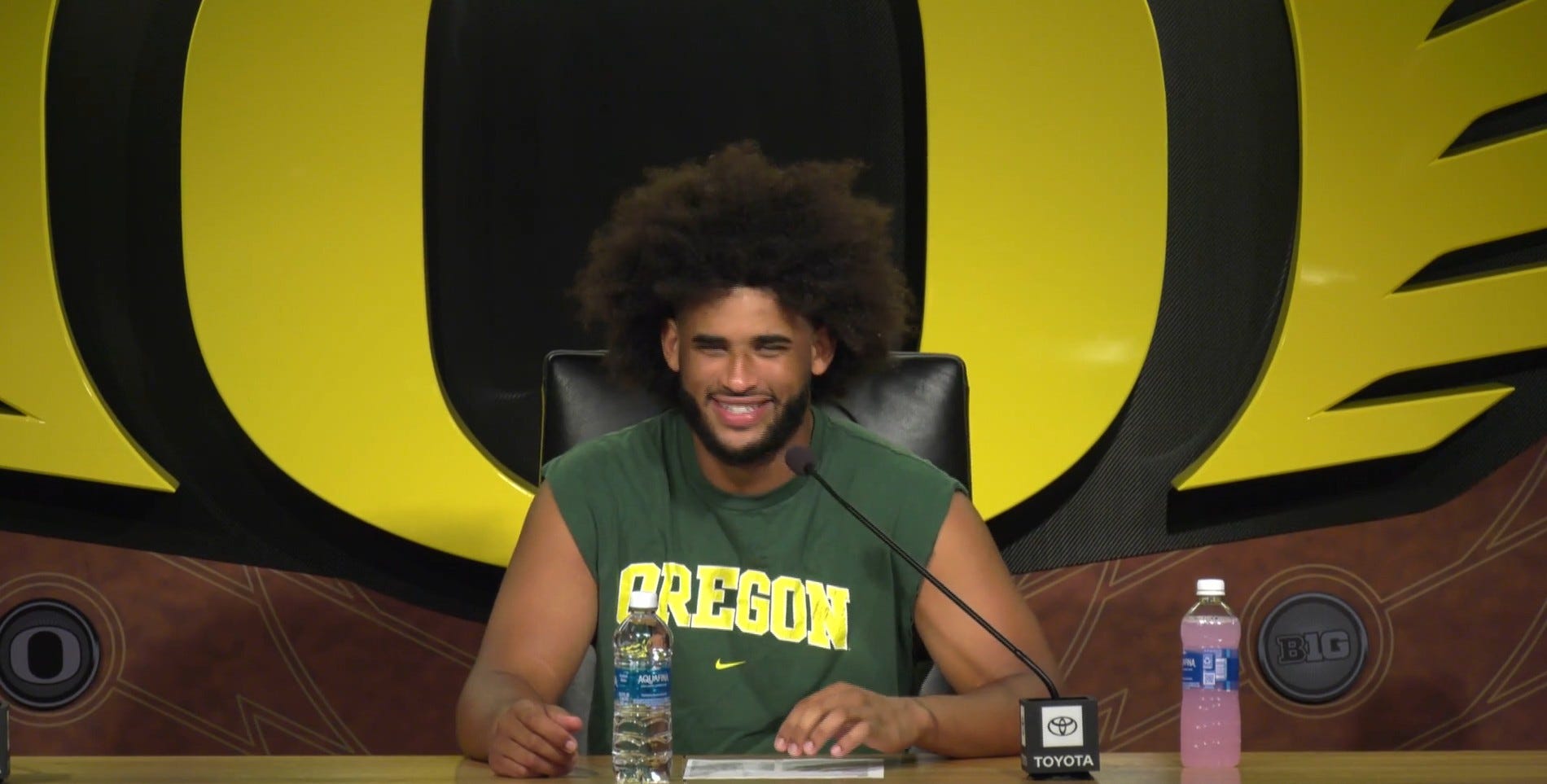
EUGENE, Ore. — There are times when a postgame press conference mostly confirms what happened on the field. Saturday night, Oregon’s helped explain why a game the Ducks controlled statistically never really felt under control.
Dan Lanning did not spend much time dressing up a 34-27 win over Boise State. He complimented the Broncos, thanked another sellout crowd at Autzen Stadium and acknowledged that Oregon had done enough to win, but his opening assessment quickly moved toward the things that kept the Ducks from making the afternoon considerably easier. The phrase that kept coming back was critical situations.
Oregon moved the ball. It created explosive plays. It eventually found a pass rush, and Dante Moore threw for 388 yards without turning the ball over. Yet the Ducks committed 10 penalties for 90 yards, failed on all three of their fourth-down attempts and allowed Boise State to remain within a possession until the final two minutes.
“In a lot of ways we won the game with total yards and some situations, but we didn’t really win the critical situations,” Lanning said. “They won some of those critical situations.”
That was a fairly accurate description of the afternoon. Oregon did enough good things to win its opener and enough bad things to spend most of the fourth quarter wondering whether it would.
THE DIFFERENCE BETWEEN MOVING THE BALL AND WINNING THE MOMENT
The traditional numbers were heavily tilted toward Oregon, but that was almost beside the point by the time Boise State tied the game at 27 with 8:45 remaining. The Ducks repeatedly moved into favorable situations and then failed to finish them. Two fourth-down failures came in the first half, penalties extended Boise State possessions and altered field position, and Evan Stewart’s first muffed punt handed the Broncos a short field that became a touchdown on the very next play.
Lanning pushed back when asked whether the offense had looked disjointed, saying he thought offensive coordinator Drew Mehringer had called a good game and that the larger issue was execution.
“There’s a couple plays where you talk about, OK, that was good process, bad result,” Lanning said. “The process, we were right in what we were calling. The penalties is what we have to eliminate.”
That is where the game film will probably give Oregon a more complete answer than the scoreboard. There were certainly moments where Boise State simply made a play, but there were also too many where Oregon made the job easier for the Broncos. The Ducks were penalized after the snap, jumped offsides at costly moments and committed a pass interference penalty that helped extend one of Boise State’s second-half scoring drives.
Lanning made an important distinction afterward between mistakes that happen within the flow of football and discipline errors Oregon controls. “Some mistakes happen and they’re going to happen,” he said. “Some of them are discipline penalties. To have multiple post-snap penalties, those are the things that can’t happen.”
That matched what the game looked like from the press box. Oregon’s biggest problem was not that Boise State uncovered some glaring schematic weakness and exploited it for four quarters. The Broncos certainly had answers, particularly early, but the Ducks repeatedly took situations that should have favored them and made them less favorable.
There was also an element of Oregon’s own preseason emphasis showing up in uncomfortable fashion. Starting fast and finishing had been two of the most consistent themes of fall camp, yet Oregon did neither particularly well in the opening half. “We talk about starting fast,” Lanning said. “We didn’t start fast tonight.”
The Ducks instead found themselves down 17-7 late in the second quarter, at home, against a Boise State team that looked considerably more settled than the No. 2 team in the country. What followed may ultimately matter more than the start.
DANTE MOORE LOOKED LIKE THE CALMEST PART OF AN UNEVEN GAME
For all of the questions Oregon carried into its opener, quarterback suddenly feels like one of the easier ones. Moore completed 28 of 37 passes for 388 yards and three touchdowns without an interception, and more importantly, he did it in a game where the Ducks repeatedly created situations that could have encouraged a quarterback to force something that was not there.
He largely refused to do it. Lanning said some of the plays Oregon will celebrate internally will not appear in any highlight package because they were throwaways, checks and decisions that kept the football out of danger.
“I thought he operated really clean,” Lanning said. “We don’t have to win because of our quarterback. We have to make sure our quarterback doesn’t cost us.”
Lanning then went a little further, saying Moore played well enough to put Oregon in position to win and, in a lot of ways, helped create the conditions for the Ducks to win because of him. His final assessment was the line that probably best captured Moore’s afternoon: “He threw to win today.”
There were mistakes. Moore missed Jeremiah McClellan high on what could have been a touchdown in the second half, and there were moments when his eyes and body seemed to give away his intended target earlier than you would like. Those were individual plays, though, not evidence of a quarterback losing command.
The possession before halftime offered the clearest example. Boise State had gone ahead 17-7 and appeared positioned to take that lead into the locker room when Oregon forced a punt from deep in Bronco territory. Moore suddenly had the ball back with less than a minute to work, and four plays later he hit Jamari Johnson for a 27-yard touchdown.
Moore said the situation felt familiar because Oregon had drilled it so often during spring and fall camp.
“When it got to the point where we had to drive down the field and do it, it was just kind of like second nature for us,” Moore said. “We all was calm. We all was confident.”
That touchdown did more than make the halftime score 17-14. Oregon opened the second half with a field-goal drive, giving the Ducks 10 points across what Lanning calls the middle eight — the final four minutes of the first half and first four of the second. Lanning specifically identified that stretch as one of the areas where Oregon finally began reclaiming momentum.
Moore had another revealing answer later. Rather than wishing Oregon had opened the season with an easy blowout, he said there was value in being forced to confront problems immediately.
“I’m glad this game was how it was,” Moore said. “Thank God it wasn’t a 40 to 50 point blowout because this just shows us who we are right now and what we have to attack coming into next week.”
There is some natural postgame optimism in that answer. No player is going to stand at a podium after a win and complain that it should have been easier, but the larger point makes sense. Oregon now knows what Moore looks like when the Ducks are down 10, when Autzen is uneasy and when a possession actually matters. He looked comfortable.
THE EXPLOSIVE OFFENSE IS REAL, BUT THE RUNNING GAME STILL NEEDS DEFINITION
Jeremiah McClellan spent much of fall camp becoming one of those players coaches could not stop mentioning, and Saturday turned those comments into production. McClellan caught six passes for 150 yards and a touchdown, repeatedly creating explosive plays when Oregon’s offense needed something to change. His 50-yard reception helped Oregon escape the shadow of its own goal line in the first quarter, and another long catch helped keep the Ducks moving when little else was comfortable.
Lanning said McClellan showed the same “juice and energy and consistency” Oregon had been seeing every day in practice. Moore was even less surprised, describing the time the two have spent watching film together away from the facility and calling McClellan a player who had been “so dialed into this process” throughout the offseason.
The bigger takeaway was that Boise State could not devote its attention entirely to McClellan. Stewart finished with eight catches, Johnson caught the touchdown before halftime and Dakorien Moore turned a relatively ordinary crossing route into the winning 62-yard touchdown late in the fourth quarter.
That play may have been the best demonstration yet of what Dakorien gives Oregon. Two Boise State defenders had an opportunity to limit the gain, both wound up on the ground and Dakorien was suddenly running toward the end zone.
Dante Moore said the route had actually been a point of correction in practice. “We messed the play up because it was one-high man,” Moore said. “I said, ‘Hey, let’s run the route this way.’ And at practice, he didn’t do it. Come game time, I coached him up. He did it the right way.”
The result was the decisive touchdown, and Moore called it probably Dakorien’s best play in his eyes because it showed the natural playmaking ability Oregon has seen in practice.
The receivers were easily the most consistently dangerous part of the offense. The running game was harder to evaluate.
Oregon handed the ball to a running back only once in the first quarter, and the early imbalance was noticeable. Jordon Davison eventually finished with 90 yards on 12 carries, including a 40-yard run that helped ignite Oregon’s second touchdown drive of the third quarter, but the production improved more than Lanning’s assessment did.
“I didn’t think we ran the ball to our capabilities today,” he said.
His evaluation of the offensive line followed the same pattern. “Good at times, bad at times,” Lanning said, adding that Oregon did a good job overall of protecting Moore but did not consistently generate the push he wanted in the running game.
That seems like the more important issue than the number of run calls by itself. Oregon can throw the football, and Saturday removed any question about that. With Stewart, McClellan, Dakorien Moore and Johnson all capable of creating matchup problems, Mehringer has plenty of reasons to put the ball in his quarterback’s hands.
But Oregon also spent the offseason talking about a deep running back room, and Davison showed what can happen when the Ducks get him moving downhill. The question entering Oklahoma State week is not whether Oregon should suddenly become run-heavy, but whether the Ducks can establish enough physicality on the ground that defenses cannot dictate when Oregon is allowed to run it.
THE DEFENSIVE NUMBERS LOOKED BETTER THAN THE DEFENSE FELT
This may have been the area where Lanning’s postgame assessment most closely matched what we saw. Boise State finished with only 93 rushing yards, averaged fewer than 3 yards per carry and was held below 300 yards of total offense. Those are normally numbers you would happily take.
Asked directly how he felt about the run defense, though, Lanning needed only a few words.
“Not good enough. Not good enough. Not to our standard.”
That sounded much closer to the actual game than simply pointing at 93 rushing yards. Boise State did not produce many explosive runs, but the Broncos repeatedly found enough on first down to keep their offense on schedule. Oregon spent stretches of the game dealing with second-and-5 and second-and-4 instead of putting Madsen into the obvious passing situations where this defensive front should have an enormous advantage.
Lanning identified exactly that problem in his opening statement. “We were just off schedule too much tonight,” he said. “It was too many second-and-fives, too many second-and-fours.”
That helps explain why the pass rush did not immediately resemble the group Oregon had been talking about during camp. There were flashes, with Teitum Tuioti recording an early sack, Matayo Uiagalelei creating pressure and Nasir Wyatt and others beginning to affect Madsen more as the game progressed. But much of the early “havoc” we expected was absent.
Lanning thought Oregon handled Madsen better after halftime, particularly when it came to keeping the quarterback inside the pass-rush cage. “We did a much better job caging the quarterback in the second half,” Lanning said. “I thought we rushed with power, but also some awareness.”
Uiagalelei agreed that the rush improved when Oregon finally got the situations it wanted. “When we had the chances to rush the passer, I think we definitely made an impact,” he said, while acknowledging the Ducks could have contained Madsen better earlier.
The encouraging part came late. Oregon had spent most of the afternoon failing to make the defensive play that would finally allow the Ducks to separate, but once Dakorien Moore put Oregon ahead 34-27, the front began to look more like the unit we expected.
Uiagalelei’s sack helped force a punt. On Boise State’s final possession, Oregon created pressure, challenged throws and finally got Offord into position to break up the fourth-down pass that essentially ended the game. The defense did not dominate, but it did finish, and that distinction is important heading into Week 2.
THE PLAYER-LED PART FINALLY HAD TO BE REAL
There was one more theme running through nearly every postgame interview, and it goes back to something Oregon talked about constantly during camp: player-led leadership.
It sounded good when Lanning discussed players demanding louder crowd noise at practice or asking for additional reps. It sounded good when veterans talked about accountability. Saturday put some actual weight behind it because Oregon went into halftime trailing after a half in which very little had gone according to plan.
That was exactly the kind of situation where the language of August either becomes real or gets exposed as offseason talk. Lanning said he knew he had a choice between allowing the team to settle into the game or changing the energy.
“Is this one where you need to go ahead and ramp it up and change the energy and the juice, or is this one where you need to have patience?” he said.
He decided Oregon needed more energy.
“The player-led leadership that we talked about all offseason has to show up,” Lanning said. “There has to be some accountability.”
According to the players, it did. Dante Moore said Devon Jackson pulled the defense together at halftime, Jamari Johnson mentioned Poncho Laloulu and other leaders speaking up, and Uiagalelei specifically pointed to Bear Alexander, Jackson and others using their voices when teammates needed to hear them.
Teitum Tuioti admitted there was some shock in the locker room because of how tight the game had become, but the message was to reset. “It’s still 0-0,” Tuioti recalled. “We’ve got to focus on the present.”
Oregon came out of halftime and played better. Not perfectly, because Boise State still scored 10 second-half points and tied the game twice after Oregon had taken the lead, but the Ducks did not look like the same team that spent the opening half waiting for the afternoon to become easier.
That may ultimately be the most useful part of this opener. Oregon did not learn Saturday that it is a finished product. Quite the opposite.
The Ducks learned that penalties can neutralize their talent, the running game still needs work, the defensive front cannot wait for the fourth quarter to become disruptive and special teams can turn an otherwise statistically dominant performance into a one-possession game. They also learned that Moore can handle being behind, the receiving corps can manufacture explosive plays from several different spots and the leadership structure Lanning spent August praising did not disappear when Oregon finally encountered some adversity.
Uiagalelei put the larger question pretty well afterward while reflecting on another Oregon team that struggled early before finding its footing. The important part was not that problems surfaced. It was whether Oregon could identify them and fix them.
“That would be the question for this team,” Uiagalelei said. “Will we be able to fix the problems?”
After Saturday, that is probably the right question to carry into Stillwater.


