


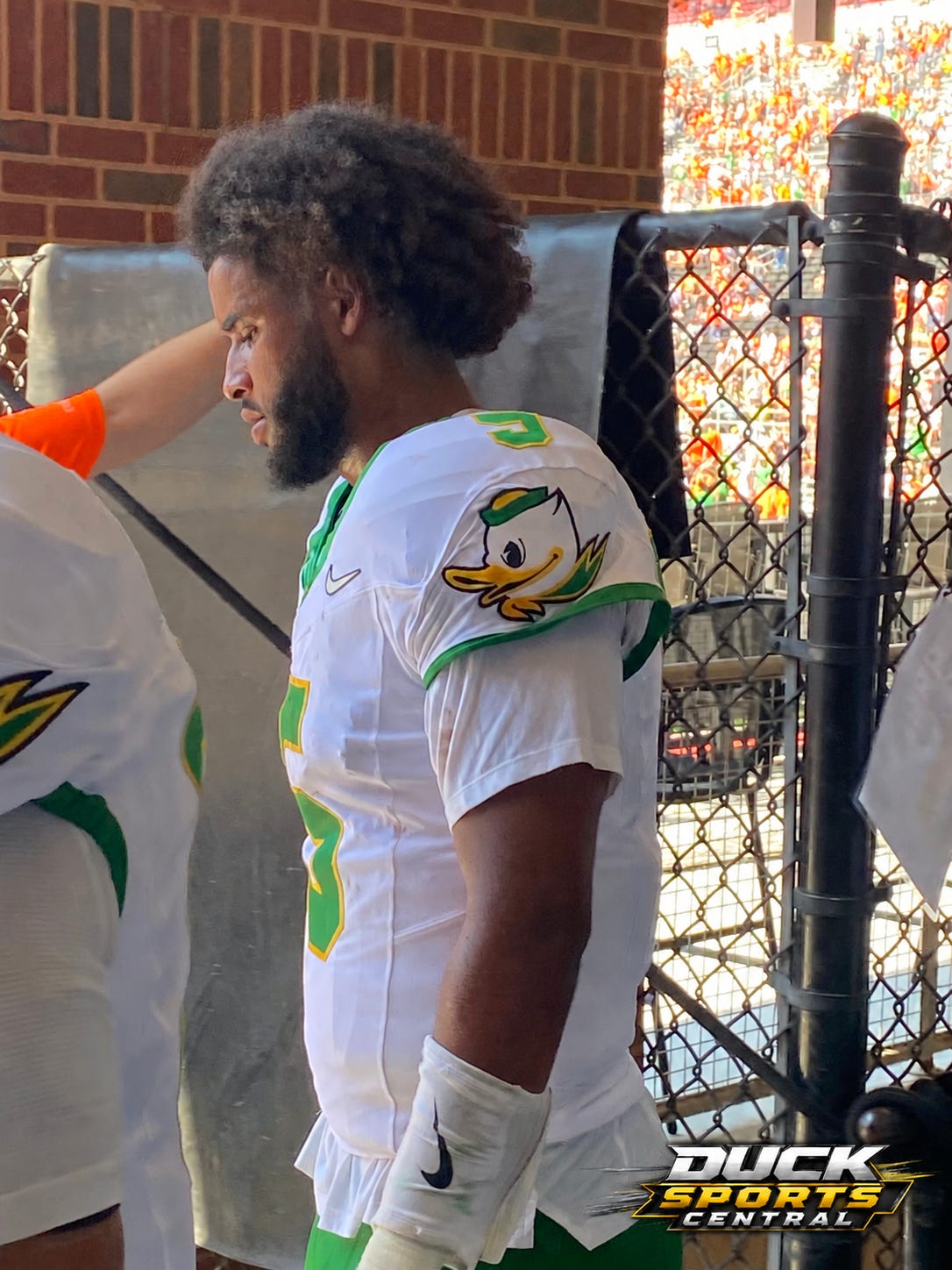
STILLWATER, Okla. — Dan Lanning did not spend much time trying to soften what happened to Oregon on Saturday.
“The score was closer than it really was because it wasn’t close in a lot of ways,” Lanning said after the Ducks’ 39-31 loss to Oklahoma State. “We got our ass kicked in a lot of areas. Tons of credit to Coach Morris and his staff.”
It was a strikingly direct assessment, but perhaps the more revealing part of Oregon’s postgame availability came when the comments from the Ducks were placed alongside what Oklahoma State’s players were saying in their own interviews.
There was not much disagreement.
Oregon talked about losing the line of scrimmage. Oklahoma State talked about playing fast, physical and vertical there. Oregon talked about missed tackles, poor eye discipline and a lack of execution. Oklahoma State talked about recognizing Oregon’s weaknesses and attacking them. Oregon talked about needing a higher level of focus and urgency. The Cowboys described a week of practice built around exactly those things after their own disappointing opener.
The two sides were essentially telling different halves of the same story.
The line of scrimmage became the starting point
Lanning identified the most obvious issue almost immediately.
“Overall, as a team, we didn’t tackle well in Week 1. We didn’t tackle well in Week 2,” he said. “We didn’t win the line of scrimmage on either side of the ball. We’ve got to do a better job there.”
The comment covered both sides of the football, but the defensive front will probably draw the most attention because of how Oregon entered the season. This was supposed to be an experienced, deep group capable of controlling games. Oklahoma State instead rushed for more than 200 yards, gave Drew Mestemaker time to attack downfield and repeatedly kept the Oregon defense from creating the difficult down-and-distance situations it wanted.
Teitum Tuioti did not attempt to excuse it.
“Yeah, we got to find a way to stop them,” Tuioti said. “We keep on killing ourselves, penalties, just one person not doing their job. And that goes for everyone, including me. So all of us got to do our job, and we got to be better.”
He later added that Oregon was not yet the championship defense it wants to become.
“We can get there,” Tuioti said. “We’re not there right now, for sure we’re not there right now. Just like I said, little mess-ups here and there cost us the game, cost us everything. Those little things add up throughout the game and that’s a lot of yards.”
Oklahoma State’s offense saw the matchup much differently once the game began.
Running back Caleb Hawkins called the performance of the Cowboy offensive line “unbelievable” and said the group was “firing off the ball on all cylinders.” He returned to the subject later, saying the linemen were “firing off the ball every play” and that neither his rushing production nor Mestemaker’s performance happens without them.
The offensive line had heard about Oregon’s defensive front all week. Oklahoma State guard Johnny Dickinson said the answer was not to become overly concerned with the players lined up across from them.
“Really, we preached it, and Coach Morris preached it, was play fast, and play fast, play fast,” Dickinson said. “No matter who we were playing, who we were facing or what guys they had, the whole mindset was just to play fast so we can just get off the ball quick.”
That simplification mattered. Dickinson said the Cowboys were able to play more freely because they were not overthinking every technique or possible response.
“Only thing we’re getting graded on is how fast you move with every play,” he said. “And it just opened up a lot for us to just play freely and smoothly.”
The same story appeared on the other side of the ball.
Oklahoma State linebacker Ethan Wesloski said the Cowboys intentionally asked their defensive line to create disruption and force Oregon’s running backs away from their preferred tracks.
“Our D-line was playing so physical and so violent and so vertical that it made these backs bubble,” Wesloski said.
Then came perhaps the most pointed observation from the Oklahoma State side.
“We knew that this O-line was going to struggle a little bit with movement,” Wesloski said.
That does not mean Oregon’s offensive-line problems are permanent, but it does show how Oklahoma State entered the game. The Cowboys saw something on film they believed they could attack and then did it successfully enough to keep Oregon from ever establishing the running game Lanning wanted.
Lanning acknowledged as much afterward.
“Yeah, I think we have to improve in the run game,” he said. “We have to find more creative ways to be able to run the ball.”
There were personnel issues involved. Trent Ferguson was banged up during the game, and Lanning said Dave Iuli was not really able to go. But the larger evaluation now becomes figuring out what Oregon can consistently do well rather than what the offense was expected to do before the season.
Execution was the word on both sides
If there was one word that appeared repeatedly in Oregon’s postgame interviews, it was execution.
Lanning rejected the idea that Saturday should immediately become a referendum on the promotions at offensive and defensive coordinator.
“No,” Lanning said. “I think that’s the easy thing to say if you’re watching — ‘Oh yeah, obviously it’s an OC-DC thing.’ No. It’s a combination of a staff. The decisions I make, the decisions we make as an offensive staff, the decisions we make as a defensive staff and then execution. All of those things play into it, and every bit of that I own. I’m responsible for it.”
That did not absolve the coaching staff.
“Can we call better plays? Absolutely, on both sides of the ball,” Lanning said. “But this isn’t a Hampton thing. This isn’t a Drew thing. That’s not the reason. We have to go execute plays.”
Tuioti reached essentially the same conclusion from the player side.
“We got the play call fast,” he said. “That’s all we can ask for. Get it on time so that we don’t have a play where we don’t have a call. So we just got to execute what we’re given. I really believe that the players can make plays. So when we get a call, man, we got to execute. That goes for me, too.”
What made that theme more interesting was hearing Oklahoma State players use almost identical language to describe what changed for them following the Tulsa loss.
Wesloski said the Cowboys spent the week acknowledging that their opener did not represent what they believed they could be.
“We knew that that wasn’t our team,” he said. “We knew that we’re so much better than that, and we knew that everything that happened negative last Saturday was a result of our lack of execution.”
Their solution was to simplify the message: “Play fast, play vertical,” trust what they saw and let themselves play.
There is an uncomfortable comparison there for Oregon.
Both teams entered Saturday disappointed with Week 1. Both teams spent the week emphasizing improvement and execution. Oklahoma State came out looking faster, more physical and more certain of what it wanted to do.
Oregon did not.
“This is a game where we needed to show improvement, and we didn’t show improvement,” Lanning said. “So we have to see that now moving forward with our team.”
Oklahoma State believed early
Mestemaker’s 75-yard run on Oklahoma State’s first offensive snap will show up in the box score as one explosive play. Listening to the Cowboys afterward, it was clearly more significant than that.
Hawkins said that was the moment Oklahoma State understood it could play with Oregon.
“I felt like Drew kind of just set the tone for us and made sure that we knew that even though these players are so well put together that everybody’s human and we can do just as well,” Hawkins said.
Later, Hawkins returned to the same play.
“Oh, 100%,” he said when asked whether the run gave Oklahoma State confidence. “He set the tone from obviously the very first play that we had, so him setting that tone just made the game just come to us so easily because we were like, all right, we got this strength, we got this focus and we got this confidence now.”
James Williams described it as a moment that changed the psychology of the game.
“There’s always something that you got to set the tone with when you’re playing a team that is better than you,” Williams said. “Realistically, it was Drew’s run at the beginning of the game.”
Williams believed Oregon was waiting to see whether the Cowboys would look like the team that struggled against Tulsa.
“You could tell, like, with how Oregon approached us,” Williams said. “They go out there, expect like trying to see if we’re gonna fall over. Like, oh, are they gonna play like how they did against Tulsa? Are they gonna bring it? And we brought it.”
Whether Oregon actually entered the game expecting Oklahoma State to “fall over” is impossible to know. Lanning specifically rejected the idea that his players were looking beyond the Cowboys. But the important part is how Oklahoma State interpreted the opening minutes.
The Cowboys felt Oregon’s uncertainty, gained confidence from it and never really gave that confidence back.
Even when Oregon rallied from 27-17 down and eventually took a 31-30 lead, Oklahoma State did not respond as if the favorite had finally restored order. Wyatt Young said Mestemaker spent the game reminding teammates to stay level-headed.
“Stay level-headed, stay level-headed, we’re good,” Young recalled Mestemaker telling the offense. “This is our game.”
Oklahoma State responded to Oregon’s fourth-quarter touchdown with the drive that put the Cowboys back in front.
Focus, preparation and adjustment
Lanning did not believe Oregon’s players were caught looking ahead because of the larger expectations attached to this season, but he did say the Ducks need more from their work during the week.
“I don’t get that feeling from our players that they were looking too far ahead,” Lanning said. “I think they have high aspirations, but I think their focus has been on the immediate.”
His next point was more revealing.
“I think there has to be a higher temperament in practice, a higher level of focus in practice for us to be able to execute,” Lanning said. “And then we have to be faster making adjustments throughout the game. People are going to play us differently at times. They did a great job on both sides of the ball of playing us a little bit differently, and we have to make adjustments quickly.”
Oklahoma State linebacker Tate Romney described the Cowboys entering Saturday with exactly the kind of focus Lanning said Oregon now needs.
“Coach Morris is very dialed in, very focused,” Romney said. “And I think some of us just kind of follow his example. We all came into this game with an intensity and with a focus that we really wanted to have.”
The 90-minute weather delay did not change that approach. Romney said the Cowboys simply remained calm, while Lanning dismissed the idea that Oregon could use the delay as an explanation for its own performance.
“I don’t think the delay impacted us,” Lanning said. “I think that would just be an excuse that somebody wanted to use.”
Tuioti was more willing to at least consider whether Oregon’s preseason praise had affected the group.
“Maybe we were too lackadaisical,” Tuioti said. “Maybe, you know, we were reading our press clippings too much. We’ve really got to lock in now. There’s no room for error right now.”
He later qualified the comment, saying he was trying to explain what had just happened and that there could be many reasons for it. What he did not back away from was where the response has to begin.
“It just starts with the leaders on our defense,” Tuioti said.
That point becomes particularly interesting because Oklahoma State players described their own response to Tulsa in almost identical terms. Wesloski said the Cowboys needed to be challenged during the week and that the response became player-driven.
“The best teams are created off adversity, and they’re self-led,” Wesloski said. “We had a lot of leaders step up, ones with C on their chest, ones without C on their chest. We had a lot of leaders step up this week and take control.”
For an Oregon team that spent much of fall camp talking about becoming player-led, that might be one of the more relevant comments to come from the other locker room.
Where Oregon goes from here
There were individual positives Saturday. Devon Jackson’s interception return for a touchdown was one of them, and Lanning said Jackson’s big plays “really kept us in the game.” Oregon also created another interception when Dylan Williams deflected a pass that Matayo Uiagalelei secured deep in Oklahoma State territory.
Lanning’s larger point, though, was that Oregon did not capitalize on those momentum swings.
“It wasn’t as close as it looked,” Lanning said. “They got to the red area a couple of times and had turnovers in the red area. It could have been a little worse than what it really looked like.”
That is not a particularly comfortable place for Oregon to begin the next week, but nobody inside the Ducks’ postgame availability seemed interested in pretending otherwise.
Tuioti described an angry and disappointed locker room, but also said there was already “a fire under us.” He said the first two games were not to Oregon’s standard and that there is now “a problem” that has to be fixed.
“One game isn’t going to define us,” Tuioti said. “Everyone in the locker room right now, we’ve got to stay together really, really closely right now. You know, it’s going to be hostile around here. So Oregon’s got to stay together.”
Lanning approached the response through his own experience with championship teams.
“I’ve been a part of two national championships, and in both of those seasons, we had losses,” Lanning said. “Those locker rooms felt similar to this.”
The answer in both cases was not complicated.
“What did it end up being about? Getting better and going back to work,” Lanning said. “So I just told the guys the same thing: We have to go back to work.”
Oklahoma State already provided Oregon with one example of what that can look like.
The Cowboys were embarrassed by their performance against Tulsa, spent a week confronting what went wrong and arrived Saturday looking like a different team. Young said the difference could be felt in practice before Oregon ever arrived in Stillwater.
“The way we practiced leading up to this game was different,” Young said. “You could feel it from the Tulsa week to this week. We all were disappointed in ourselves.”
Saturday was Oklahoma State’s response.
Oregon gets to decide what its own response looks like now.