


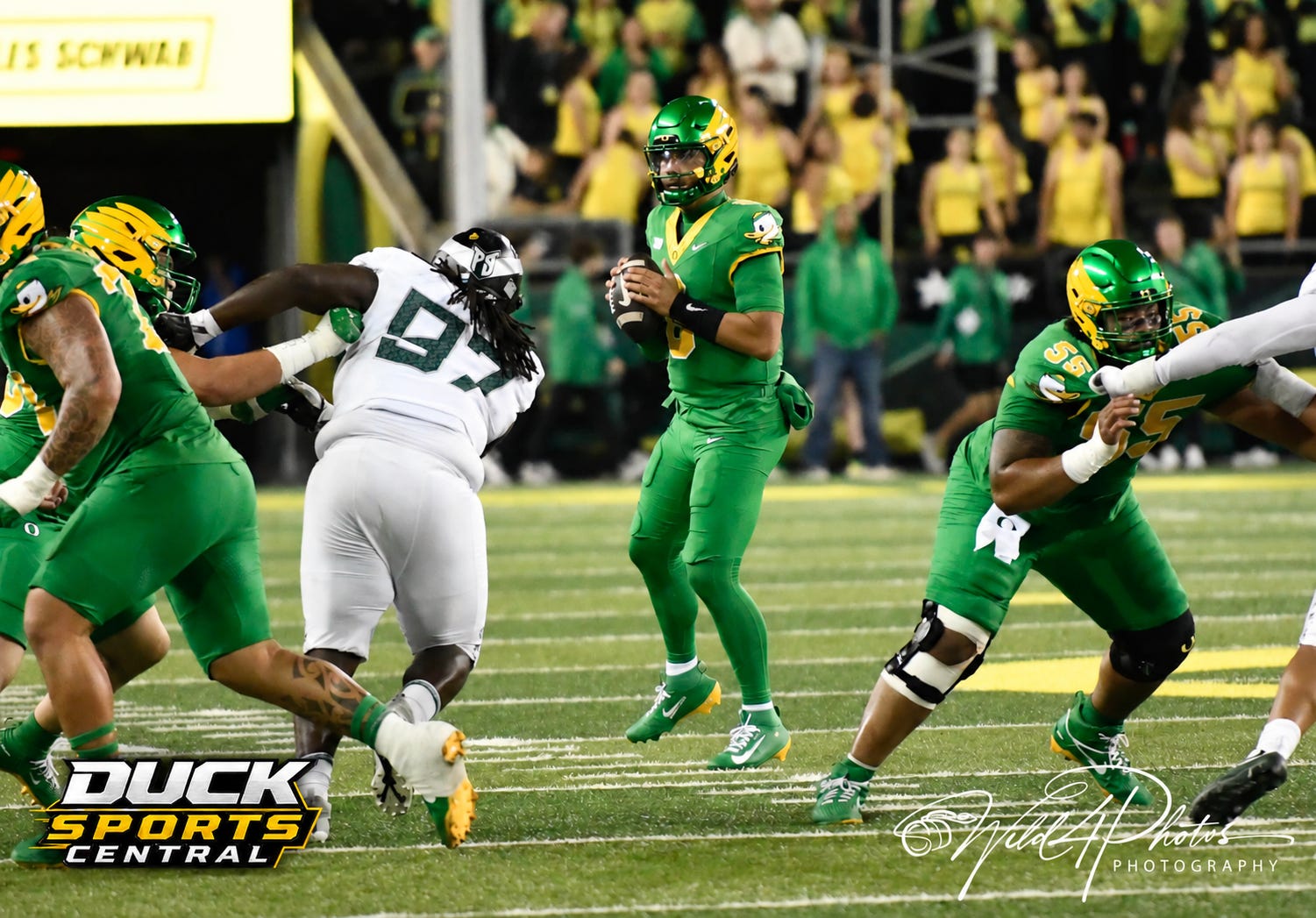
There was never going to be much value in trying to measure Oregon against Portland State by the scoreboard alone. The Ducks were supposed to win this game comfortably, and Dan Lanning acknowledged that almost immediately after an 84-0 victory that was every bit as lopsided as the score suggests. Oregon had more talent, more depth and physical advantages almost everywhere on the field, so the result itself was never going to answer all of the questions created by the previous two weeks.
What Friday night could reveal was whether Oregon looked more like the team it had spent the week trying to become.
Lanning had challenged the Ducks after Oklahoma State, not simply because of the result, but because of the preparation and execution that led to it. Throughout the week, players talked about accountability, fixing mistakes immediately and refusing to let little details slide. By the time the locker room opened Friday night, the most consistent theme running through nearly every interview was that the improvement Oregon saw on the field had begun several days earlier.
“I did like some of the creativity that I was able to see from a scheme,” Lanning said. “And then the execution, I got to see the plays that we ran tonight were the same plays we ran consistently throughout practice multiple times at a high level. And so when you see that, that’s something you’re satisfied to see.
“When you don’t execute it well in practice and then expect it to be done well in a game, that’s — you shouldn’t be surprised by the results. So what showed up in practice really showed up in the game tonight.”
That idea became the thread connecting almost everything Oregon said afterward.
The response began Monday
Dante Moore did not describe Friday as something that suddenly clicked once Oregon walked into Autzen Stadium. For him, the response began almost as soon as the Ducks returned to work following Oklahoma State, when Lanning pushed the team and mistakes were no longer allowed to simply pass without correction.
“There was some adversity that was shown, of course, last weekend, but I feel like it was needed,” Moore said. “It just showed us who we are as a team, and, you know, we didn’t shy away from it. We attacked it starting Monday. Coach Lanning pushed us, you know, pushed us at practice. And when there was mistakes that happened, we made sure we repeated that play and made sure we attacked it.
“So this game, you know, showed how we practiced this week. We got, you know, way more better plays to make out there and fix some mistakes. But it’s a game of football, and, you know, there’s no better feeling than having to win.”
Jordon Davison offered essentially the same explanation when he was asked why Oregon’s running game looked different. There was no complicated answer about scheme or some dramatic adjustment. The difference, he said, came from being more demanding during the week.
“It just all came in this week’s practice, being more detailed and just not letting things slide, calling things out when there’s a problem and correcting it there and now.”
That is probably the part of Friday that matters more than the 84 points.
Nobody needed this game to prove Oregon had better players than Portland State. The important question was whether those players were doing what they were supposed to do more consistently. Lanning saw progress there, even while acknowledging there were still formation mistakes and defensive eye-discipline issues that will matter much more against better opponents.
“I think there was moments where I saw us in the first half, we didn’t line up in the right formation at times, where our eyes were in the wrong spot on defense,” Lanning said. “But as a whole, I’d say it was a much higher percentage of guys doing the right thing consistently in this.
“And then obviously the matchup was also a benefit as well. So when you have a better player across from a player that’s not at the same level, you’re going to be able to win that matchup. But are you doing the right thing? And I saw our guys do that at a higher clip, but want to go evaluate the film to make sure what I saw is true.”
That distinction matters. Oregon could overpower Portland State even when everything was not perfect. What the Ducks needed to see was evidence that the football itself was becoming cleaner.
Accountability became something tangible
Leadership was one of the words Lanning used repeatedly during the week, but Moore gave the best explanation Friday night of what that leadership actually looked like once Oregon returned to practice.
It was not about speeches or some dramatic locker-room moment. It was far more mundane than that, which is probably why it mattered. A huddle that was too slow got repeated. A poorly placed throw created extra work afterward. A quarterback carrying out a fake became something worth correcting because those details eventually become tells against a defense talented enough to recognize them.
“When we break the huddle, if the huddle isn’t broke fast enough against the ball, calling it back, redoing that practice,” Moore said. “If I don’t complete a right pass with the right ball placement, getting extra throws after practice. If it’s me carrying out my fakes this week, I was focused on my feet, make sure there was no tells about that.
“So it’s just every player has that. And I think after practice, there’ll be so many players on the field getting extra work. If it’s extra catches, extra run game footwork, just so many things and, you know, that was something I attacked this week and going to do next week.”
Moore also included himself when he talked about the larger leadership challenge. That felt important because it would have been easy after an 84-point night for Oregon’s starting quarterback to frame the week as something the rest of the roster needed to correct.
Instead, he talked about his own responsibility.
“Leadership is huge,” Moore said. “I feel like me as well as a player, I think I can get, you know, I think I know I can get better as a leader. A lot of us players. That’s something we’re attacking, and this whole week, we made sure that when something didn’t look right, that we uphold the standard and made sure that it get fixed right then and there.
“Come game time, there was a lot of guys that got into the game, and we just made sure we stayed on the sidelines, coaching them, giving them the thoughts and the views that we had on the field. So we’re all in this together, and we’re all dedicated.”
Lanning agreed that the preparation was better, but his response also carried a warning. Leadership is relatively easy when the scoreboard says 84-0 and everyone on the sideline is getting an opportunity to celebrate. The challenge is making the same standard survive when things get uncomfortable again.
“It’s easy to be a leader when you’re comfortable, right? And the score looks like it does,” Lanning said. “But I do think the preparation was better this week. I thought guys stepped up to the table. I thought there was a standard that was established and set. It’s got to carry over now for us. It’s got to be something that leads to future success.”
That is probably where the real evaluation of this week begins. Oregon responded. Now it has to prove the response was more than temporary.
The run game finally looked like part of the offense again
Few areas drew more attention after Oklahoma State than Oregon’s running game, and Friday provided the Ducks an opportunity to get back to something that had been missing. Portland State is not a fair measuring stick for whether those problems are solved, something Lanning readily admitted, but there was still value in seeing the timing and physicality look more like what Oregon expects.
For Davison, the importance of establishing the run was less about his own production than what it allowed the entire offense to become.
“We always preach start fast,” Davison said. “In our room, we always want to run the ball, run the break tackle, run the win.
“Once you establish the run game, it always opens up the pass game. We got elite players like Evan out there and Dante and Dylan that can throw the ball real good. Just establishing the run game really helps create explosives for the pass game too.”
Dylan Raiola saw the same relationship once he entered the game. When Oregon could consistently stay ahead of the chains on the ground, everything around the quarterback became easier.
“Obviously when you can run the football, stuff opens up in the pass game,” Raiola said. “And I think you saw that Jordon and J.D., you know, Jordon and Dierre running hard early. Their backs have a high standard in their room, so they know there’s no drop-off.
“And then once we play action, you know, things are a little more open for us, and the O-line holds up great. So it makes football easier when you can just hand the ball off and rush for four yards, five yards at a time. And, you know, it makes it simple for all of us to kind of understand where we’re going with what’s going to be called and things like that.”
Lanning was not prepared to declare anything fixed, and he should not have been. Still, he liked the creativity and, more importantly, the fact that the execution Friday mirrored what the staff had seen during the week.
That makes this less a declaration that Oregon has solved the running game and more a reminder of what the offense is supposed to look like when the pieces work together.
A night when the entire sideline became part of it
The nature of the game gave Oregon something it did not get during the first two weeks: the opportunity to turn the second half over to players who had been doing most of their work away from the spotlight.
That mattered to Lanning because September depth often becomes November necessity.
“Every season we’ve been here, you’re going to end up leaning on somebody that showed up in the game tonight and maybe didn’t have a huge role at the beginning of the season,” Lanning said. “So nights like tonight are great for having an opportunity to see what that’s going to look like and building trust.”
There were plenty of those moments. Messiah Hampton scored twice. Jett Washington intercepted two passes. Brady Bidwell caught a touchdown while taking a significant hit. Young running backs carried the ball and Raiola finally received enough snaps to settle into the Oregon offense.
For Raiola, those snaps carried more significance than the statistics. The last time he had walked off a field after playing college football, he was dealing with a broken leg.
“It was so much fun,” Raiola said. “My coaches and teammates prepared me so well. And, you know, I’m just grateful. You know, I took a moment to kind of just, like when I came from, like the last time I got on a football field, I was walking off with a broken leg.
“And so kind of putting that in perspective to have a whole new change and everything, I’m just blessed to be a part of this program and a part of, you know, the win today.”
Moore watched Raiola complete all 11 of his passes and did not sound particularly surprised because he has already seen that version of him away from game day.
“Every day at practice, he’s pushing me, I’m pushing him,” Moore said. “He’s someone that’s in the film with me tapping my shoulder, showing me this look of what they’re going to do on defense. And he’s just someone that the stat doesn’t blow my mind. I mean, he does it at practice. He’s someone that just takes control of the ball. He’s dedicated to his craft. And he’s just a great teammate to be around.”
That theme came up with Hampton as well. Moore called him the “Prince of New York” and talked about a young receiver whose production Friday was not a surprise to the players who watch him work every day.
“We call him the Prince of New York,” Moore said. “He’s someone that has been so dedicated, had a great spring ball, had a great fall camp. He’s just someone that just puts the work in, and when his number isn’t called, he’s still going to put the work in. And when he had his number called today, I mean, he does that at practice. You know, we’re all not surprised.”
That might have been the best part of Friday night. The score stopped mattering long before the game ended, but the opportunity did not.
The defense went back to something simpler
The defensive side carried its own frustrations into the week, and the solution players described afterward sounded much like the one coming from the offense. Oregon did not spend the week searching for some revolutionary answer. The Ducks went back to basics.
Jerry Mixon said the emphasis was on responding and then repeating that response every week as Oregon moves into Big Ten play.
“I feel like we’re growing for sure,” Mixon said. “Like this week, this past week, we’ve been talking about responding. So just going back to the basic responding. And it’s really just getting ready for Big Ten play just like you said. It’s going to be challenging. So just going out there every week and doing the same thing.”
The defense allowed only 103 total yards and two rushing yards, but Mixon seemed more pleased by what happened after the starters left the game. Oregon’s younger defenders did not allow the standard to drop simply because the names on the field changed.
“The coaches always preach whoever on the field is a starter,” Mixon said. “So it felt great that the younger guys held the standard, as well as the older guys. So, you know, it’s all being on the same page. So it felt great doing that for sure.”
Jett Washington’s two interceptions became another example of the same pattern. Na’eem Offord pointed back to practice when asked about Washington’s night.
“I was real happy for him to see that he had two interceptions back-to-back,” Offord said. “But it started off in practice, you know. I feel like all the guys, all the defensive guys, we had practiced pretty hard this past week because, you know, we really won it. So, you know, we talk about just going back to the basics. So, yeah, I was happy for him.”
Different side of the ball, same story.
Now comes the part that actually matters
There was an obvious sense of relief around Oregon after the game, even if nobody quite described it that way. Evan Stewart called it a “good bounce back game,” and there was a looseness around the players that had been harder to find after the first two weeks. There were jokes about the “Prince of New York,” Jamari Johnson becoming “Coach JJ” and the tight ends becoming the “C-Gap CEOs.” Raiola laughed about being so focused on third down that he barely understood what was happening around him during “Shout.”
There was some value in that, too.
Stewart said the night helped the offense recover some rhythm after Oklahoma State.
“I think it was a good bounce back game for sure, especially with what happened last week,” Stewart said. “I think just building up the confidence and just getting that rhythm with this game and just catching our feet again just definitely made a difference and made an impact with all of us. Just building on top of that, going into next week, knowing that we got a big week coming. So it was pretty good.”
Lanning, however, was not interested in allowing the relief to become satisfaction. When asked about the value of shedding some of the stress from the previous week, he pushed back on the premise.
“Stress doesn’t disappear. Pressure doesn’t disappear,” Lanning said. “But you create that, again, with expectations and what we want to be able to do. I think you saw examples of how we’re able to execute at times. And then also, this isn’t completely a measure of the games that we’re going to have to face and what we’re going to have to do in the future with the teams that we’ll face.”
That is probably the proper place to leave this game.
Oregon did what it was supposed to do against Portland State, but the most encouraging part was not that the Ducks scored 84 points or allowed none. It was that nearly everyone who spoke afterward described a week in which preparation became more demanding, teammates became more willing to correct one another and the details that had slipped during the opening weeks became harder to ignore.
Friday night looked like that week.
Now USC will tell Oregon whether it can look that way when the opponent is capable of pushing back.