


CHAMPAIGN, Ill. — An impressive opening drive offered the promise of a breakthrough, but the Ducks surrendered 21 unanswered points as familiar problems with execution, preparation and physicality turned a winnable game into a damaging defeat.
Oregon entered Saturday’s matchup with Illinois carrying the momentum of a victory, but also the unmistakable weight of a season that has rarely unfolded according to plan. The Ducks had followed a frustrating 17-15 loss to UCLA with another low-scoring struggle against Nebraska, needing Dylan Raiola to come off the bench and rescue an offense that had sputtered for much of the afternoon under Brock Thomas. Raiola delivered, engineering a 17-14 comeback victory that offered some measure of redemption, even as the offensive limitations that nearly cost Oregon the game remained difficult to ignore. The Ducks had survived, but there was little evidence that they had solved the problems threatening to derail a season that began with considerably greater expectations.
And then, as has seemingly become the rhythm of this Oregon season, the challenges only multiplied. With starting quarterback Dante Moore still sidelined by injury, Raiola was preparing for another start, this time without four of Oregon’s most important receiving options. Evan Stewart’s DUII arrest had cast an unfortunate shadow over the program, while Friday’s injury report confirmed that Messiah Hampton and Jalen Lott would join Stewart and Jeremiah McClellan among those unavailable against Illinois. An offense already searching for consistency would now have to find answers with a significantly diminished receiving corps and an offensive line that had struggled to establish the physical identity Oregon expected.
On paper, the Fighting Illini presented an opportunity against a defense that had struggled through the early portions of the season, but a significant defensive overhaul complicated that assessment. Oregon’s own defense had played well enough in recent weeks to suggest the Ducks could dictate the afternoon, particularly against an Illinois offense relying on a true freshman quarterback. Yet the central question was whether Oregon could develop enough offensive consistency to complement that defensive strength. For a team that had spent much of the fall learning that talent and expectation offer little protection against the unpredictable realities of college football, the trip to Champaign represented another opportunity to demonstrate that the difficult lessons of the previous two weeks had finally begun to take hold.
Yet whatever concerns surrounded the Ducks before kickoff, few could have anticipated the manner in which Saturday would unfold. Illinois scored 21 unanswered points after falling behind by 10, turning an afternoon that began with perhaps Oregon’s finest offensive possession of the season into a 21-10 victory that left the Ducks confronting difficult questions about their preparation, their physicality and the direction of a season that once carried championship expectations.
Oregon (4-3) outgained Illinois 426-314, produced 21 first downs to the Illini’s 15 and averaged 5.8 yards per play. None of those statistical advantages could disguise the reality that the Ducks were outplayed when the game mattered most, surrendering control of both lines of scrimmage while failing to score a point over the final 32 minutes. For Dan Lanning, now in his fifth season directing the Oregon program, the defeat represented something more troubling than another afternoon of missed opportunities. The Ducks have struggled to find offensive continuity since losing starting quarterback Dante Moore to injury, but Saturday suggested that their problems extend well beyond the absence of one player.
An opening glimpse of what Oregon could be
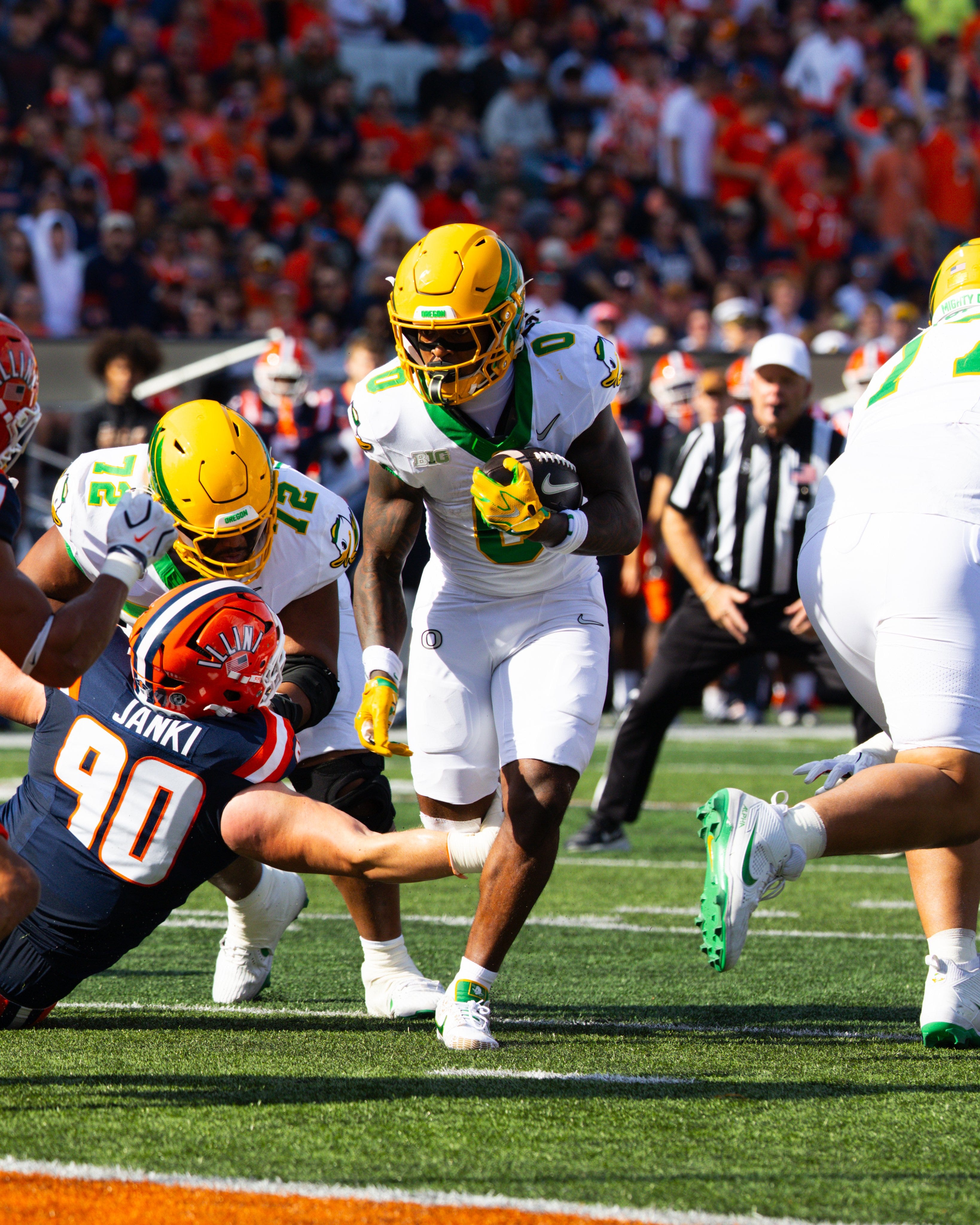
There was little indication of the afternoon’s eventual outcome when Oregon took possession to begin the game. Offensive coordinator Drew Mehringer opened with an impressive script that used motion, personnel changes and different formations to keep Illinois off balance. Raiola appeared comfortable operating the offense, completing three of five passes for 45 yards on an 11-play, 75-yard drive that ended with Jordon Davison scoring on a 2-yard run.
A quick completion to Dierre Hill Jr. opened the afternoon, followed by a 25-yard catch and run from Dakorien Moore that showcased effective perimeter blocking. Davison found room behind an offensive line that initially appeared capable of controlling the point of attack, while Jamari Johnson converted a third down to extend the possession. It was the kind of opening series Oregon had rarely produced this season, particularly since Dante Moore’s injury, with Raiola playing decisively and Mehringer finding creative ways to get the ball to his playmakers.
Unfortunately for Oregon, that opening possession would prove more exception than indication of things to come. The Ducks managed just three additional points over the remaining 56 minutes, allowing Illinois to gradually seize control despite an offense that struggled to produce anything meaningful early in the game.
Oregon’s defense initially appeared ready to carry the afternoon. Teitum Tuioti delivered a strong opening half, the coverage unit limited Illinois quarterback Michael Clayton II and the Ducks forced punts on the Illini’s first three possessions. When Raiola lost a fumble near the end of the first quarter, Tuioti immediately responded with a strip sack that Matayo Uiagalelei recovered, preventing Illinois from capitalizing on excellent field position.
Even then, Oregon could not turn the defensive opportunity into points, as the offensive line repeatedly undermined promising possessions with protection failures and missed assignments. A false start by Gernorris Wilson complicated one second-quarter drive, although Raiola found Moore for a conversion. A subsequent loss on a third-down rushing play forced Gage Hurych into a 52-yard field goal attempt that missed.
The contrast was becoming increasingly difficult to ignore. Mehringer had shown an ability to create favorable opportunities with his early play designs, but the execution required to sustain those opportunities was inconsistent at best. That inconsistency proved particularly damaging near the goal line, where Oregon squandered another opportunity to build a commanding advantage.
Davison broke loose for 32 yards on Oregon’s next meaningful possession, and Hill followed with a 41-yard run that carried the Ducks inside the Illinois 10. But another false start and a sack of Raiola turned a promising touchdown opportunity into a fourth-and-goal decision at the 2-yard line. Oregon initially lined up to go for the touchdown before calling timeout and settling for a 20-yard Hurych field goal.
The kick extended Oregon’s lead to 10-0 with 2:29 remaining in the first half, but the narrow advantage hardly reflected how thoroughly the Ducks had controlled the game. Illinois had produced just 52 yards of offense to that point against an Oregon defense that appeared capable of controlling the afternoon, yet the Ducks had repeatedly failed to convert opportunities into the kind of separation their statistical dominance suggested was possible.
One play changes the afternoon
What had been a comfortable defensive performance changed in a matter of seconds. On the first play of the ensuing possession, Illinois running back Aidan Laughery found room on the right side, cut back through the Oregon defense and raced 75 yards for a touchdown that reduced the deficit to 10-7.
It was a catastrophic breakdown for a defensive unit that had otherwise played disciplined football through much of the opening half. More importantly, it fundamentally altered the trajectory of the game, allowing an Illinois offense that had struggled to sustain drives to suddenly find itself within three points while an Oregon team that had dominated statistically was left protecting a narrow advantage.
The Ducks compounded the problem with a conservative possession featuring three consecutive rushing attempts that gained only nine yards, returning the ball to Illinois despite having an opportunity to build on their early offensive success. The approach was particularly frustrating because Oregon had demonstrated the ability to generate explosive plays through both the running and passing games, yet seemed increasingly reluctant to trust that potential when the situation demanded more.
Oregon finished the half with a 230-127 advantage in total yards, but led only 10-7. The warning signs were evident in the squandered opportunities to build separation, and Illinois had discovered that it could challenge Oregon’s defense on the ground. What followed after halftime would turn those concerns into something considerably more damaging.
The collapse begins in the trenches
Illinois opened the second half with a nine-play, 70-yard touchdown drive that exposed problems Oregon had largely avoided during its previous two games. The Illini repeatedly attacked the edges of the Oregon defense, using quarterback Carson Boyd and a combination of running backs to exploit poor containment and undisciplined pursuit angles.
Boyd, whose primary contribution was as a runner, broke free for 20 yards on third-and-2, setting up Clayton’s 9-yard touchdown pass to Christian Abney that gave Illinois a 14-10 lead with 9:22 remaining in the third quarter. For an Oregon program built around physicality and defensive discipline, the ease with which Illinois moved the ball was troubling, particularly because the drive reflected fundamental breakdowns rather than extraordinary individual efforts.
The Ducks had difficulty recognizing misdirection, maintaining outside leverage and winning individual battles along the defensive front. Illinois repeatedly created manageable third-down situations, allowing an offense that entered the afternoon with considerable limitations to dictate the pace of the game.
Perhaps most concerning was that Oregon appeared to lose the very identity it needed most with Moore unavailable. The expectation had been that a talented defensive front and improving rushing attack could compensate for limitations in the passing game, but Illinois increasingly controlled both sides of the line of scrimmage while Oregon’s offense retreated into conservative, predictable play calling.
Following Illinois’ go-ahead touchdown, the Ducks opened their next possession with two interior runs and a short completion that failed to reach the first-down marker. The creativity that characterized Oregon’s opening possession had largely disappeared, replaced by an approach that made it easier for Illinois to anticipate what was coming and considerably more difficult for Oregon to establish any offensive rhythm.
It was not simply a matter of missing receivers or having a backup quarterback under center. Oregon had demonstrated an ability to run effectively in the first half, yet too frequently failed to build on that success with complementary play designs. The offensive line continued to struggle with individual assignments, particularly on the edges, while missed blocks undermined screen plays designed to give Raiola manageable opportunities.
A third-quarter screen to Johnson offered a particularly revealing example. Wilson missed a block that could have opened the play for a significant gain, leaving Oregon facing another fourth down instead. The play itself was not inherently flawed, but its execution was, and the distinction mattered for an offense increasingly unable to overcome even modest mistakes.
A fourth quarter without answers
Trailing by four entering the final quarter, Oregon still had opportunities to regain control. The Ducks received a potential break when Peyton Woodyard appeared to intercept Clayton with 9:50 remaining, but a replay review overturned the ruling after officials determined the ball had not been secured.
Instead of taking possession at their own 36-yard line, Oregon was forced to start at its 19 following the Illinois punt. Brandon Smith provided a 17-yard reception on a well-designed play, and Oregon moved into Illinois territory with the help of a fourth-down conversion by Davison. But another protection breakdown stalled the possession, leaving Hurych to attempt a 53-yard field goal that missed, his second unsuccessful attempt of the afternoon.
With just over six minutes remaining, the Ducks still trailed 14-10, but the underlying problems were becoming almost impossible to overcome. Illinois continued to find success on the ground, eventually finishing with 225 rushing yards on 39 attempts. The Ducks struggled to get the defense off the field, and the Illini converted eight of 16 third-down opportunities compared with just four of 15 for Oregon.
Facing third-and-7 with under three minutes remaining, Clayton found Collin Dixon for a 23-yard touchdown that extended Illinois’ advantage to 21-10 and effectively ended Oregon’s hopes. The Ducks had allowed 21 consecutive points after their promising opening half, with Illinois scoring touchdowns on three of its final six meaningful possessions and repeatedly exploiting vulnerabilities Oregon had been unable to correct.
Raiola, who had been asked to operate cautiously for much of the afternoon, finally found success pushing the ball downfield late. Consecutive completions to Johnson highlighted a possession that reached Illinois territory, but another missed Hurych field goal — this one from 47 yards — ensured Oregon would finish with only 10 points.
Raiola completed 27 of 41 passes for 246 yards without a touchdown or interception, numbers that reflected both his ability to distribute the ball and an offense that struggled to translate yardage into meaningful production. Davison finished with 92 yards rushing and a touchdown on 14 carries, while Hill added 83 yards on 13 attempts.
Moore led Oregon’s receivers with nine catches for 70 yards, while Johnson contributed seven catches for 69 yards and Hudson Lewis added five for 68. The Ducks finished with 180 rushing yards, a notable improvement over their recent struggles, but much of that production came in bursts rather than through the sustained physical dominance Oregon had hoped to establish.
For Illinois, Laughery finished with 123 rushing yards and a touchdown, Jordan Anderson added 67 yards and Clayton completed 11 of 18 passes for 84 yards and two touchdowns. Dixon led the receiving corps with six catches for 65 yards and the decisive fourth-quarter score, providing Illinois with just enough production through the air to complement an increasingly effective ground attack.
A defeat that raises larger questions
Three missed field goals will undoubtedly receive attention in the aftermath, and reasonably so. Those nine potential points would have changed the complexion of a game decided by 11, but reducing Saturday’s failure to the kicking game would overlook the more fundamental issues that put Oregon in that position.
The Ducks moved the ball between the 20-yard lines, but struggled to finish possessions. Their defense showed considerable ability in the opening half, then surrendered the physical advantage after intermission. Their offensive coordinator demonstrated creativity early, only to spend much of the afternoon relying on conservative concepts that allowed Illinois to dictate the terms of the game.
There is an important distinction between having an offense that struggles because of injuries and having an offense that repeatedly fails to maximize the personnel available. Oregon has unquestionably been affected by significant injuries and absences, particularly at quarterback and receiver, but the offensive line’s continued inconsistency, communication failures and inability to handle pressure are problems that cannot be explained entirely by the injury report.
Those issues raise legitimate questions about the unit’s development under offensive line coach A’lique Terry and the staff’s decision not to pursue additional experience through the transfer portal. The Ducks have shown flashes of improvement in the running game, but the inability to protect their quarterback consistently or execute fundamental assignments under pressure suggests that the problems run deeper than simply finding the right combination of personnel.
The defensive performance warrants similar scrutiny. Oregon entered the season with a roster widely regarded as among the most talented in program history, particularly along the defensive front, yet Illinois repeatedly won critical rushing situations, often through fundamental concepts that demanded disciplined positioning rather than extraordinary individual effort.
The larger concern for Lanning is no longer whether the Ducks can survive the absence of Dante Moore. It is whether a team constructed to compete for a national championship has developed the cohesion, preparation and accountability necessary to compete consistently at all. Injuries may explain some of the difficulties Oregon has encountered, but they cannot fully account for the persistent failures in execution that have appeared across different opponents and different circumstances.
Saturday’s loss dealt a severe blow to Oregon’s College Football Playoff hopes and placed even greater importance on the remaining schedule. It also introduced more difficult questions about roster confidence, player development and how a disappointing season might influence the program’s future.
There is still football left to play, and there are opportunities for the Ducks to demonstrate that the potential visible on their opening possession represents something more than an occasional glimpse of what could have been. But the contrast between that first drive and the 56 minutes that followed offered a revealing portrait of Oregon’s season, one in which the talent remains visible and the moments of competence are unmistakable, yet the ability to connect those moments into four quarters of disciplined, effective football continues to elude this team.
On an afternoon when Oregon gained 112 more yards than Illinois, the final scoreboard offered the only measurement that ultimately mattered. The Ducks had arrived in Champaign looking for evidence that their season was beginning to turn, but instead departed with another defeat and a growing collection of questions for which the answers have become increasingly difficult to find.
Player of the Game: Aidan Laughery, Illinois
Laughery rushed for 123 yards and a touchdown on 13 carries, averaging 9.5 yards per attempt while providing the explosive play that changed the complexion of the game. His ability to threaten the edges and capitalize on Oregon’s pursuit mistakes helped Illinois establish the rushing attack that eventually wore down the Ducks.
Key Play: Laughery’s 75-yard touchdown run
With Oregon leading 10-0 and seemingly in control late in the second quarter, Laughery broke free on the first play of an Illinois possession for a 75-yard touchdown. The run transformed a game Oregon had statistically dominated into a three-point contest, giving Illinois the momentum it carried into the second half while exposing defensive vulnerabilities the Illini would continue exploiting throughout the afternoon.
Key Stat: Third-down efficiency
Oregon: 4 of 15 (26.7%) | Illinois: 8 of 16 (50%)
Despite finishing with 426 total yards and an advantage of 112 yards over Illinois, Oregon could not sustain drives when it needed to, converting fewer than 27% of its third-down opportunities. Illinois, meanwhile, converted half of its attempts, frequently using its rushing attack to maintain possession and control the tempo. The disparity illustrated why Oregon’s statistical advantages produced so little on the scoreboard.