


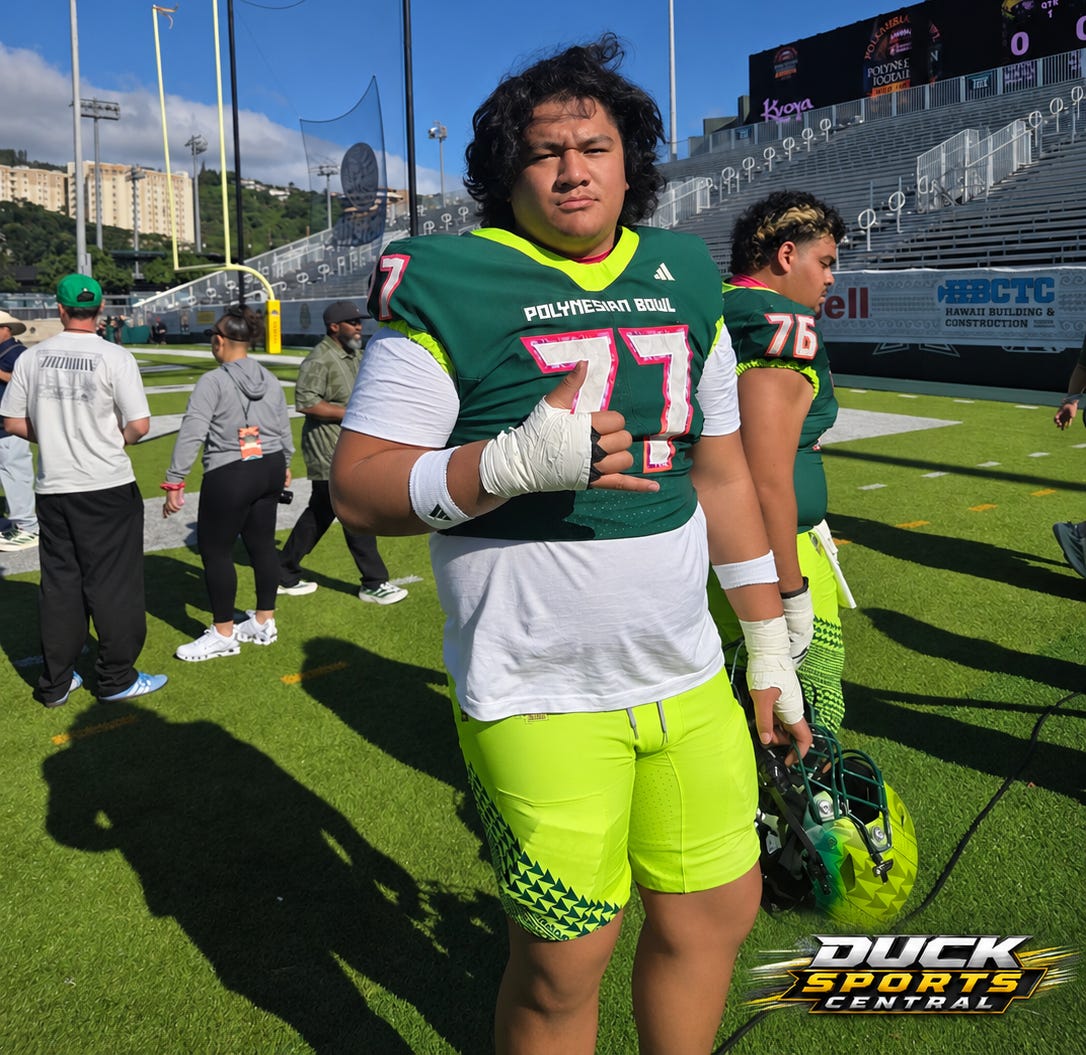
EUGENE, Ore. — When Tommy Tofi arrived at the Polynesian Bowl in Honolulu last January, the massive offensive lineman already had a fairly clear picture of what he wanted his freshman season at Oregon to look like. He wanted to compete immediately, learn the Ducks’ offense and establish himself as someone capable of contributing before his first season was finished. There was little hesitation when asked about his expectations, particularly considering the competition he would encounter upon arriving in Eugene.
“First year, starting first year and just building on from there and just three and up,” Tofi told Duck Sports Central during an interview at Kalani High School.
Ten months later, the path toward that goal has proven considerably more complicated than the talented freshman might have anticipated. A promising spring performance generated excitement about his potential, but the beginning of the regular season brought a different reality as Oregon continued searching for the right combination along its offensive line. Tofi spent much of the early schedule watching, learning and waiting for an opportunity that eventually arrived as the Ducks attempted to stabilize an offense that had struggled to find consistency.
Now, as Oregon prepares for Saturday’s trip to Ohio State, Tofi has become an increasingly important piece of an offensive line that appears to be finding its identity. Alongside fellow young guard Doug Utu and experienced linemen Fox Crader and Poncho Laloulu, Tofi is part of a group whose recent improvement has coincided with a renewed willingness to establish a physical presence at the line of scrimmage. His development represents something larger than one freshman finally earning playing time, particularly as the Ducks begin relying on younger players to fill important roles during the final month of the regular season.
Throughout this week’s interviews, Oregon’s coaches and players repeatedly returned to the importance of preparation, patience and understanding individual responsibilities, themes that have become increasingly important as the Ducks attempt to recover from an uneven October. Head coach Dan Lanning described Wednesday’s practice as an encouraging step toward the challenge awaiting his team in Columbus, emphasizing the energy he observed and the level of preparation required against an opponent with Ohio State’s personnel.
“All right, good day today. I mean, a lot of good energy from our players, and it’s necessary in a game like this when you’re traveling to a hostile environment with a team that has as much talent as anybody in the country, and they do a really good job overall as a program, right, in all three phases.”
The challenge will be substantial, but Oregon’s preparation this week has been about more than simply recognizing the talent Ohio State possesses. The Ducks are attempting to build on the improvement demonstrated against Northwestern while continuing to develop the younger players who increasingly determine what this team is capable of becoming. That combination of preparation for the immediate challenge and development for the remainder of the season provided the central theme of Oregon’s practice availability.
Offensive line finding stability through competition
Few position groups have experienced more uncertainty this season than Oregon’s offensive line. Injuries, personnel changes and inconsistent execution forced the Ducks to experiment with different combinations, making it difficult to develop the continuity necessary for sustained offensive success. Over the past two weeks, however, Oregon has begun to establish a more consistent group, and Lanning believes the improvement is becoming noticeable in the way the Ducks are controlling the line of scrimmage.
“I think we’re still identifying strengths as we go through, but this is a group that’s been cohesive kind of the last two weeks,” Lanning said Wednesday. “I think we’ve done a better job of moving bodies up front, which I think is really where it always starts. You talk about winning the line of scrimmage. And some of those were just necessary reps to get us to the point to where we felt like we had that.”
Lanning emphasized that the current combination is not necessarily permanent, particularly given the physical demands of the season and the possibility of additional injuries. But the competition that initially contributed to uncertainty has also helped create an environment where individual players understand they must consistently earn their opportunities. The coach believes that approach has helped the entire position group improve because nobody can assume that a starting assignment is guaranteed.
“I think the competition has really helped us at those positions, right? Those guys feel like they’re battling every single day to go out there and play, knowing that nothing’s guaranteed and it’s about what you do each day.”
That philosophy has resonated with Utu, who acknowledged the challenges created by the constant movement along the offensive line. Rather than viewing the competition as a distraction, he believes it has helped push the group toward improvement, even when the uncertainty surrounding playing time occasionally became difficult. The process has also forced younger players to develop a greater understanding of multiple positions and the responsibilities associated with different combinations.
“No, yeah, it’s for sure been a bumpy road for the offensive line,” Utu said Tuesday. “I feel like it’s a good thing that we don’t really have, like, a starting five because it actually pushes us to compete to, like, really get that starting spot.”
Utu’s own development has been shaped by the opportunity to learn from more experienced teammates, particularly Laloulu. He described the importance of establishing a consistent daily routine and understanding what is required to prepare at the college level, a transition that has become easier as his familiarity with the program has increased. The experience of playing behind established linemen during his first season gave him an opportunity to observe their preparation before being asked to assume greater responsibility himself.
“I feel like last year was kind of a growth moment. It’s kind of like just a good feel of college. And this year, I just started knowing what to do and when to do it. Learning from Poncho, being behind Poncho, learning from him.”
The progression has also required Utu to incorporate lessons from veteran Dave Iuli, whose physical approach left a significant impression on the younger lineman. Utu identified aggression and the ability to finish blocks as qualities he hopes to continue developing, particularly as Oregon prepares to face one of the more physically imposing defensive fronts on its schedule. That emphasis on finishing plays has become increasingly important for an offense attempting to establish greater consistency on early downs.
“I feel like one big thing I learned from Dave is just finishing. Just aggression. I feel like out of anyone I knew that played a line, I’ve never seen someone more aggressive than Dave.”
For Oregon, those lessons are beginning to appear in the way the interior line operates. Utu expressed confidence in the group’s progress following Northwestern, particularly after a performance in which the offensive line did not surrender a sack. His assessment of the interior combination was brief, describing the group as having a “solid middle,” but the significance is considerable for an offense that has spent much of the season searching for continuity.
The emergence of two young guards could provide the foundation for greater consistency as the Ducks enter the final stretch of the regular season. Ohio State will present a much more demanding challenge than Northwestern, particularly because of its ability to change defensive fronts and create difficult blocking assignments, but Oregon’s recent improvement suggests the coaching staff may finally be finding a combination capable of handling those responsibilities.
Tommy Tofi: From Polynesian Bowl ambition to Big Ten responsibility
The progression of Tofi may be one of the more revealing individual stories of Oregon’s season, particularly when viewed against the expectations he carried into the program. During our January interview at the Polynesian Bowl, Tofi spoke confidently about his decision to attend Oregon and the opportunity to develop within a program that had recruited him consistently throughout high school. His relationship with the coaching staff was a particularly important part of that decision, and he viewed the continuity within the program as evidence that Oregon could provide the environment necessary for his development.
“I mean, Oregon was the first team that actually recruited me from my freshman year all the way to my senior year,” Tofi said at the time. “They still have the same coaching staff, same team, and I like that they have the stability to stay together. It’s just, it’s just working.”
Tofi also understood that earning a role would require competing against one of the nation’s most talented defensive fronts. He welcomed that challenge, describing the opportunity to work against Oregon’s defensive linemen as an important part of his development. Even before arriving in Eugene, he recognized that the daily competition would be significantly more demanding than what he had encountered during high school.
“Iron sharpens iron, you know,” he said in Honolulu. “Like Coach Terry said, they practice, they make practice hard so the game could be easy, so. I don’t know, this is the best D-line unit in the nation too, so I can’t wait to go up against them in practice.”
Those remarks have taken on additional meaning as the season has progressed, particularly now that Tofi has experienced what competing against Oregon’s defensive front actually requires. On Wednesday, he described the value of working against Matayo Uiagalelei, Bear Alexander, A’Mauri Washington and Teitum Tuioti, explaining that the level of competition he encounters during practice has helped prepare him for the physical and technical demands of college football.
“Just being able to go head up with Tayo, Bear, A’Mauri, Teitum. Like, I don’t see, like, iron sharpens iron. Like, you just get better and better every day. And those guys helped me, and a lot of cuss-outs from the old linemen.”
The reference to receiving criticism from veteran teammates was delivered with humor, but it also reflected the way Oregon’s experienced players have helped younger linemen learn the expectations of the program. Those lessons have extended well beyond learning assignments, especially as Tofi has adjusted to playing guard after spending much of his high school career at tackle. The move inside requires quicker recognition, different footwork and more precise hand placement because interior defenders close space considerably faster than edge rushers working from wider alignments.
“That’s one big thing that I needed to work on was strike timing and also footwork,” Tofi explained. “You’re not going up against six three very lengthy guys that runs like a four three. You’re going up against big hefty dudes like Bear and A’Mauri.”
Lanning identified similar areas of development when discussing the freshman’s progress, particularly the importance of recognizing defensive movement and consistently executing assignments. The coach emphasized that Oregon had been confident in Tofi’s physical potential from the beginning, but the transition to college football required additional development before that ability could consistently translate into successful performance against experienced defensive linemen.
“Tommy is a guy that we’ve had a lot of confidence in from the beginning,” Lanning said Wednesday. “He’s gotten better and better. I think the guys around him have communicated really well but he’s got good good strength got good the ability to move people, which is huge.”
The next challenge involves learning to maintain the same effort throughout every play, something Lanning believes becomes particularly important when talented high school players encounter opponents who possess comparable physical ability. At the high school level, Tofi could often rely on his natural strength to overwhelm defenders, but the margin for error has become considerably smaller against defensive linemen with similar physical tools.
“In high school, he was able to move whoever’s across him without much effort. Right now in college, there’s great effort across from you, especially this week with what we’ll see on the D-line from Ohio State, that it’s going to take just a little bit more, a little more effort, a little bit more time.”
That observation helps explain why Tofi did not immediately become a starter despite the promise demonstrated during the spring. His physical ability was never the primary concern, but the speed of defensive recognition, consistency of technique and ability to execute against talented opponents required additional development. Tofi acknowledged that waiting through the early portion of the season became an important part of that process, particularly as the coaching staff experimented with different positions and combinations.
“Just like trying out like different positions from left to right and just kind of like finding my rhythm and setting out those four to five games, it kind of like it was like. Kind of like a learning moment for me,” he said.
The support he received from Crader, Laloulu and offensive line coach A’lique Terry helped him prepare for the opportunity he eventually received. Tofi believes the experience allowed him to develop a stronger understanding of the offense while becoming more comfortable with the responsibilities of playing inside. That process has also changed the way he approaches outside expectations, particularly after attracting considerable attention following his spring game performance.
“To be honest, like, I had to delete X and, like, other social media,” Tofi said. “But I’m very glad I got a big fan base, you know. It’s just pretty exciting.”
The difference between his ambitions in Honolulu and his circumstances in November is not that his goals have changed. It is that he has developed a clearer understanding of the work required to accomplish them, and the experience of waiting for an opportunity has become part of that development. For Oregon, that progression could prove increasingly valuable as the Ducks prepare for one of the most talented defensive fronts they will face all season.
Freshman running back Brandon Smith embracing his opportunity
Tofi is not the only freshman whose role has expanded as Oregon’s season has progressed. Running back Brandon Smith emerged as an important contributor against Northwestern after injuries created additional opportunities in the second half, providing another example of a young player moving from a relatively limited role into meaningful responsibility when the Ducks needed help.
Lanning explained Wednesday that the progression reflects the way Oregon attempts to develop its younger players, beginning with smaller assignments and allowing those responsibilities to expand as trust grows. The coaching staff has seen Smith’s potential throughout the season, but earning additional playing time requires more than demonstrating athletic ability during practice. It involves consistently executing assignments and preparing for situations that may not arise until an unexpected opportunity presents itself.
“We see that every single day in practice from Brandon,” Lanning said. “And I think he’s done what a lot of our young players have done that have been able to come in and make an impact as you start with a small role. And then that role grows over time as trust builds, as you see what they’re able to do.”
Lanning was particularly impressed by Smith’s ability to execute despite receiving fewer practice repetitions than the players ahead of him on the depth chart. That is often one of the more difficult challenges for young players because they must remain mentally engaged even when they are not physically participating in every repetition. When the opportunity finally arrives, the expectation is that they will understand the assignment well enough to execute at the same standard as the players receiving most of the practice work.
“What’s really impressive about that is you’re not always getting every rep in practice, but then to be able to go execute in a game, something you maybe ran one time or didn’t walk through rep, and then be able to execute at a really high level, just speaks to the natural football player he is and the skill set he has.”
Smith described the importance of remaining mentally prepared even when he is not physically participating in a particular practice repetition. The freshman understands that an unexpected opportunity may arrive without warning, making preparation essential regardless of his position on the depth chart. He has developed a habit of mentally following each play while watching the players ahead of him, attempting to understand the responsibilities he would have if his number were called.
“For myself, I just like to sit back and watch and kind of just, like, go through the play behind, just understanding that, like you said, I don’t really get as much one and two reps,” Smith explained. “So just knowing that, like, this is what I have to do because if I get put into the moment and I mess it up, then I’m probably not going to get another chance at it.”
That preparation became particularly important against Northwestern, when injuries forced Oregon to adjust its running back rotation. Smith said Dierre Hill Jr. encouraged him to recognize the opportunity and approach it with confidence rather than becoming overwhelmed by the circumstances. The advice reinforced the importance of remaining prepared throughout the season, even when an immediate opportunity does not appear likely.
“Right before I got in, Dierre was kind of just talking to me about, like, this is my opportunity, like, it’s time to go, you know?” Smith said.
Smith credited Jordon Davison and Dierre Hill Jr. with helping him understand the importance of patience during the early portion of his freshman season. Their guidance reinforced the idea that limited playing time does not mean a player can afford to prepare any differently, particularly when injuries can quickly change the responsibilities within a position group.
“They were just telling me just to work when it’s my time, it’s my time. And when I get my time, I got to ball out.”
The relationship between Oregon’s young running back and its emerging freshman guard also provided one of the more interesting connections from this week’s interviews. Smith described Tofi as a close friend and praised the lineman’s role in helping him find the end zone against Northwestern, a moment that demonstrated how the development of two young players could contribute directly to Oregon’s success.
“Yeah, Tommy’s my guy. I’ve been knowing him for a little bit now. And the chemistry that we have is just amazing. I mean, I love him to death. He’s a big guy, opened up holes for me.”
Tofi returned the compliment Wednesday, noting that Smith’s performance reminded him of one of the NFL’s most accomplished running backs. He also recognized the importance of the freshman responding when Oregon needed additional production, particularly after injuries disrupted the team’s original plans.
“He was moving like Saquon. It was crazy,” Tofi said. “But just seeing him playing on Saturday, it was like next man up mentality. So he was the next man up, and he stepped up big for us.”
The connection between the two freshmen provides another encouraging sign for Oregon’s future. Both entered the season behind more established players, and both have begun demonstrating that they can contribute when the circumstances require them to take on greater responsibilities. Their development has not followed identical paths, but the common denominator has been the willingness to prepare for opportunities that were not guaranteed to arrive.
For Smith, the immediate challenge is maintaining that preparation as the Ducks approach Ohio State with uncertainty surrounding the availability of some of their running backs. His response suggested he has little intention of changing his mindset based on the number of opportunities he expects to receive, recognizing that every game presents the possibility of being asked to contribute in a larger role.
“Whether Jordon or Dierre is down or they’re not, I just always got to be prepared for my moment,” Smith explained.
Defensive confidence built around individual responsibility
While Oregon’s offense has been attempting to establish greater consistency, the defense has spent much of the past month emphasizing the importance of individual assignments and coordinated execution. Lanning’s comments earlier in the week about wanting “assassins, not superheroes” became a recurring topic during Tuesday’s player interviews, reflecting the coaching staff’s concern about defenders attempting to create extraordinary plays at the expense of their responsibilities.
Cornerback Ify Obidegwu explained that the concept is particularly important when preparing to face a receiving group led by Jeremiah Smith. Oregon’s defensive backs understand the challenge associated with defending one of college football’s most talented receivers, but they also recognize that attempting to make individual plays outside the defensive structure could create opportunities for Ohio State elsewhere.
“Basically, just guys that just want to go out there and just do their job, you know, kill, go out there and just dominate the guy in front of them,” Obidegwu said. “Not somebody trying to, you know, just do something out there, like do, like jump out their gap or, you know, like try to make a play and not doing their job.”
Linebacker Dylan Williams echoed that message, explaining that Oregon’s defensive improvement has coincided with players becoming more consistent in their responsibilities. The objective is not to reduce aggression but to ensure that every defender understands how his actions affect the players around him, particularly when the defense encounters an opponent capable of exploiting even a brief breakdown.
“It really just means to me, like, he wants me to go out there and do my job. Doesn’t want me being a superhero, going out my way to try to make plays,” Williams said. “We got all 11 guys doing their job. We’re going to be sound.”
For Uiagalelei, the distinction involves maintaining aggression without allowing individual ambition to compromise the defensive structure. The experienced edge defender understands that opportunities to make disruptive plays will develop naturally when players execute their assignments, but attempting to manufacture those opportunities can leave the defense vulnerable.
“I’m going to play hard within the scheme. I’m going to do my job. And if there’s a play to be made, then I’m going to make the play,” Uiagalelei explained. “But I’m not going to risk putting a team, like hurting the team, trying to make a play and force something that’s, you know, not my job to do.”
The message is particularly important considering the difficulty Oregon experienced containing Northwestern quarterback Aidan Chiles at different points last Saturday. Uiagalelei acknowledged that the Ducks could have done a better job keeping Chiles contained, particularly when the quarterback escaped the pocket and created opportunities with his legs. Oregon eventually improved its execution, but the experience reinforced the importance of maintaining coordinated pressure rather than allowing individual defenders to become overly aggressive.
“I mean, Aidan definitely did, you know, definitely got out and hurt us, you know, escape in the pocket,” Uiagalelei said. “You know, definitely could have done a lot better job of trying to cage him in.”
Against Ohio State, those lessons carry additional significance because the Buckeyes possess the kind of skill-position talent capable of exploiting a single missed assignment. Obidegwu described Jeremiah Smith as a tremendous challenge, but one Oregon’s defensive backs are looking forward to facing, particularly considering the improved athleticism and experience within the position group.
“Yeah, you know, he’s big, physical, fast. You know, we’re big, we’re physical, fast corner, so it’s just a good matchup for sure, and we’re just definitely excited and ready to go for sure.”
The junior also emphasized that Oregon cannot become so focused on Smith that it overlooks Ohio State’s other receivers. The Buckeyes have assembled a talented group capable of creating problems throughout the field, particularly when opposing defenses devote additional attention to their best player. Williams believes the responsibility for limiting Smith must extend beyond the secondary, with linebackers contributing by disrupting routes and helping defensive backs avoid being placed in difficult individual matchups.
“Really just if I get a chance, maybe like just get reroutes on them and just help my DBs out so they’re not straining or having to take them on one-on-one,” Williams said.
The challenge will require Oregon to maintain the disciplined approach that helped the defense improve during the second half against Northwestern. The Ducks cannot eliminate Ohio State’s talent, but they can make the Buckeyes execute within a structure that prevents individual mistakes from becoming explosive plays. That collective responsibility has become one of the most consistent messages coming from Oregon’s defensive players this week.
The defensive front preparing for a different quarterback
Ohio State’s transition from Julian Sayin to freshman Luke Fahey has also influenced Oregon’s preparation, although the Ducks do not appear to be approaching the matchup as though the Buckeyes’ offense has fundamentally changed. The Buckeyes still possess an experienced offensive staff and talented skill-position players, making it important for Oregon to understand how Fahey operates within the existing system rather than assuming his inexperience will automatically create opportunities.
Obidegwu noted that Fahey possesses enough athletic ability to create problems outside the pocket while demonstrating a willingness to deliver the football quickly. He also suggested the Buckeyes have maintained much of their offensive structure, placing greater emphasis on quicker throws and intermediate opportunities rather than completely changing their approach.
“He can run. You know, so we got to just be accountable for his legs and, you know, things like that,” Obidegwu said. “They definitely, I think they run the same, pretty much the same offense they ran before. You know, just a new quarterback back there. They try to get the ball, get the ball out fast, intermediate throws, stuff like that.”
Uiagalelei was similarly complimentary of Fahey’s decision-making, suggesting the freshman has demonstrated a level of composure that makes him more difficult to disrupt than his experience might indicate. His ability to recognize pressure and avoid forcing throws could make Oregon’s defensive approach more complicated than simply attempting to overwhelm an inexperienced player.
“I think he makes good decisions. I think he, you know, he has a little bit of good pocket awareness,” Uiagalelei said. “And I think the biggest part is just he seems, you know, he’s not going to force anything.”
That assessment suggests Oregon’s defensive front recognizes the importance of maintaining discipline rather than assuming the freshman quarterback will make mistakes simply because he lacks starting experience. Uiagalelei believes the front has improved in recent weeks by demanding greater effort and physicality while allowing players to perform within their assignments, an approach that becomes particularly important against an offense capable of creating explosive plays when defenders become overly aggressive.
Williams has been particularly appreciative of the production generated by Oregon’s defensive linemen, noting that their ability to control gaps creates opportunities for the linebackers to pursue the football. The relationship between the two position groups is essential to Oregon’s defensive structure, especially when the Ducks are attempting to control the running game without sacrificing their ability to pressure the quarterback.
“Man, I love my defensive front. One thing about them guys, they’re going to cause havoc and they’re going to hold up gaps for me so I can come down and make some plays,” Williams said.
For Oregon, that relationship between the defensive line and linebackers will be important against a Buckeyes offense attempting to establish its running game while protecting an inexperienced quarterback. Consistent gap control and disciplined pursuit could force Ohio State into longer passing situations, creating opportunities for Oregon’s pass rush without compromising the coverage behind it. The challenge will be maintaining that discipline when the Buckeyes attempt to use their talented receivers to stretch the defense and create favorable running opportunities.
Preparing for the noise and the moment
Oregon’s preparation has also included the practical challenges associated with playing at Ohio Stadium, where the expected crowd could exceed 100,000 and communication will become a major consideration for the offense. The Ducks have experience competing in difficult road environments, but the size and intensity of Ohio Stadium present a challenge that requires specific preparation, particularly for the younger offensive linemen who have not previously played in Columbus.
Utu explained that the Ducks have been using artificial crowd noise during practice in an attempt to replicate the environment they expect to encounter Saturday. The objective is to improve communication and familiarity with the challenges that develop when verbal calls become difficult to hear, particularly against a defense capable of changing its alignment immediately before the snap.
“We just had a crowd noise, loudspeakers, trying to replicate what it’s like being in the horseshoe as much as possible,” Utu said.
For Tofi, the preparation has included advice from someone who knows exactly what it takes to win in that environment. Ryan Walk, Oregon’s assistant offensive line coach, was a member of the Ducks’ offensive line during their 2021 victory at Ohio State, giving him firsthand experience of the crowd noise, atmosphere and communication challenges awaiting Oregon’s younger linemen.
When asked Wednesday whether Walk had shared anything about that victory or offered guidance on what to expect Saturday, Tofi indicated that the former Oregon lineman’s message had focused on remaining composed and executing assignments rather than becoming distracted by the surroundings.
“Just stay calm and composed. It’s going to be loud at the Shoe, but once you look at the film, you just got to stay calm and composed and just do your job. Once you do your job, the result is going to be what you wanted. So that’s what they’ve been – that’s, like, the big emphasis this week.”
The advice carries particular significance for a freshman preparing for his first appearance in one of college football’s most recognizable venues. Walk was part of the Oregon team that defeated Ohio State in Columbus five years ago, and his experience offers a practical reminder that the atmosphere itself does not determine the outcome. For Tofi and the rest of Oregon’s offensive line, maintaining communication and trusting preparation will be essential against a defensive front capable of changing alignments and creating difficult blocking assignments.
The significance of the venue has not been lost on Oregon’s players, particularly those who have never experienced a game at Ohio Stadium. Uiagalelei described the opportunity with excitement, explaining that he has never played in the Horseshoe and is looking forward to competing against a program with Ohio State’s history and talent.
“For me, I think the extra juice just comes from excitement. You know, I just started playing in a game like this, never played at the Shoe. And, you know, it’s going to be fun. Big opportunity.”
Williams expressed a similar perspective, emphasizing that the significance of the game comes from the opportunity to compete against a talented opponent in one of college football’s most recognizable environments. He also pointed to the experience of sharing that opportunity with his teammates, something that has become increasingly meaningful as the Ducks have navigated the adversity of an unexpectedly difficult season.
“I’m really excited, man. I think about it every day. It’s a blessing, man. I’m going out to Ohio to play these guys at one of the biggest venues in college football, so it’s truly a blessing. And the best part is I got my guys with me.”
Lanning has attempted to keep that excitement focused on the preparation required to compete rather than allowing the significance of the matchup to become a distraction. When asked whether the release of the initial College Football Playoff rankings had influenced his message to the team, the Oregon coach dismissed the idea that outside evaluations should change the Ducks’ immediate priorities.
“That doesn’t matter. It doesn’t matter unless we do what we need to do. And we haven’t talked to our players about it. I’m not going to talk to our players about it. Like, let’s go play this game, right?”
That approach reflects a recurring theme throughout Oregon’s preparation. The Ducks recognize the significance of playing Ohio State, but their emphasis remains on individual execution and avoiding the mistakes that have contributed to an uneven season. The atmosphere in Columbus may provide additional excitement, but Oregon’s ability to compete will ultimately depend on the same preparation and discipline required in every other game.
Availability and the next-man-up mentality
Oregon’s injury situation remains an important consideration, particularly at running back and wide receiver, where several players have experienced interruptions during the season. The Ducks have been forced to rely on different personnel combinations throughout the schedule, making the development of younger contributors increasingly important as the coaching staff attempts to maintain consistency.
Lanning said Monday that Jeremiah McClellan has returned to some practice activity, offering an encouraging indication of progress without establishing a definitive timeline for his return.
“He’s been doing some stuff with us in practice. Continue to evaluate where he’s at, but certainly it’s promising the growth and the steps that he’s taken.”
The coach also addressed Jordon Davison’s injury, indicating that he did not believe the issue would be long-term while directing reporters to the team’s official availability report for additional information. Those uncertainties have increased the importance of younger players such as Smith, whose preparation could become especially valuable if Oregon is forced to continue adjusting its personnel.
Smith believes every opportunity requires the same level of preparation, particularly because he understands how quickly circumstances can change during a football game. His experience against Northwestern reinforced the importance of remaining ready even when other players are expected to receive most of the available repetitions.
“Whether Jordon or Dierre is down or they’re not, I just always got to be prepared for my moment,” Smith explained.
The approach mirrors what Tofi experienced earlier in the season, when he continued preparing despite not immediately receiving the opportunity he anticipated. Both players have learned that a role can change quickly, but the preparation necessary to succeed must begin long before that opportunity arrives. The lessons have become increasingly relevant as Oregon navigates injuries and attempts to establish more consistent production during the final month of the regular season.
The bigger picture: Development becoming production
Perhaps the most encouraging development from Oregon’s weekly interviews was the number of younger players who appear increasingly comfortable with the responsibilities they have been asked to assume. Tofi and Utu are developing continuity along the offensive line, Smith has demonstrated the ability to contribute when injuries create opportunities, and Oregon’s defensive leaders are emphasizing the importance of coordinated execution rather than individual heroics.
None of those developments guarantees success against Ohio State, particularly considering the talent the Buckeyes possess throughout their roster. But they provide evidence that Oregon’s emphasis on preparation and development is beginning to produce meaningful contributions from players whose roles were considerably smaller earlier in the season. That progression is particularly important for a program that entered the year with significant expectations but has been forced to adjust repeatedly as injuries and inconsistent performances changed the direction of its season.
Lanning described that progression as a natural part of building trust within the program, noting that players often begin with limited responsibilities before demonstrating they can handle more. The process requires patience from both coaches and players, particularly when talented freshmen arrive with expectations of making an immediate impact. Tofi’s experience provides a useful example because his ambitions were clear long before he arrived in Eugene, and the path toward accomplishing them has required more patience than he initially anticipated.
At the Polynesian Bowl in January, he spoke about representing his Samoan family, the importance of Oregon’s commitment throughout his recruitment and his confidence that he could establish himself immediately. He also understood that the program’s experienced defensive linemen would challenge him in ways he had not previously experienced, something he welcomed as an opportunity to become a better player.
Ten months later, those expectations have been tested by the realities of college football. The freshman has learned that physical talent alone is not enough, that understanding defensive movement requires repetition and that earning a starting role involves more than demonstrating promise during spring practice. His development has included setbacks, positional adjustments and long stretches of preparation without the immediate reward of playing time.
The same lessons are becoming evident throughout Oregon’s roster. Smith spent much of the season preparing for opportunities that had not yet arrived, while Utu learned from veteran offensive linemen before becoming a more consistent contributor himself. Their individual experiences have followed different paths, but each represents the kind of development that can become especially valuable when a team encounters adversity.
For Saturday, the challenge will be carrying those developments into an environment where mistakes are likely to be punished more severely than they were against Northwestern. Ohio State’s talent, defensive complexity and home-field advantage will test Oregon’s communication, confidence and ability to maintain its assignments under pressure. The Ducks cannot assume that the improvement demonstrated last weekend will automatically translate against a more talented opponent, but the preparation described throughout this week’s interviews suggests the players recognize what will be required.
Oregon enters Columbus with more than simply the memory of a comeback victory. The Ducks have an offensive line beginning to establish continuity, young players demonstrating they can contribute and defensive leaders who appear to understand the importance of disciplined execution. Those developments do not erase the problems that have contributed to three losses, but they provide reasons to believe the team may still be capable of producing its best football during the final month of the season.
For Tofi, the journey from Honolulu to Columbus has already provided a lesson in the difference between expecting an opportunity and earning one. The freshman who arrived at Oregon determined to start immediately has learned that development rarely follows a perfect schedule, and the work required to earn an opportunity often matters more than the timeline originally imagined.
On Saturday, he and several other young Ducks will have another opportunity to demonstrate just how much they have learned, this time against an Ohio State team that will provide a considerably more demanding test of their progress.