


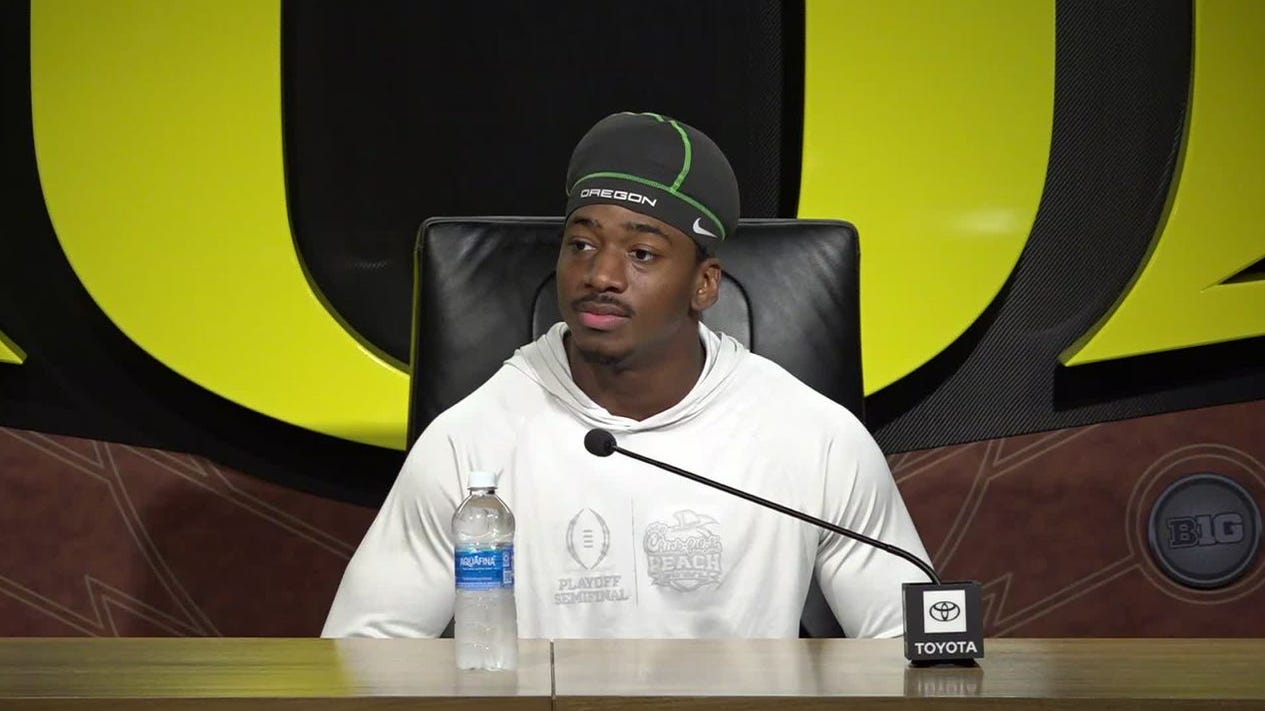
Something changed inside Oregon’s football program before the Ducks began winning again, and the players have now given that change a name. Operation Swaggerback.
It might sound like something invented in a locker room to lighten the mood during a difficult stretch of the season, but listening to Oregon’s players describe the last several weeks, there is a more significant story behind it. The Ducks have rediscovered some of the enjoyment that comes with playing football, and the return of that confidence has coincided with improved preparation, greater offensive efficiency and a renewed belief that the season still holds considerable possibilities.
The interesting part is when that change began. According to defensive lineman A’Mauri Washington, the difference became noticeable on the practice field before it showed up on Saturdays.
“I feel like after Illinois, it was like just a click. We called it Operation Swaggerback,” Washington said. “Whatever the offense did, I feel like they were just killing us for a little bit. I’m like, man, what are we doing? What are we doing? They was killing it. It started to translate into the game. I’m like, we got it, man. If we just keep going and just don’t let the standards slip, man.”
That perspective is particularly revealing because it comes from a defensive player who was experiencing Oregon’s improving offense from the opposite side of the practice field. The change was not simply something players recognized after wins over Northwestern and Ohio State. It was something that began emerging during the week, when offensive execution improved enough to create problems for a defense that had already established itself as one of the team’s strengths.
Quarterback Dylan Raiola offered another explanation for the change, describing an effort by Lanning and the coaching staff to make the daily process more enjoyable without sacrificing the attention to detail necessary to win.
“Just fun. Guys are smiling. Guys are having a blast playing the game we love,” Raiola said. “I think we kind of got lost in the monotony of football. It can get like that when you’re doing the same thing for a while. And Coach Lanning’s done a great job of kind of mixing some things up and kind of getting us different ways to kind of enjoy football, but also, you know, be focusing on our job assignments. So it’s a good mix we have right now, and hopefully keep it going.”
That balance between enjoyment and execution has become the central theme of Oregon’s preparation for Michigan. The Ducks are coming off their most impressive victory of the season, but the message from coaches and players throughout the week was that the improvement must continue.
The comments also provided a more detailed picture of how that progress is taking place, from Raiola’s film preparation to the development of young defensive players, the return of injured receivers and the adjustments required following the loss of Teitum Tuioti.
The Details Behind Raiola’s Development
Perhaps the most interesting revelation from Lanning’s Wednesday press conference involved the preparation that has helped Raiola become a more confident and efficient quarterback.
The numbers from Oregon’s last two games illustrate the improvement, but Lanning described something happening away from the field that may be considerably more important to the quarterback’s long-term development.
“I think he’s been a really good preparer throughout the season,” Lanning said. “But I did feel like I saw a difference when we’re watching one reel. It’s like our opportunity to play a game before the game in front of the offensive unit. Coaches will put a clip up there, and then they’ll talk about this call, this call, this call. And every time that happened last week, Dylan immediately is calling out the coverage before the ball’s even snapped, recognizing alignments. I think that’s really helped him.”
The exercise is particularly important because it provides insight into how Raiola is beginning to process defenses before the ball is snapped. Recognition of coverage structures, defensive alignments and potential pressure allows a quarterback to make decisions earlier, reducing the amount of time required to identify favorable opportunities after a play begins.
Lanning emphasized that the improvement does not mean Raiola has completed his development. In fact, the quarterback’s ability to recognize mistakes from otherwise productive performances has become another encouraging aspect of his preparation.
“All that said, he’s had that same prep and that same mindset this week, but he also looks back at that game and says, OK, here’s a really big growth moment. Here’s where I can really be better. So if he keeps sharpening his tools and continues to make himself better and continues to prepare like he’s prepared and then realize that he doesn’t have to make every play, let the guys out there that you have around you go make the plays and you just do your job, then he’s going to be able to operate at a really high level. His prep, I’ve really liked watching it and seeing how he does it. He’s really developing his process, and it’s growing.”
Raiola’s own comments reinforced that explanation, particularly when discussing the offensive line’s recent improvement in pass protection. Oregon has not surrendered a sack in either of its last two games, but the quarterback acknowledged that protection is not simply the responsibility of the five players in front of him.
“Just kind of knowing, I’ve done so much pocket work in practice and kind of feeling the spots in the pocket where I need to move to or get to,” Raiola said. “And also, my receivers do a good job of getting open. In that piece, they understand the install and where we want to get to. So, yeah, I feel like we’ve done a great job of working the pocket and kind of maneuvering around in the pocket when there’s push or pressure, and just being able to get the ball to my receivers in space.”
Lanning expanded on that concept, pointing out that sack prevention is the product of quarterback decisions, offensive line execution and offensive design working together.
“I’ve always thought the sack statistic is put on the O-line a little bit too much at times,” Lanning said. “I always feel like that’s a quarterback stat. It’s an O-line stat. It’s a scheme stat. I think we’ve been better schematically. I think our O-line’s improved, and I think our quarterback’s improved in those categories and the decisions you make, the timing of when the ball’s supposed to be out.”
The improvement has also created a growing level of confidence between Raiola and his offensive line. When asked whether he had rewarded his blockers for keeping him upright, the quarterback revealed a weekly tradition that has become part of their relationship.
“I haven’t bought them a steak dinner yet, but they get an extraordinary amount of cookies every week. I make them, or my girlfriend makes them cookies, so that’s cool,” Raiola said. “Those dudes, they strain. The bottom line is they strain, and they just honestly want to fight to keep me clean. I’m very grateful for that because sometimes it can get hard in the trenches and it’s just like, ah, I can let up this one play, but there’s no letup. They strain every single time and couldn’t be more proud of them. And I couldn’t be more confident with those guys in front of me.”
There is a meaningful difference between a quarterback becoming more comfortable because his protection has improved and an offense developing because the quarterback understands how to contribute to that protection. Oregon appears to be experiencing both, and the process Raiola described suggests the improvement has come through deliberate work rather than simply greater familiarity with his receivers.
A Different Kind of Confidence in the Receiver Room
The return of Jeremiah McClellan has provided another encouraging development for an Oregon offense that has experienced significant injuries throughout the season.
McClellan revealed Tuesday that his foot injury occurred during warmups before the Portland State game, when he pushed off during a routine release and immediately recognized something was wrong.
“Basically, what happened was I was just warming up and I just basically did a normal release,” McClellan said. “And as I released, I pushed off too hard and I just kind of felt the pop. I already broke my foot in high school before, so I knew the feeling of it and kind of what it was. I tried to put a metal plate in my shoe and tried to go back out there and tough it out and play, but I couldn’t do it. So I got an X-ray, it was broken.”
The injury forced him to watch from the sidelines while Oregon’s offense struggled through portions of the season. Rather than separating himself from the team’s preparation, McClellan attempted to become an additional resource for the younger receivers who were being asked to assume larger roles.
“I just knew I had to be the biggest cheerleader for my teammates, coach up the younger guys like Jalen Lott, Messiah Hampton, coach up them guys, give them little mini tips, help them see what I can see on the sideline and on the iPads and things like that,” McClellan said. “But just getting back out there with my guys, it feels amazing, man, just to get back out there on the field and actually be back out there with them.”
McClellan provided a more detailed explanation of how he approached that responsibility when asked about watching the offense struggle during his absence.
“I would say it was kind of tough, but the biggest thing for me was just kind of seeing what I see and trying to coach up the younger guys like Jalen Lott, tell them like, hey, you can do this a little better, or hey, you can run this like this, or the DB’s playing you like this, this release will work, things like that. So just trying to help out as much as I can on the sideline.”
His return also introduced an interesting connection with Raiola. Although the two had not played together at Oregon before Ohio State, their relationship began during the recruiting process.
“Me and Dylan, we’ve kind of had a connection going all the way back to high school,” McClellan said. “It was a camp in Atlanta, so we had a connection all the way since high school. So just actually being out there on the field with Dylan is amazing. He’s a great quarterback, gutsy quarterback. He’s a ballplayer, so just being out there with him is amazing.”
Raiola remembered that relationship as well, describing McClellan as someone whose personality has a meaningful impact on the offense.
“We were, you know, through the recruiting process, we were on a couple visits together,” Raiola said. “Through the recruiting, we just stayed in touch. And we obviously both went our separate ways, but we just stayed connected through it. J-Mac’s the type of guy that lights a room up with his smile, with his joy. He just brings such a passion of football to the game and to our huddle. So we’re very grateful for him, and we’re glad he’s back out there doing what he loves.”
The process of returning remains gradual. McClellan acknowledged that being cleared to play does not automatically mean he is ready to assume a full workload, particularly after undergoing surgery.
“It’s hard getting back, being able to play a game within six weeks after getting surgery and things like that,” McClellan said. “But I would say just getting back out there and trusting myself again.”
With McClellan returning and Oregon’s other receivers becoming available, Raiola believes the offense is developing a more complete collection of options.
“There’s a lot of options, a lot of guys to throw the ball to,” Raiola said. “It just gives us a little bit more of what we can do. And I also think those guys are very selfless players. Normally they’d want the ball thrown to them every single play, and they want all the attention. But they’re going to go block on the perimeter. They’re going to put their face in there in the run game, and then they’re going to make tough catches. And I think that’s what makes them a full wide receiver group. They can do everything that’s asked of them in this system.”
That willingness to contribute without the football has become an important part of Oregon’s offensive improvement. The Ducks have talented receivers capable of producing explosive plays, but their development as blockers and their understanding of individual responsibilities may be equally important against Michigan’s physical defense.
The Tight End Room Continues to Develop
Another important development involves freshman tight end Kendre Harrison, whose opportunities have increased with Andrew Olesh dealing with an injury.
Lanning said Wednesday that Olesh’s absence is not expected to be long-term, describing the injury as a blow to the head and expressing optimism about his return.
“I don’t think it’s long-term,” Lanning said. “He got knocked on the head, and we’ll see when we can get him back here. I’m certainly anticipating having him back soon.”
Harrison’s response to the additional opportunity has been encouraging, particularly in an area that does not always appear in traditional receiving statistics.
“I’m so proud of Kendre, because I think the tight end is one of those examples of a position that requires really a lot of different skill sets,” Lanning said. “You’ve got to be a route runner. But the reality is, even if you pass the ball 30 times a game, not all 30 of those are going to the tight end. What do you do the majority of the game? You’ve got to control the C area. You’ve got to be able to win on the edge, the perimeter, just like our edge defenders on the other side of the ball.”
Lanning emphasized that Harrison has always demonstrated a willingness to be physical, but his technique and execution as a blocker have become noticeably better during practice.
“That’s really stepped up, the willingness, the attack, the technique, because he’s always wanted to. He’s not afraid to bite. He’ll throw his head in there. But to do it at the level that he’s been doing it lately here in practice, I’m excited to see that continue to show up in a game. It’s just going to be honing in on that technique a little bit more, lowering my pad level, hands inside, hands, and continuing to push. But he’s really gotten better and better, and even though it doesn’t necessarily always show up on game day, he’s really improved in that area.”
Jamari Johnson also praised Harrison’s response to being called upon.
“Andrew was out for a little bit, and Kendre stepped in to dominate the role, and that’s what he did,” Johnson said. “They called his number. Once his number was called, he accepted his opportunity and rolled with it.”
The development matters because Oregon’s tight ends are being asked to contribute in several different ways. Against a Michigan defensive front capable of controlling conventional rushing lanes, the ability to block effectively on the edge while remaining a credible receiving threat could become especially valuable.
A Defense Adjusting to Life Without Tuioti
The emotional impact of Tuioti’s season-ending injury was evident throughout the week, particularly among teammates who have spent several seasons developing alongside him.
Washington described the news as particularly difficult because of their shared experience in the program.
“I definitely feel for him, though, man. It had me in tears, especially coming up with him all four years,” Washington said. “Seeing how it was for him, man. It happens, though, man. You never know when that time comes. It’s really unexplainable.”
Johnson expressed a similar reaction.
“It brought a tear to my eye, man, to see this guy working every day and just to see it taken away from him in the snap of a finger,” Johnson said. “It was emotional, and I’m praying for my guy.”
Lanning acknowledged that replacing Tuioti’s leadership will be every bit as difficult as replacing his production, but he believes the team understands the responsibility created by his absence.
“Every one of our players loves Tuioti, and he’s in the team meeting with us, watching some of the plays that he made this past Saturday and what the impact that has,” Lanning said. “Like I said, you don’t replace that. You don’t replace even the leadership standpoint, but I think those guys want to go out there and play really hard for him and respect the sacrifice that he’s made for this program and what he’s done for this program.”
Washington has already noticed a response among the defensive players who recognize the additional opportunities and responsibilities that come with Tuioti being unavailable.
“I feel like it was definitely some juice out there,” Washington said. “Dudes was knowing like, oh, 4-4 is down. So dudes was coming in with some enthusiasm, trying to come up and step up for the job, just coming in dialed in.”
One of the players expected to assume an increased role is Nasir Wyatt, whose development has been a consistent subject of discussion throughout the season. Lanning offered a detailed assessment of Wyatt’s progress Wednesday, emphasizing that his growth extends well beyond rushing the passer.
“Nas has grown as a player every single year he’s been here, every moment he’s been here. He’s gotten better and better and better,” Lanning said. “We’ve asked him to do so much. His position, it’s one of the more challenging positions to play because the amount of volume that they have and have to assimilate every single snap, and that’s really leveled up for him.”
Lanning continued by explaining that Wyatt has made noticeable progress in the responsibilities that receive less attention than sacks and pressures.
“Everybody sees that value he has as a pass rusher, but he’s grown as a player in every facet, including run, including coverage. He’s gotten a lot better, and there’s still room to improve, but he’s gotten a lot better there. And the things that Nas really attacks, he gets a lot better at.”
Those improvements will become particularly important against Michigan because Oregon may face an offense that looks somewhat different under its new coordinator. Wyatt’s ability to recognize blocking responsibilities, maintain gap integrity and contribute in coverage will matter alongside his ability to pressure the quarterback.
Young Defenders Are Becoming Important Contributors
Oregon’s ability to survive injuries has depended heavily on younger players accepting expanded responsibilities, and freshman defensive back Devin Jackson has become one of the more encouraging examples.
Lanning described Jackson as a player whose development has been driven by additional preparation and an increasingly sophisticated understanding of defensive communication.
“It just starts with getting extra,” Lanning said. “Devin’s a guy that’s always coming up to watch extra film, do more, has become really coachable, understands when his level of communication goes up, his level of play goes up, and realizing how quickly that can help him have success on the field. And then he has a lot of skill. He’s a talented player.”
Jackson explained that the veterans in Oregon’s secondary have helped him avoid mistakes by sharing the lessons they learned during their own development.
“Just coming in, looking around, seeing who everybody is, getting connected with everybody,” Jackson said. “And then just taking their mistakes and them giving me what they took from their mistakes and then bringing it to me so I won’t make those same mistakes. And me just being able to lean on those guys whenever I make mistakes, they can coach me up on it instead of going to the coaches and stuff like that.”
His interception against Ohio State provided a visible example of that development, particularly because of the concentration required to secure the football while keeping his feet inbounds.
“I just played it to my call. Coach made the right call. I believe that coach made the right call, so I just did my one-eleventh and made the play,” Jackson said. “My teammates was there for me. Everybody was happy, and it just felt unreal.”
The opportunity emerged after Aaron Flowers was injured, creating a situation where Jackson needed to develop more quickly than might ordinarily be expected of a freshman.
“Whenever Flowers went down, I just knew that I had to step up. I couldn’t be a freshman. I’m no longer a freshman. I got to be a veteran on the field,” Jackson said. “Aaron also helped me throughout his journey. Coming in January, he always was behind me, being able to walk me through things that I didn’t know and being able to pick me up when I didn’t know things. So I was thankful to have Aaron. I was thankful to be able to back him up whenever he went down.”
Jackson also described the influence of former Oregon defensive backs on his development. He grew up watching Jevon Holland and models portions of his game after Kam Chancellor, while Oregon staff member Verone McKinley helped make his interception at Ohio State particularly memorable.
“Verone, me and Verone talked after the pick. He congratulated me. We was all hyped, but he never told me that he made the pick in the same place,” Jackson said. “So when I heard that, that was crazy to me, and I went up to him about it and everything, and he said, yeah, and we just bonded over that.”
There is a broader story in Jackson’s emergence because Oregon has repeatedly turned to younger defenders throughout the season. The willingness of experienced players to help develop their replacements has become an important part of maintaining defensive continuity despite injuries.
Offord Believes Oregon Has the Nation’s Best Cornerback Room
Na’eem Offord did not attempt to disguise his confidence when discussing Oregon’s secondary Tuesday.
The freshman cornerback had additional motivation against Ohio State because of his recruiting history with the Buckeyes, but his assessment of Oregon’s defensive backs extended well beyond one performance.
“We’ve been training our butts off the whole offseason,” Offord said. “We already had came together and said this was going to be a year for us, a big, huge year. Coach preaches to us every day, the whole corner room. He wants us to be the best, everybody, not just us three, all of us. And I feel like, in my mind, we’re the best corner room in the country. If you really pay attention and watch film, it’ll tell. But I ain’t no cocky guy. I’m a humble guy.”
Offord’s confidence is supported by the improvement Oregon’s secondary has demonstrated throughout the season, but he also emphasized the preparation necessary to maintain that performance against Michigan.
The Wolverines have struggled offensively, but Offord cautioned against overlooking their receivers, particularly their ability to win contested catches.
“As we was watching film, they got a lot of good receivers,” Offord said. “Their receivers, they’re good on top of their routes. Like you said, they’re nice with contested catches. They make sure they do their job as well. They’re not a team you can just sit there and play around with. They are a good team.”
Offord also acknowledged that Michigan’s offensive coordinator change creates additional uncertainty, particularly because Oregon experienced a similar transition earlier this season.
“That’s actually a good question because we went through the same thing in that same week,” Offord said. “Our offense, they were very explosive at practice. So you just got to be very dialed in to detail. Don’t look ahead. Don’t look behind. You want to just look what’s ahead of you and what’s right now. Be present. Be in the moment. Just take everything serious at practice, because at this point, every rep counts.”
That observation connects directly to Washington’s description of Operation Swaggerback. Oregon’s defense witnessed the offensive improvement that followed its own coordinator change, giving the Ducks firsthand experience with how quickly a team can respond when its offensive approach or leadership changes.
Preparing for Michigan — and Potentially Difficult Weather
The Wolverines’ defense has been a central focus throughout the week, and Oregon’s players have consistently emphasized the physical challenge awaiting them.
Raiola described Michigan’s defensive front as one of the most impressive groups Oregon has studied this season.
“Absolutely. Elite front. Elite front,” Raiola said. “Immediately when you turn the tape on, that’s what jumps out at you. It’s a great challenge for us. Tremendous respect. They’re the winningest program in college football for a reason, and they have players there for a reason. So it’s going to be a great challenge for us. We’re going to keep preparing and getting ready to put our best foot forward and put our best résumé on the field on Saturday, because our résumé is our film.”
The preparation has also included consideration of potentially heavy rainfall at Autzen Stadium, a possibility Lanning addressed with an explanation of how Oregon attempts to simulate wet conditions during practice.
“We just pour a lot of water on the footballs,” Lanning said. “I was hoping for bad weather on Tuesday and Wednesday to where we got to kind of experience a little bit of that. But we just basically dump buckets of water on the football at practice and then make sure that your game plan protects ball-security options.”
Lanning acknowledged that simulating genuine game conditions can be difficult, particularly when heavy rain affects not only the football but also the field, equipment and communication.
“We’ve been in weird conditions before, so it’s nothing new,” Lanning said. “It’s hard to really recreate out there on the practice field. So the only thing we know to do is just have a lot of water bottles going around and spraying people with it.”
Raiola took a similar approach, emphasizing fundamentals rather than treating the possibility of rain as a reason to dramatically change the offense.
“You can do all the drills. You can do all the stuff. But at the end of the day, it’s fundamentals and technique,” Raiola said. “If you plan on the ball being wet, you can kind of mentally prepare for that. Honestly, I haven’t really looked at the weather too much because I just don’t know how you can predict the weather that far ahead. But if it rains, it rains, we’ll be prepared. If it doesn’t rain, then it’ll be a beautiful day. And regardless, we’ll be ready to play.”
The preparation becomes particularly important against Michigan because the Wolverines’ defensive front has been exceptionally effective at creating negative plays. Wet conditions could increase the importance of ball security and field position, particularly if both offenses struggle to generate consistent rushing production.
For Oregon, the priority remains executing the offensive concepts already installed while ensuring weather does not create unnecessary turnovers or protection problems.
The Locker Room Has Chosen Its Direction
Perhaps the most consistent theme from the week’s interviews was the refusal to allow Oregon’s earlier losses to determine the direction of the rest of the season.
Johnson described the team’s response as a deliberate decision rather than something that happened simply because the offense began playing better.
“It happened because we chose to make that decision,” Johnson said. “We chose this season. It hasn’t been going our way, and we decided to flip things around and to just bring as much problems as we could to other teams that we got coming up.”
Washington approached the same question from the perspective of a veteran who understands how limited a college football career can be.
“How bad do you really want it, though, man?” Washington said. “Do you want to just give up when it’s easy? If somebody just gave you the white flag or the bell to just ring it, do you want to ring it? I feel like that’s what it comes down to. I don’t think nobody here made that decision to just do that.”
Lanning offered a more philosophical explanation Wednesday, describing the importance of helping players recognize the value of the opportunities available to them.
“In football, you have so many limited opportunities,” Lanning said. “You’re just trying to paint the picture for guys so that, I know my body couldn’t, but man, it would be fun to go play football right now. When you start to recognize that those opportunities are really limited and you have a chance to take advantage of opportunities that are in front of you, it’s like, what do you want that to look like?”
He continued by referencing a lesson from Nick Saban about the choices players make in their daily development.
“I think it’s that illusion of choice that Coach Saban used to talk about, of I can either grow and get better and add value or I won’t. I can’t. And it feels like a choice, but it’s really not a choice. I think what’s happened within our team is a lot of guys making the choice of, hey, let’s not worry about the outcome. Let’s focus on adding value and getting better and taking advantage of the limited opportunities you have when it comes to football.”
The emphasis on controlling what is immediately available has also shaped how Oregon’s players are approaching the postseason conversation.
Raiola acknowledged that the Ducks understand the national discussion surrounding their playoff possibilities, but said the team’s focus remains on Michigan.
“Obviously you hear about it, you see about it,” Raiola said. “It’s cool, but we also don’t control our own destiny right now, so it doesn’t really mean a whole lot. To be honest, we just got to keep controlling what we can. And all we can control is getting ready and preparing for Michigan. It’s a great challenge. It’s a great football team. Their record shouldn’t say anything about the kind of team they are because they got the players. They got a team. So we got to be ready to play on Saturday.”
Lanning was more willing to acknowledge what Oregon’s recent performances might mean for the team’s national standing, although he returned to the same emphasis on the work immediately ahead.
“I talked to our team about closing the gap,” Lanning said. “We showed that we’re capable of being one of the best teams in the country. And I’m certain that people wouldn’t want us in there, especially if we start to click. And we had to overcome a lot of adversity early in the season. I think we’ve kind of figured out a little bit who we are. Let’s see if that’s true when we come out here and play Saturday, because that’s what we control, is what’s right in front of us right now on the field with the next opportunity.”
The final point may be the most important observation from this week’s interviews. Oregon’s players are not describing a team that has suddenly discovered a new collection of plays or an entirely different football philosophy. They are describing a program that has become more comfortable trusting the responsibilities already established within its system.
The offense is executing more consistently, Raiola is recognizing defensive structures earlier and the offensive line is developing confidence through continuity. The receiver room is becoming healthier, younger players are gaining experience and the defense is attempting to maintain its standards despite losing an important leader.
Those developments do not guarantee that Oregon will continue winning. Michigan presents a significant challenge, particularly along its defensive front, and the Ducks still have areas that require improvement.
But there is a difference between a team searching for evidence that it can succeed and one beginning to recognize why its success has returned.
Oregon appears to be moving toward the latter.
And perhaps the most revealing part of Operation Swaggerback is that the name emerged from the practice field, where teammates began noticing the change before anyone outside the program had reason to believe it was coming.
The Ducks are smiling again, but the work behind those smiles is what matters most.
Reporting note: This week’s practice report is based on Monday and Wednesday comments from Dan Lanning and interviews with Jamari Johnson, Jeremiah McClellan, Na’eem Offord, A’Mauri Washington, Dylan Raiola and Devin Jackson. The interviews provide insight into practice and preparation; they do not represent independent observations of practices unavailable to the media. Quotations have been lightly cleaned for transcription clarity while preserving the speakers’ wording and meaning.