


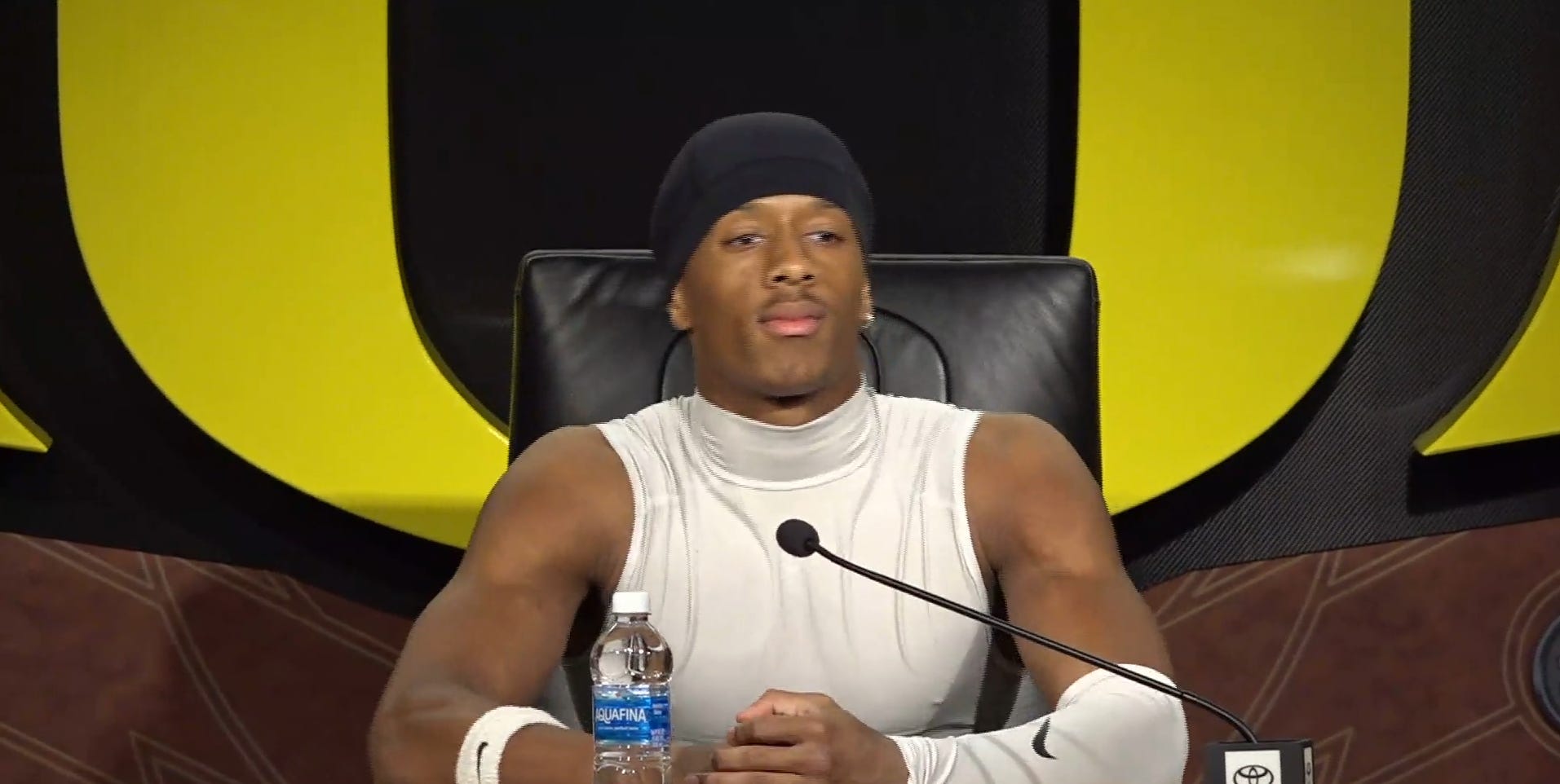
There was a different kind of energy surrounding Oregon’s practices this week, although perhaps the most revealing development had little to do with how loudly the Ducks celebrated a successful play or how enthusiastically they approached another competitive period. With a new offensive play-caller, the realization that Dante Moore will not return this season and a disappointing loss to Illinois still fresh in their minds, Oregon’s players have been asked to confront the uncomfortable reality that the approach they have followed through seven games has not produced the results they expected.
By Wednesday afternoon, there were indications that something had changed. The offense won a competitive seven-shots period after struggling in that situation during recent practices, players described a renewed sense of focus and several veterans suggested that the team had begun rediscovering some of the intensity that had been missing. Yet Lanning was careful not to mistake a productive afternoon for evidence that Oregon’s larger problems had suddenly disappeared.
“I thought today there was some real positive,” Lanning said Wednesday. “We attacked, you know, talked to the team about really you don’t control outcomes, but you do control how you can influence outcomes, right, and our decisions and what we attack.”
He continued by explaining that the Ducks had emphasized individual responsibility throughout the week, with players concentrating on the assignments and decisions that remain within their control.
“I thought the energy was there on the field today,” Lanning said. “Guys really focusing on their job, what they need to attack. There were some good competitive periods, so really a positive day today.”
For an Oregon team preparing to face No. 20 Northwestern, the challenge is translating that response into something meaningful Saturday. The Wildcats arrive with a 6-1 record, an efficient offense directed by Chip Kelly and a defense that has consistently forced opponents to earn their scoring opportunities. Oregon will need more than an emotional response to its recent struggles, and the players who spoke this week appeared to understand that distinction.
Practice Focus: Execution Before Emotion
One of the more revealing comments of the week came from defensive back Brandon Finney Jr., who was asked Wednesday to describe the atmosphere surrounding Oregon’s practices following the Illinois loss and the offensive coaching change.
“Intent. Intent is a word that I would use,” Finney said. “Not too much like over getting hype. It’s just like how can we execute? Juice is good, but juice and you run in the wrong direction, that’s not going to do anything. How can you execute? That’s what we’re focusing on right now.”
It was an interesting observation because it addressed something that has repeatedly surfaced during Oregon’s difficult season. The Ducks have not necessarily lacked effort or enthusiasm, but they have struggled to translate those qualities into consistent execution. At times, particularly when the offense has failed to sustain drives or the defense has surrendered an explosive play, the team’s response has appeared to deteriorate along with its performance.
Lanning acknowledged Wednesday that managing those moments remains a problem, even as he expressed encouragement about the overall direction of practice.
“I think we’re still a team at times that we just don’t handle adversity well,” Lanning said. “When it’s good, there’s a level of energy and effort. And when it’s not good, right, it almost looks like your dog died, right? And you just can’t operate that way in our profession and the job that we do. You got to bring in every single play.”
The issue was significant enough that Lanning stopped practice at certain points to address how players were responding to unsuccessful repetitions.
“Today there were some moments that was really good,” he explained. “And then there were some moments where it’s like, hey, wait, let’s pause practice right now. Let’s identify exactly where we’re at, right? Let’s talk about what we said our reaction is going to be.”
That willingness to interrupt practice and address the response rather than merely correcting the assignment speaks to an emphasis that extends beyond Saturday’s game plan. Oregon is attempting to rebuild habits that have not consistently held up under pressure, particularly when an unsuccessful play threatens to influence the next opportunity.
Finney described a similar mindset when discussing the team’s response to its disappointing record.
“If we’re going to sit back and cry about it, we’ll lose the rest of our games,” he said. “And so it’s just like, we get back to what can we do to get better and not really power about it.”
Offensive players echoed that sense of urgency. Tight end Jamari Johnson pointed to Wednesday as a particularly encouraging practice, suggesting that the emotional response to recent events had begun giving way to more productive work.
“Today I felt like was that was like the switch today was a, was a great practice,” Johnson said. “And I felt like we just, we on that, on that way to really up just to get us going.”
The descriptions were encouraging, although they should be understood within the limits of what a practice report can establish. Players and coaches described improvement, but the more important evidence will come when the Ducks encounter resistance Saturday and must demonstrate that their preparation has changed the way they perform.
The Offense: Jay Johnson Takes the Lead
The most significant operational change this week involved Jay Johnson assuming responsibility for Oregon’s offensive play-calling following Drew Mehringer’s dismissal. Lanning has described the arrangement as collaborative, with Johnson directing the offensive staff’s efforts while bringing a different perspective to an operation that has struggled to establish consistency.
For the players, the transition has been relatively straightforward in terms of terminology and the underlying offensive system. Jamari Johnson indicated that the changes have been more focused on details than a complete restructuring of what Oregon has been doing.
“It’s not challenging for real,” Johnson said when asked about the adjustment. “Everything is pretty much the same. It’s just some things inside the offense, like some details and stuff change like that. But it’s pretty much the same thing. Just making some tweaks.”
Running back Jordon Davison described Johnson as a direct communicator and expressed optimism about his experience as an offensive coach.
“He’s pretty straight to the point. He’s a great guy,” Davison said. “So his history is great. His track record is great. I’m excited to see what he does with the offense.”
The most tangible indication of progress came during Wednesday’s seven-shots period, a competitive situational drill that places the offense and defense in scoring opportunities near the goal line. According to Lanning, the offense had experienced difficulty winning that period in recent practices but reversed the trend Wednesday.
“We do a period called seven shots on like a day like today, and our offense hasn’t had as much success there the last few,” Lanning said. “Today they did. They went and won that period.”
Lanning viewed the result as evidence of improved execution rather than proof that the offensive problems had been solved.
“Nice competitive period, but that’s just like a small glimpse of, okay, let’s take advantage of what we can do and do it at a high level, make sure guys are doing the assignment that they’re responsible for,” he said. “As coaches, you’re responsible for guys’ execution. The execution in that period today was a good reflection of where they’ve grown a little bit. Just today. That’s just today.”
That final qualification is important. Oregon has produced isolated periods of offensive success throughout the season, including productive opening possessions and moments when the running game appeared to find rhythm. The problem has been sustaining those performances, particularly once opponents begin adjusting or the offense encounters an unfavorable situation.
Dakorien Moore offered an interesting perspective on the changes, acknowledging that he was surprised by Mehringer’s departure while maintaining that the players understand the need to improve.
“I was kind of surprised, being that we felt like he was a good OC,” Moore said. “He was a good contributor to this team. So very surprising, but it’s a next-man-up mentality.”
Moore also outlined what he hopes will emerge from the transition.
“I really have no expectations except for... I mean, having a better offense now because, I mean, every decision is not to go backwards,” he said. “You know, everything we do is to move forward. So with the new change that we got, we’re expected to get new plays in and get more yards, get more touchdowns, and get more wins.”
The comments reflect a team still processing the human consequences of losing a coach while recognizing that the offense must become more productive. Jamari Johnson acknowledged that Mehringer’s departure was emotional, particularly for players who had developed close relationships with him during recruiting and throughout their time in Eugene.
“Coach Merringer was my dog, man,” Johnson said. “And to hear that news also almost brought a tear to my eye. That was my coach coming in. From seeing him every day to seeing him not at all, it’s a little tough.”
Yet Johnson also described a noticeable sense of urgency from the new offensive leadership.
“But Coach Jake coming in with his hair on fire, man, ready to go,” he said. “So I’m excited.”
For Oregon, the task now is finding enough immediate improvement to take advantage of the remaining schedule. The players do not appear to expect an entirely new offense, but they are looking for a more productive version of the one they already know.
The Running Game: An Improving Offensive Line and a Simple Message
One area where Oregon believes it has developed momentum is along the offensive line, particularly after more productive rushing performances during the fourth quarter against Nebraska and throughout the Illinois game.
Davison expressed confidence that the offensive front has begun developing the cohesion that was missing during earlier portions of the season.
“Yes, sir. I feel like our O-line is starting to gel and we starting to click,” Davison said. “They’re starting to get going, and we excited.”
The running back’s assessment was supported by observations from the defensive side of practice. Defensive lineman D’Antre Robinson, who has worked against Oregon’s offensive front throughout the season, suggested that the line has become more effective at recognizing defensive movement and communicating its responsibilities.
“Yeah, definitely. I feel like they’re picking up on games pretty good now,” Robinson said. “I feel like Poncho, he’s a great leader for the whole team. So I feel like the whole line go to like travel towards him when he’s speaking and stuff like that.”
Robinson also pointed to the reciprocal benefit of the improvement, explaining that stronger competition from the offensive line has helped develop the defensive front.
“So I feel like them in the run game has been very good for us as a D-line as well,” he said. “I feel like we’re getting better as well.”
Those observations align with Lanning’s comments earlier in the week about finding more effective interior offensive line combinations. The Ducks have shown improvement running the football, and the next challenge is maintaining that production against a Northwestern linebacker group that has been particularly aggressive attacking downhill.
Davison understands the physical demands of the matchup.
“They’re a very physical unit, and I feel like they play aggressive,” he said. “We just got to come with our helmets strapped up and be ready to punish them too.”
The larger emphasis from Oregon’s running backs has been finishing plays, an area that Davison identified repeatedly when asked about the offense’s priorities.
“Finish. Like finish blocks, it’s a couple plays where it’s like if we get that one block, it’s a big play or a touchdown even,” Davison explained. “So it’s just our main goal is to finish plays and dominate plays.”
When asked what he wanted the offense’s identity to become over the remaining five games, his answer remained consistent.
“Finishing, like punishing defenses and finishing blocks, finishing runs, and finishing in the end zone.”
It is a relatively simple message, but one that addresses several of Oregon’s most persistent problems. The Ducks have frequently been close to generating explosive plays without finishing the blocks necessary to create them, and they have moved the football into scoring territory without consistently converting those opportunities into touchdowns.
The emphasis on finishing is therefore about considerably more than physicality. It is about eliminating the small failures that have repeatedly turned promising possessions into missed opportunities.
Quarterback Development: Competition Remains Part of the Plan
The confirmation that Dante Moore is not expected to return this season has changed the immediate outlook for Oregon’s quarterback room. Lanning made clear Monday that the decision is medical rather than a matter of Moore choosing not to play, emphasizing that the quarterback remains involved with the team and continues to contribute during controlled practice activities.
For his teammates, the news carried an emotional weight that extended beyond its football implications.
Dakorien Moore spoke about the personal connection he developed with the quarterback shortly after arriving at Oregon.
“He was the first guy to even speak to me when I first got here,” Moore said. “We got the same last name to give us even more connection. So just that bond that we have in general, I feel for him. It was very heartbreaking to hear.”
Davison likewise emphasized the team’s support for Moore, explaining that the players understand the medical circumstances surrounding his absence.
“We all kind of like gathered behind him and supported his decision,” Davison said, before clarifying, “It’s kind of like, yeah, like medical advising. You know what I’m saying? We all support him, and we all care for him and love him.”
Although Davison used the word decision, Lanning has emphasized that Moore’s return is not a matter of personal choice. The quarterback has been able to participate in practice under controlled conditions, but the coaching staff does not have authority to determine when he can safely return to game competition.
Robinson described Moore as continuing to provide leadership despite being unable to play.
“He’s with us. He’s been a good leader. He’s being vocal still. He’s helping us a lot,” Robinson said. “And I feel like just having him around is just going to make us go harder because we’re doing it for him.”
The absence leaves Oregon evaluating its remaining options, with Lanning emphasizing that consistency and ball security must become priorities for everyone competing at the position.
Akili Smith Jr. remains part of that discussion. Lanning acknowledged Monday that the young quarterback has demonstrated improvement in practice, particularly with his arm strength and mobility, although he still needs to develop greater consistency before earning a larger role.
Moore has also noticed that development.
“Of course, he got like a big cannon of an arm. So he going to make them bomb plays,” Moore said when asked about Smith. “He going to use his legs when he has to. He going to make the reads. You know, I think he’s getting more confident.”
The receiver believes the growing confidence has been particularly important.
“Once you get more confidence, you know what you want to do. And it’s like at that point you can take over. And I’ve been seeing him do that.”
Those observations do not establish that Oregon intends to change starters or expand Smith’s role Saturday. They do, however, suggest that the quarterback competition remains active during practice, particularly as Johnson evaluates how to create a more effective offensive operation.
For now, the Ducks are attempting to improve the conditions surrounding whichever quarterback takes the field. Better protection, more consistent rushing production and clearer offensive sequencing would help reduce the burden on a position that has been asked to overcome too many difficult situations.
Defensive Preparation: The Challenge of Chip Kelly’s Offense
Oregon’s defensive preparation has been unusually demanding this week because of Northwestern’s offensive versatility. Lanning described the Wildcats as presenting something resembling three different offenses, and the players have echoed that assessment while explaining the need for greater concentration during practice.
Robinson said the variety of Northwestern’s concepts has required the defense to maintain a particularly high level of attention.
“I feel like we’ve got to be more focused than ever because, like you said, there’s a lot of different stuff that you’ve got to prepare for,” Robinson said. “I feel like during practice, the whole team has been very locked in on plays and stuff like that, trick plays and all these bunches and all the stuff that we’re going to see.”
Finney offered a more detailed explanation of the challenges created by Kelly’s system, noting that Northwestern can shift between option concepts, vertical passing opportunities and unconventional offensive looks.
“This team is very, obviously Chip Kelly, really good OC, but they do a lot of stuff,” Finney said. “They do a triple option offense. They do a lot of shots. They’ll get up past the ball, do a CFL type of offense, but it’s just at the end of the day, they can do anything.”
For Finney, the response must remain grounded in the assignments provided by defensive coordinator Chris Hampton.
“How can we line up and do our job and execute the calls that Coach Hamp presents us?”
Lanning devoted considerable attention Wednesday to explaining why quarterback Aidan Chiles creates problems that cannot necessarily be solved by assigning a defender to spy on him. Northwestern’s ability to move the pocket, incorporate play-action and threaten the perimeter means that dedicating a player exclusively to the quarterback can create weaknesses elsewhere.
“When you dedicate a person to do that as a spy in the middle of the field, then you probably just removed an edge,” Lanning explained. “If you remove an edge with a team that nakeds and patrol passes and moves the pocket as much as they do, now the guy that you’re spying from the middle of the field has to go run to the right or run to the left to get him pulled up.”
The challenge becomes even more complicated because Chiles has demonstrated the ability to punish defenses through the passing game when additional pressure creates favorable matchups.
“Do you just pressure?” Lanning asked. “But he has proven with his arm that he can take advantage of that too. So I think you have to have a lot of those answers on your call sheet and a lot of ways to be able to do that.”
The Ducks must therefore balance disciplined quarterback containment with the need to pressure Chiles and prevent Northwestern’s running game from establishing a consistent rhythm.
Lanning pointed to Teitum Tuioti as an example of the relentless effort required to make that approach effective, recalling a recent sack that developed despite the edge defender encountering multiple blockers.
“He got chipped last game. Then he’s getting blocked by the tackle, and then he creates a sack,” Lanning said. “And it’s like that wasn’t necessarily technique. That was effort. So there’s going to be some effort plays that have to show up in this game to be able to control QB like Aiden.”
The secondary faces its own challenges, particularly against Northwestern receiver Griffin Wilde and the Wildcats’ ability to use different personnel combinations to create favorable matchups. Finney identified Wilde as a significant threat, while also pointing to the versatility of Northwestern’s slot personnel.
“17, a really good receiver. We played him last year,” Finney said. “19 in the slot, a very diversity gadget type of guy.”
For Oregon, the emphasis has been on executing assignments rather than attempting to anticipate every possible wrinkle Kelly might introduce. The Wildcats possess enough offensive variety that the Ducks cannot reasonably expect to eliminate every challenge before kickoff, making communication and disciplined responses especially important.
Personnel and Availability: More Changes Along the Defensive Front
Oregon received additional clarity Wednesday regarding several players who have been dealing with injuries, including two whose seasons have been interrupted by surgical procedures.
Lanning confirmed that Matt and Dave, referenced by first name during the availability discussion, have undergone or are scheduled for surgery and will remain unavailable. The coach explained that one had continued attempting to work through an injury and had dressed for the previous game, but ultimately could not perform.
“Matt is having surgery. He’s going to be down for us, right? Same for Dave now,” Lanning said. “You know, he’s been fighting through it, battling through it. Thought he might have some availability last week and was dressed for the game. He’s been, you know, really tough. But the reality is he just wasn’t able to perform, so he had surgery as well.”
There was more encouraging news regarding Manny Iheanacho, who has returned to practice and could become available before the end of the week.
“Manny is back practicing with us,” Lanning said. “We feel like we could have him back by the end of this week.”
The potential return would provide additional depth for an offensive line that has been working through different personnel combinations while attempting to establish more consistent protection and rushing production.
Lanning also provided a brief update Monday on Na’Eem Offord, who saw limited action during the second half against Illinois. The coach indicated that Offord was dealing with a minor physical issue but expected him to be fine.
The injury situation remains important because of the number of younger players who have been forced into significant roles. Lanning noted that approximately 45 percent of Oregon’s snaps against Illinois came from first- or second-year players, creating opportunities for development while also exposing the team to the natural difficulties associated with limited experience.
The final availability report will provide a clearer indication of which players Oregon can use against Northwestern, but the Ducks have spent this week continuing to prepare with an expectation that depth and flexibility will remain necessary.
Player Development: D’Antre Robinson and the Value of Preparation
One of the more encouraging individual developments has come from Robinson, who delivered one of his better performances of the season against Illinois and attributed that progress to the quality of his preparation.
“I feel like my time here has become like very good for me,” Robinson said. “I feel like I’ve got smarter during football. I feel like my play has been better in practice.”
He credited a productive practice week with helping him perform more effectively Saturday.
“I feel like a good week of practice can bring you a good week in a game,” Robinson explained. “That’s what it did. I feel like I had a pretty good week of practice and I just got to continue to have good weeks of practice.”
Robinson’s role has also required an adjustment from the heavier snap counts he experienced earlier in his collegiate career. Rather than allowing fewer opportunities to influence his preparation, he has emphasized remaining ready when his number is called.
“I have no control over that,” he said. “So I just got to control what I can control and just keep going every day in practice and just keep my head up. And when my number is called, I just got to go perform.”
It is a relatively straightforward approach, but one that reflects what Lanning has been asking from the entire team. Oregon’s ability to improve over the remaining five games will depend partly on players accepting their responsibilities, preparing consistently and making the most of opportunities that may not always be predictable.
For Robinson, the improvement has extended beyond his individual performance. He believes his relationship with the coaching staff and teammates has strengthened throughout the season, even if the results have not matched his original expectations.
“My connection with the team has got better with the coaches and everything,” he said. “And Coach Landon, he’s a great person. Coach T, they’re great. And they got me better. And they taught me a lot of things.”
The emphasis on preparation has become particularly meaningful for a defense that will need contributions from multiple players against Northwestern’s versatile offense.
Leadership, Accountability and the Response to Adversity
Beyond the specific football adjustments, Oregon’s players spent much of the week discussing accountability, preparation and the importance of responding more effectively when circumstances become difficult.
Jamari Johnson acknowledged that complacency had become a concern, particularly after Oregon allowed opportunities to slip away against Illinois.
“Just knowing that, like, it could be taken away at any moment,” Johnson said. “And as we saw last game, it’s like we can’t leave any plays out there on the field. So moving forward from here on out, we just got to can’t get complacent and just keep trending up.”
Finney offered a particularly revealing perspective when reflecting on the touchdown reception he surrendered against Illinois. Despite appearing to be in favorable coverage position, Finney watched the opposing receiver complete the play, illustrating how a defender can execute much of his responsibility correctly and still experience an unfavorable result.
“I feel like moments like that can either move you up or break you down,” Finney said. “I’m not going to be the person that I’m going to let it break me down.”
He described the experience as an opportunity to develop the emotional resilience required to play defensive back, where the difference between a successful play and an unsuccessful one can be remarkably small.
“Really you can do something really good in life and still lose,” Finney said. “And I feel like that’s something you can learn in life, not just on the football field.”
It was an observation that fit neatly within Lanning’s broader message. Oregon cannot control every result, nor can it guarantee that proper preparation will prevent an opponent from making an exceptional play. What it can control is how its players respond afterward.
That distinction has become especially important for a team that has struggled to maintain emotional consistency when games begin moving in the wrong direction.
Lanning acknowledged Wednesday that the coaching staff must demonstrate the same confidence it expects from the players, particularly when making aggressive decisions during games.
“I’ve got to show our team that I’ve got confidence in what we’re going to do,” Lanning said. “That means I’ve got to be really satisfied with the plan, right, as we go in.”
He also made clear that the difficult season cannot become a reason for Oregon to abandon the competitive approach that has helped establish the program’s identity.
“But I can’t play scared, right?” Lanning said. “We’ve got to be true to who we are, right?”
The coach specifically referenced fourth-and-short situations, acknowledging that Oregon has sometimes become more conservative than it would have been during previous seasons. While he emphasized that aggression must be supported by preparation and sound decision-making, he does not want the Ducks allowing fear of failure to determine their approach.
“We’re not going to go live in fear and not be who we are because we’re worried about what somebody will say after the game,” Lanning said.
For a team attempting to rebuild confidence, that message carries significance. Oregon’s players must believe that their preparation gives them an opportunity to succeed, while the coaching staff must demonstrate the willingness to trust that preparation when difficult decisions arise.
The Practice Report Takeaway: A Good Wednesday Is a Beginning
The most encouraging development from Oregon’s practice week was not necessarily the offense winning seven shots, the reported improvement along the offensive line or the enthusiasm surrounding Jay Johnson’s first week directing the offense. Those are meaningful details, but they become important only if they represent something more sustainable than an isolated period of successful execution.
The more revealing development was the consistency of the message coming from different parts of the roster.
Davison talked about finishing blocks and runs. Robinson emphasized preparation and assignment discipline. Moore discussed restoring the offensive identity that has produced success in previous seasons. Finney stressed the importance of execution over emotion, while Jamari Johnson described a renewed focus on eliminating complacency and taking advantage of every opportunity.
Lanning’s assessment was similarly grounded. He acknowledged the positive developments while openly discussing the moments when the team’s response to adversity still fell short of what he expects.
“I think there’s been a spark, a focus there,” Lanning said. “We’ll see what that translates like to Saturday. There’s no guarantees.”
That qualification may be the most important observation from the entire week.
The Ducks have experienced moments of improvement before, including stretches during games when their offense appeared capable of finding a rhythm and their defense demonstrated the physicality and discipline that have defined the program under Lanning. The problem has not been an absence of those moments, but an inability to sustain them long enough to produce consistent results.
Northwestern will provide a particularly demanding test of whether that pattern has begun to change. Kelly’s offense will challenge Oregon’s defensive communication and assignment discipline, while the Wildcats’ experienced defense will test the Ducks’ ability to establish offensive rhythm without relying on explosive plays or favorable circumstances.
There is reason to believe Oregon has made some progress during the week, particularly with its offensive execution and the manner in which players have responded to the coaching transition. But the more difficult work involves demonstrating that those improvements can survive the frustration of a failed possession, the disappointment of an opponent’s big play or the pressure of another closely contested game.
Wednesday offered evidence that the Ducks understand what needs to change.
Saturday will reveal whether they have learned how to make those changes last.