


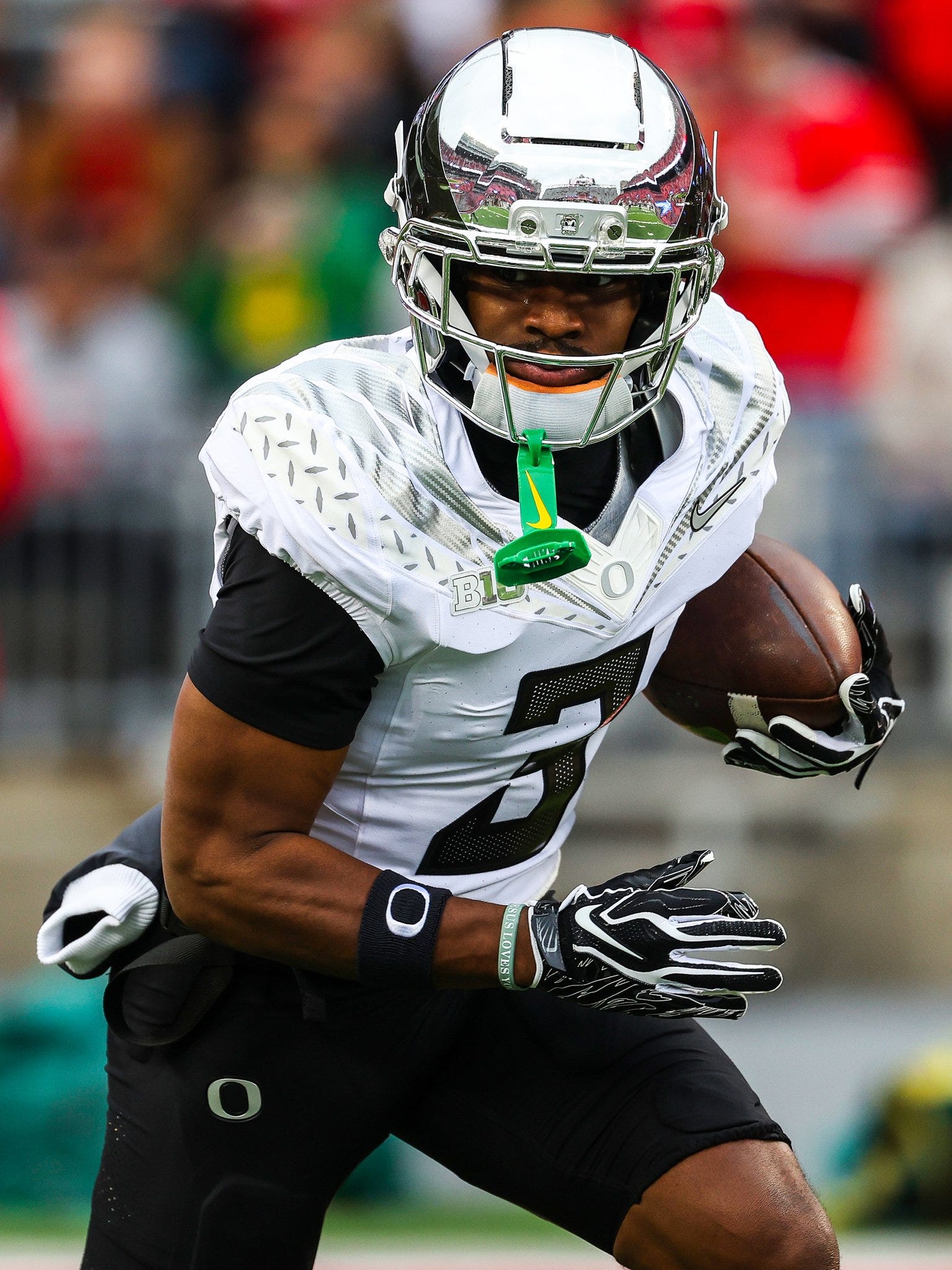
COLUMBUS, Ohio — Somewhere between the disappointment of October and the uncertainty that accompanied Oregon into Ohio Stadium on Saturday afternoon, the Ducks rediscovered something that had seemed lost for much of this season. It was more than confidence, more than offensive creativity and certainly more than the hope that a talented football team might eventually find a way to live up to its considerable expectations.
It was the realization that the team everyone believed Oregon could be in August might still exist in November.
For much of the season, the Ducks had looked like a collection of extraordinary individual talents struggling to become a complete football team. Against Ohio State, however, those individual pieces finally came together in a way that transformed a potentially disastrous afternoon into one of the most remarkable performances of Dan Lanning’s tenure.
Oregon overcame a 14-point first-quarter deficit, scored 38 consecutive points and overwhelmed the Buckeyes for nearly three quarters before leaving the Horseshoe with a stunning 41-28 victory. In doing so, the Ducks demonstrated something far more significant than their ability to survive another difficult game. They showed they were capable of dominating one of college football’s most talented programs on its home field.
The victory was not simply an upset, nor was it the product of a handful of fortunate plays. Oregon controlled the line of scrimmage defensively, made critical adjustments against Ohio State’s explosive offense and found a level of creativity and execution that had been conspicuously absent during its frustrating start to the season.
Perhaps most importantly, the Ducks did it after everything seemed to be going wrong.
Ohio State opened the afternoon by marching 75 yards in 11 plays, with Bo Jackson finishing the possession on a 16-yard touchdown run. The Buckeyes needed only four plays to travel 82 yards on their next scoring possession, as Jackson broke multiple tackles on an 8-yard run that gave Ohio State a 14-0 lead with 1:20 remaining in the opening quarter.
At that point, the familiar concerns surrounding Oregon’s season appeared justified. The defense had surrendered 174 yards in the opening quarter, the running game was struggling to generate consistent yardage and freshman quarterback Dylan Raiola was facing one of the nation’s most formidable defenses in one of college football’s most intimidating environments.
But what happened next was the kind of response that changes the character of a football team.
One Gamble Changes Everything
There will be plenty of attention directed toward Oregon’s offensive production, particularly the 38 unanswered points that turned a two-touchdown deficit into a commanding fourth-quarter advantage. Yet the defining moment of Saturday’s victory did not come on a conventional offensive play.
It came from two defensive players on fourth down.
Trailing 14-3 with just over two minutes remaining in the first half, Oregon faced fourth-and-9 from its own 31-yard line. The Ducks had just endured another disappointing offensive possession, and Ohio State appeared positioned to regain possession with an opportunity to extend its lead before halftime.
Instead, Lanning reached into his playbook and delivered the gamble that changed the afternoon.
On a perfectly executed fake punt, Teitum Tuioti threw a 30-yard completion to fellow defensive standout Matayo Uiagalelei, moving Oregon to the Ohio State 39-yard line. The play was audacious considering the field position, the opponent and the consequences had it failed. But it also represented the kind of aggressive confidence that had become a defining characteristic of Oregon’s rise under Lanning.
The effect was immediate.
Raiola connected with Jamari Johnson for 15 yards before finding Dierre Hill Jr. for 20 yards on third-and-15, a critical conversion that kept the possession alive. Hill finished the drive with a 9-yard touchdown run, bringing Oregon within 14-10 with 1:25 remaining in the half.
The momentum shift was unmistakable, but the Ducks were not finished.
On Ohio State’s ensuing possession, defensive back Devin Jackson intercepted a deep throw from Luke Fahey near the Oregon sideline. The play was initially ruled incomplete before replay confirmed Jackson had established possession inbounds, giving the Ducks another opportunity with 1:06 remaining.
Raiola took advantage.
A 31-yard screen pass to Brandon Smith moved Oregon into scoring position, and a beautifully layered 19-yard completion to Evan Stewart advanced the ball to the Ohio State 10. After a defensive holding penalty extended the possession, Oregon appeared to take the lead on a touchdown pass to Dakorien Moore, only for replay to overturn the score when Moore failed to maintain control of the football.
With two seconds remaining, Lanning again refused to settle for the conventional decision.
Rather than attempt a field goal to cut the deficit to one point, Oregon used a swinging-gate formation and a direct snap to Jamari Johnson, who powered into the end zone for a 2-yard touchdown as time expired.
A team that had looked overwhelmed in the opening quarter suddenly walked into the locker room leading 17-14, having scored 17 unanswered points and positioned itself to receive the second-half kickoff.
The fake punt had changed the momentum. What Oregon did afterward changed the game.
A Defensive Transformation
For all the offensive creativity that followed, Oregon’s defensive performance deserves equal consideration as the most encouraging development of the afternoon.
Ohio State’s first two touchdown drives covered 157 yards on just 15 plays. Jeremiah Smith was finding opportunities against Oregon’s secondary, Fahey was extending plays with his legs and Jackson appeared capable of exploiting the perimeter whenever the Buckeyes needed a critical gain.
But defensive coordinator Chris Hampton and his players made the necessary adjustments, and the result was a remarkable reversal.
After allowing 174 yards in the opening quarter, Oregon held Ohio State to just 17 yards in the second. The Buckeyes were shut out in both the second and third quarters, and by the time the fourth quarter began, their offense had gone from operating with impressive efficiency to struggling to sustain even the most basic possessions.
The defensive front consistently disrupted Ohio State’s blocking schemes, while the secondary tightened its coverage and became increasingly effective at limiting yards after the catch.
Devon Jackson delivered one of his finest performances with eight tackles, including three tackles for loss. Ify Obidegwu was equally impressive, finishing with seven solo tackles and repeatedly demonstrating the kind of disciplined open-field tackling that prevented short completions from becoming explosive gains.
Nasir Wyatt recorded a critical second-quarter sack, while Uiagalelei added a fourth-quarter sack on a fourth-down attempt that gave Oregon possession deep in Ohio State territory.
The Ducks finished with nine tackles for loss and two sacks while limiting Ohio State to just 53 rushing yards on 21 attempts. Jackson, who had scored twice in the opening quarter, managed only 48 rushing yards for the game.
Perhaps the most revealing defensive statistic was Ohio State’s inability to convert a single fourth-down attempt. The Buckeyes finished 0-for-4, with Oregon repeatedly turning opportunities for Ohio State to regain momentum into opportunities for its own offense to extend the lead.
The secondary was particularly impressive considering the challenge of defending Jeremiah Smith, one of the nation’s most talented receivers. Smith finished with seven receptions for 133 yards and a touchdown, but 57 of those yards came on a completion in the final minute after Oregon had already established an insurmountable advantage.
Na’eem Offord broke up two passes, including a critical fourth-down attempt, and the Ducks consistently showed improved coverage discipline as the afternoon progressed.
This was not a defense simply benefiting from Ohio State’s mistakes. It was a defense that adjusted, responded and eventually dictated how the Buckeyes could attack.
Oregon Finds Its Offensive Identity
The offensive turnaround was nearly as striking.
Raiola, making another start in place of the injured Dante Moore, entered the afternoon facing considerable questions about whether he could effectively operate the offense against an elite defense. His performance against UCLA had suggested there would be a substantial learning curve, and Ohio State presented a challenge considerably more demanding than anything he had previously encountered.
Yet Raiola played with increasing poise as the game progressed, finishing 25 of 40 for 257 yards and two touchdowns without an interception.
There were occasional mistakes, including throws into coverage and moments when he appeared to lock onto receivers too early. But he demonstrated an ability to move through the pocket, deliver difficult throws under pressure and recognize opportunities to take what the defense was allowing.
His offensive line also deserves considerable credit. Despite Ohio State consistently disrupting Oregon’s running game, the Buckeyes failed to record a sack, giving Raiola opportunities to operate in passing situations that might otherwise have derailed drives.
The Ducks were particularly effective on third down through the air. Raiola completed nine of 11 third-down passes for 127 yards, repeatedly extending possessions despite facing an average distance of nearly eight yards to gain.
Those conversions became increasingly important because Oregon never established the kind of consistent rushing attack that traditionally makes its offense so difficult to defend.
The Ducks rushed for 113 yards on 32 carries, averaging just 3.5 yards per attempt. Fifteen rushing plays were stopped for no gain or a loss, and Hill’s 48-yard touchdown accounted for more than 42% of Oregon’s total rushing production.
But Oregon found explosive opportunities when it mattered.
After entering halftime with a three-point lead, the Ducks needed just five plays to march 75 yards on their opening possession of the third quarter. Hill delivered the decisive blow, breaking through a well-blocked opening on the right side for a 48-yard touchdown that pushed Oregon’s advantage to 24-14.
Ohio State subsequently failed on two fourth-down conversion attempts, and Oregon capitalized on the second with a 42-yard touchdown drive. A 20-yard completion from Raiola to Jamari Johnson kept the possession alive before Dakorien Moore produced one of the afternoon’s most spectacular individual efforts.
Facing second-and-10 from the Ohio State 11, Moore made an extraordinary one-handed reception near the corner of the end zone, securing the football for a touchdown that extended Oregon’s lead to 31-14 with 6:37 remaining in the third quarter.
It was the kind of catch that reminded everyone why Moore had entered the season with such enormous expectations, but it also reflected how much more comfortable Oregon’s passing attack had become.
Moore finished with seven receptions for 56 yards and a touchdown. Stewart added four catches for 47 yards, while Johnson contributed three receptions for 42 yards and his unconventional rushing touchdown.
Smith emerged as another critical contributor, catching three passes for 52 yards, including a 15-yard touchdown on a perfectly executed screen early in the fourth quarter.
That score, which came after Uiagalelei’s fourth-down sack had given Oregon possession at the Ohio State 13, extended the advantage to 38-14 with 12:02 remaining.
For a team that had struggled to find any offensive consistency earlier in the season, the sight of Oregon scoring 38 unanswered points against Ohio State was almost difficult to reconcile with what had transpired just weeks earlier.
Yet the improvement was evident in more than the scoreboard.
Oregon finished with 400 total yards and 22 first downs, converted eight of 17 third-down opportunities and scored on all six red-zone possessions. Five of those trips resulted in touchdowns.
There were still flaws, particularly in perimeter blocking and the inability to consistently win traditional rushing situations. But the Ducks found ways to overcome those weaknesses rather than allowing them to define the offense.
More Than Just Another November Victory
Ohio State eventually ended Oregon’s scoring streak with a 13-yard touchdown reception by Jeremiah Smith and a successful 2-point conversion with 3:25 remaining.
The Ducks recovered the ensuing onside kick, and freshman Tradarian Ball delivered a critical 15-yard third-down run that effectively eliminated any realistic opportunity for a comeback. Gage Hurych added a 40-yard field goal with 1:08 remaining, extending the lead to 41-22.
Fahey completed a late scoring drive with a 15-yard touchdown pass to Nate Roberts, accounting for the final 41-28 margin. He finished with 360 passing yards and two touchdowns, although much of Ohio State’s late production came after Oregon had built its decisive advantage.
By the final minutes, thousands of Ohio State fans were already leaving the Horseshoe. High above the field, Oregon supporters remained in their section, celebrating a performance that few could have reasonably anticipated when the Buckeyes raced to that early 14-point lead.
The victory also ended one of the more remarkable streaks in college football. Before Saturday, Ohio State had won 140 consecutive home games in which it held a lead of at least 14 points, a streak dating to Oct. 13, 2001, when Wisconsin rallied to defeat the Buckeyes. For more than a quarter-century, Ohio Stadium had been a place where a two-touchdown advantage effectively guaranteed victory. Oregon not only erased that advantage, but turned it into a 24-point lead of its own before the Buckeyes managed to respond.
Five years after Oregon stunned Ohio State in Columbus with a victory that helped establish the program’s national credibility, another group of Ducks delivered a performance that could become equally meaningful for entirely different reasons.
The 2021 victory demonstrated Oregon’s ability to compete with the sport’s traditional powers. Saturday’s victory suggested the Ducks might still have the ability to become one of them this season.
That distinction matters.
The struggles of October cannot be erased, and a single victory does not guarantee Oregon a place in the College Football Playoff. The remaining schedule still presents significant challenges, and the weaknesses exposed throughout the season have not magically disappeared.
But there is a considerable difference between a team trying to salvage a disappointing season and one discovering that its ceiling might be much higher than recent performances suggested.
For much of the fall, the conversation surrounding Oregon had centered on what went wrong, what had been lost and how a team with national championship aspirations could have fallen so far short of expectations.
Saturday offered a different conversation.
The Ducks did not merely survive Ohio State. For nearly three quarters, they were the better team in virtually every meaningful phase of the game. Their defense overwhelmed the Buckeyes, their offense consistently delivered in critical situations and their coaching staff demonstrated both the creativity and the willingness to take calculated risks necessary to win games of this magnitude.
In a season that has demanded more answers than Oregon has been able to provide, the Ducks finally delivered one that was impossible to overlook.
Perhaps the team that arrived in Columbus was not quite the team we thought it was. It may have been considerably better.
Game Honors
Player of the Game: Dylan Raiola, QB, Oregon
25-of-40 passing, 257 yards, 2 touchdowns, 0 interceptions
Raiola’s performance was about much more than his final statistics. Against an Ohio State defense that had the talent to overwhelm an inexperienced quarterback, he demonstrated composure, resilience and an increasingly sophisticated understanding of Oregon’s offense.
His third-down execution was particularly important, completing nine of 11 passes for 127 yards in those situations. He protected the football, delivered difficult throws when the Ducks needed them and helped orchestrate the offensive turnaround that made the victory possible. For a quarterback who had struggled in his previous opportunity, this was a significant step forward.
Play of the Game: Tuioti to Uiagalelei, 30-yard fake punt
Second quarter, 2:00 remaining, fourth-and-9 from Oregon’s 31-yard line
No play better represented the transformation of Saturday’s game than Oregon’s perfectly executed fake punt. Trailing 14-3 and facing the prospect of giving Ohio State another opportunity to score before halftime, Lanning entrusted two defensive standouts with a play that carried considerable risk.
Tuioti delivered the pass, Uiagalelei secured the reception and Oregon converted a potential momentum-killing possession into the beginning of its most important offensive sequence of the afternoon. The Ducks scored a touchdown on that drive, added another before halftime and never trailed again.
It was the moment Oregon stopped reacting to Ohio State and began dictating the game.
Key Play: Dakorien Moore’s one-handed touchdown
Third quarter, 6:37 remaining, 11-yard reception from Raiola
With Oregon already leading 24-14, Moore provided the kind of individual brilliance that can define a season’s highlight reel. His one-handed reception near the corner of the end zone was an exceptional display of concentration, body control and athletic ability.
The touchdown pushed Oregon’s lead to 31-14 and illustrated the explosive potential of an offense that had finally begun to play with confidence and creativity.
Key Stat: Ohio State 0-for-4 on fourth down
The Ducks did more than limit Ohio State’s offensive production. They repeatedly ended possessions when the Buckeyes were desperate to sustain them.
Ohio State failed on all four fourth-down conversion attempts, including two in the third quarter that helped Oregon build its commanding advantage. The combination of disciplined coverage, defensive pressure and outstanding situational execution transformed opportunities for Ohio State to regain momentum into decisive advantages for the Ducks.
Against a team with Ohio State’s offensive talent, those four stops were among the most important contributions to Oregon’s victory.