


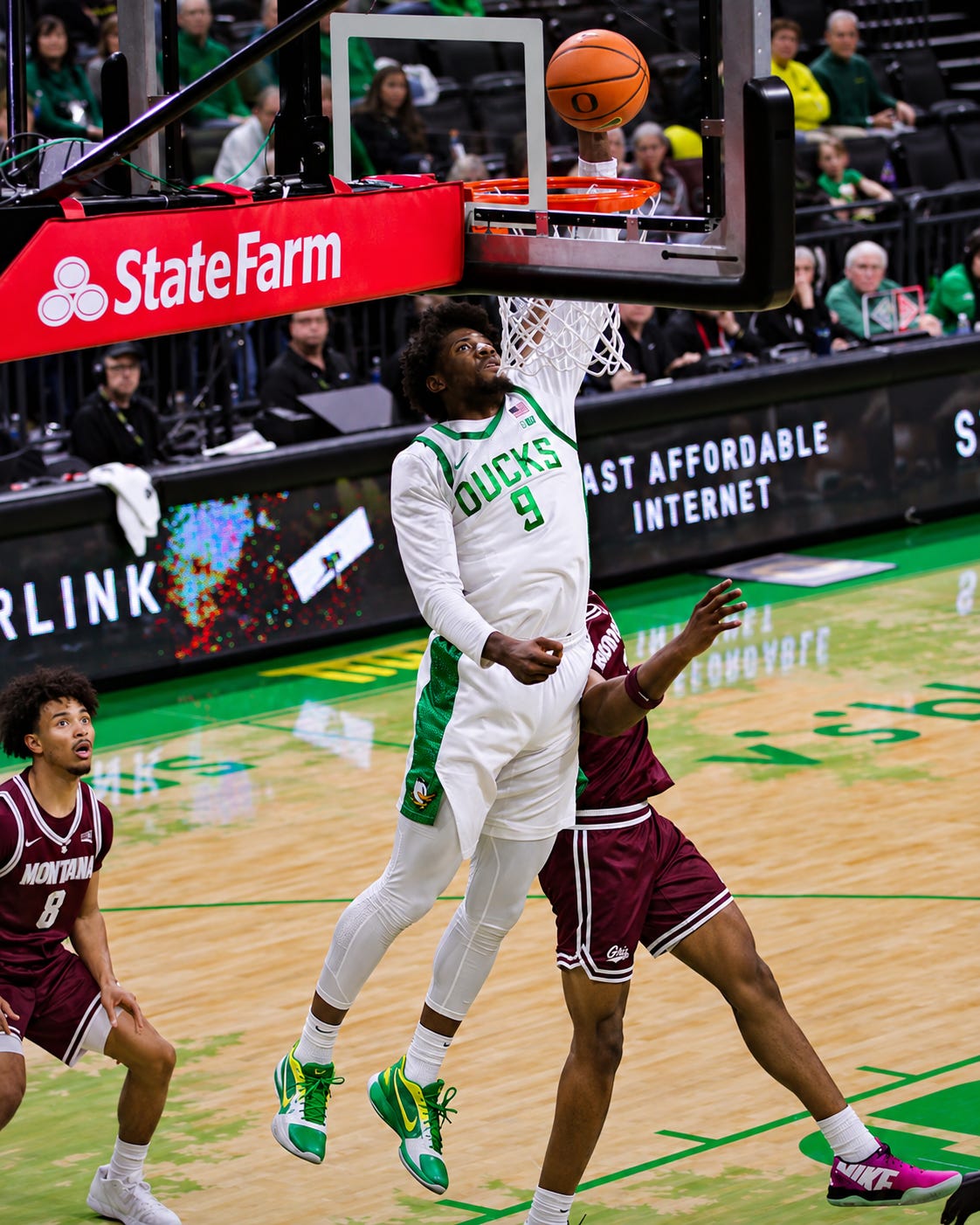
EUGENE, Ore. — Oregon basketball opened the 2026-27 season with a pair of victories Monday as the Ducks’ men’s and women’s programs delivered impressive offensive performances in wins over Montana and Hawaii, respectively.
The men overcame an early deficit and a second-half Montana rally to pull away for an 87-69 victory, while the women used relentless defensive pressure and a commanding advantage on the glass to cruise past Hawaii 87-54.
Both teams reached 87 points, but their paths to victory were considerably different. The men relied on exceptional shooting efficiency and an overwhelming advantage around the basket, while the women turned defensive pressure, offensive rebounding and second-chance opportunities into a lopsided result.
Men: Ducks dominate inside to pull away from Montana
Tyrone Riley IV scored 17 points, Malique Ewin added 14 points and 13 rebounds, and Oregon shot 60.3% from the field to defeat Montana 87-69 in its season opener.
Andrew Meadow contributed 14 points on 6-of-7 shooting, while Fred Payne finished with 12 points and five assists as Oregon placed six players in double figures.
The Ducks were particularly effective inside, outscoring Montana 54-14 in the paint and outrebounding the Grizzlies 37-26. Oregon made 35 of its 58 field-goal attempts, including a remarkable 20-of-28 performance in the second half.
Montana threatened to make the opener uncomfortable, however, using its perimeter shooting to keep the game competitive well into the second half.
The Grizzlies connected on their first four 3-point attempts to build a 12-4 lead just three minutes into the contest. Oregon answered with a 20-2 stretch, taking control behind improved defensive pressure and a series of baskets around the rim.
Montana briefly regained the lead at 14-13 before Wei Lin connected from beyond the arc to put Oregon ahead for good. The Ducks eventually built an 11-point first-half advantage before carrying a 40-31 lead into halftime.
The visitors mounted another challenge after the break, erasing a 15-point deficit behind a barrage of perimeter shots and Oregon turnovers.
Jordan Clark’s 3-pointer with 10:41 remaining completed the comeback and tied the game at 57, setting up the first significant test for Oregon’s new-look lineup.
The Ducks responded emphatically.
Payne immediately restored the lead with a jumper, and Riley followed with a three-point play. Ewin added a putback before Riley threw down an alley-oop dunk from Taylor Bol Bowen to extend Oregon’s advantage to 70-59 with 7:47 remaining.
The decisive stretch continued as Payne converted a fast-break layup and Riley added another transition dunk, effectively putting the game out of reach.
Oregon outscored Montana 30-12 over the final 10:15 after the game was tied, providing a strong finish to an otherwise uneven second half.
Lin gave the Ducks an additional offensive spark with 10 points on 4-of-5 shooting, including two 3-pointers. Bowen added six points, five rebounds and four assists, while Sean Stewart provided six points and six rebounds off the bench.
Jalen Brown and Clark each scored 19 points for Montana, while Tyler Thompson added 14. The Grizzlies made 13 of 30 attempts from beyond the arc but struggled inside, shooting just 9 of 28 on 2-point attempts.
For Oregon, the most encouraging numbers came from its offensive balance. The Ducks recorded 21 assists against just nine turnovers, received 24 points from their bench and finished with a 28-10 advantage in 2-point field goals.
Women: Defensive pressure fuels dominant victory over Hawaii
Mallory Heyer scored 16 points, Ehis Etute recorded a double-double with 15 points and 14 rebounds, and Oregon overwhelmed Hawaii 87-54 behind a relentless defensive effort.
Katie Fiso added 14 points and nine assists, while Ari Long contributed 14 points as the Ducks placed four starters in double figures and controlled nearly every aspect of the contest.
Oregon forced 23 turnovers, collected 18 steals and converted Hawaii’s mistakes into 36 points. The Ducks also dominated the offensive glass, collecting 24 offensive rebounds and turning those additional opportunities into 24 second-chance points.
The result was a 33-point victory that showcased Oregon’s ability to manufacture offense even when its shots were not consistently falling.
Hawaii briefly controlled the opening minutes, building a 6-2 advantage before Oregon’s defensive pressure changed the game.
After Heyer tied the score at 6 with a layup and Etute scored in transition, Heyer connected on a 3-pointer to give Oregon its first lead at 9-6 midway through the opening quarter.
The Ducks never trailed again.
Fiso followed with a 3-pointer, and Oregon continued forcing turnovers that created transition opportunities and extra possessions. Long connected on two first-quarter 3-pointers, helping the Ducks establish a commanding 28-10 advantage after 10 minutes.
Hawaii found some offensive rhythm in the second quarter, scoring 23 points, but Oregon maintained control and entered halftime leading 47-33.
The Ducks removed any remaining doubt in the third quarter, outscoring the Rainbow Wahine 24-10 to extend their lead to 71-43 entering the final period.
Oregon eventually pushed its advantage to 33 points in the closing minute, matching its largest lead of the game.
Heyer finished 6 of 12 from the field and made four 3-pointers, while Long also connected four times from beyond the arc. Together, they accounted for eight of Oregon’s 11 3-pointers.
Etute was particularly effective on the glass, collecting 14 rebounds in just 20 minutes while providing a physical presence around the basket.
Fiso’s nine assists against just one turnover reflected the Ducks’ ability to create quality offensive opportunities. Oregon finished with 17 assists and committed only 11 turnovers despite playing at an aggressive pace.
Brooklynn Haywood added nine points off the bench, while Eylul Krstevski contributed six points and Filippa Tilliander grabbed five rebounds.
Bailey Flavell led Hawaii with 24 points, while Ritorya Tamilo added 14 points and 12 rebounds. The Rainbow Wahine shot just 35.7% from the field and made only three of their 17 attempts from beyond the arc.
Oregon finished with a 50-35 rebounding advantage and outscored Hawaii 25-14 in bench production.
Although the Ducks shot just 38.8% overall, their ability to generate 80 field-goal attempts compared with Hawaii’s 56 illustrated how thoroughly they controlled the possession battle.
Two victories, two encouraging starting points
The opening victories provided different early indicators for Oregon’s two programs.
For the men, shooting efficiency, interior scoring and offensive balance were the defining characteristics. Oregon demonstrated the ability to produce points from several positions, but Montana’s second-half comeback also exposed stretches of vulnerability when the Ducks struggled with turnovers and defending the perimeter.
For the women, defensive activity and rebounding created the foundation for a comfortable victory. Oregon did not need an especially efficient shooting performance because its pressure and offensive rebounding repeatedly generated additional scoring opportunities.
Both teams will have plenty to evaluate as the season progresses, but the opening night offered an encouraging starting point.
Oregon’s men showed they could respond when an opponent erased a significant lead, while the women demonstrated the kind of defensive intensity and rebounding advantage that can carry a team through difficult shooting stretches.
The result was a successful opening night for both programs, with 174 combined points and a pair of victories to begin the new season.