


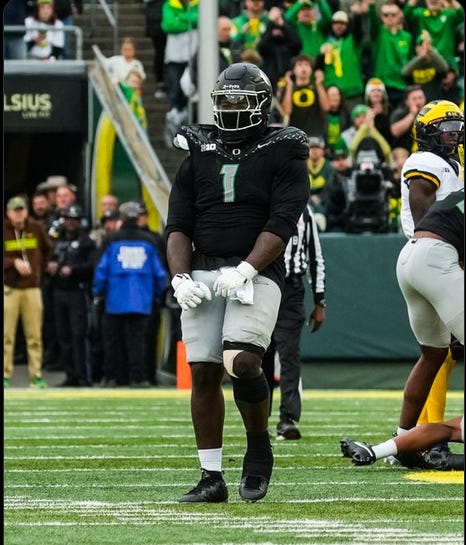
After a breakthrough victory at Ohio State revived their playoff hopes, the Ducks took care of business against Michigan, using an explosive passing attack and another resilient defensive performance to keep their postseason ambitions alive.
EUGENE, Ore. — A week ago in Columbus, Oregon did something that once seemed increasingly unlikely. The Ducks walked into Ohio Stadium, overcame a 14-point deficit and defeated Ohio State 41-28, turning a season that had appeared headed toward disappointment into one suddenly filled with possibilities again.
The victory propelled Oregon back into the College Football Playoff conversation and lifted the Ducks to No. 16 in the latest rankings. But beating Ohio State was only the beginning of the work required to make that opportunity matter. Oregon still needed to prove it could handle success with the same urgency it had shown while fighting through adversity, particularly against a Michigan team capable of presenting a considerably different challenge.
On Saturday afternoon at Autzen Stadium, the Ducks took another step toward answering that question.
Dylan Raiola threw for 341 yards and four touchdowns, Oregon scored twice in the opening quarter and the Ducks held Michigan scoreless over the final three periods in a 31-7 victory that kept their playoff ambitions alive.
Raiola completed 20 of 28 passes without an interception, connecting with four different receivers for touchdowns as Oregon rolled up 467 yards of total offense. Jeremiah McClellan caught four passes for 105 yards and a touchdown, while Dakorien Moore finished with seven receptions for 101 yards and another score.
Dierre Hill Jr. added 98 rushing yards on 21 carries and caught a 49-yard touchdown pass, helping Oregon overcome a relatively quiet second half offensively. The Ducks generated 326 yards before halftime and built a 21-7 lead before relying largely on their defense to protect that advantage.
Michigan rushed for 215 yards, but the Wolverines struggled to generate anything through the air and finished with just 71 passing yards on six completions in 20 attempts. Oregon recorded three sacks, forced two turnovers and prevented Michigan from scoring despite several extended possessions that threatened to make the game considerably closer.
The result marked Oregon’s third consecutive victory and offered another indication that the improvement displayed against Ohio State was not simply a one-week response to the disappointment of an uneven first half of the season.
Ducks waste little time taking control
Oregon entered Saturday facing a Michigan defense that had established itself as a disciplined, physical unit capable of making opponents earn their yardage. Rather than gradually testing the Wolverines’ secondary, the Ducks immediately attacked downfield and established an offensive advantage that Michigan would spend the remainder of the afternoon attempting to overcome.
After receiving the opening kickoff, Oregon moved from its own 25 to the 40 on three plays before Raiola connected with McClellan for a 60-yard touchdown. The scoring pass came just two minutes into the game and provided an early indication that Oregon intended to challenge Michigan vertically rather than allow the Wolverines to dictate the pace with their defensive front.
Michigan responded by moving across midfield on its opening possession, but the drive stalled when the Ducks forced consecutive incompletions. Oregon’s next possession began at its own 3-yard line, yet Raiola quickly flipped field position with a 38-yard completion to Evan Stewart before the drive eventually ended in a punt.
The Ducks extended their advantage late in the quarter after beginning a possession at their own 36. A Michigan unsportsmanlike conduct penalty moved Oregon across midfield, and Raiola completed passes to Moore and Jamari Johnson to help advance the ball inside the Wolverines’ 20.
Hill converted a fourth-and-1 with a 10-yard run to the Michigan 4, keeping alive a possession that ended when Raiola found Da’Jaun Riggs for a 2-yard touchdown with 13 seconds remaining in the quarter.
Oregon led 14-0 after the opening period, having outgained Michigan 172-41 while holding the ball for 10 minutes, 28 seconds. Raiola completed all eight of his first-quarter passes for 133 yards, and the Ducks averaged 9.1 yards per offensive play while Michigan managed just 11 snaps.
The disparity illustrated how thoroughly Oregon had controlled the opening quarter. Michigan’s offense had barely been on the field, and the Ducks were generating explosive plays against a defense that had entered the game with the personnel and discipline to make Oregon work for its opportunities.
But Michigan needed only one play early in the second quarter to demonstrate the danger of allowing even a brief defensive breakdown.
Savion Hiter broke free for a 70-yard touchdown run on the Wolverines’ second offensive play of the period, cutting Oregon’s advantage to 14-7. The explosive run represented the kind of mistake Oregon had largely avoided during its resurgence, with Michigan finding a crease and turning it into an immediate touchdown.
The Ducks responded with another productive offensive possession, moving from their own 38 to the Michigan 2 behind completions of 18 and 22 yards to McClellan. Oregon eventually faced fourth-and-2, but Raiola’s pass intended for Kendre Harrison was broken up by Jyaire Hill, giving the Wolverines possession deep in their own territory.
Michigan could not take advantage of the stop, and neither offense managed another score until the closing seconds of the half.
With 58 seconds remaining and Oregon backed up at its own 9-yard line, Raiola orchestrated one of the Ducks’ most important possessions of the afternoon. A pair of completions to Moore and Jamari Johnson moved the ball to the Oregon 41 before Raiola found Moore downfield for a 59-yard touchdown with six seconds left.
The four-play, 91-yard drive took just 52 seconds and restored Oregon’s two-touchdown advantage at 21-7. Instead of entering halftime within one possession, Michigan faced a 14-point deficit against a defense that had increasingly limited its ability to move the football through the air.
Defense holds firm as Michigan dominates third-quarter possession
Oregon’s offense had controlled the first half through an aggressive passing attack, but the game took a considerably different shape after halftime.
Michigan received the second-half kickoff and began leaning heavily on its running game, extending possessions and limiting the opportunities available to Oregon’s offense. The Wolverines possessed the ball for 11 minutes, 57 seconds during the third quarter, running 19 plays compared with just five for the Ducks.
The difference was remarkable considering Oregon’s overwhelming advantage in the opening quarter. Michigan outgained Oregon 92-39 in the third, generated seven first downs and converted four of five third-down opportunities.
Yet the Wolverines could not turn that possession advantage into points.
Michigan’s opening drive crossed midfield before Oregon stopped Tommy Carr on fourth-and-3 at the Ducks’ 37-yard line. Oregon responded with a 36-yard run by Hill, but a personal foul pushed the offense backward and the possession ended when Gage Hurych missed a 46-yard field goal.
Michigan then embarked on a methodical possession that consumed the remainder of the third quarter and extended into the fourth. The Wolverines moved from their own 28 to the Oregon 3, relying on their rushing attack and several important third-down conversions to threaten the Ducks’ lead.
Matayo Uiagalelei delivered two sacks during the quarter, including a 6-yard loss that forced Michigan into third-and-13. Carr responded with an 18-yard completion to Jalen Hoffman to extend the drive, and the Wolverines continued moving downfield before reaching the Oregon 8 as the third quarter ended.
With Michigan threatening to reduce the deficit to one possession, Oregon’s defense delivered one of its most important stands of the afternoon.
Carr’s first-down pass fell incomplete, Jordan Marshall gained four yards on second down and Carr managed just one yard on third-and-4. Facing fourth-and-3 at the Oregon 3, Carr attempted a pass to Andrew Marsh, but the ball fell incomplete following defensive pressure and coverage from Jett Washington.
The turnover on downs with 13:19 remaining effectively ended Michigan’s best opportunity to turn the game into a fourth-quarter contest.
For Oregon, the defensive performance was especially significant because of the contrast between the first and third quarters. The Ducks had dominated the opening period with their offense, yet they protected the same two-touchdown advantage in the third despite controlling the ball for barely three minutes.
That ability to withstand an extended possession without surrendering points illustrated the improvement Oregon has made defensively, even on an afternoon when its rushing defense was not always as consistent as the coaching staff would have preferred.
Michigan’s rushing total masks a more complicated performance
Michigan’s 215 rushing yards will undoubtedly receive attention when Oregon reviews Saturday’s defensive performance, particularly after the Wolverines averaged 5.4 yards per carry.
But those totals require context.
Three Michigan runs accounted for 102 yards, including Hiter’s 70-yard touchdown and Carr’s gains of 20 and 12 yards. On the Wolverines’ other 37 rushing attempts, Oregon allowed just 113 yards, an average of 3.1 yards per carry.
The distinction does not eliminate concern about the explosive plays. Oregon cannot afford to surrender a 70-yard touchdown simply because it defended the remaining runs effectively, particularly against opponents with more balanced offenses capable of capitalizing on those opportunities.
Still, the numbers suggest the Ducks were not consistently being overwhelmed at the line of scrimmage. Michigan’s production was heavily influenced by a handful of breakdowns rather than sustained success running the football, and Oregon’s defense largely controlled the Wolverines’ conventional rushing attack outside those plays.
That was especially important considering Michigan’s inability to generate much production through the air.
Carr completed four of 12 passes for 45 yards, while Bryce Underwood finished 2 of 8 for 26 yards. Michigan’s quarterbacks combined for just six completions, and the Wolverines failed to complete a pass longer than 18 yards.
Uiagalelei finished with two sacks and three quarterback hurries, while Nasir Wyatt added another sack as Oregon consistently disrupted Michigan’s passing opportunities. Dylan Williams led the Ducks with 10 tackles, Devon Jackson added seven and Koi Perich finished with five.
Oregon’s secondary also contributed seven pass breakups, including two by Ify Obidegwu, as the Wolverines struggled to find success challenging the Ducks downfield.
Michigan finished with just 14 first downs and converted four of 13 third-down attempts, despite the third-quarter stretch in which it repeatedly extended possessions.
Oregon finishes the job in the fourth quarter
With Michigan still trailing 21-7 early in the fourth, Oregon’s defense continued making the plays necessary to keep the Wolverines from mounting a comeback.
Bear Alexander forced a Bryson Kuzdzal fumble that Brandon Finney recovered with 6:38 remaining, ending a Michigan possession near midfield. Oregon failed to move the ball on the ensuing series, but the Ducks regained possession shortly afterward when Williams forced a Carr fumble that Na’eem Offord recovered.
The turnovers eliminated valuable opportunities for Michigan while giving Oregon’s offense additional chances to put the game away.
The Ducks finally delivered the decisive offensive blow with just over four minutes remaining.
Facing third-and-19 at the Michigan 49, Raiola found Hill on a short pass to the right. Hill turned upfield, broke into the open and raced for a 49-yard touchdown that extended Oregon’s lead to 28-7.
One of the most important contributions on the play came from Jalen Lott, who worked his way across from the backside to deliver a block that proved essential to Hill breaking free.
It was a notable effort from the freshman receiver, whose contribution will not appear in the statistical summary but helped turn a play designed to overcome a difficult third-down situation into a touchdown. The block reflected the kind of effort away from the football that has become increasingly important to Oregon’s offensive production.
Hurych added a 21-yard field goal with 40 seconds remaining, giving Oregon its final 31-7 margin.
The Ducks finished with 10 explosive plays accounting for 317 yards, compared with five for Michigan totaling 130 yards. Oregon also averaged 7.3 yards per offensive play, generated 341 passing yards and did not commit a turnover.
There were areas that will require attention before Oregon’s next game. The Ducks struggled to sustain their offensive production after halftime, generating just 141 yards over the final two quarters, and finished 2 for 4 in the red zone. Penalties also contributed to stalled possessions, including a third-quarter drive that reached the Michigan 8 before eventually ending in a missed field goal.
But the larger picture was considerably more encouraging.
A week after delivering one of the biggest victories of the season in Columbus, Oregon avoided the kind of emotional letdown that can follow an upset of a highly ranked opponent. The Ducks established control early, prevented Michigan from capitalizing on its substantial third-quarter possession advantage and finished with another victory that strengthened their late-season position.
Ohio State had given Oregon a reason to believe its playoff hopes were alive again. Saturday’s victory over Michigan ensured the Ducks would continue having something meaningful to play for as the regular season moved closer to its conclusion.
Player of the game: Dylan Raiola, QB, Oregon
20-of-28 passing, 341 yards, four touchdowns, no interceptions
Raiola delivered another efficient performance, completing 71.4% of his passes while averaging 12.2 yards per attempt. He completed six of eight passes of at least 15 yards downfield and produced touchdown throws of 60, 59 and 49 yards, giving Oregon the explosive passing production needed to overcome a Michigan defense that limited the Ducks’ rushing attack to 126 yards.
Key play: Raiola’s 59-yard touchdown pass to Dakorien Moore
With Oregon leading 14-7 and just six seconds remaining in the first half, Raiola found Moore for a 59-yard touchdown that completed a four-play, 91-yard drive in 52 seconds. The score restored Oregon’s two-touchdown advantage and changed the complexion of the second half, forcing Michigan to play from behind against a defense that had allowed little success through the air.
Key stat: 3.1 yards per carry on Michigan’s other 37 runs
Michigan finished with 215 rushing yards, but three plays accounted for 102 of them. Oregon allowed just 113 yards on Michigan’s other 37 rushing attempts, demonstrating that the Ducks’ biggest defensive issue was a handful of explosive breakdowns rather than consistent inability to stop the run.
By the numbers
StatisticMichiganOregonFinal score731Total offense286467Passing yards71341Rushing yards215126First downs1418Third downs4-136-15Turnovers20Sacks23Time of possession29:3930:21
Scoring by quarter
Team1st2nd3rd4thFinalMichigan07007Oregon14701031No letdown for No. 16 Oregon as Raiola throws four touchdowns in 31-7 win over Michigan
After a breakthrough victory at Ohio State revived their playoff hopes, the Ducks took care of business against Michigan, using an explosive passing attack and another resilient defensive performance to keep their postseason ambitions alive.
EUGENE, Ore. — A week ago in Columbus, Oregon did something that once seemed increasingly unlikely. The Ducks walked into Ohio Stadium, overcame a 14-point deficit and defeated Ohio State 41-28, turning a season that had appeared headed toward disappointment into one suddenly filled with possibilities again.
The victory propelled Oregon back into the College Football Playoff conversation and lifted the Ducks to No. 16 in the latest rankings. But beating Ohio State was only the beginning of the work required to make that opportunity matter. Oregon still needed to prove it could handle success with the same urgency it had shown while fighting through adversity, particularly against a Michigan team capable of presenting a considerably different challenge.
On Saturday afternoon at Autzen Stadium, the Ducks took another step toward answering that question.
Dylan Raiola threw for 341 yards and four touchdowns, Oregon scored twice in the opening quarter and the Ducks held Michigan scoreless over the final three periods in a 31-7 victory that kept their playoff ambitions alive.
Raiola completed 20 of 28 passes without an interception, connecting with four different receivers for touchdowns as Oregon rolled up 467 yards of total offense. Jeremiah McClellan caught four passes for 105 yards and a touchdown, while Dakorien Moore finished with seven receptions for 101 yards and another score.
Dierre Hill Jr. added 98 rushing yards on 21 carries and caught a 49-yard touchdown pass, helping Oregon overcome a relatively quiet second half offensively. The Ducks generated 326 yards before halftime and built a 21-7 lead before relying largely on their defense to protect that advantage.
Michigan rushed for 215 yards, but the Wolverines struggled to generate anything through the air and finished with just 71 passing yards on six completions in 20 attempts. Oregon recorded three sacks, forced two turnovers and prevented Michigan from scoring despite several extended possessions that threatened to make the game considerably closer.
The result marked Oregon’s third consecutive victory and offered another indication that the improvement displayed against Ohio State was not simply a one-week response to the disappointment of an uneven first half of the season.
Ducks waste little time taking control
Oregon entered Saturday facing a Michigan defense that had established itself as a disciplined, physical unit capable of making opponents earn their yardage. Rather than gradually testing the Wolverines’ secondary, the Ducks immediately attacked downfield and established an offensive advantage that Michigan would spend the remainder of the afternoon attempting to overcome.
After receiving the opening kickoff, Oregon moved from its own 25 to the 40 on three plays before Raiola connected with McClellan for a 60-yard touchdown. The scoring pass came just two minutes into the game and provided an early indication that Oregon intended to challenge Michigan vertically rather than allow the Wolverines to dictate the pace with their defensive front.
Michigan responded by moving across midfield on its opening possession, but the drive stalled when the Ducks forced consecutive incompletions. Oregon’s next possession began at its own 3-yard line, yet Raiola quickly flipped field position with a 38-yard completion to Evan Stewart before the drive eventually ended in a punt.
The Ducks extended their advantage late in the quarter after beginning a possession at their own 36. A Michigan unsportsmanlike conduct penalty moved Oregon across midfield, and Raiola completed passes to Moore and Jamari Johnson to help advance the ball inside the Wolverines’ 20.
Hill converted a fourth-and-1 with a 10-yard run to the Michigan 4, keeping alive a possession that ended when Raiola found Da’Jaun Riggs for a 2-yard touchdown with 13 seconds remaining in the quarter.
Oregon led 14-0 after the opening period, having outgained Michigan 172-41 while holding the ball for 10 minutes, 28 seconds. Raiola completed all eight of his first-quarter passes for 133 yards, and the Ducks averaged 9.1 yards per offensive play while Michigan managed just 11 snaps.
The disparity illustrated how thoroughly Oregon had controlled the opening quarter. Michigan’s offense had barely been on the field, and the Ducks were generating explosive plays against a defense that had entered the game with the personnel and discipline to make Oregon work for its opportunities.
But Michigan needed only one play early in the second quarter to demonstrate the danger of allowing even a brief defensive breakdown.
Savion Hiter broke free for a 70-yard touchdown run on the Wolverines’ second offensive play of the period, cutting Oregon’s advantage to 14-7. The explosive run represented the kind of mistake Oregon had largely avoided during its resurgence, with Michigan finding a crease and turning it into an immediate touchdown.
The Ducks responded with another productive offensive possession, moving from their own 38 to the Michigan 2 behind completions of 18 and 22 yards to McClellan. Oregon eventually faced fourth-and-2, but Raiola’s pass intended for Kendre Harrison was broken up by Jyaire Hill, giving the Wolverines possession deep in their own territory.
Michigan could not take advantage of the stop, and neither offense managed another score until the closing seconds of the half.
With 58 seconds remaining and Oregon backed up at its own 9-yard line, Raiola orchestrated one of the Ducks’ most important possessions of the afternoon. A pair of completions to Moore and Jamari Johnson moved the ball to the Oregon 41 before Raiola found Moore downfield for a 59-yard touchdown with six seconds left.
The four-play, 91-yard drive took just 52 seconds and restored Oregon’s two-touchdown advantage at 21-7. Instead of entering halftime within one possession, Michigan faced a 14-point deficit against a defense that had increasingly limited its ability to move the football through the air.
Defense holds firm as Michigan dominates third-quarter possession
Oregon’s offense had controlled the first half through an aggressive passing attack, but the game took a considerably different shape after halftime.
Michigan received the second-half kickoff and began leaning heavily on its running game, extending possessions and limiting the opportunities available to Oregon’s offense. The Wolverines possessed the ball for 11 minutes, 57 seconds during the third quarter, running 19 plays compared with just five for the Ducks.
The difference was remarkable considering Oregon’s overwhelming advantage in the opening quarter. Michigan outgained Oregon 92-39 in the third, generated seven first downs and converted four of five third-down opportunities.
Yet the Wolverines could not turn that possession advantage into points.
Michigan’s opening drive crossed midfield before Oregon stopped Tommy Carr on fourth-and-3 at the Ducks’ 37-yard line. Oregon responded with a 36-yard run by Hill, but a personal foul pushed the offense backward and the possession ended when Gage Hurych missed a 46-yard field goal.
Michigan then embarked on a methodical possession that consumed the remainder of the third quarter and extended into the fourth. The Wolverines moved from their own 28 to the Oregon 3, relying on their rushing attack and several important third-down conversions to threaten the Ducks’ lead.
Matayo Uiagalelei delivered two sacks during the quarter, including a 6-yard loss that forced Michigan into third-and-13. Carr responded with an 18-yard completion to Jalen Hoffman to extend the drive, and the Wolverines continued moving downfield before reaching the Oregon 8 as the third quarter ended.
With Michigan threatening to reduce the deficit to one possession, Oregon’s defense delivered one of its most important stands of the afternoon.
Carr’s first-down pass fell incomplete, Jordan Marshall gained four yards on second down and Carr managed just one yard on third-and-4. Facing fourth-and-3 at the Oregon 3, Carr attempted a pass to Andrew Marsh, but the ball fell incomplete following defensive pressure and coverage from Jett Washington.
The turnover on downs with 13:19 remaining effectively ended Michigan’s best opportunity to turn the game into a fourth-quarter contest.
For Oregon, the defensive performance was especially significant because of the contrast between the first and third quarters. The Ducks had dominated the opening period with their offense, yet they protected the same two-touchdown advantage in the third despite controlling the ball for barely three minutes.
That ability to withstand an extended possession without surrendering points illustrated the improvement Oregon has made defensively, even on an afternoon when its rushing defense was not always as consistent as the coaching staff would have preferred.
Michigan’s rushing total masks a more complicated performance
Michigan’s 215 rushing yards will undoubtedly receive attention when Oregon reviews Saturday’s defensive performance, particularly after the Wolverines averaged 5.4 yards per carry.
But those totals require context.
Three Michigan runs accounted for 102 yards, including Hiter’s 70-yard touchdown and Carr’s gains of 20 and 12 yards. On the Wolverines’ other 37 rushing attempts, Oregon allowed just 113 yards, an average of 3.1 yards per carry.
The distinction does not eliminate concern about the explosive plays. Oregon cannot afford to surrender a 70-yard touchdown simply because it defended the remaining runs effectively, particularly against opponents with more balanced offenses capable of capitalizing on those opportunities.
Still, the numbers suggest the Ducks were not consistently being overwhelmed at the line of scrimmage. Michigan’s production was heavily influenced by a handful of breakdowns rather than sustained success running the football, and Oregon’s defense largely controlled the Wolverines’ conventional rushing attack outside those plays.
That was especially important considering Michigan’s inability to generate much production through the air.
Carr completed four of 12 passes for 45 yards, while Bryce Underwood finished 2 of 8 for 26 yards. Michigan’s quarterbacks combined for just six completions, and the Wolverines failed to complete a pass longer than 18 yards.
Uiagalelei finished with two sacks and three quarterback hurries, while Nasir Wyatt added another sack as Oregon consistently disrupted Michigan’s passing opportunities. Dylan Williams led the Ducks with 10 tackles, Devon Jackson added seven and Koi Perich finished with five.
Oregon’s secondary also contributed seven pass breakups, including two by Ify Obidegwu, as the Wolverines struggled to find success challenging the Ducks downfield.
Michigan finished with just 14 first downs and converted four of 13 third-down attempts, despite the third-quarter stretch in which it repeatedly extended possessions.
Oregon finishes the job in the fourth quarter
With Michigan still trailing 21-7 early in the fourth, Oregon’s defense continued making the plays necessary to keep the Wolverines from mounting a comeback.
Bear Alexander forced a Bryson Kuzdzal fumble that Brandon Finney recovered with 6:38 remaining, ending a Michigan possession near midfield. Oregon failed to move the ball on the ensuing series, but the Ducks regained possession shortly afterward when Williams forced a Carr fumble that Na’eem Offord recovered.
The turnovers eliminated valuable opportunities for Michigan while giving Oregon’s offense additional chances to put the game away.
The Ducks finally delivered the decisive offensive blow with just over four minutes remaining.
Facing third-and-19 at the Michigan 49, Raiola found Hill on a short pass to the right. Hill turned upfield, broke into the open and raced for a 49-yard touchdown that extended Oregon’s lead to 28-7.
One of the most important contributions on the play came from Jalen Lott, who worked his way across from the backside to deliver a block that proved essential to Hill breaking free.
It was a notable effort from the freshman receiver, whose contribution will not appear in the statistical summary but helped turn a play designed to overcome a difficult third-down situation into a touchdown. The block reflected the kind of effort away from the football that has become increasingly important to Oregon’s offensive production.
Hurych added a 21-yard field goal with 40 seconds remaining, giving Oregon its final 31-7 margin.
The Ducks finished with 10 explosive plays accounting for 317 yards, compared with five for Michigan totaling 130 yards. Oregon also averaged 7.3 yards per offensive play, generated 341 passing yards and did not commit a turnover.
There were areas that will require attention before Oregon’s next game. The Ducks struggled to sustain their offensive production after halftime, generating just 141 yards over the final two quarters, and finished 2 for 4 in the red zone. Penalties also contributed to stalled possessions, including a third-quarter drive that reached the Michigan 8 before eventually ending in a missed field goal.
But the larger picture was considerably more encouraging.
A week after delivering one of the biggest victories of the season in Columbus, Oregon avoided the kind of emotional letdown that can follow an upset of a highly ranked opponent. The Ducks established control early, prevented Michigan from capitalizing on its substantial third-quarter possession advantage and finished with another victory that strengthened their late-season position.
Ohio State had given Oregon a reason to believe its playoff hopes were alive again. Saturday’s victory over Michigan ensured the Ducks would continue having something meaningful to play for as the regular season moved closer to its conclusion.
Player of the game: Dylan Raiola, QB, Oregon
20-of-28 passing, 341 yards, four touchdowns, no interceptions
Raiola delivered another efficient performance, completing 71.4% of his passes while averaging 12.2 yards per attempt. He completed six of eight passes of at least 15 yards downfield and produced touchdown throws of 60, 59 and 49 yards, giving Oregon the explosive passing production needed to overcome a Michigan defense that limited the Ducks’ rushing attack to 126 yards.
Key play: Raiola’s 59-yard touchdown pass to Dakorien Moore
With Oregon leading 14-7 and just six seconds remaining in the first half, Raiola found Moore for a 59-yard touchdown that completed a four-play, 91-yard drive in 52 seconds. The score restored Oregon’s two-touchdown advantage and changed the complexion of the second half, forcing Michigan to play from behind against a defense that had allowed little success through the air.
Key stat: 3.1 yards per carry on Michigan’s other 37 runs
Michigan finished with 215 rushing yards, but three plays accounted for 102 of them. Oregon allowed just 113 yards on Michigan’s other 37 rushing attempts, demonstrating that the Ducks’ biggest defensive issue was a handful of explosive breakdowns rather than consistent inability to stop the run.