


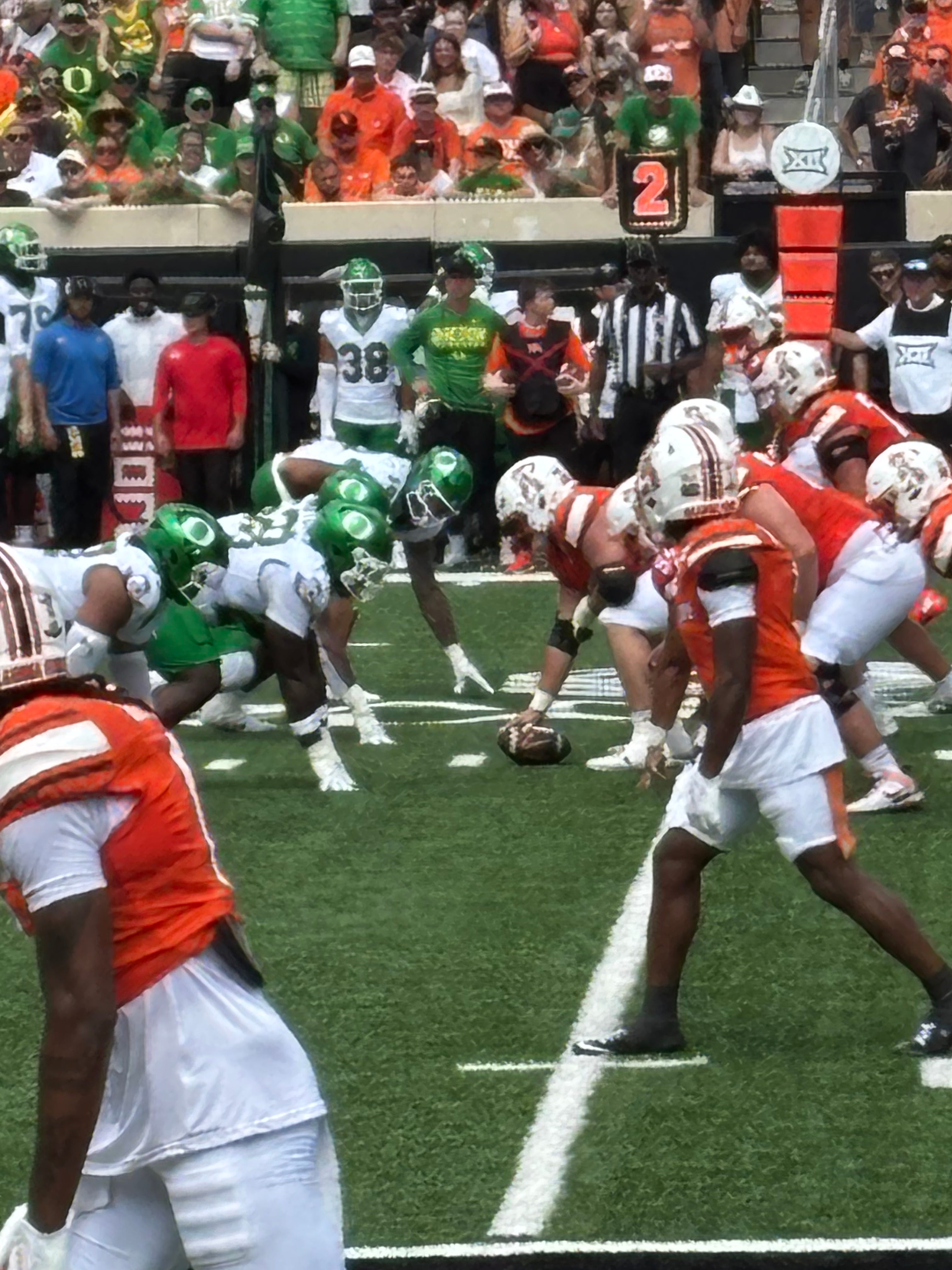
STILLWATER, Okla. — The one thing we knew going into Oregon’s trip to Oklahoma State was that each team was seeking its own form of redemption.
Neither coaching staff necessarily used that word during the week, but the circumstances were difficult to ignore. Oregon arrived after a closer-than-expected win over Boise State in which some of the rust and mistakes of an opener were obvious. The Ducks wanted to play closer to the standard they had spent an offseason discussing. Oklahoma State was simply looking for evidence that something better was coming.
Only one of them found it.
Oklahoma State upset No. 6 Oregon 39-31 on Saturday at Boone Pickens Stadium, handing the Ducks a loss that will force a considerably different conversation about this team than the one Oregon expected to be having two weeks into the season.
The Cowboys suffered through a 1-11 season last year, and Eric Morris was brought in from North Texas to revive the offense and begin rebuilding the program. Oklahoma State added 91 new players during the offseason, but I think we sometimes look at something like Curt Cignetti’s immediate success at Indiana and assume roster turnover can produce instant transformation everywhere.
There is a reason striking lightning in a bottle is considered rare.
Then, almost fittingly, those storylines had to wait a little longer. Lightning delayed kickoff by roughly 90 minutes before a packed stadium finally got to see Oregon become the highest-ranked nonconference opponent to visit Stillwater in nearly half a century.
There was probably some sort of ironic poetry in that reality. Oregon fans had waited all offseason for another opportunity to move beyond the disappointment that ended last season. Oklahoma State was trying to wash away an inauspicious beginning to the Morris era after losing 24-10 at Tulsa.
But nature sometimes reminds us that redemption follows no schedule. The storm passes when it is ready.
When this one finally did, Oregon never really found the version of itself it expected to bring to Stillwater.
The problems started almost immediately.
Oregon opened without tight end Jamari Johnson because of an undisclosed injury, putting freshman Andrew Olesh into the starting lineup. The Ducks then gained just four yards before an incomplete pass to Jordon Davison produced a three-and-out.
Oklahoma State needed one offensive snap to announce that nothing about this game was going to follow the expected script.
Drew Mestemaker kept the ball on a quarterback run and raced 75 yards to the Oregon 4 after Teitum Tuioti crashed from the edge and nobody maintained outside contain. Oregon managed to keep the Cowboys out of the end zone, with Brandon Finney making an important third-down tackle, but Oklahoma State converted a 20-yard field goal for a 3-0 lead.
Oregon followed with another three-and-out.
This time there was no immediate defensive recovery. Oklahoma State began moving Oregon backward at the line of scrimmage, creating running lanes for Mestemaker and Caleb Hawkins while giving its quarterback time to operate from the pocket. A 34-yard completion helped move the Cowboys back into the red zone, and the Ducks looked nothing like the veteran defense that had received so much praise throughout fall camp.
Then came Oregon’s first escape.
D’Antre Robinson deflected a Mestemaker pass near the goal line, Devon Jackson intercepted it and returned it 97 yards for a touchdown. Instead of Oklahoma State potentially building a two-score lead, Oregon suddenly led 7-3.
It completely changed the scoreboard without really changing what was happening on the field.
The Cowboys continued moving the ball, and Oregon continued creating problems for itself. An offsides penalty and a pass-interference call extended one Oklahoma State possession after the Ducks appeared ready to get off the field. Oregon eventually forced a punt, but the offense could not take advantage.
The Ducks finally picked up their first first down when Dierre Hill Jr. broke a 14-yard run, but the passing game remained disjointed. Dante Moore was high on several throws, Oklahoma State’s secondary stayed attached to Oregon’s receivers and a third-down completion to Olesh left Oregon facing fourth-and-2.
Dakorien Moore came open.
The pass was not perfect, but it was catchable. Moore dropped it, and Oklahoma State took possession.
That became another theme Saturday. Oregon repeatedly found moments that could have changed the direction of the game and repeatedly failed to finish them.
The Cowboys made the Ducks pay early in the second quarter. Poor gap integrity opened a 25-yard run that put Oklahoma State inside the Oregon 10, and Mestemaker eventually found Carson Kolb uncovered for a 1-yard touchdown and a 10-7 lead.
What followed became considerably more concerning.
Oregon’s offensive line struggled to create movement in the run game and allowed pressure on Moore. A missed block by Ziyare Addison contributed to a sack, and the Ducks punted again. Oklahoma State answered with a flea-flicker for 33 yards before Hawkins started running through a defensive front that had been expected to become one of Oregon’s strengths.
First and goal. First and the season?
That probably sounds dramatic eight quarters into a schedule, but there are moments when a team reveals something about itself. Oregon was not simply being surprised schematically. The Ducks were getting pushed backward by a rebuilt Oklahoma State offensive line, missing tackles and allowing an offense that had scored 10 points against Tulsa to dictate the physical nature of the game.
Hawkins finished the possession by running through Oregon from 5 yards out, extending the lead to 17-7 with 8:44 remaining in the half.
At that point, the Oklahoma State defense looked considerably more like what Oregon’s defense had been expected to look like.
The Ducks went three-and-out again, with Jeremiah McClellan dropping a pass that hit him in the hands, and Bailey Ettridge continued being one of Oregon’s few consistently reliable players by pinning Oklahoma State deep.
Once again, a tipped pass rescued the Ducks.
Dylan Williams got his hand on Mestemaker’s throw, Matayo Uiagalelei intercepted it and returned the ball to the Oklahoma State 1. Davison scored on the next play, cutting the deficit to 17-14.
Oregon was somehow within three despite being thoroughly outplayed.
Then Oklahoma State provided the clearest evidence yet that the two interceptions had been disguising the actual game.
Mestemaker had plenty of time on the next possession, and Oregon’s secondary broke down when Wyatt Young got behind the coverage for a 52-yard touchdown. Oklahoma State needed four plays to travel 75 yards and rebuild its advantage to 24-14 with 3:47 remaining.
There was no reasonable way to blame that on the heat, the lightning delay or the awkward rhythm of the afternoon. Great teams encounter strange circumstances all the time. They do not allow those circumstances to become excuses for getting dismantled.
Oregon did at least answer before halftime.
Moore converted third-and-17 with an excellent cross-body throw to Messiah Hampton, Davison followed with a 10-yard run and Gage Hurych eventually connected from 41 yards to make it 24-17.
The seven-point margin was flattering.
Oklahoma State had outgained Oregon 353-101 in the first half and averaged 9.5 yards per play compared with Oregon’s 3.2. The Cowboys had 174 rushing yards, Oregon had 56, and the only reason the Ducks remained within one possession was a pair of tipped passes that became 14 Oregon points.
This was not the Boise State game, when Oregon controlled much of the statistical profile while allowing mistakes in critical situations to keep an opponent close.
This time Oregon was the team being controlled.
The analytical premise entering Saturday was that Oregon needed to win early downs, control the line of scrimmage and force Mestemaker to operate from obvious passing situations. Oklahoma State instead spent most of the afternoon ahead of the sticks and allowed its quarterback to choose when to attack Oregon with his arm and when to punish the Ducks with his legs.
That continued to begin the second half.
Oklahoma State drove 69 yards before Oregon finally stiffened near the goal line and forced a field goal, stretching the Cowboys’ lead to 27-17.
Then Oregon finally looked different.
Moore hit Evan Stewart for a first down, responded to a holding penalty with a 20-yard completion to McClellan and dropped a perfectly placed ball to Dakorien Moore for a 36-yard touchdown. The six-play, 75-yard possession took only 2:38 and suddenly made it 27-24.
For perhaps the first time all afternoon, there was energy suggesting Oregon might actually take control.
The defense followed with its first three-and-out. Finney diagnosed the possession particularly well, finishing it with excellent underneath coverage and a tackle that forced the punt.
Oregon had its opening.
The Ducks began moving the ball again, with Hill making defenders miss and Stewart creating yards after the catch, but a false start turned third-and-short into third-and-long. Oregon eventually faced fourth-and-7 at the Oklahoma State 43, and Moore took a sack after running into pressure despite having an underneath option available.
The opportunity disappeared.
Oklahoma State responded by converting fourth-and-1 with Hawkins and eventually extending the lead to 30-24 on a 44-yard field goal with 36 seconds left in the third quarter. Morris then made perhaps his biggest mistake of the afternoon, drawing an unsportsmanlike-conduct penalty that helped Oregon begin its next possession around midfield.
The Ducks took advantage.
On the first snap of the fourth quarter, Moore worked from a clean pocket and found Stewart for a 38-yard touchdown.
After spending most of the afternoon looking completely overmatched, Oregon led 31-30 with 14:51 remaining.
Moore had completed 8 of 10 passes for 139 yards and two touchdowns in the second half to that point. Oregon had somehow wrestled the lead away from a team that had dominated most of the afternoon.
Now the defense needed one stop.
For a moment, it appeared to have one.
Oklahoma State kept moving behind Hawkins and Mestemaker, but Aaron Flowers made an excellent open-field tackle to help create third-and-6. Oregon finally recognized the quarterback run on the next sequence and forced fourth-and-4.
The Ducks made the play they needed.
Then a facemask penalty on Finney erased it.
Instead of Oregon taking possession with a one-point lead and an opportunity to finally put Oklahoma State under pressure, the Cowboys received a first down at the Oregon 31. Mestemaker immediately attacked downfield, moved Oklahoma State to the 12 and then finished the possession himself with a 10-yard touchdown run.
The two-point conversion failed, but Oklahoma State had retaken the lead 36-31.
Oregon never got it back.
The Ducks’ next possession included another sack from the right side of the offensive line and two delay-of-game penalties, including one before the punt. Some of Saturday belongs to players simply failing to execute, but there also has to be accountability for preparation and discipline.
Well-coached teams are supposed to improve from Week 1 to Week 2.
Oregon did not.
The defense gave the offense one more opportunity when Nasir Wyatt tipped a third-down pass and forced an Oklahoma State punt. With 7:25 remaining, the larger questions about the College Football Playoff, national championship expectations or individual awards no longer mattered.
There was simply a football game to win.
Moore nearly threw an interception on the first snap of the possession, then missed another throw before Oregon eventually faced fourth-and-8 from its own 33. The Ducks went for it and failed, handing Oklahoma State the ball already in scoring territory.
The Cowboys did not need to chase the touchdown. A 31-yard field goal made it 39-31 with 3:16 remaining.
That left Moore with one more chance.
This was no longer about a Heisman Trophy, the NFL draft or whether Oregon belonged in a discussion with Ohio State, Texas, Georgia or Notre Dame. Moore simply needed to drive his team down the field, score and somehow find a way to force overtime.
Oregon never got that far.
Coming out of the two-minute timeout, Hill failed to secure a quick pitch from Moore as he appeared to turn his attention upfield before controlling the ball. Oklahoma State recovered at the Oregon 40.
Mestemaker finished the job himself, using his legs one final time to convert the first down that allowed Oklahoma State to kneel away the remaining seconds.
The final numbers were considerably more revealing than the eight-point margin.
Oklahoma State outgained Oregon 558-281 and ran 83 plays to Oregon’s 59. The Cowboys held the ball for more than 36 minutes and produced 12 big plays worth 352 yards. Oregon had 10 for 196.
The advanced numbers were just as stark. Oklahoma State finished with a 39% offensive success rate compared with Oregon’s 22%, and its field-position rate was 57% compared with 22% for the Ducks.
But the number that probably tells the story best comes from first down.
Oklahoma State generated 343 yards on 38 first-down plays, an average of 9 yards every time the Cowboys started a new series of downs. Oregon produced 126 yards on 24 first-down snaps, averaging 5.3.
That meant Mestemaker rarely had to play the game Oregon expected to make him play.
Instead, he dictated it.
Oregon falls to 1-1 with considerably more questions than it carried into Stillwater. The Ducks showed enough in the second half to erase a 10-point deficit and briefly take the lead, which matters. Moore responded after a miserable start, the defense created three-and-out opportunities later in the game and Oregon continued fighting after an awful first half.
But this cannot be dismissed as merely another slow start.
Oklahoma State was more physical. It was more efficient. It controlled early downs, dictated field position and repeatedly won at the line of scrimmage. Even after two interceptions directly produced 14 Oregon points, the Cowboys never allowed those mistakes to define the game.
Oregon spent much of Saturday waiting for its talent to change the direction of things.
It never did.
Afterward, the bigger question was no longer where Oregon might finish the season. It was how the Ducks respond to a September loss that suddenly changes the path toward everything they expected this season to become.
That is where all of the talk about player-led leadership and culture starts to matter.
Not when everything is going according to plan.
Now.
Player of the Game: Drew Mestemaker
Two interceptions normally make this a more difficult choice, but Mestemaker was the best and most consequential player on the field Saturday.
The Oklahoma State quarterback completed 26 of 43 passes for 317 yards and two touchdowns while adding 109 yards and another score on six carries. That gave him 426 yards of total offense against a defense that entered the season expecting to be among the best in college football.
Both interceptions came on deflected passes, and both became touchdowns for Oregon — one directly on Jackson’s return and the other after Uiagalelei returned his interception to the 1. Mestemaker nevertheless kept attacking. He consistently operated well when Oregon generated pressure, repeatedly created something with his legs and delivered the fourth-quarter drive Oklahoma State needed immediately after Oregon took its only offensive lead of the afternoon.
His final run to move the chains with fewer than two minutes remaining was fitting.
Oregon spent all afternoon trying to contain him.
It never really did.
Key Play: The fourth-down stop that wasn’t
There were later plays that made Oregon’s loss official, particularly Hill’s fumble with two minutes remaining, but the most important snap came shortly after Stewart’s touchdown gave the Ducks a 31-30 lead.
Oregon had finally forced Mestemaker into fourth-and-4 and appeared to make the stop.
Finney’s facemask penalty erased it.
Instead of Oregon’s offense getting the ball back with the lead and a chance to make Oklahoma State chase the game for the first time, the Cowboys received a fresh set of downs. Mestemaker quickly moved them inside the red zone and scored on a 10-yard run to restore Oklahoma State’s lead.
Oregon had spent three quarters trying to create that exact opportunity.
When it finally arrived, the Ducks gave it away.
Key Stat: Oklahoma State averaged 9.0 yards on first down
This was the opposite of what Oregon needed the game to become.
Oklahoma State gained 343 yards on 38 first-down plays, averaging 9 yards per snap. Oregon managed 126 yards on 24 first-down plays, an average of 5.3.
That difference affected almost everything else.
The Cowboys rarely had to live in obvious passing situations, Oregon could not consistently unleash its pass rush and Mestemaker had access to essentially the entire offense throughout the afternoon. Oklahoma State finished with a 72% leverage rate while Oregon finished at 59%.
This was supposed to be the area where Oregon’s talent and defensive front made life difficult for a rebuilt Oklahoma State offense.
Instead, it became the foundation of the upset.
Next Up
Oregon returns to Autzen Stadium for its final nonconference game against Portland State before beginning Big Ten play at USC.
It was very tough to watch. Lots of questions remain and unfortunately there is a ton of uncertainty with this team now.