


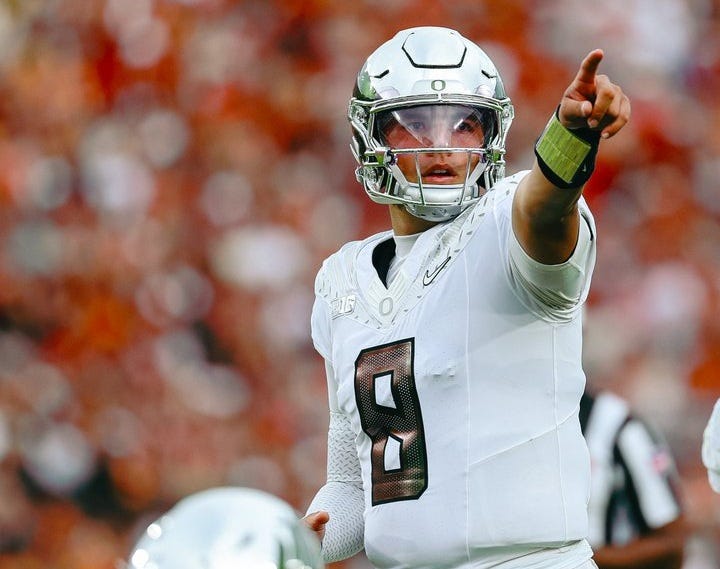
LOS ANGELES — In different ways, this game has been circled on the calendars since the Big Ten announced the schedule for this season. Oregon at USC. It would play a role in the playoff race as well as the Big Ten title chase. That was always going to be the case. But the Oklahoma State loss threw a different level of meaning into this game. The room for error was suddenly gone for the Ducks. While a loss at USC might not knock Oregon completely out of the playoffs, it would make every game for the rest of the 2026 season a playoff game.
For USC, the pressure has been on a little bit more as the Trojans had not quite lived up to the expectation that came with Lincoln Riley’s arrival from Oklahoma. There was a significant talent gap between the Trojans and the top of the Big Ten and it showed. Riley has done plenty to improve the talent level and there were expectations that the Trojans should be able to take that next step. Oregon was the measuring stick. A team that the Trojans had not taken down an Oregon team since the disastrous final season of Mark Helfrich’s tenure. Four losses over a decade. Eight losses in the last ten matchups.
This game mattered on many levels and the buildup over the week focused a lot on this history.
Yet the game would ultimately become about something nobody could have reasonably planned for. Oregon lost starting quarterback Dante Moore midway through the second quarter after a frightening late hit left him on the field for more than 15 minutes before he was taken away by ambulence to a local.
Dylan Raiola entered with Oregon trailing 7-3, immediately finished a touchdown drive and then spent the rest of the night looking considerably more like a quarterback who had been preparing for the moment than one suddenly thrown into it. Raiola completed 19 of 25 passes for 289 yards and two touchdowns without an interception, Dierre Hill Jr. accounted for 191 all-purpose yards and two scores, and No. 20 Oregon pulled away late for a 41-27 win over No. 12 USC.
It was not comfortable and it was not clean. For much of the second half, it was not even clear Oregon’s defense was going to be able to get USC off the field.
But when the Ducks finally needed one defensive possession to change the game, they got it. With Oregon leading 34-27 and 7:15 remaining, USC faced fourth-and-long near midfield after Nasir Wyatt helped collapse the pocket and Na’eem Offord held up in coverage.
Matayo Uiagalelei generated pressure again on fourth down, Brandon Finney closed on the football and knocked Jayden Maiava’s pass away. For the first time in five USC scoring possessions, Oregon had stopped the Trojans.
Then Oregon did something even more important. It finished them.
The Ducks took possession inside USC territory and methodically turned the defensive stop into an eight-play touchdown drive. Evan Stewart converted a fourth-and-3 with a short reception he turned into a 15-yard gain, Hill followed with consecutive runs that moved Oregon inside the USC 5 and Jordan Davison scored with 2:03 remaining.
What had been a 27-27 game with 12:41 left was suddenly 41-27. That final margin disguised just how uncomfortable the game had become.
A game changes in one moment
Oregon’s first objective was straightforward. The Ducks needed to show they could handle USC’s offense without allowing the Trojans to dictate the game with the run, then establish enough physicality offensively to prevent Gary Patterson’s defense from turning Oregon one-dimensional.
The defense accomplished the first part early, although USC moved the ball efficiently enough on its opening possession. The Trojans opened from their own 35 after Oregon intentionally squibbed the kickoff out of bounds, a decision that appeared designed to remove explosive returner Boobie Feaster from the equation, and mixed King Miller runs with Maiava’s passing while converting a fourth-and-short.
Oregon began generating pressure once USC crossed midfield. Jerry Mixon recorded Oregon’s first sack on second-and-6 from the Oregon 30, Devon Jackson tipped away a potential touchdown near the goal line and Bear Alexander added another sack to force a 33-yard field-goal attempt.
Caden Chittenden pushed the kick wide right, allowing Oregon to escape the opening possession without surrendering points. USC had moved the ball, but Oregon had survived.
The Ducks answered with a 10-play, 68-yard drive highlighted immediately by Davison’s 45-yard run behind an unbalanced formation. Jamari Johnson, back after missing the Portland State game, caught his first pass and Oregon moved inside the USC 25, but holding penalties on Emmanuel Pregnon and Kenyon Olesh repeatedly pushed the offense backward.
Dante Moore remained composed through it, and his protection held up on third-and-goal. He overthrew Messiah Hampton on a corner route, however, and Gage Hurych’s 30-yard field goal gave Oregon a 3-0 lead.
Those penalties mattered because Oregon did not consistently dominate the USC front despite Davison’s opening run. The Ducks were creative with formations and personnel early, but they were also repeatedly putting themselves in situations in which the defense could dictate the terms.
USC eventually capitalized when the Trojans took over at their own 42 early in the second quarter. They needed only four plays to go 58 yards, with Oregon getting the matchup wrong on Kaden Dixon-Wyatt and leaving the USC receiver working against Mixon.
Maiava exploited it for a 31-yard touchdown that put the Trojans ahead 7-3. Oregon’s next possession changed everything.
Moore stepped up beautifully against pressure and hit Johnson for 37 yards. On the following play, Moore again climbed the pocket and took off through the middle, sliding after another significant gain.
Then came the hit, and everything around the game seemed to stop. USC linebacker Desman Stephens arrived late and struck Moore as he slid, leaving Moore on the field while medical personnel worked around him.
The scene became uglier when Stephens celebrated during the aftermath, contributing to an unsportsmanlike sequence in which every player from both teams was assessed a penalty. Moore was eventually taken from the field on a cart, leaving Oregon to process the moment while still having to finish the game.
But this is football and much like life, the game has to go on. Oregon brought Dylan Raiola for the future, but that future got here sooner than expected.
At QB, you’re always one play away from being the guy, and Raiola was suddenly the guy. Oregon resumed from the USC 7, with Davison gaining four yards on first down before Raiola sold the run fake and quickly delivered the football to Stewart for a touchdown.
The Ducks led 10-7, and there was no warmup period or gradual introduction to the offense. Oregon simply handed the game to Raiola and asked him to keep it moving.
Raiola answers every question
USC tied the game at 10 when Chittenden converted from 38 yards with 5:32 remaining in the first half, but Oregon’s next possession provided the first real indication that the offense did not have to shrink because its starting quarterback had left the game. Raiola converted a third-and-5 when a tipped pass somehow found Hampton for 20 yards, and Oregon later converted fourth-and-short with Davison.
Raiola began showing the traits that would define his night — patience in the pocket, an ability to move when protection deteriorated and enough touch to attack USC’s zones without forcing throws. Johnson made what initially appeared to be a spectacular reception inside the 5, only for another holding penalty to erase it.
Oregon recovered anyway, with Raiola delivering a perfectly placed pass on third-and-long to move the chains before dumping the football to Hill for another 12 yards. The Ducks eventually reached the USC 1, and that was where the offense became too predictable.
While credit has to be given to the USC defense for the goal-to-go defensive stop at the end of the first half, I also thought that the offense was way too predictable on second and third downs. Straight up the middle runs, even with an extra OL and unbalanced lines, lacked any movement, or anything that would have told the defense that it could not simply key the run. If you take away Davison’s opening 45-yard run, he had 10 carries for 16 yards; the rest of the team had seven carries for 32 yards, so it’s not like the Ducks had been dominating the line of scrimmage.
Luke Wafle chased down Davison from the backside on third-and-goal, and Dan Lanning elected to take the points rather than gamble on fourth down. Hurych’s 19-yard field goal gave Oregon a 13-10 halftime lead after a 16-play, 76-yard drive that consumed 5:26.
Oregon had controlled 16:03 of the first half and outgained USC 234-166 despite Moore’s injury. The Ducks had 94 rushing yards to USC’s 50 and had sacked Maiava twice, but four penalties for 45 yards prevented Oregon from creating more separation.
What happened after halftime was significantly different because Oregon stopped pounding blindly into loaded boxes and immediately found space elsewhere. On the second play of the third quarter, Raiola flipped a quick sidearm screen to Hill and watched the play turn into a 52-yard gain.
Hill followed by finding a crease that moved Oregon to the USC 2. The Ducks brought three additional offensive linemen onto the field, but rather than simply hammering the ball between the tackles again, they pitched it to Hill for the touchdown.
Four plays, 75 yards and only 1:56 off the clock gave Oregon a 20-10 lead. It was the kind of response the Ducks needed coming out of halftime, but USC answered almost immediately.
Maiava repeatedly escaped pressure just long enough to extend plays, and the Trojans attacked Oregon’s defense horizontally as well as vertically. A back-shoulder throw to Feaster moved USC to first-and-goal, then Maiava kept the football against an Oregon defense committed to stopping the inside run and walked into the end zone.
The margin was back to three, and Raiola answered again. A poor snap nearly destroyed Oregon’s next possession, but Raiola secured the football and got it out to Hill.
On third-and-10, Johnson split the defense for a 34-yard gain. Hill later took another short pass, made USC defenders miss on the perimeter and turned it into 28 yards before scoring on a 4-yard run behind strong blocking on the right side.
Oregon’s seven-play, 75-yard response needed only 2:41. The lead was back to 27-17, and that became the rhythm of the second half as USC pushed and Oregon answered.
Waiting for the defense
The uncomfortable part was that USC kept pushing. Oregon’s defensive front produced its best pressure of the season for stretches, particularly from Alexander and A’Mauri Washington, and the Ducks remained mostly stout against interior runs.
Yet Maiava continued finding ways around that pressure, drifting backward when the pocket collapsed and buying enough time for receivers to uncover. USC drove inside the Oregon 15 late in the third quarter and faced fourth-and-3 from the 12.
Riley initially kept the offense on the field before an Oregon timeout changed the decision. Chittenden kicked a 29-yard field goal instead, cutting the lead to 27-20, and Oregon went three-and-out on the possession that followed.
USC came right back, and in a tight game, one defensive stop can make the difference. USC made a stop to get the ball back in a game where the Ducks had not yet done much to stop the USC offense. In the first six possessions, excluding the one second-quarter possession headed to halftime, Oregon had forced just one punt, on the second drive of the game, giving up two touchdowns and two field goals on the next four possessions. The Ducks had done a good job matching offensively with USC, but would need the defense to make a stop or make a play to swing the momentum and create a little more separation.
Instead, USC tied it. Maiava used a 22-yard completion and another 12-yard connection with Dixon-Wyatt to reach Oregon territory, then Miller gained 10 on a counter before Maiava found Tanook Hines running free for an 11-yard touchdown.
Five consecutive meaningful USC possessions had produced points, making it 27-27 with 12:41 left. If Oregon was going to win, it appeared the offense might have to keep scoring because the defense had not yet demonstrated it could string together an entire possession without a breakdown.
There had been good individual plays, plenty of pressure and several well-covered throws, but the Ducks had not sustained their discipline long enough to stop USC from eventually finding the mistake. Raiola answered one more time, beginning with a 17-yard connection to Johnson early in the possession.
A false start eventually put Oregon into third-and-15, but USC gave the Ducks new life with a roughing-the-passer penalty. Raiola then moved outside the pocket and found Dakorien Moore for a first down at the USC 31.
A few plays later, Oregon faced third-and-6 and Raiola delivered perhaps his best throw of the night. He dropped the football deep to Moore for a 29-yard touchdown that restored Oregon’s lead at 34-27 with 8:35 remaining.
For everything Raiola had already done, USC could still answer unless Oregon’s defense finally changed the equation. This time, it did.
One stop changes the game
Maiava opened USC’s next possession by going deep for Hines, but Ify Obidegwu stayed in position. Maiava found Zachariah Williams on second down to move the ball to the 46, but a short run and an incompletion left USC facing third-and-7.
Wyatt generated pressure while Offord stayed connected downfield, leaving USC facing fourth-and-long. Uiagalelei created pressure again and Finney broke on the football, knocking down Maiava’s fourth-down pass.
It was officially only a turnover on downs, but within the context of this game, it felt much bigger. Oregon had spent most of the night waiting for one defensive series that would allow the offense to stop matching USC score for score.
The Ducks finally had it, leading by seven with 7:15 remaining and taking possession already across midfield. Now the offense had to capitalize.
Oregon began conservatively with a 3-yard run, then Hampton caught a pass just short of the sticks. Wafle blew up Davison on third-and-short, leaving Oregon facing fourth-and-3, and Lanning left the offense on the field.
Raiola got the football quickly to Stewart, who turned upfield and gained 15 yards. That conversion changed the drive, giving Oregon the chance to start working the clock while continuing to attack USC.
Hill ripped off another run to the USC 13, stayed in bounds on another carry to keep the clock moving and then powered inside the 5 for first-and-goal. Davison finished it with a touchdown at 2:03, giving Oregon its first two-score lead since early in the third quarter.
More importantly, the Ducks had taken the defensive stop and turned it into exactly what USC could least afford — points and nearly five minutes disappearing from the game. While the Ducks had what seemed like a comfortable enough advantage with the two-minute timeout at hand, they really could not afford to relax. USC still had plenty of playmakers that could break one to the house and being disciplined in coverage and tackling would matter as the Trojans took possession back. The Ducks needed to not just ‘hang on’ for this game, but control it.
They did exactly that, with Peyton Woodyard separating Mackenzy Bowman from the football on one reception and Washington batting away another Maiava pass. USC repeatedly reached fourth down and kept the possession alive, but the clock became an opponent the Trojans could not beat.
With 13 seconds remaining, Maiava threw one final deep ball toward the end zone and Koi Perich intercepted it. Four seconds remained, and in a fitting way, this was the best thing because Dylan Raiola would be able to take a knee and then hold up ‘Fives’ for Dante Moore.
More than the backup quarterback
Raiola’s final line is going to command most of the attention, and it should. He entered unexpectedly in one of the biggest games on Oregon’s schedule and completed 19 of 25 passes for 289 yards and two touchdowns.
He did not turn the ball over and was not sacked, finishing with a passer rating of 199.5. Combined with Moore’s eight completions in 10 attempts before the injury, Oregon quarterbacks finished 27 of 35 for 366 yards and two touchdowns.
But reducing this game only to what Raiola did would miss how Oregon survived it. Johnson was exceptional in his return, catching all seven passes thrown his direction for 119 yards.
Stewart caught seven passes for 56 yards and a touchdown, but his fourth-down conversion late may have been more valuable than any of them. Dakorien Moore caught three passes for 42 yards, including the 29-yard touchdown that broke the fourth-quarter tie.
And then there was Hill, whose impact stretched across nearly every area of Oregon’s offense. The freshman finished with 63 rushing yards and two touchdowns on 15 carries, caught four passes for 105 more yards and added 23 yards on his only kickoff return.
His 191 all-purpose yards repeatedly turned routine plays into something USC could not contain. The numbers also reveal something important about the way Oregon won.
The Ducks and Trojans finished with identical 35% offensive success rates and identical 42% rushing success rates. USC actually generated 14 explosive plays to Oregon’s 12, but Oregon’s explosives were more damaging.
The Ducks gained 329 yards on those 12 big plays compared with USC’s 276 on 14. Oregon also averaged 10.5 sack-adjusted yards per pass attempt compared with USC’s 7.2, another significant difference in a game where both teams created explosive opportunities.
The contrast became even more pronounced on third down. Oregon converted six of 12 while USC converted only two of 11.
Raiola and Moore combined to complete eight of nine third-down passes for 141 yards, producing six first downs while averaging 15.7 yards per attempt. USC’s third-down passing game produced only 25 yards on seven attempts.
That was the hidden difference in a game where both offenses spent long stretches moving the football. Oregon kept finding ways to extend possessions, while USC too often needed fourth down to do it.
Oregon finished with 504 yards, averaging 7.4 yards per play, while USC finished with 446 at 5.9 per snap. The Ducks were perfect on two fourth-down attempts, scored on all six red-zone possessions and finished without a turnover.
USC was productive enough to make Oregon uncomfortable nearly the entire night, but Oregon was efficient enough to eventually make that irrelevant. The Ducks arrived in Los Angeles needing to prove they could respond after Oklahoma State, only to be forced to answer a much more difficult question when their starting quarterback was carted off the field in the second quarter.
They found the answer in Raiola, and then finally found the defensive stop to go with him. That combination turned a game that felt like it might come down to the final possession into a 14-point Oregon win.
PLAYER OF THE GAME: Dylan Raiola
There are plenty of arguments for Hill after 191 all-purpose yards and two touchdowns, but the circumstances make Raiola the player of the game. He entered with Oregon trailing after watching Moore leave the field on a cart, completed his first drive with a touchdown pass and never allowed the offense to lose its identity.
Raiola finished 19 of 25 for 289 yards and two touchdowns, did not turn the ball over and repeatedly solved USC when Oregon found itself behind the chains. His 29-yard touchdown to Dakorien Moore on third down in the fourth quarter may have been his best throw, but the larger story was that his performance never felt like emergency quarterback play.
KEY PLAY: Brandon Finney’s fourth-down breakup
Raiola’s touchdown throw to Moore gave Oregon the lead, but Finney’s fourth-down breakup with 7:15 remaining changed the structure of the game. USC had scored on five consecutive meaningful possessions and had erased Oregon’s advantage every time the Ducks appeared ready to create separation.
Pressure from Uiagalelei forced Maiava to make the throw before he wanted to, and Finney finished the play. Oregon took possession inside USC territory, converted a critical fourth down of its own and drove for the Davison touchdown that turned a seven-point game into a 14-point margin.
KEY STAT: USC went 2-for-11 on third down
USC finished with 446 yards, 26 first downs and 27 points, numbers that make it difficult to describe Oregon’s defensive performance as dominant. But the Trojans converted only two of 11 third downs, compared with Oregon’s six conversions on 12 attempts.
The contrast was even larger through the air. Oregon completed eight of nine third-down passes for 141 yards and six first downs while USC went two of seven for 25 yards and one first down. In a game where USC repeatedly survived by converting fourth downs, Oregon’s ability to win third down ultimately gave the Ducks more opportunities to control when possessions ended — and, finally, when the game did.
UP NEXT
Oregon gets a chance to exhale before the next stretch of the season. The Ducks are off next week, giving them time to recover physically, evaluate the areas that still need to be cleaned up and, most importantly, get a clearer picture of Dante Moore’s status after he left the USC game in the second quarter.
Oregon returns to Autzen Stadium on Oct. 10 to face UCLA. The bye comes at a useful time after an emotionally and physically demanding trip to Los Angeles, but it also gives the Ducks two weeks to build on what worked against USC and address the inconsistencies that kept the game tight deep into the fourth quarter.