Practice has narrowed, film study has expanded, the run game has a specific point of emphasis and Oregon is already rehearsing its first road trip. Here is what we learned this week that hasn’t been part of the larger conversation.
The easiest part of football to see is Saturday. We see the touchdown, the missed tackle, the explosive run, the penalty and eventually the final score. By the time most of us start forming opinions about what happened, the players are already moving into the part of the process we rarely get to watch.
That may be the most interesting thing I took away from Oregon this week.
The Ducks had plenty to correct after a 34-27 win over Boise State that was considerably more difficult than expected, but the conversations around the program have gradually moved away from what happened and toward what comes next. What stood out wasn’t some dramatic schematic overhaul or a sudden change in philosophy. It was how specific the work has become.
A running back is thinking about his offhand punch and driving his knees through contact. A defense has narrowed its practice menu to the calls most likely to matter against Oklahoma State. A linebacker can trace the snaps he earned Saturday back through months of speed work, weight-room sessions and extra time in the playbook.
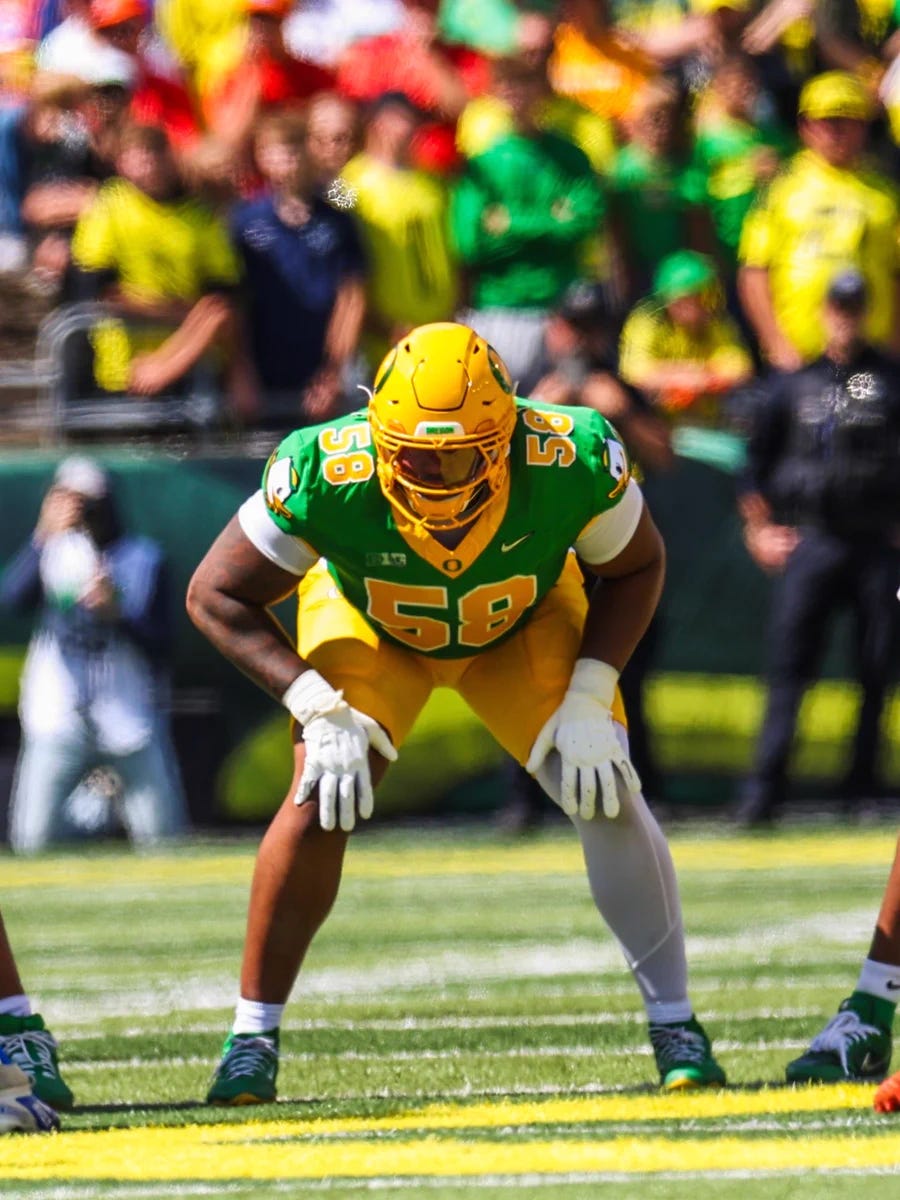
And a young left tackle who finally earned his first start came away from it thinking almost immediately about how much farther he wants to go.
That last part felt familiar to me.
I Had Seen This Version of Ziyare Addison Before
Long before Ziyare Addison became Oregon’s starting left tackle, I had the opportunity to watch him closely in Hawaii during the 2025 Polynesian Bowl week. What I remember most wasn’t his size or recruiting ranking. It was how often he seemed to be searching for one more thing he could learn.
After practices, Addison would linger around the offensive line coach. During breaks, he would find opportunities to ask questions. Some were about technique, others about scheme, assignments or why something worked the way it did. It wasn’t performative. Most people had already started moving on while Addison was still trying to pull one more piece of information from somebody who knew more than he did.
There was another moment that week that had nothing to do with football.
During our visit to Shriners Children’s hospital, the Polynesian Bowl announced a partnership with the hospital and the governor of Hawaii attended the event. Addison eventually moved off to the side and struck up a conversation with him. What caught my attention was that the discussion wasn’t centered on Oregon, recruiting or football. Addison wanted to talk about things outside his own world.
That moment stuck with me because it seemed connected to the same curiosity I had watched on the practice field. He wanted to understand more, whether that meant becoming a better offensive lineman or simply becoming a person capable of adding something worthwhile to the world around him.
We’ve seen pieces of that bigger picture since. Addison later drew attention for buying pizzas for people in need and personally helping deliver them. Even during Polynesian Bowl week, the football version of that curiosity kept showing itself. After one practice, he spent extra time working with former NFL offensive tackle Taylor Lewan, again looking for another voice, another technique and another way to improve his craft.
So when Addison was asked this week what happened after finally earning his first Oregon start, his answer didn’t surprise me nearly as much as it might have a year ago.
“I don’t see how people get complacent with the game, especially if you love it,” Addison said. “Me being out there, I’m just hungry for more. I’m like, shoot, since I’m out there, now I’m going to start at how I could be a first-round pick.”
That could sound like another young player’s NFL ambition if the answer ended there. It didn’t.
“I see myself as a first-round pick,” Addison continued, “so now I’m just attacking it way harder, just trying to get all the ins and outs and the details of how I could be the best version of myself that I could be.”
That is the part that matters.
The first start didn’t become a reward for everything Addison had already done. It became evidence of what might be possible if he does more. That was the player I remember from Hawaii, constantly asking another question and looking for another lesson. Oregon has now reached the point where all of that curiosity is starting to show up on Saturdays.
Addison said he went through his Boise State tape with offensive line coach A’lique Terry and others on the staff, looking specifically for the technical details that could improve immediately.
“I just go back to the drawing board, discuss everything with them, and then attack it at practice today,” Addison said. “Just trying to find bits and pieces of my game that I can improve to be the best version of Ziyare Addison I can be.”
There is something powerful about that progression. He wanted to know more when he was a recruit. He wanted to know more when he was buried on Oregon’s depth chart. Now he is starting at left tackle, and apparently the questions haven’t stopped.
They have simply changed.
Oregon’s Week Has Started to Look the Same Way
Addison may be the clearest example, but that search for another detail showed up throughout Oregon’s media availability this week.
Aaron Flowers gave perhaps the simplest explanation of how practice itself changes once fall camp gives way to the season. During camp, Oregon has the freedom to work broadly. Coaches can install, experiment and revisit large portions of the playbook because the opponent is still theoretical.
That changes once there is somebody specific on the other sideline.
“During game weeks, we have certain plays that we’re going to be more harped on than others,” Flowers said. “So that’s really the main difference in practice.”
Dan Lanning filled in some of those details Wednesday. Oklahoma State’s offense presents a different type of challenge because the Ducks may not get many traditional opportunities to simply unleash the pass rush.
“There’s going to be limited opportunities when it comes to rushing the passer because it’s going to be sideline to sideline,” Lanning said. “They’ll go screen, screen, screen. Try to run the ball, trick play, trick play.”
Oregon’s offense has its own set of problems to solve against Oklahoma State’s simulated pressures and defensive change-ups, and that is where a game week becomes less about doing everything and more about doing the right things repeatedly.
“I thought overall we had a good practice and attacked some things well today,” Lanning said. “So, still prepping, ready to roll.”
Flowers also offered an interesting glimpse into how Oregon is handling an Oklahoma State roster that turned over almost completely. With so little film of these particular players wearing Cowboys uniforms, the Ducks have expanded the search backward into the history of the coaching staff and the schemes those coaches have used elsewhere.
“It’s harder because you’re not used to seeing the team that you’re used to seeing on film,” Flowers said. “So you have to look up past year’s film and look at what coordinators do.”
Then he summarized the philosophy in a way that was almost too simple.
“At the end of the day, coordinators do what they do,” Flowers said. “You just look at the plays, not really the players.”
The more I thought about that answer, the more it fit the larger theme of the week. Good preparation often isn’t about finding some hidden secret. It is about knowing where to look, asking the next question and continuing until the picture gets a little clearer.
Sometimes Improvement Is One Defender
Jordon Davison described the same process in much smaller terms.
We can make Oregon’s running game against Boise State into a fairly large discussion if we want. There are offensive-line combinations, run-pass balance, early-down efficiency and plenty of other ways to analyze what happened. Davison’s version was much simpler.
“I feel like us as a room left a couple opportunities just being one tackle away from breaking a long one,” Davison said. “Breaking more tackles and creating explosives in the run game was a big emphasis over the weekend.”
That means at least part of Oregon’s response wasn’t going back to the drawing board and inventing something new. It was recognizing that some of the desired results may already have been sitting one defender away.
Asked what that means for him individually, Davison didn’t speak in generalities.
“Being able to make that one guy miss, using an offhand punch and just working on knee drive,” he said, “just driving my legs out of tackles.”
That is the invisible part of football that fascinates me.
If Davison breaks that tackle Saturday and turns a six-yard run into 35, the television replay will show the finish. The box score will record the explosive play and somebody will eventually point to Oregon’s improved rushing numbers.
The actual improvement may have happened Tuesday afternoon when a running back spent another repetition working an offhand punch.
Dylan Williams’ Saturday Started Months Ago
Dylan Williams offered another version of the same lesson.
His increased role against Boise State looked like a Week 1 development from the outside. Williams knew better because he could trace those snaps backward through an offseason built around making himself impossible to ignore.
“I’ll say number one, mentality,” Williams said. “I have the mentality going into it that I’m going to outwork anyone. I’m not going to let anyone outwork me. And whether I get to play or not, it is what it is. Just be able to help my team out as much as possible.”
Then he described what that actually looked like.
“One of my main goals was to get bigger, faster and stronger,” Williams said. “Working with Coach Bolt with speed, had a few one-on-one sessions with him, and then being in the weight room with Coach Love and Coach Kinsey, developing my body.”
There was another layer after the physical work.
“The last part, obviously, football,” Williams continued. “Just meeting with B-Mike like once or twice a week, just going over the playbook and getting everything dialed in. And then we’ll have summer walkthroughs and everything will just start clicking from there.”
That progression matters because the opportunity only looked sudden if you started watching Saturday.
The Boise State game was simply where everyone else finally got to see the result.
The Work Between Saturdays
Lanning even described Oregon’s first road trip in similar terms. He doesn’t want the airplane, the hotel, the environment or the early kickoff to become things his players process for the first time when they experience them.
He wants them thinking through those situations before the Ducks ever leave Eugene.
“I think it’s always about painting the picture of what’s going to happen,” Lanning said. “What’s it going to look like on the airplane? How do we prep for that? What’s it look like when we get to the hotel? How do we prep for that? What’s the environment going to be like? What do you expect? What do you expect to see? And then what are our expectations for you?”
There is a consistency to all of this that I probably didn’t appreciate until listening back through the week’s interviews.
Addison asks questions until he understands more. Flowers describes practices narrowing toward the situations Oregon expects to encounter. Davison identifies the single defender standing between a normal run and an explosive one, then works on the technique required to beat him. Williams can list the individual sessions and meetings that eventually turned waiting into playing time. Lanning wants even the experience of traveling to feel rehearsed before it happens.
None of it is particularly glamorous.
That might be the point.
We spend most of a football season looking for evidence of improvement on Saturdays, when the scoreboard makes everything easy to measure. The players doing the improving experience it differently because Saturday is usually only the final step in a process that began somewhere nobody was watching.
That is why Addison’s answer stayed with me.
“I don’t see how people get complacent with the game, especially if you love it.”
I had seen that curiosity in Hawaii before he ever played a meaningful snap for Oregon. I saw it after practices when he kept asking questions, with Taylor Lewan when another practice was already finished, and even during a hospital visit when football temporarily wasn’t the most interesting thing in the room.
Now Addison has his first start.
His response was to ask how he gets better from here.
That may be the most powerful reminder Oregon gave us this week. The visible part comes Saturday, but development usually happens somewhere else — in another meeting, another conversation, another repetition or one more question after everyone else has decided the workday is over.
The game gives us the result.
The work between Saturdays explains where it came from.