


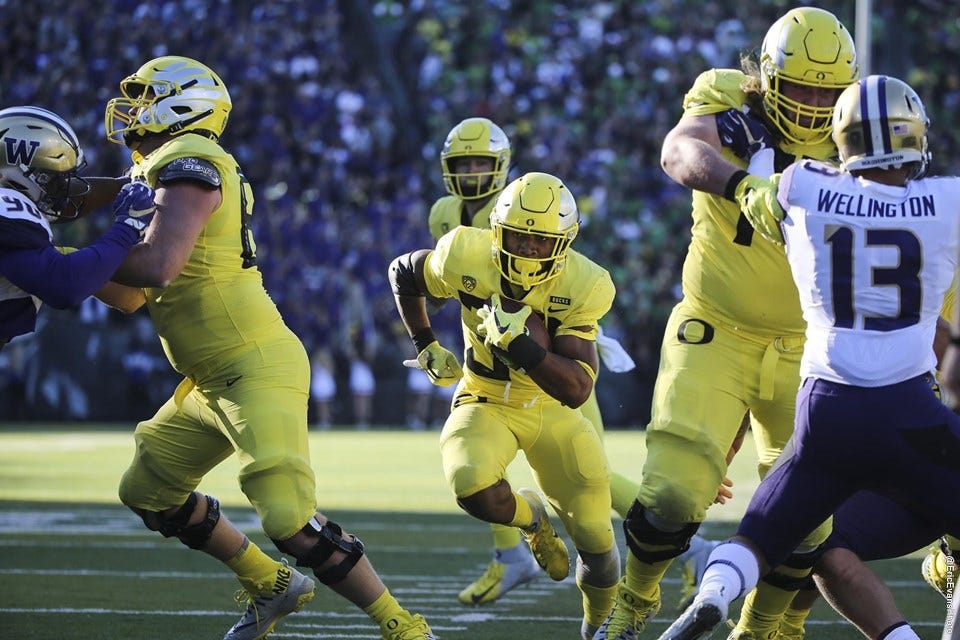
In 2013, Oregon headed into a newly renovated Husky Stadium and the Duck-Husky rivalry seemed as one-sided as ever. Time and the coaching carousel have changed who has been on top in the years since, but neither has done much to extinguish the fire between the two fan bases. Even the demise of the conference in which this rivalry developed couldn’t separate the two schools. They simply packed up their animosity and took it to the Big Ten.
Most consider the series to have been reinvigorated in 1994. While that isn’t entirely true, it was, in many ways, reborn the moment Oregon believed it could compete with Washington with more than just an occasional moment of good fortune. Kenny Wheaton’s interception will forever be the defining image of that afternoon, but what changed that day was how Oregon viewed itself relative to Washington. The Ducks could compete with the Huskies on talent, and that was monumental.
For those of us who grew up watching Oregon football in the 1970s and 1980s, Washington represented much of what we wanted Oregon to become. Of course, there was also a certain arrogance emanating from Seattle that made it particularly enjoyable when the Ducks eventually surpassed the Huskies.
I’ve been writing some version of this column every year since 2017. Going back through those columns is an interesting exercise because so much has changed about the circumstances surrounding the games, yet the underlying sentiment remains virtually unchanged. Each generation of Oregon and Washington fans seems to inherit a healthy portion of the resentment from the generation that preceded it.
Apples, as they say, don’t fall far from their trees. College football in the Pacific Northwest has spent decades proving the point.
The changing balance of power
For years, much of the bitterness surrounding Oregon’s rise to national prominence was rooted in the perception that the Ducks had purchased their way into college football’s elite. Washington fans frequently pointed to Oregon’s investment in athletic facilities as some sort of unfair advantage.
I’ve noted in previous versions of this column that the $281 million renovation of Husky Stadium cost more than the 2002 expansion of Autzen Stadium, the Jacqua Center, the Hatfield-Dowlin Complex and Matthew Knight Arena combined. Washington also had a considerably larger alumni base from which to solicit financial support. The notion that Oregon was somehow competing under a different set of financial circumstances never made much sense to me.
What the money did was enhance a foundation Rich Brooks and Mike Bellotti had spent years building. Better player development produced better results, which gradually made Eugene a more attractive destination for talented athletes who previously might not have considered forsaking the beaches and sunshine for the fog and rain of winter in the Willamette Valley.
Washington’s struggles with coaching hires in the early 2000s also opened a door for Oregon to establish a recruiting foothold in the Northwest that would have been almost unimaginable a decade earlier. The Ducks were getting better players, developing them and beating Washington with them. No amount of complaining about Oregon’s facilities was going to change that.
The financial argument seems particularly antiquated today. College football has largely abandoned the pretense that money isn’t a significant component of recruiting, and Washington is competing under the same general realities as Oregon. Both programs are spending considerable sums of money trying to assemble championship-caliber football teams.
As we’ve learned at Oregon this season, however, assembling a talented football team and getting that team to play good football can be two remarkably different things.
The finger point
It’s been 10 years since Jake Browning pointed at an Oregon defender on his way into the end zone at Autzen Stadium. After 12 consecutive Oregon victories in the series, there was something particularly humiliating about watching a sophomore quarterback taunt the Ducks while the Huskies were in the process of putting 70 points on the scoreboard.
I’ve never forgotten how that afternoon felt. It wasn’t simply that Oregon was losing to Washington. It was watching the culmination of several years during which the program had gradually lost some of the qualities that had made it successful. Washington exposed all of it in front of a home crowd that had grown accustomed to celebrating this particular Saturday.
The Huskies would go on to participate in the College Football Playoff, while Oregon would dismiss its coaching staff and begin the process of rebuilding. When Washington dispatched the Ducks 38-3 in Seattle the following season, Husky fans were understandably enthusiastic about the possibility of embarking on their own 12-year run of dominance.
Then CJ Verdell ran into the end zone in overtime at Autzen Stadium in 2018.
By that point, Oregon was recruiting at a level we hadn’t previously experienced. There would be some frustrating moments over the next several years, including three consecutive losses to Washington in 2022 and 2023, but the foundation of the program was considerably healthier than it had been when Browning made his memorable trip into the end zone.
There is a lesson in that history for both fan bases. Washington fans spent much of my childhood believing their superiority over Oregon was simply the natural order of things. Oregon fans eventually developed much the same attitude toward Washington.
Neither was particularly well prepared for the afternoon when that belief collided with reality.
A season we didn’t anticipate
Had someone told me in August that Oregon would enter the Washington game with an opportunity to reach the Big Ten Championship Game, I wouldn’t have been particularly surprised. Getting there with four losses in seven games seemingly waiting around the corner in October was certainly not something I envisioned.
When the Ducks fell to 4-3, I wondered whether the best we could reasonably hope for was a strong finish that would generate some optimism heading into 2027. Oregon had lost Dante Moore, the offense was undergoing substantial changes and there were legitimate questions about whether the problems we’d been discussing since September could be corrected during the season.
What we’ve learned about this football team over the past month is considerably more interesting than what we might have learned had Oregon simply won the games it was expected to win in September and October.
The Ducks haven’t suddenly become healthy. The offensive line hasn’t been without its problems, and Dylan Raiola is still working through the challenges of taking over an offense that wasn’t initially built around him. There have been stretches during this four-game winning streak when Oregon hasn’t played particularly well.
That was part of what made the win at Ohio State so gratifying. Oregon fell behind by 14 points in a stadium where the Buckeyes hadn’t lost a game after establishing that kind of lead in 25 years. Given everything we’d seen from Oregon earlier in the season, there was little reason to assume the Ducks were going to find their way back into that football game.
They did, and they won it by 13 points.
I think we sometimes lose sight of the human component of a season like this because we’re so preoccupied with what happens on the next Saturday. These players entered the season with championship expectations and spent much of October watching those expectations seemingly disappear. They lost their starting quarterback, experienced changes within the coaching staff and heard people questioning the direction of the program.
It would have been easy to spend the final month of the season going through the motions, particularly in an era when some players might already have been thinking about where they would be playing next season. Instead, Oregon has won four consecutive games and given itself a chance to play for a conference championship.
I’ve covered Oregon teams that were considerably better than this one. But there is something about watching a team salvage a season that makes me appreciate the individual accomplishments a little differently.
Washington would love nothing more
Whatever disappointment Washington fans might have about their own season would be considerably easier to stomach if the Huskies could finish it by destroying Oregon’s postseason aspirations. Anyone who has followed this rivalry for any length of time understands how satisfying that would be for the people in Seattle.
There is also enough talent on this Washington football team to make me uncomfortable about Saturday’s game. After spending much of the week examining the Huskies, I can see how they’ve managed to lose four games. I can also see how they could make Oregon’s afternoon considerably more difficult than some fans anticipate.
Much of that starts with Demond Williams Jr. Washington has experienced problems protecting its quarterback, but there is a considerable difference between getting pressure on Williams and getting him on the ground. His ability to escape the pocket and turn a relatively innocent play into an explosive gain makes him particularly dangerous against a defensive front that likes to get after the quarterback.
For all the good things we’ve seen from Oregon’s defense this season, Saturday will require some restraint from individual players. There will be opportunities to pursue Williams that are probably better left alone if doing so compromises the integrity of the defense. Sometimes the best thing a defensive end can do against a quarterback like Williams is resist the temptation to make the play himself.
Washington’s secondary also presents some concerns. The Huskies have been opportunistic in the passing game, and Oregon has experienced enough offensive inconsistency this season that I’m not particularly interested in seeing Raiola attempt to force the issue downfield.
I’ve never entirely subscribed to the notion that records go out the window in rivalry games. Better football teams generally remain better football teams, regardless of the respective uniforms. But Washington doesn’t need to be better than Oregon over the course of an entire season to accomplish what it wants to accomplish Saturday.
The Huskies need to be better for about three and a half hours.
What makes this game different
There is an interesting recruiting weekend taking shape in Eugene, and several younger prospects will experience a game at Autzen Stadium for the first time. Among them is 2028 defensive back Jordan Hicks, whose previously scheduled visit for the Michigan game was derailed by the FAA ground stop.
I mentioned in this week’s recruiting primer that Hicks has taken notice of Oregon’s response to the difficulties it experienced earlier in the season. The Ducks’ ability to recover from their October struggles appears to have resonated with him. That’s an interesting perspective from someone evaluating where he might eventually play college football.
Saturday will give him a glimpse of something he probably can’t fully appreciate through conversations with the coaching staff.
There will be people in Autzen Stadium who remember when beating Washington was an extraordinary accomplishment. There will be others who grew up during Oregon’s 12-game winning streak and had never experienced losing to the Huskies until 2016. Some of the younger fans were introduced to this rivalry through the frustrations of 2022 and 2023.
The respective histories of those fans are considerably different, yet they’ll walk into the stadium Saturday with much the same feeling about Washington. I’ve always found that interesting, particularly as college football has become a sport in which so many of the traditional connections between players, universities and their communities have changed.
The players don’t necessarily grow up disliking Washington the way many of us did. Some might even find themselves playing for the other school at some point in their college careers. But the people sitting in the stands have been carrying the emotional baggage of this rivalry for decades.
There is no amount of conference realignment or television revenue that can manufacture that kind of history.
GAME NOTES & THOUGHTS:
After spending much of the week digging into the numbers and the individual matchups, I keep coming back to Oregon’s defense. The Ducks have the better defensive front, and Washington’s inability to consistently sustain offensive possessions gives Oregon a distinct advantage if it can keep Williams from extending plays with his legs.
Washington has converted roughly a third of its third-down opportunities this season. That isn’t particularly encouraging for an offense facing an Oregon defense that has been the most dependable component of this football team. The concern is that Williams doesn’t necessarily need to convert three or four third downs to get Washington into the end zone. One breakdown in pursuit can accomplish much the same thing.
I would expect Oregon to be conscious of that when deciding how aggressively to pursue pressure. There will be opportunities to get to Williams, but I’d rather see the Ducks force him to make difficult throws from the pocket than create situations in which he has open space in front of him.
Offensively, I’d like to see Oregon establish the running game early. Brandon Smith’s emergence has been particularly timely given the uncertainty surrounding the health of the running back room. Getting productive yardage on first down would allow Raiola to operate in more favorable circumstances against a Washington secondary capable of punishing mistakes.
Dakorien Moore is another player I think could have a significant impact on this game. There is value in getting the ball into his hands without necessarily asking Raiola to make difficult downfield throws. Moore’s ability to create yardage after the catch could help Oregon sustain possessions while limiting some of the opportunities Washington’s secondary thrives on.
More than anything, I don’t want Oregon giving Washington short fields. The Huskies have enough offensive talent to take advantage of favorable circumstances, but they haven’t been consistently good enough at sustaining long drives to make me believe they can score frequently against Oregon’s defense without a little help.
Of course, discipline has been an issue for Oregon at various points this season. A holding penalty that puts the offense behind the chains, an unnecessary personal foul or a turnover could be particularly costly in a game where I expect the Ducks to have the advantage if both teams are forced to execute over the length of the field.
I don’t think Oregon needs an exceptional offensive performance to win this game. It needs an efficient one, and I think there is enough evidence over the past four weeks to believe the Ducks are capable of providing it.
I’m going with Oregon to win 31-20. I suspect Williams will make enough plays to keep things uncomfortable for a while, but I trust Oregon’s defense to eventually dictate how this game is played.
One more thought
In 2013, I wrote that as long as Oregon continued to find creative ways to stay ahead of the curve and avoided falling victim to complacency, there was little reason to fear the future.
Thirteen years later, I still believe that, although I probably have a greater appreciation for how difficult it is to sustain success. Some of the advantages Oregon enjoyed during its rise to national prominence have become commonplace among the better-funded programs in college football. Finding the next advantage is considerably more difficult than it was when the Ducks were disrupting the established order of the sport.
Perhaps that’s why this past month has been so enjoyable for me. For all the money invested in Oregon football, the recruiting successes and the resources available to Lanning, none of those things could guarantee that the people inside the Hatfield-Dowlin Complex would find a way to salvage this season.
We’ve spent much of the year talking about what Oregon doesn’t have, what it has lost and what it hasn’t done particularly well. Saturday, I think, is a good opportunity to appreciate what this team has accomplished since the middle of October.
A little more than a month ago, there was genuine uncertainty about whether Oregon could make anything meaningful out of the remainder of its season. Now, the Ducks enter the final Saturday of November with a chance to play for a championship.
And the Washington Huskies would love nothing more than to take it away from them.
After all these years, isn’t that exactly how we’d want it?
All for now!