


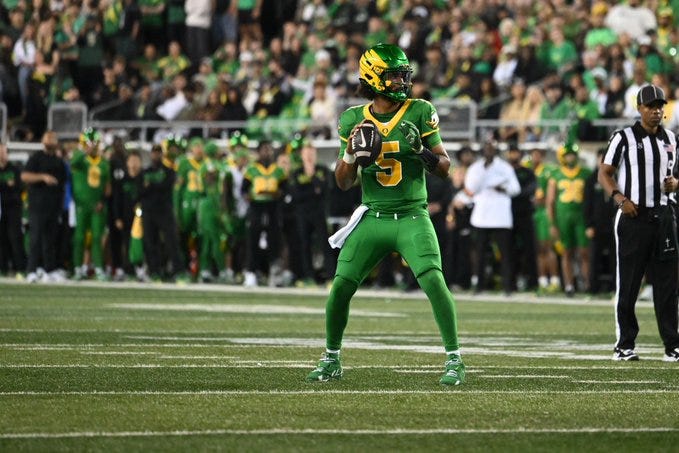
Early season Friday games have a unique appeal. Often the matchup is not what fans relish - but with students starting to move in, and a day that started cloudy with pleasant temperatures turned into an almost perfect late summer day with Eugene spending a good portion of Friday afternoon under blue skies and September sunshine, the temperature settling comfortably into the mid-70s before the shadows began to stretch across the Willamette Valley.
By kickoff, the sun was gone and Autzen Stadium suddenly basked in the glow of the pink sunset that faded into football under the lights.
There is something different about football at night, especially after a week spent carrying around the ‘beast of burden’ that came before. The mistakes feel farther away. The noise feels a little louder. The field seems a little brighter. And for a few hours, at least, the game gets to become simple again.
For Oregon, maybe that was exactly what this particular Friday night needed to be.
This wasn’t about erasing the previous two weeks. It was not an opportunity to prove that every problem had suddenly vanished. It was just another game, under the lights, and a chance to put the beast down long enough to play football again.
In a game that was expected to be a blowout, there was no surprise. Oregon opened as 57.5 point favorites, found a way to cover that spread and still left some things for film review that will need some additional cleanup.
Oregon did considerably more than that Friday night, overwhelming Portland State 84-0 in a game that was effectively settled before halftime. The Ducks scored touchdowns on each of their seven first-half possessions, rolled up 723 yards of total offense and spent most of the night looking like the prepared, precise and varied football team that had been noticeably absent during stretches of the first two weeks.
That distinction matters, even if the opponent requires some perspective. Portland State entered the night winless and was physically overmatched almost everywhere, so an 84-point victory does not suddenly answer every question raised by Oregon’s previous performances. The Ducks could only control their own preparation and execution, however, and both were substantially better Friday night.
It started with an offense that looked less predictable almost immediately. After Oregon’s tendencies became one of the major talking points coming out of Oklahoma State, the Ducks altered some of their pre-snap presentation, showed more variety in their formations and used motion and misdirection to make the defense process more information before the snap.
One of the best examples came on Oregon’s opening possession. Facing second-and-10, Drew Mehringer showed action to one side before Dierre Hill Jr. slipped the other direction for a shovel pass that went 29 yards, setting up a Jordon Davison touchdown on the next play. It was only one play against an inferior opponent, but it represented the kind of tendency-breaking creativity Oregon had not shown consistently enough during its first two games.
That continued throughout a first half in which Oregon produced points almost at will. Dante Moore threw touchdown passes of 45 yards to Dakorien Moore and 39 yards to Evan Stewart in the first quarter, then found Kendre Harrison and Messiah Hampton for scores in the second as Oregon built a 49-0 halftime advantage.
More encouraging than the score was how comfortable Moore looked running the offense. He moved through his progressions, stood in the pocket when his first read was not available and generally put the football where it needed to go. His final line — 19-for-23 for 280 yards, four touchdowns and no interceptions — reflected an evening in which very little looked difficult.
There was one throw over the middle that probably should have resulted in his first interception of the season, and Portland State generated a sack when nobody came open later in the first half. Those moments offered something useful for the film room without significantly changing what was otherwise an efficient performance from Oregon’s starting quarterback.
The offensive line also looked more cohesive than it had a week earlier. Oregon continued to experiment with combinations up front, but the group featuring Poncho Laloulu in the middle, Dave Iuli and Emmanuel Pregnon? Actually, Oregon’s rotation itself mattered less than the broader result: the Ducks were cleaner technically, protected Moore well for most of his night and eventually began generating consistent movement in the running game.
The latter took a little longer to develop. Oregon’s passing game created most of the early explosives, while the traditional run game initially felt more efficient than dominant. Davison eventually began finding room, Da’Jaun Riggs showed excellent vision between the tackles and Oregon finished with 266 rushing yards and five touchdowns on the ground.
Riggs was one of the quieter standouts of the night. He may not have Hill’s acceleration in space, but he ran decisively, saw lanes develop well and consistently took the yardage available to him. Oregon’s running back room had already looked deep entering the season, and Friday offered another reminder that the Ducks have several backs capable of contributing in different ways.
The statistical domination by halftime was almost comical. Oregon had 405 yards to Portland State’s 32, held a 21-2 advantage in first downs and converted all five of its third downs while the Vikings went 0-for-6. Portland State averaged 0.5 yards per rushing attempt while Oregon was averaging 9.4 yards every time it snapped the football.
That created the unavoidable dilemma surrounding this game. After the loss a week ago, 49-0 at halftime against Portland State essentially became the expectation, and anything considerably less would have generated another round of questions. Doing what was expected does not prove Oregon has fixed everything, but there is still value in recognizing that the Ducks actually did it.
The energy inside Autzen was part of that story as well. After a week filled with criticism and frustration, the crowd brought considerably more life than might have been expected for a Friday night game against an overmatched FCS opponent, treating long stretches of the first half more like a late-season matchup than a game Oregon entered as an overwhelming favorite.
That atmosphere probably helped create exactly the kind of looseness Oregon needed. The Ducks did not look like a team carrying the previous week’s result onto the field with them, and they did not spend the evening trying to make some grand statement with every possession. They simply played cleaner football.
The second half became more about development than outcome, beginning with Dylan Raiola making his first appearance as a Duck. Raiola immediately looked comfortable operating the offense, completing a 13-yard touchdown pass to Andrew Olesh on his first possession and showing impressive patience when the pocket became less stable.
That patience may have been the most encouraging part of his debut. Raiola did not immediately abandon the pocket when pressure appeared, instead stepping forward, keeping his eyes downfield and allowing routes to develop. By the time his night was finished, he had completed all 11 of his passes for 124 yards and three touchdowns.
His performance also offered Oregon something it had not really needed to demonstrate yet this season — legitimate quarterback depth. Moore remains the unquestioned starter, but Raiola looked capable of operating the offense rather than simply surviving mop-up duty, and that matters over the course of a long season.
The second half also belonged to several of Oregon’s younger players. Davon Benjamin recorded the first interception of his career, while Jett Washington intercepted two passes as the Ducks began turning Portland State mistakes into additional opportunities for the reserves.
Brandon Smith received his first extended work at running back and showed some of the traits that made him such an intriguing late addition to Oregon’s 2026 class. There were freshman moments, including one run where he tried to create more than what was available and probably cost himself a few yards, but he also showed enough speed and physical ability to make his development worth watching.
Tradarian Ball provided another glimpse at the depth in that room. Ball nearly broke a 14-yard run for considerably more before eventually scoring his first touchdown as a Duck in the fourth quarter, helping Oregon continue to control the game even after the starters had long since finished their night.
Akili “KJ” Smith Jr. also received his first collegiate snaps late in the game and flashed some arm talent immediately. He put one deep ball in an excellent spot despite tight coverage and narrowly missed Nathan McCoy on another throw that could have produced the first touchdown pass of his career.
Those repetitions are one of the legitimate benefits of a game like this. Oregon was able to play deep into the roster without sacrificing the standard of execution, giving young players meaningful snaps that will create actual teaching tape rather than simply handing the ball off until the clock expired.
Still, an 84-0 score did not hide everything.
The biggest lingering concern remained Oregon’s ability to generate pressure with its defensive front. The Ducks controlled Portland State’s running game almost completely and eventually produced some disruption, but there were still too many snaps in which the Vikings’ quarterback had time to operate without significant pressure.
Portland State finished with almost nothing offensively, but that does not mean every defensive snap was as dominant as the final numbers suggest. Oregon occasionally allowed the quarterback to escape the pocket and extend plays, something that did not hurt the Ducks Friday night but becomes considerably more dangerous against a quarterback with better protection and better weapons around him.
There were also a few explosive completions against Oregon’s reserves. It would be unreasonable to judge third-team defensive backs by the same standard as starters, particularly in a game that had been decided hours earlier, but those snaps still become useful film for a staff preparing to face a substantially more dangerous passing attack next week.
The line-of-scrimmage numbers offered another small reason for caution. Through three quarters, Portland State had five tackles for loss while Oregon had only two, an odd statistic in a game the Ducks otherwise dominated almost completely. Some of those plays came against Oregon’s reserves, but Oregon’s depth should still hold a physical advantage over Portland State’s starters.
That is probably the proper way to view Friday night as a whole. Oregon did not prove that every problem from the first two weeks has disappeared, and an opponent as overmatched as Portland State simply cannot provide that kind of evidence. What the Ducks did show was better preparation, more thoughtful play-calling and substantially cleaner execution.
Those things matter regardless of opponent.
Oregon finished with 723 total yards, 42 first downs and 12 touchdowns while converting 11 of 13 third-down opportunities. The Ducks were perfect on 10 trips into the red zone, did not turn the ball over and held Portland State to 105 yards while forcing four turnovers.
Oregon quarterbacks combined to complete 35 of 43 passes for 457 yards and seven touchdowns without an interception. Moore supplied the polished first half, Raiola produced a nearly flawless debut after halftime and a collection of young skill players turned the final two quarters into something more useful than an extended countdown toward the final whistle.
The final touchdown probably captured the night as well as anything. With the outcome decided long before, Oregon continued working to give its younger players meaningful opportunities, and Brandon Smith scored from 2 yards out with 29 seconds remaining to make it 84-0.
There will be people who dismiss the entire evening as Oregon simply doing what Oregon was supposed to do. They are not necessarily wrong, because Portland State was hopelessly overmatched and nothing that happened Friday can undo what happened seven days earlier.
But there is another side to that.
Preparation still matters against Portland State. Execution still matters against Portland State. Breaking tendencies, running clean routes, protecting the quarterback and playing with urgency still matter against Portland State. Oregon did those things considerably better Friday than it had during the first two weeks.
That is not proof that the Ducks have solved everything. It is evidence that they took a step in the right direction, and after the week Oregon had just spent carrying its own beast of burden, perhaps that was all Friday night really needed to be.
The beast did not disappear. For one night under the lights, Oregon simply put it down long enough to remember what playing good football felt like.
Next week will tell us much more. Oregon travels to USC for a 4:30 p.m. kickoff Saturday, where the opponent, the environment and the consequences for the same mistakes will all be considerably different.
Player of the Game — Dante Moore: Moore finished 19-for-23 for 280 yards and four touchdowns without an interception, directing seven touchdown drives on Oregon’s seven first-half possessions. More important than the numbers, he looked comfortable working through progressions and consistently delivered the football on time.
Key Play — Dierre Hill Jr.’s 29-yard shovel pass: The play itself did not decide an 84-0 game, but it represented one of the most important changes from a week earlier. Oregon used misdirection and formation to break tendency on its opening drive, with Hill’s 29-yard gain setting up Davison’s touchdown and immediately showing a more creative approach from Mehringer.
Key Stat — 11-for-13 on third down: Oregon spent much of the previous two weeks making life unnecessarily difficult for itself, but Friday the Ducks consistently stayed on schedule and finished 11-for-13 on third down. Portland State, by comparison, did not convert any of its nine third-down opportunities.