


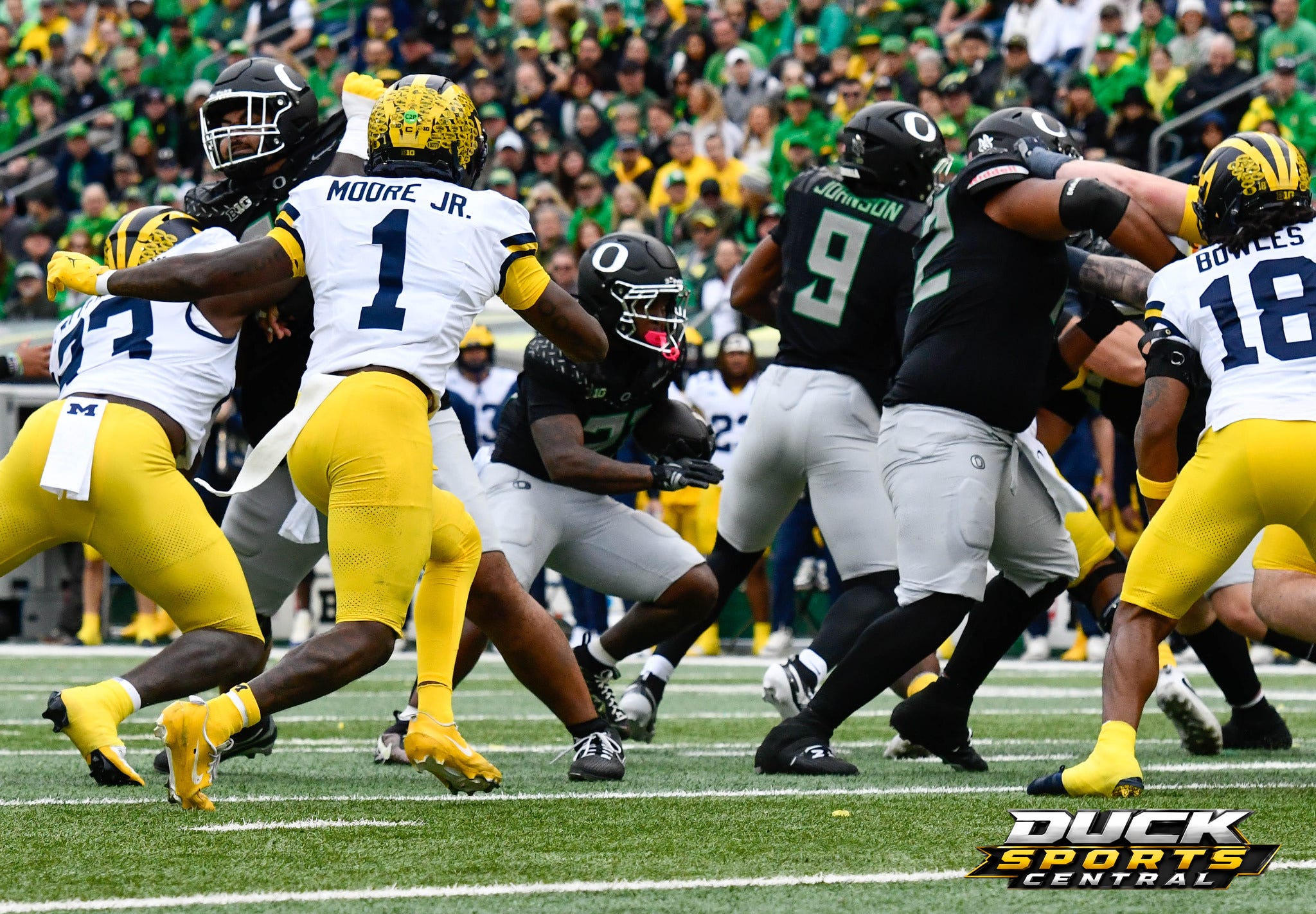
A week ago, Oregon was trying to prove its victory over Ohio State represented something more than one extraordinary afternoon. Saturday’s 31-7 win over Michigan provided additional evidence that the Ducks have begun putting their early-season struggles behind them, even if some of the issues that contributed to those struggles remain unresolved.
Now comes a different challenge, with Oregon traveling to East Lansing for a Friday night matchup against Michigan State. The Ducks have one fewer day to prepare, a second consecutive opponent from the state of Michigan and an increasingly meaningful opportunity to strengthen their College Football Playoff résumé.
On the surface, the Spartans don’t appear especially threatening. Michigan State is 3-7 overall and 1-6 in Big Ten play, averaging just 18.8 points and 297.1 yards per game. Those numbers reflect a program that has struggled to establish consistent offensive production throughout Pat Fitzgerald’s first season.
But there is more to the story than the record suggests, particularly when examining the Spartans’ recent performances. Michigan State defeated Michigan 15-6 in Ann Arbor on Nov. 7, forcing four turnovers and recording five sacks. The Spartans followed that performance with a competitive 21-14 loss to Washington on Saturday, holding the Huskies to just 44 rushing yards while remaining tied until the final minutes.
Those two performances don’t suddenly make Michigan State a championship contender, but they suggest Oregon is encountering an opponent that may be considerably more competitive than its overall record indicates. As the Ducks have learned during their own uneven season, a team’s recent performance sometimes tells us considerably more than its record, particularly when the circumstances surrounding a game create an opportunity for an opponent with little to lose.
Three observations
Michigan State’s defense is capable of making games uncomfortable
The Spartans have not been particularly effective offensively, but their defense has become a more interesting part of the conversation over the past two weeks. Against Michigan, Michigan State held the Wolverines to fewer than 200 yards of total offense while forcing four turnovers and recording five sacks. The Spartans controlled possession for more than 38 minutes and limited Michigan to a touchdown that came in the final two minutes.
That performance was especially significant because Michigan State had entered the rivalry game on a six-game losing streak. Fitzgerald’s team demonstrated that it could still execute a defensive plan, create pressure and control the tempo against a Big Ten opponent despite the disappointment surrounding its season.
Saturday’s loss to Washington provided another example of that capability. Michigan State held the Huskies to just 44 rushing yards, although Washington generated 288 yards through the air and connected on two touchdown passes to Chris Lawson.
The contrast is interesting for Oregon because it suggests the Spartans may be better equipped to challenge the Ducks’ running game than their overall defensive reputation might indicate. Michigan State is allowing 132.8 rushing yards per game and 3.9 yards per carry this season, respectable numbers for a team that has struggled to win consistently.
The Spartans have also shown they can generate pressure, particularly when an opponent falls behind schedule and is forced into predictable passing situations. That brings us back to Oregon’s performance against Michigan, where the Ducks generated 467 yards and four passing touchdowns but managed only 126 rushing yards on 36 attempts.
Oregon’s reported rushing success rate was just 29%, indicating that the explosive passing performance concealed some continued difficulty producing consistent gains on the ground. Michigan State may not have the overall defensive talent Michigan brought to Autzen Stadium, but the Spartans have demonstrated enough effectiveness against the run to make that part of Oregon’s offense worth watching.
The Ducks should have opportunities to attack Michigan State vertically, especially considering Washington’s recent passing success. But if Oregon cannot establish a more consistent running game, it may again find itself relying heavily on explosive passing plays to overcome inefficient possessions, a formula that has worked during its recent resurgence but remains less dependable than a balanced offensive approach.
Michigan State’s offense has an identity problem, and now a quarterback question
The most obvious weakness in Michigan State’s statistical profile is its inability to generate consistent offensive production. The Spartans average just 4.6 yards per play, including 3.0 yards per rushing attempt and approximately 6.5 yards per passing attempt. They have scored only nine passing touchdowns in 10 games, illustrating the difficulty Fitzgerald’s offense has experienced turning possessions into meaningful scoring opportunities.
Alessio Milivojevic has handled most of the quarterback responsibilities, completing 149 of 229 passes for 1,559 yards, seven touchdowns and three interceptions. His 65.1% completion rate suggests he can operate the shorter passing game, but the overall production has not been particularly explosive.
The situation became more complicated Saturday when Milivojevic left the Washington game with an injury. Cam Fancher replaced him and completed 14 of 22 passes for 134 yards and a touchdown, giving Michigan State some productive moments but also throwing an interception during a promising third-quarter possession.
Fancher’s mobility introduces another dimension Oregon must prepare for, especially after the Ducks surrendered several significant rushing gains to Michigan quarterbacks and running backs. The Spartans also have a useful running option in Brandon Tullis, who carried 21 times for 82 yards against Washington after rushing for 86 yards against Michigan.
His recent workload suggests Michigan State will attempt to establish a physical offensive presence rather than ask its quarterback to carry the entire offense. But the passing game remains a concern, particularly against an Oregon defense that just held Michigan to 71 passing yards on six completions.
The Wolverines struggled to protect their quarterbacks and consistently challenge the Ducks’ secondary, allowing Matayo Uiagalelei to record two sacks and three quarterback hurries. Michigan State faces a similar problem if it cannot establish enough offensive balance to prevent Oregon from concentrating on disrupting the passing game.
The quarterback situation will be worth monitoring throughout the week, but the larger concern for Michigan State is that neither option has consistently demonstrated the ability to produce the kind of explosive offense needed to keep pace with Oregon when the Ducks are playing well. That becomes particularly important if the Spartans fall behind early, forcing them to abandon the deliberate offensive approach that has given them their best opportunities to remain competitive.
The Spartans have already demonstrated that their record doesn’t define their effort
There is a temptation to look at Michigan State’s seven losses and assume the Spartans are simply waiting for the season to end. Their recent performances suggest that would be a mistake, particularly for an Oregon team that has already experienced the consequences of failing to consistently meet expectations.
The victory at Michigan was particularly revealing because it came after six consecutive defeats, including narrow losses to Illinois and Northwestern. Michigan State had little reason to expect an easy turnaround, yet the Spartans produced one of their most complete defensive performances of the season against their biggest rival.
They followed that by remaining competitive with Washington through most of Saturday’s game. The Huskies scored the winning touchdown with 2:24 remaining, and Michigan State subsequently moved the football into Washington territory before losing a fumble during its final possession.
Those performances are not the profile of a team that has completely stopped competing, even if the results have rarely gone its way. There is also a historical element worth recognizing as Oregon prepares for its first trip to East Lansing since 2015.
Michigan State is 3-0 against Oregon at Spartan Stadium, including a 31-28 victory over the seventh-ranked Ducks in 2015. The programs have changed considerably since that meeting, but Friday’s game will represent another opportunity for the Spartans to defend their home field against a nationally prominent opponent.
It also comes on Senior Day, giving Michigan State’s players another reason to approach the game with considerable emotion. For Oregon, that means preparation cannot be based solely on the opponent’s record, particularly when the Spartans have demonstrated an ability to compete against recognizable Big Ten opponents over the past two weeks.
The Ducks experienced their own struggles earlier this season, including losses to opponents they were expected to defeat. They should understand better than most teams that motivation, execution and the circumstances surrounding a particular game can matter considerably more than preseason expectations or the standings.
Two questions
Can Oregon establish a dependable offense without relying on the explosive play?
This may be the most important offensive question heading into Friday, particularly after what happened against Michigan. Raiola was outstanding Saturday, completing 20 of 28 passes for 341 yards and four touchdowns. Oregon repeatedly challenged the Wolverines downfield, with six completions on eight attempts traveling at least 15 yards.
But the overall production also revealed a potential vulnerability. Ten explosive plays accounted for 317 of Oregon’s 467 yards, meaning approximately 68% of the Ducks’ offense came from fewer than 16% of their offensive snaps.
That is an impressive demonstration of Oregon’s big-play capability, but it also suggests the offense has not yet become consistently efficient on ordinary downs. Against Michigan State, the Ducks should have opportunities to challenge the Spartans’ secondary, particularly if Raiola continues recognizing coverage structures as effectively as he did against Michigan.
But the more interesting test may be what happens when those explosive opportunities aren’t immediately available. Can Oregon create manageable third downs through its running game? Can the offensive line establish enough consistency to keep the Ducks from becoming dependent on deep completions? And can the offense finish productive possessions without penalties turning scoring opportunities into missed chances?
Those questions are increasingly important because Oregon’s recent success has changed the standard against which the offense should be evaluated. The Ducks have already shown they can create explosive plays against quality defenses, including Ohio State and Michigan.
Becoming more complete means demonstrating that they can also sustain productive possessions when opponents succeed in limiting those opportunities. Michigan State’s recent success against the run provides an opportunity to evaluate whether Oregon has made meaningful progress in that area or remains too dependent on the passing game’s ability to create extraordinary gains.
Will the short week reveal how much Oregon’s preparation has improved?
Oregon has spent the past several weeks discussing the relationship between preparation, execution and the ability to handle changing circumstances. Now the Ducks will have an opportunity to demonstrate that growth under a condensed schedule, with fewer days available for recovery, film study and the normal process of installing a game plan.
Lanning explained after the Michigan victory that Oregon would effectively move its preparation forward one day, placing a greater emphasis on recovery before returning to its normal practice routine.
“Today’s really Sunday. Tomorrow’s really Monday, right? It kind of speeds up,” Lanning said. “So we kind of lose a day in the week. I think it’s important that our players recover, especially this late in the season.”
That creates an interesting challenge for a team that has played two physical opponents in consecutive weeks and now faces another road trip. Michigan State may not possess the same overall talent as Ohio State or Michigan, but the Spartans’ recent defensive performances suggest they are capable of making opponents work for their yardage.
Oregon’s preparation must account for a potentially different quarterback, the possibility of more designed quarterback runs and a defense that has demonstrated the ability to generate pressure when opponents become predictable. The shortened week also leaves less time to correct the mistakes that appeared against Michigan, particularly the rushing breakdowns and offensive penalties that prevented Oregon from maximizing several scoring opportunities.
For a team attempting to demonstrate that its improvement is rooted in daily habits rather than occasional emotional performances, this is exactly the kind of challenge that can reveal whether those habits have become dependable. The coaching staff has repeatedly emphasized the importance of preparation throughout Oregon’s resurgence, and Friday will provide another opportunity to determine how well that message has taken hold.
One prediction
Oregon will win comfortably, but the most meaningful progress will come from the running game
Michigan State’s recent defensive performances deserve respect, and the combination of a Friday night road game, Senior Day and a shortened preparation schedule creates circumstances Oregon cannot afford to overlook. But the overall matchup still favors the Ducks considerably, particularly when comparing the teams’ offensive capabilities and the defensive improvement Oregon has demonstrated over the past several weeks.
Michigan State has struggled to generate consistent offensive production throughout the season, and Oregon’s defense has become increasingly effective limiting opponents who lack a dependable passing attack. The Spartans have shown they can run the football and extend possessions, but their 18.8-point scoring average suggests they will have difficulty matching Oregon if the Ducks establish an early advantage.
The bigger question is whether Oregon can use this matchup to improve the aspects of its offense that remain less dependable. I expect the Ducks to continue finding opportunities downfield, particularly with McClellan, Moore and Stewart providing Raiola with multiple threats. But I also expect Oregon to place greater emphasis on developing a consistent rushing attack after the difficulties it experienced against Michigan.
If the Ducks can establish productive early-down runs, they will become considerably more difficult to defend because opponents will no longer be able to rely on the possibility that an unsuccessful rushing attempt will create a predictable passing situation. That balance would also give Oregon an opportunity to control the game without depending on a handful of explosive plays to account for most of its offensive production.
My early prediction is Oregon 34, Michigan State 13, with the Ducks possessing enough offensive firepower and defensive versatility to win comfortably. The most encouraging result, however, would be a performance in which the running game becomes a more consistent contributor rather than the explosive passing attack having to solve every problem.
The larger challenge remains the same one Oregon faced after Ohio State and again against Michigan. The Ducks have put themselves back into a meaningful postseason conversation, but that opportunity only matters if they continue handling the opponent immediately in front of them.
Friday’s game offers another chance to demonstrate that the lessons of their difficult early season have become part of how they prepare, compete and respond to expectations. Michigan State’s record suggests Oregon should win, but the Spartans’ recent performances offer a reminder that the Ducks will still have to earn it.