


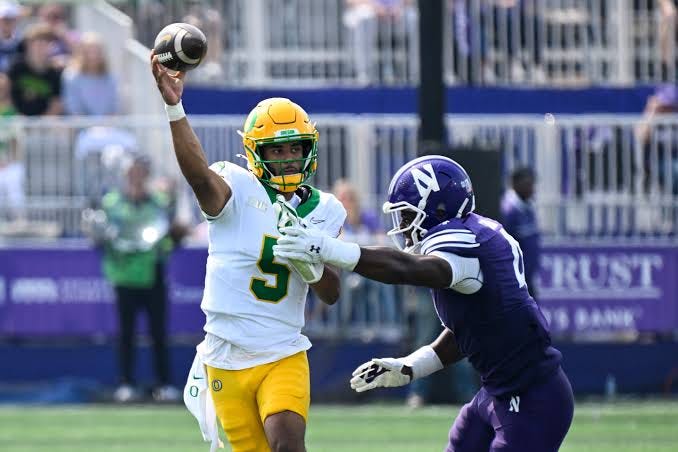
There is probably no comfortable way to fire an offensive coordinator in October, and there certainly is no comfortable way to do it six days before Chip Kelly walks back into Autzen Stadium with an offense averaging nearly 35 points per game. That is where Oregon finds itself this Monday, 4-3 with Drew Mehringer gone and Dan Lanning somehow needing to turn a week that could easily become consumed by questions about what failed into a week about what happens next.
Oregon does not have the luxury of spending three practices mourning the offense it thought it was going to have, because Northwestern is arriving with something considerably more dangerous than nostalgia attached to its offensive coordinator. Kelly’s Wildcats are 6-1 after beating Rutgers 42-14 Saturday, producing 502 yards and averaging 7.6 yards per play. Northwestern is averaging 34.7 points and 435.6 yards per game, including 204.6 rushing yards, while averaging 6.8 yards every time it snaps the football.
This is therefore not simply a recovery week for Oregon. It is an identity week, one in which the Ducks have to decide very quickly what they can still become before Northwestern starts asking questions they may not yet be ready to answer.
THREE THINGS OREGON HAS TO DO
1. Make the Offense Smaller Before Trying to Make It Better
There will be a natural temptation following Mehringer’s dismissal to make Saturday look dramatically different. New play caller, new ideas, new tendencies and perhaps enough cosmetic alteration to convince everyone that Oregon has turned the page, but six days is not enough time to install a new offense, nor should Oregon try.
The Ducks have spent months installing terminology, protections, route concepts, run schemes and quarterback reads. The useful work this week is not tearing those things apart; it is determining which pieces of the existing offense Oregon’s available players execute best and eliminating some of everything else.
The numbers tell us why simplification is necessary. Oregon has scored only 42 points over its last three games, averaging 14 per game while converting just eight of 45 third downs. The Ducks still gained 426 yards at Illinois, but 21 first downs and 5.8 yards per play became only 10 points because movement never consistently became production. Oregon went four of 15 on third down and never scored after the final 2:29 of the first half.
That suggests the offense does not need another binder full of answers. It needs a smaller number of answers everyone trusts, built around the runs Oregon blocks best, the formations that give Dylan Raiola the clearest pictures, the route combinations Dakorien Moore and the remaining receivers execute most naturally and the concepts that keep Oregon out of third-and-long.
Whoever calls plays Saturday should call those things repeatedly enough that execution begins replacing hesitation. The first evidence of recovery will not be a trick play or a completely redesigned formation; it will be Oregon looking like 11 players understand exactly what the offense is trying to accomplish.
2. Make Running the Football a Requirement, Not an Aspiration
There is an irony waiting for Oregon this weekend because Chip Kelly comes back to Autzen with a Northwestern team currently averaging 204.6 rushing yards per game and 5.2 yards per carry. Oregon, the program that helped make Kelly synonymous with offensive innovation, enters the game averaging only 145.4 rushing yards and 4.3 per carry, a comparison that should bother the Ducks for reasons far beyond nostalgia.
Northwestern ran for 283 yards against Rutgers. Caleb Komolafe needed only 13 carries to produce 150 yards, including a 56-yard run, while quarterback Aidan Chiles added another 83 yards and two touchdowns. Kelly did not ask Chiles to throw 45 times to manufacture offense. Northwestern attempted 25 passes and 41 runs, controlled the game for more than 33 minutes and converted nine of 13 third downs.
Oregon needs some version of that stability on the other side. Jordon Davison ran for 92 yards against Illinois, while the Ducks as a team gained 180. There were pieces of a legitimate ground game, yet the offense still never developed the sense that the run was controlling the structure of the defense. Oregon too often has treated rushing success as something to enjoy when it appears rather than something around which the game should be constructed.
That has to change now, particularly while the quarterback room remains unsettled and the receiver rotation is depleted. Run the football, create manageable second downs and force Northwestern to add a defender to the box. Give the quarterback defined throws off that reaction, then let play-action grow from something the defense actually fears instead of something Oregon merely hopes will influence linebackers.
The Ducks do not need to rediscover 2010, but they do need to rediscover the value of making a defense solve the same problem repeatedly until it changes the way it wants to play.
3. Stop Treating the Season Like Something That Needs to Be Saved
This may be the most difficult adjustment of all because Oregon began the season as a national championship contender. Every game was therefore evaluated against that expectation, and every problem became a referendum on whether the Ducks remained capable of becoming the team everyone imagined in August.
That season is gone, but the schedule is not. Neither is the opportunity to beat good teams, develop players, build something meaningful or perhaps create a November nobody expects anymore. What is gone is the obligation to keep pretending Oregon’s 2026 season must eventually resemble the preseason projection, and there can be freedom in accepting that.
The Ducks can stop protecting what they thought they were and start discovering what they actually are. Raiola can develop rather than being asked to impersonate Dante Moore. Young receivers can play through mistakes. The offensive line can build around the concepts it executes best, while coaches can make decisions based on what will work Saturday rather than whether those decisions validate something installed in March.
Lanning’s decision to fire Mehringer suggests he has already reached that point. Oregon could have waited until December, explained the offensive collapse through injuries and made a quieter change after the season. Instead, Lanning decided the remaining games were valuable enough to justify disruption now, and that only works if Oregon embraces the disruption rather than fears it.
TWO PROBLEMS NORTHWESTERN PRESENTS
1. Aidan Chiles Changes the Math
The easiest mistake Oregon could make this week is preparing for Chip Kelly’s offense as though this is simply about scheme. It is about personnel too, and everything starts with Aidan Chiles.
Through six games, Chiles was completing 71.4% of his passes with nine touchdowns and no interceptions. Saturday against Rutgers, he completed 19 of 25 for 219 yards and three touchdowns while rushing for 83 yards and two more scores. He now has multiple games this season with at least three passing touchdowns and two rushing touchdowns.
That creates the fundamental problem Kelly has always wanted from his quarterback: the defense can be structurally correct and still be wrong. When the backside defender closes, Chiles can keep the football. When the defense adds numbers to the run fit, Northwestern can throw into the space that defender vacated. When Oregon plays man coverage, Chiles becomes another runner against defenders whose backs may be turned. When the Ducks hesitate, Komolafe is averaging more than six yards per carry on the season.
That puts enormous pressure on discipline, especially after Illinois provided a warning when Aidan Laughery broke a 75-yard touchdown run and the Illini finished with 225 rushing yards. Northwestern is a considerably more sophisticated rushing problem because the quarterback has to be accounted for as part of the fit.
Oregon cannot chase ghosts against Kelly. Edge defenders have to know their assignment, linebackers cannot overrun motion and safeties have to recognize when formation is creating leverage rather than merely decoration. Northwestern wants one defender to become uncertain, and Oregon cannot give Kelly that defender very often.
2. Kelly Will Make Oregon Defend Everything It Has Been Struggling to Become
There is an uncomfortable contrast between these offenses right now. Oregon has spent weeks searching for rhythm, while Northwestern appears to have found one.
The Wildcats have run for 1,432 yards and thrown for 1,617 through seven games, an almost ideal distribution for an offense that wants the defense uncertain about where stress is coming from. They are averaging 6.8 yards per play and 435.6 yards per game, while Saturday’s Rutgers performance included 283 rushing yards, 219 passing yards, six offensive touchdowns and a 69% third-down conversion rate.
That balance is Kelly’s real weapon. His Oregon offenses were remembered for tempo because the speed was visually overwhelming, but the deeper principle was always conflict. Formations created numbers, motion created information, the quarterback changed the arithmetic and the run game forced safeties and linebackers to participate. Once they did, space appeared somewhere else.
The modern version does not need to look exactly like the Blur Offense that once terrorized the Pac-10 and Pac-12 to carry the same DNA. Oregon’s defense has enough talent to handle it, but the question is whether it can do so without being forced to compensate for an offense that keeps sending it back onto the field.
That is where Oregon’s two crises intersect. If the Ducks spend another afternoon producing three-and-outs, failed third downs and empty possessions, they are not merely failing offensively. They are increasing the number of opportunities Kelly gets to probe the defense until he finds the matchup he wants, which makes offensive recovery part of Oregon’s defensive strategy as much as anything else.
ONE THING THAT WILL TELL US WHETHER OREGON HAS ACTUALLY CHANGED
Watch the First 15 Plays
Do not begin by watching the score, the identity of the play caller or whether Oregon breaks out some formation we have not seen all year. Watch the first 15 offensive plays and ask a much simpler question: Does Oregon look certain?
Are the Ducks getting lined up quickly? Is Raiola operating with clear answers? Are the backs hitting defined lanes instead of waiting for something to materialize? Are receivers creating easy completions? Is Oregon staying out of third-and-eight, and does one play appear to set up another? Most importantly, does the offense look like it knows what it wants to be?
That is the first thing Oregon has to recover after firing Mehringer. Confidence comes later, explosiveness comes later and the final offensive system comes much later, probably after the season when Lanning can conduct a real search and decide what Oregon’s next offensive era should look like. Saturday is about something more immediate: coherence.
Northwestern arrives in Eugene 6-1 and playing with the confidence of a team that just scored 42 points while producing more than 500 yards. Oregon arrives at 4-3 after firing the person responsible for coordinating its offense, creating a stark contrast between one team that has discovered an identity under Chip Kelly and another that has six days to begin finding a new one.
There is something almost too symmetrical about Kelly returning to Autzen in this particular week, but Oregon does not need to become Chip Kelly’s Oregon again, nor should it spend Saturday attempting to prove anything about its past. The Ducks simply need to remember one of the principles Kelly’s best teams understood better than almost anyone: an offense becomes dangerous when every player knows what problem it is trying to create for the defense.
For Oregon, recovery begins there, and Saturday will tell us very quickly whether the Ducks have started finding their way back.