


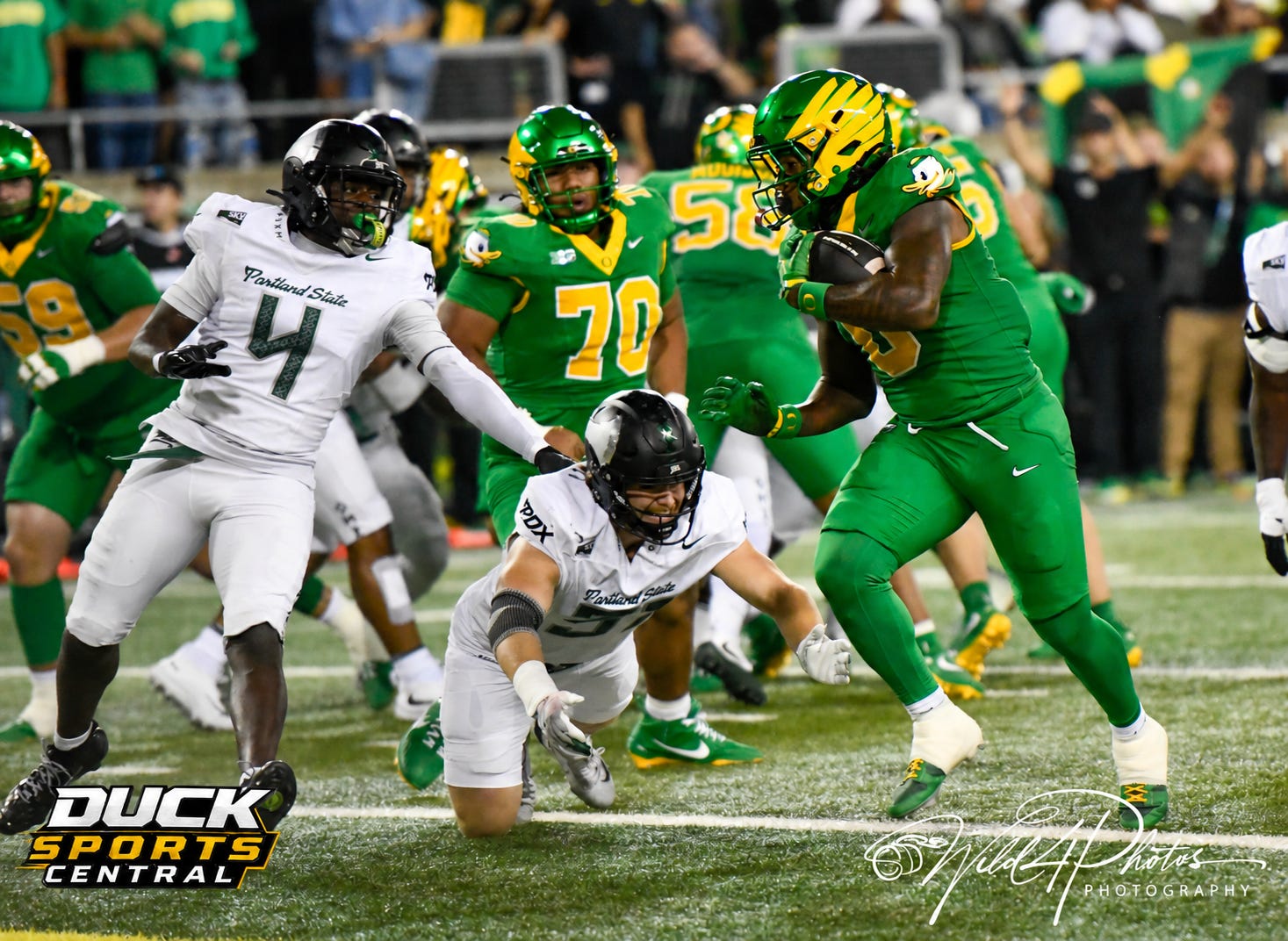
Friday night was useful for Oregon, but useful and definitive are two very different things. The Ducks did almost everything we wanted to see against Portland State, scoring 84 points, allowing only 103 yards and finally looking more like the team we expected to see when the season began. At the same time, the opponent matters, and nothing about beating an overmatched FCS team answers the questions that were created one week earlier in Stillwater.
That is where this week’s Inside Read begins. This is not the full USC scouting report — we will get much deeper into Lincoln Riley, Jayden Maiava and the Trojans later in the week — but the early data gives us a pretty interesting bridge between what Oregon just did and what comes next. Several of the advanced-data sites have not yet fully incorporated USC’s 42-35 win at Rutgers into their season profiles, so I am treating the first three games as the baseline and using Saturday’s Rutgers result as the newest reality check.
The contrast is already pretty stark. Oregon had a 32% offensive success rate and minus-0.22 EPA per play against Oklahoma State, then jumped to a 66% success rate and plus-0.46 EPA per play against Portland State. The opponent explains a lot of that swing, obviously, but not all of it. The more important part was that Oregon looked cleaner getting there, with better sequencing, fewer obvious pre-snap tells and a running game that finally gave the offense something useful on early downs. (Game On Paper)
USC presents almost the opposite problem. Before Saturday’s game at Rutgers, the Trojans were operating at a 59% offensive success rate, including a remarkable 69% success rate on pass plays. USC was also spending only about 24% of its snaps in obvious passing-down situations, which tells us something important before we ever start breaking down personnel: Lincoln Riley’s offense has been very good at avoiding the situations where a defense knows exactly what is coming. (Punta Rally)
Then USC went to Rutgers and won 42-35 while producing 461 yards at 7.3 yards per play and committing no turnovers. Rutgers, however, answered with 460 yards of its own, 168 on the ground and 292 through the air, while converting three of four fourth downs. That game does not suddenly make USC’s first three weeks meaningless, but it gives Oregon something worth studying on both sides of the ball. (USC Athletics)
3 — Three things I am carrying out of Friday night
1. Oregon did not just score more efficiently; it played more efficiently
There is an important difference between those two things. Portland State was never going to have enough answers for Oregon’s skill talent, so the Ducks could have produced a huge point total simply by winning individual matchups. What interested me more was how often Oregon avoided asking an individual player to rescue the play after the structure broke down.
The GameOnPaper numbers reflect that. Oregon’s 66% success rate was paired with 0.56 EPA per dropback and 0.48 EPA per rush, meaning the Ducks were generating efficient offense regardless of how they attacked. That matters because Oklahoma State essentially forced Oregon into one-dimensional problem solving. Against the Cowboys, the Ducks produced minus-0.27 EPA per dropback and had a 32% overall success rate, leaving too many possessions dependent on one explosive play or one individual winning a difficult situation. (Game On Paper)
We saw some of the difference Friday before the score became absurd. Drew Mehringer used movement and misdirection to get to concepts rather than simply lining up and announcing them. Dante Moore worked beyond his first read on third down. The receivers looked more precise, and Oregon mixed enough different presentations into the run game that the defense had more to process before the ball was snapped.
None of that proves Oregon has fixed the offense, but it is the kind of improvement that can travel. USC will not be overwhelmed simply because Oregon has better players, so the Ducks are going to need the play itself to create some of the advantage before the athleticism takes over.
2. The running game gave us something more meaningful than 200-plus yards
Raw rushing totals against Portland State are almost meaningless. The underlying numbers were considerably more useful.
Oregon produced an opportunity run on 67% of its carries, was stuffed only once and converted all six of its power-run opportunities. Those numbers tell us that the Ducks were consistently getting through the first part of the play before asking the running back to create something on his own. That was the missing piece at Oklahoma State, where Oregon spent too much of the afternoon turning second down into a recovery mission rather than another opportunity to attack. (Game On Paper)
The USC matchup makes that particularly interesting because the Trojans entered Rutgers having been very good against the run from an efficiency standpoint. Opponents had only a 28% run success rate through USC’s first three games, while the Trojans were allowing about 2.2 offensive-line yards per carry. Rutgers changed the picture somewhat by rushing for 168 yards, including 122 from Antwan Raymond, so there is now enough evidence to at least wonder whether Oregon can force USC to defend the same kind of balanced offense we saw Friday. (Punta Rally)
That does not mean Oregon needs to run the ball 50 times. It means Mehringer needs the threat of the run to remain credible enough that the Trojans cannot spend the afternoon playing downhill toward Moore. If Oregon can repeatedly turn first-and-10 into second-and-5, USC has to defend almost everything. If those early runs become second-and-9, we already know how quickly Oregon’s offensive tendencies can begin narrowing.
3. The defensive numbers looked better than the pass rush felt
This is the one area where I came away from Friday with two thoughts that do not fit neatly together. Oregon’s defense produced a 28% havoc rate, held Portland State to a 22% success rate and forced four turnovers. Those are dominating numbers, and they look much more like what we expected from a Chris Hampton defense. (Game On Paper)
At the same time, I spent much of the first half waiting for Oregon’s defensive front to completely overwhelm Portland State’s protection, and it never consistently happened. The run defense became increasingly disruptive and the Ducks eventually created pressure from several places, but there were still too many passing snaps where the quarterback had enough time to work. That was mostly harmless against Portland State because the Vikings could not consistently take advantage of it.
USC probably can.
Through its first three games, the Trojans had a 69% pass success rate, while Maiava and the passing offense were generating some of the best down-to-down efficiency in the country. Even at Rutgers, where USC was not completely dominant, Maiava finished with 277 yards, two touchdowns and no interceptions while the Trojans averaged 7.3 yards per play. (Punta Rally)
That makes this a much different test for Hampton. Oregon does not necessarily need five sacks, but it does need to make Maiava uncomfortable before routes have time to develop. If the Ducks spend another afternoon playing zone behind a rush that arrives a beat late, USC has the receivers and the quarterback to turn those soft areas into sustained offense.
2 — Two numbers that immediately have my attention
69%
That was USC’s pass-play success rate through the first three games, and it may be the most important early number in this matchup. Success rate is not about explosive plays; it measures whether an offense consistently gains what it needs based on down and distance. A number that high tells us USC has not needed spectacular plays to stay on schedule because the passing game has regularly created useful yardage by itself. (Punta Rally)
That is exactly why Oregon’s early-down defense matters so much next week. The Ducks cannot simply wait for third down and then unleash pressure because USC has been very good at avoiding obvious third-down passing situations in the first place. The battle may be decided as much on first-and-10 as it is on third-and-8.
460
That is how many yards Rutgers gained against USC on Saturday.
The number matters because Rutgers entered the game with a far less imposing offensive profile than Oregon, yet the Scarlet Knights finished with essentially the same yardage as USC and averaged 6.7 yards per play. They ran for 168 yards, threw for 292 and reached 35 points despite throwing two interceptions, including one that USC returned for a touchdown. (USC Athletics)
It is much too early to call the USC defense a weakness, especially because the first three games suggested a unit that was playing efficient football against the run. But Rutgers showed that the Trojans can be moved, and Oregon should enter Los Angeles believing there are opportunities available if the cleaner version of Friday’s offense shows up.
1 — One question that probably decides where this goes
Can Oregon make USC play from behind the chains?
That question works on both sides of the ball.
Defensively, Oregon needs to create some second-and-long situations instead of allowing USC to live in second-and-5, where the entire Riley playbook remains available. The Trojans have been far too efficient through the air to expect Oregon to survive if Maiava spends the afternoon throwing from comfortable down-and-distance situations.
Offensively, Oregon has to avoid doing the same thing to itself. The difference between Stillwater and Friday night was not simply talent; it was how often the Ducks stayed ahead of the down and allowed Mehringer to remain unpredictable. If the running game can produce four or five yards, Moore can work through his reads and Oregon can continue disguising where the ball is going, USC’s defense has already shown that it can give up sustained offense.
That is what makes next Saturday so useful. Portland State gave Oregon a chance to reset some things without much consequence. USC will tell us whether those changes were actually structural or simply easier to execute against a team that could not punish the mistakes.
For the first time this season, Oregon is walking into a game where both sides have enough evidence to be interesting and enough unanswered questions to make the numbers worth watching.