


Four games are enough to begin separating September impressions from actual tendencies.
Oregon has already played four very different football games. Boise State made the Ducks work into the fourth quarter, Oklahoma State exposed them in a road loss, Portland State offered an overwhelming reset and USC provided the best win of the season against the best opponent Oregon has faced.
The result is a 3-1 team that remains difficult to define by any one Saturday. But beneath the swings in performance, a few things have been remarkably consistent — and one area of concern from Stillwater suddenly looks particularly relevant with UCLA coming to Autzen Stadium on Saturday.
The Bruins are 4-0 under first-year coach Bob Chesney, averaging 44.8 points after wins over California, San Diego State, Purdue and Maryland. More importantly for Oregon, this will not feel like preparing for an entirely unfamiliar coaching staff. Chesney brought a significant portion of James Madison with him to Westwood, including coordinators Dean Kennedy and Colin Hitschler and a collection of players the Ducks encountered just 10 months ago.
THREE THINGS WE LEARNED THROUGH FOUR GAMES
1. Oregon’s quarterbacks have been aggressive without giving the ball away
For all the uneven stretches through September, Oregon has been exceptionally clean throwing the football. Duck quarterbacks have completed 104 of 145 passes — 71.7% — for 1,386 yards, 14 touchdowns and, most notably, zero interceptions. Dante Moore has nine touchdown passes without a pick while Dylan Raiola has thrown five touchdowns without one.
That matters because Oregon has not built those numbers by hiding its quarterbacks. The Ducks are averaging 9.6 yards per pass attempt and 346.5 passing yards per game, meaning they are generating explosive offense without accepting the turnover risk that often accompanies it. Boise State saw Jeremiah McClellan go for 150 receiving yards, while USC saw Jamari Johnson lead Oregon with 119 and Dierre Hill Jr. add 105 out of the backfield.
Four games in, perhaps the most encouraging offensive development is not that Oregon has discovered one player opponents cannot stop. It is that the Ducks have repeatedly changed where the pressure comes from without sacrificing ball security.
2. Third down has quietly become the defense’s most dependable down
There have been defensive stretches Oregon would certainly like back, particularly in Stillwater, but the Ducks have been exceptionally good at ending possessions. Opponents have converted only 11 of 52 third downs through four games, a rate of just 21.2%.
That number is not simply the product of Portland State going 0-for-9. Boise State managed four conversions in 15 attempts and Oklahoma State converted only five of 17 despite piling up 554 yards. By subtraction, USC finished only two of 11 against Oregon despite generating 446 yards of offense.
There is an important distinction there. Oregon has not prevented every opponent from moving the football, but it has repeatedly created a way off the field. Against a UCLA offense that wants to run the football, control the rhythm of the game and make defenses account for multiple rushing threats, preventing second-and-manageable from continually becoming third-and-short will become one of the first places to watch.
3. Stillwater left one concern UCLA is uniquely equipped to revisit
The outlier in Oregon’s defensive month remains Oklahoma State’s rushing performance. The Cowboys ran for 237 yards at 5.9 yards per attempt, and quarterback Drew Mestemaker accounted for 109 of those yards, including a 75-yard run. Boise State managed only 93 rushing yards and USC finished with 120, making Stillwater look less like a season-long weakness than a specific problem created when Oregon’s fits were stressed by multiple running threats.
That makes UCLA fascinating.
Wayne Knight has rushed for 445 yards on only 49 carries through four games, an average of 9.1 yards per attempt, with nine rushing touchdowns. Nico Iamaleava has added another 143 rushing yards, and this is hardly new territory for him after leading UCLA with 505 rushing yards a year ago.
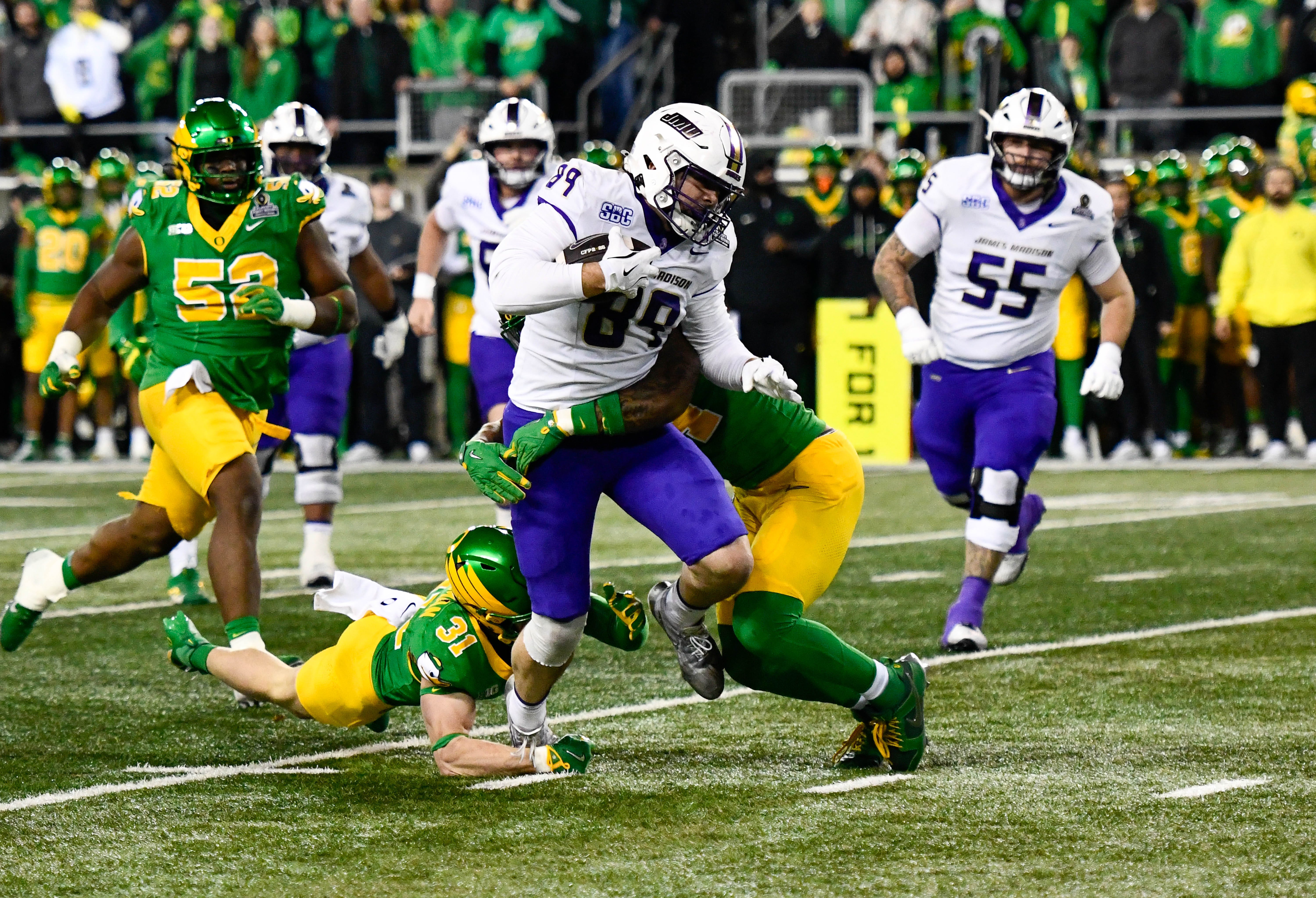
Oregon has already seen Knight, too. He rushed for 110 yards against the Ducks while playing for James Madison in December. The next challenge therefore is not simply stopping UCLA’s running game; it is proving the problem Oklahoma State created with backfield multiplicity was an isolated September breakdown rather than a blueprint.
TWO NUMBERS TO KNOW HEADING INTO UCLA
11 — James Madison transfers
This is why calling UCLA a completely rebuilt roster does not quite capture what Chesney has constructed.
UCLA added a Big Ten-leading 46 transfers overall, but 11 came from James Madison and all 11 appeared in the season-opening win at Cal. That group includes Knight, receiver Landon Ellis, defensive lineman Sahir West, defensive back Derrick Barksdale and multiple offensive linemen. Seven assistant coaches from Chesney’s James Madison staff also initially followed him to UCLA, including Kennedy and Hitschler in the same coordinator roles they held last season.
So Oregon will be preparing for blue and gold jerseys, but there will be a lot of familiar football underneath them. UCLA is not trying to install the foundation of what Chesney did at James Madison; it imported much of the foundation and then surrounded it with a roster possessing more Power Four talent.
That distinction probably explains why the turnaround has been immediate rather than gradual.
509 — James Madison’s yards against Oregon last December
The final score makes that College Football Playoff game look more comfortable than some of the underlying numbers were. Oregon won 51-34 and led 34-3 after scoring on its first five possessions, but James Madison ultimately finished with 509 yards, including 186 rushing and 323 passing. The Dukes also produced 23 first downs and converted nine of 22 third downs.
That 509-yard total was the most Oregon allowed to any opponent during the 2025 season. Knight rushed for 110 yards, while Ellis had three catches for 83 yards, including a 50-yard reception — two players now occupying prominent roles in UCLA’s offense.
There is plenty from that tape Oregon can use this week. There is also enough from that tape to prevent anybody inside the program from dismissing the Bruins as a surprising 4-0 team that has merely taken advantage of a manageable September schedule.
ONE KEY QUESTION
How much does familiarity actually help Oregon?
That may be the most interesting part of this matchup.
Oregon has already prepared for Chesney. It has already defended Kennedy’s offense. It has already studied Knight, Ellis and several of the players who followed their coach across the country. In a sport increasingly defined by turnover, the Ducks rarely get this much recent information on a first-year coaching staff.
But UCLA gets the other half of that equation.
Chesney and his former James Madison players also spent an entire playoff preparation studying Oregon less than a year ago. They know what gave the Ducks problems because they produced more than 500 yards against them, even in defeat. Now Chesney gets to run many of those same ideas with Iamaleava at quarterback, more Power Four personnel around him and four games of evidence showing that his approach has translated immediately.
That is what makes UCLA more interesting than its preseason expectations suggested.
Oregon spent September learning what it can trust about itself. The passing game has protected the football, the defense has consistently won third down and the Ducks have shown enough offensive variety to avoid relying on one matchup every week. Yet the one opponent that successfully stressed Oregon with a multifaceted rushing attack also handed the Ducks their only loss.
UCLA is about to ask that question again, only this time Oregon has seen much of the exam before. The challenge Saturday will be proving it learned the right answers.