


Track speed has always been an interesting component of evaluating running backs. I’ve seen plenty of high school running backs with impressive track times who needed an awful lot of space to make that speed matter on a football field. The ones who intrigue me are those who can accelerate through traffic, particularly when there isn’t much of a running lane to begin with.
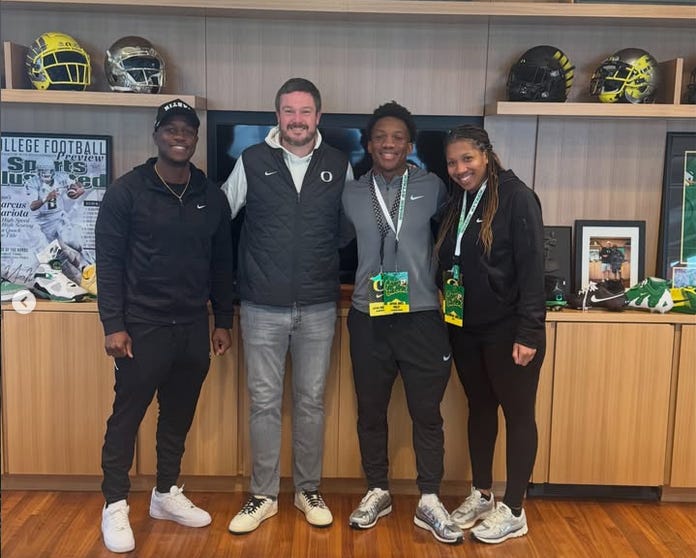
That’s part of what makes Oregon’s Thanksgiving Day addition of Arlington (Texas) Martin running back Javian Jones-Priest interesting. The four-star prospect announced his commitment to Oregon on Thursday, two days after backing away from a Virginia Tech commitment he had held since May.
Jones-Priest becomes the 27th commitment in Oregon’s 2027 recruiting class and the second running back, joining fellow Texas prospect CaDarius McMiller. Listed at 5-foot-10 1/2 and 195 pounds, Jones-Priest is ranked No. 292 nationally, No. 21 among running backs and No. 33 in Texas according to the Rivals300 rankings.
The recruitment
Ra’Shaad Samples identified Jones-Priest relatively early in the recruiting process, extending an offer in December 2025. Jones-Priest made multiple unofficial visits to Eugene during the offseason, but it was the relationship he developed with Virginia Tech running backs coach Norval McKenzie that ultimately led to his commitment to the Hokies in May.
Virginia Tech made a substantial investment in that relationship. Jones-Priest was the first recruit to take an official visit under James Franklin’s new coaching staff, spending a weekend on campus with the attention of the staff largely devoted to him. McKenzie’s consistent communication throughout the recruiting process helped Virginia Tech secure a commitment despite already having two running backs in the class.
That last part is worth remembering. Jones-Priest has now twice committed to a program with other running backs already in its recruiting class. The presence of McMiller apparently did little to diminish Oregon’s appeal.
For Samples, landing Jones-Priest nearly a year after initially offering him is another recruiting victory in a state where he has deep ties. Oregon now has commitments from two Texas running backs in the same recruiting cycle, both coming from a high school football environment where the competition is about as good as you’ll find anywhere in the country.
A senior season worth noticing
Recruiting rankings can sometimes become an anchor in how we evaluate a player. An assessment made during a player’s junior season tends to shape the perception of that player throughout the remainder of his recruitment, even when there is compelling evidence that he has become a better football player.
Jones-Priest’s senior production warrants a closer look.
As a junior, he rushed for 1,154 yards and 12 touchdowns on 144 carries, averaging eight yards per attempt. Through 12 games this fall, he has rushed for 1,478 yards and 33 touchdowns on 187 carries. Despite the increased workload, his yards per carry barely moved, dropping to 7.9.
The jump from 12 rushing touchdowns to 33 certainly gets your attention, but I’m equally interested in what he has done as a receiver. After catching just seven passes for 37 yards as a junior, Jones-Priest has caught 20 passes for 225 yards and three touchdowns as a senior.
He has accounted for 1,703 yards from scrimmage and 36 touchdowns this season, averaging nearly 142 yards of offense per game. He’s doing that against Texas 6A competition, which provides some meaningful context to those numbers.
The expanded receiving production is particularly encouraging because his limited involvement in the passing game was one of the developmental questions coming out of his junior season. It doesn’t necessarily answer every question about his ability to become a three-down running back at the college level, but it’s a meaningful step in that direction.
What Oregon is getting
The speed is legitimate. Jones-Priest qualified for the Texas 6A regional track meet in both the 100 and 200 meters as a junior, recording season-best times of 10.41 and 21.25 seconds. As a sophomore, those numbers were 10.49 and 21.83, respectively.
What I like about his athletic profile is that he isn’t an undersized running back who needs to operate almost exclusively in space to take advantage of that speed. At 195 pounds, he has a solid physical foundation for the position, runs with naturally low pads and can narrow his frame to work through congested running lanes.
There is a difference between a running back who can outrun a safety and one who can get through the line of scrimmage before that safety has time to react. Jones-Priest’s initial acceleration is arguably more valuable than his top-end speed because of how quickly it can change the geometry of a running play.
Where I would like to see further development is in how he handles defenders once he reaches the second level. His natural inclination is to accelerate past defenders rather than force them into bad pursuit angles through changes of speed or direction. That works quite well when you’re one of the fastest players on a high school football field, but the margin for error narrows considerably in the Big Ten.
Learning to slow down occasionally might sound counterintuitive for a running back with his speed, but getting a defender to commit his hips in the wrong direction before accelerating again can be devastating. It’s an area where Samples could help Jones-Priest become an even more dangerous runner without fundamentally changing what he does well.
The impact on Oregon’s running back room
If there is a lesson to be taken from Oregon’s running back room this season, it’s that there really isn’t such a thing as having too many talented running backs.
Consider how differently we viewed Brandon Smith’s role in the offense in August compared to where we are today. The contributions of Jordon Davison and Dierre Hill Jr., along with Smith’s emergence, have been a reminder of how much can change over the course of a season and how important it is to have legitimate talent beyond the first couple of names on the depth chart.
Oregon will lose at least one running back following the season when Simeon Price exhausts his eligibility. Beyond that, trying to project what the running back room will look like in the fall of 2027 is probably an exercise in futility given the current realities of college football.
What I appreciate about adding both McMiller and Jones-Priest is that Oregon can continue building the position through high school recruiting rather than finding itself in a situation where it has to address a shortage of talent through the transfer portal. There is value in giving Samples the opportunity to develop these players within the program from the beginning of their college careers.
I’m also reluctant to assign either player a specific role in Oregon’s future offense. We’ve seen enough young running backs develop under Samples to understand that what a player does particularly well in high school doesn’t have to define the entirety of his college career.
The bottom line
After years of covering recruiting, I’ve grown to appreciate prospects who give me a reason to revisit their original evaluations during their senior seasons. Sometimes the most interesting player in a recruiting class isn’t the one with the highest ranking, but the one whose development suggests we might still be underestimating him.
Jones-Priest is faster than he was two years ago, has become more productive against quality competition, has maintained his rushing efficiency with a heavier workload and is becoming a more involved component of his team’s passing offense. Those are measurable signs of development, not projections based solely on athletic testing.
There is still plenty for Jones-Priest to learn about playing the position, but Samples is getting a running back with legitimate speed, a good physical foundation and an increasingly diverse offensive skill set. Considering how much better Jones-Priest has become over the past two years, I’m particularly interested in seeing what another two years of development might produce.