


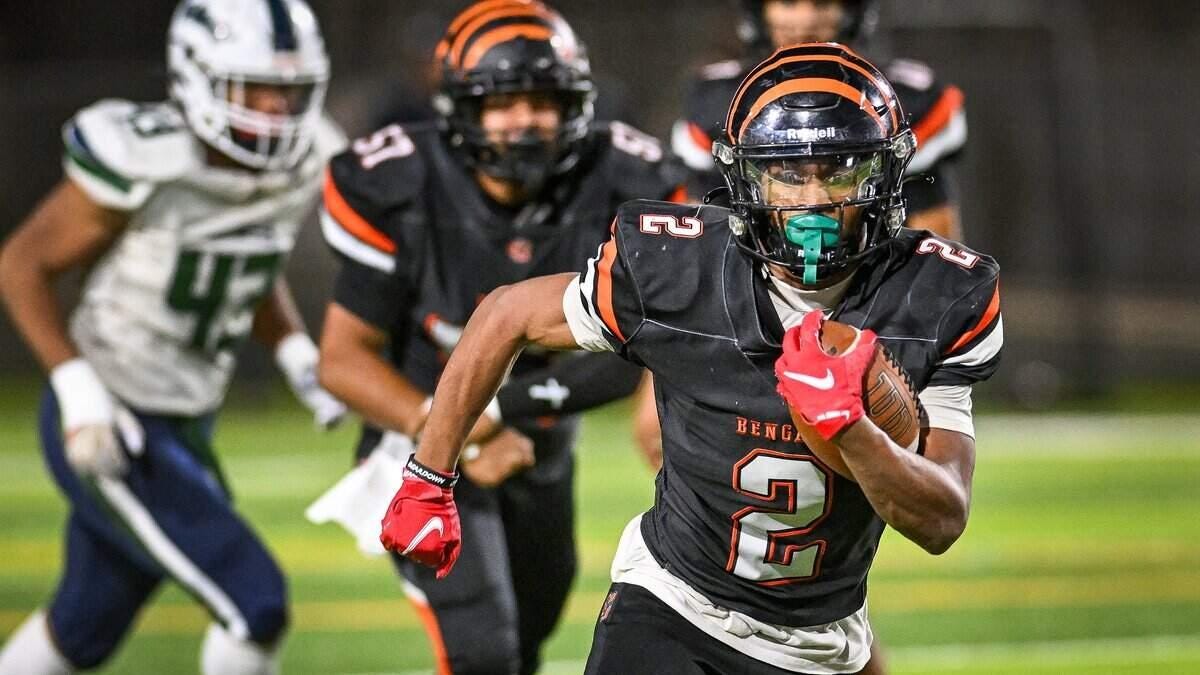
Oregon’s 2027 recruiting class was already among the strongest in the country before Dan Lanning and wide receivers coach Ross Douglas made another late addition. The commitment of Fresno (Calif.) Central East wide receiver Relando Jefferson IV, however, provides something beyond another highly regarded prospect. It gives the Ducks an explosive, productive receiver whose recruitment developed quickly, whose national profile is still catching up to his senior season and whose family already has a connection to the Oregon program.
Jefferson, a 6-foot-1, 170-pound prospect, announced his commitment Monday after emerging as one of Oregon’s late recruiting priorities. The former Fresno State pledge reopened his recruitment in October, received an Oregon offer during his visit for the Northwestern game and ultimately committed despite travel disruptions preventing him from returning to Eugene for an official visit this past weekend.
His decision gives Oregon 26 verbal commitments in the 2027 cycle, strengthening a class currently ranked among the nation’s top four. More importantly, it adds another receiver with a demonstrated ability to turn opportunities into explosive gains.
Production That Demanded Attention
Jefferson’s senior season has made an increasingly compelling argument that his previous recruiting evaluation underestimated his ability.
Through 10 games, Jefferson recorded 58 receptions for 1,197 yards and 15 touchdowns. That works out to 20.6 yards per reception, 119.7 receiving yards per game and a touchdown approximately every four receptions. He surpassed 100 receiving yards seven times, including a 225-yard performance against Clovis East immediately before his October trip to Eugene.
Those numbers suggest more than a receiver occasionally benefiting from a favorable matchup. They describe a player consistently producing explosive gains while carrying a significant portion of his team’s passing offense.

His emergence has also been reflected in the recruiting rankings. Jefferson entered Monday’s updated Rivals300 at No. 294 nationally and No. 37 among wide receivers, moving into four-star territory after previously being rated as a three-star prospect.
Recruiting rankings are useful reference points, but they are not always synchronized with a player’s development. In Jefferson’s case, the timing of his rise is particularly interesting. His junior campaign at Clovis West was shortened by injury after seven games, and he returned to Central East for his senior season with an opportunity to demonstrate what he could accomplish over a more sustained stretch.
He has done precisely that.
The combination of increased production, improved consistency and rising national recognition gives Oregon another prospect whose recruiting trajectory is moving upward as signing day approaches.
A Complementary Piece in a Crowded Receiver Class
Oregon’s receiver recruiting under Lanning has increasingly reflected a preference for acquiring different kinds of offensive weapons rather than simply collecting players with similar physical profiles.
The 2027 group already includes five-star Dakota Guerrant, four-star Xavier Sabb and three-star Malachi Garlington. Four-star athlete Tae Walden Jr., recruited primarily as a defensive back, also possesses the athletic ability to contribute on offense if the Ducks choose to explore that possibility.
Jefferson adds another option because of the combination of acceleration, change-of-direction ability and downfield production described in his evaluations.
At his listed size, he is not necessarily the imposing possession receiver who wins primarily through physical mismatches. His potential value is more closely connected to creating separation, threatening space vertically and becoming dangerous after the reception.
That matters in an Oregon offense that has spent considerable time searching for ways to produce more consistent explosive plays without relying entirely on difficult throws or individual improvisation.
The ability to turn a short reception into a significant gain changes how a defense must approach coverage. A receiver who can threaten vertically while also accelerating through intermediate space forces defensive backs to respect multiple possibilities. That can create opportunities for other receivers even when he is not the primary target.
Jefferson does not have to become the centerpiece of this class to make it better. His ability to complement the other incoming receivers may be just as valuable as his individual statistical ceiling.
The Value of an Existing Connection
The circumstances surrounding Jefferson’s recruitment also distinguish him from a typical late-cycle addition.
His father, Rolando Jefferson, was connected to Oregon’s 2009 recruiting class, while his uncle, former Ducks cornerback Cliff Harris, became one of the program’s most recognizable defensive playmakers. Jefferson also attended Central East, the same Fresno-area program that produced current Oregon freshman running back Brandon Smith.
Those connections do not guarantee college success, but they provide a degree of familiarity with Oregon that can matter when recruiting decisions accelerate.
Jefferson had already attended a summer camp in Eugene before returning for the Northwestern game on Oct. 31. That second trip proved important, leading to an offer from Douglas and putting Oregon in position to secure his commitment shortly afterward.
His planned official visit for the Michigan weekend was disrupted by the nationwide aviation issues affecting travel. Rather than waiting for another opportunity to return to campus, Jefferson made his decision, with an official visit now scheduled for Oregon’s Nov. 28 rivalry game against Washington.
There is another meaningful aspect to the timing. Jefferson’s commitment follows a stretch in which Oregon has demonstrated resilience after a difficult middle portion of its season, including a significant road victory over Ohio State.
The Ducks have continued selling a program whose long-term direction is not determined by an individual Saturday. Jefferson’s addition reinforces that the recruiting operation remains active and capable of responding to opportunities as they emerge.
What This Means Going Forward
For Oregon, Jefferson’s commitment is valuable both because of the player he is and because of the roster-building flexibility he provides.
The Ducks are assembling a receiver group with multiple possible roles, and Jefferson’s production suggests he should eventually compete for opportunities beyond a narrowly defined position. His ability to contribute in the return game, where he has recorded experience on both kickoffs and punts, offers another possible route toward early involvement.
There will be developmental work ahead. Jefferson needs to continue adding functional strength, refining his releases against physical coverage and preparing for the much smaller throwing windows he will encounter in college. His background also includes significant injuries, making continued physical development and durability important parts of his transition.
But the larger picture is encouraging. Oregon has acquired a receiver whose senior production demonstrates a level of playmaking ability that exceeds what his earlier recruiting profile suggested.
Jefferson becomes another piece of a broader receiving corps built around variety, athleticism and long-term upside. He brings proven explosive production, a developing technical foundation and familiarity with the program he has chosen.
For a recruiting class already positioned among the nation’s best, that is a meaningful addition. And for a player whose reputation has risen considerably over the past few months, the next step is an opportunity to show that his development is far from finished.